When Only One Thing Matters

iStock-968895338.jpg

In my head is the vague memory of some political talking head who predicted economic ruin under Obama. He had once worked for the US Government in the 80s and had predicted a recession using only three economic indicators. His call that a recession was imminent led to much derision and he was ultimately let go from his job, left presumably to wander the earth seeking out a second life as political commentator making outlandish claims. I forget his name and, so far, Google hasn’t been much help.

I bring this half-formed memory up because we live in a world that seems focused on ONE BIG THING. The ONE BIG THING is so big that it clouds out the wider picture, limiting conversation and making it hard to plan for the future. That ONE BIG THING is Trump’s trade war.

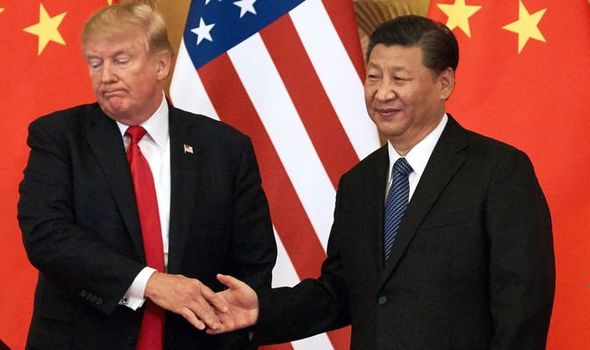
I get all kinds of financial reports sent to me, some better than others, and lately they’ve all started to share a common thread. In short, while they highlight the relative strength of the US markets, the softening of some global markets, and changes in monetary policy from various central banks they all conclude with the same caveat. That the trade war seems to matter more and things could get better or worse based on what actions Trump and Xi Jinping take in the immediate future.
Donald-Trump-Xi-Jinping-1127037

Now, I have a history of criticizing economists for making predictions that are rosier than they should be, that predictions tend towards being little more than guesses and that smart investors should be mindful of risks that they can’t afford. I think this situation is no different, and it is concerning how much one issue has become the “x-factor” in reading the markets, at the expense of literally everything else.

What this should mean for investors is two-fold. That analysts are increasingly making more useless predictions since “the x-factor” leaves analysts shrugging their shoulders, admitting that they can’t properly predict what’s coming because a tweet from the president could derail their models. The second is that as ONE BIG THING dominates the discussion investors increasingly feel threatened by it and myopic about it.

This may seem obvious, but being a smart investor is about distance and strategy. The more focused we become about a problem the more we can’t see anything but that problem. In the case of the trade war the conversation is increasingly one that dominates all conversation. And while the trade war represents a serious issue on the global stage, so too does Brexit, as does India’s occupation of Kashmir (more on that another day) , the imminent crackdown by the Chinese on Hong Kong (more on that another day), the declining number of liberal democracies and the fraying of the Liberal International order.

This may not feel like I’m painting a better picture here, but my point is that things are always going wrong. They are never not going wrong and that had we waited until there were only proverbial sunny days for our investing picnic, we’d never get out the door. What this means is not that you should ignore or be blasé about the various crises afflicting the world, but that they should be put into a better historical context: things are going wrong because things are always going wrong. If investing is a picnic, you shouldn’t ignore the rain, but bring an umbrella.
181025-Tani-Republican-Party-Press-tease_zr23lf

The trade war represents an issue that people can easily grasp and is close to home. Trump’s own brand of semi-authoritarian populism controls news cycles and demands attention. Its hard to “look away”. It demands our attention, and demands we respond in a dynamic way. But its dominance makes people feel that we are on the cusp of another great crash. The potential for things to be wiped out, for savings to be obliterated, for Trump to be the worst possible version of what he is. And so I caution readers and investors that as much as we find Trump’s antics unsettling and worrying, we should not let his brash twitter feuds panic us nor guide us. He is but one of many issues swirling around and its incumbent on us to look at the big picture and act accordingly. That we live in a complex world, that things are frequently going wrong and the most successful strategy is one that resists letting ONE BIG THING decide our actions. Don’t be like my half-remembered man, myopic and predicting gloom.

Information in this commentary is for informational purposes only and not meant to be personalized investment advice. The content has been prepared by Adrian Walker from sources believed to be accurate. The opinions expressed are of the author and do not necessarily represent those of ACPI.

What’s Next? (And When Will It Happen)

economyis bad

Talk of recession is in the air and amongst my clients and readers of this blog the chief question is “when”?

Ever since Trump was elected, questions about when “it’s going to happen” have been floating about. Trump, an 800-pound gorilla with a twitter addiction, has left a predictable path of destruction and the promise of more chaos always seems on the horizon. It should not be surprising then that investors have been waiting with bated breath for an inevitable correction.

Those predicting imminent doom got a little taste of it last week when markets convulsed and delivered the worst day of the year so far, shedding a dramatic 800 points off the Dow Jones. Globally the news hasn’t exactly been stellar. Germany, Italy and France are all showing a weakening economic outlook, which is to say nothing of Great Britain. Despite three Prime Ministers and two deadline extensions, the nation has yet to escape its Brexit chaos and is no closer to figuring out what to do about Northern Ireland. China too is facing a myriad of problems. Trump’s tariffs may be making American’s pay more for things, but it does seem to be hurting the Chinese economy. Coupled with the persistent Hong Kong protests and its already softening market, last week the Chinese central bank opted to weaken the Yuan below the 7 to 1 threshold, a previously unthinkable option aimed at bolstering economic growth.

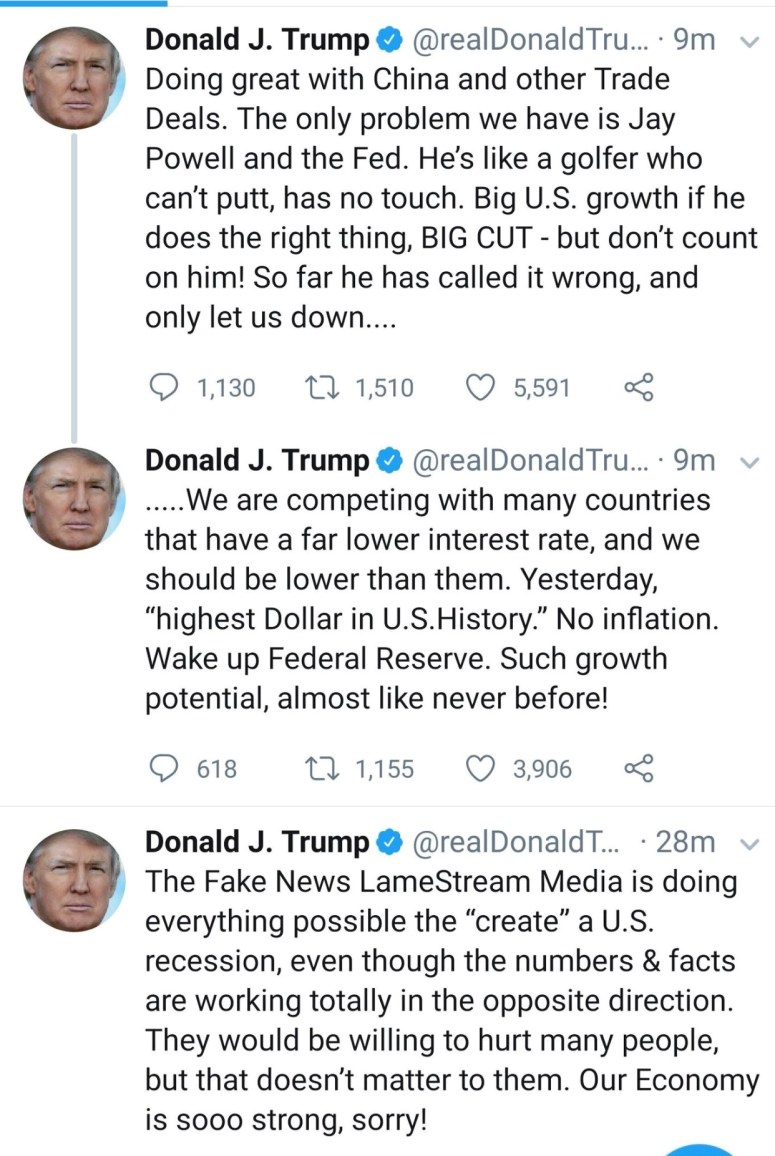
In all of this it is the American economy that looks to be in the best shape. Proponents of the “U.S. is strong” story point to the historic low unemployment and other economic indicators like consumer spending and year over year GDP growth. But this news comes accompanied with its own baggage, including huge subsidies for farmers hit by Chinese import bans and other trade related self-inflicted wounds. This issue is best summarized by Trump, who himself has declared that everything is great, but also now needs a huge rate cut.

Trump TweetThe temptation to assume that everything is about to go wrong is therefore not the most far-fetched possibility. Investors should be cautious because there are indeed warning signs that the economy is softening and after ten years of bull market returns, corrections and recessions are inevitable.

But if there is an idea I’ve tried to get across, it is that prognostication inevitably fails. The real question that investors should be asking is, “How much can I risk?” If markets do go south, it won’t be forever. But for retirees and those approaching retirement, now ten years older since the last major recession, the potential of a serious downturn could radically alter planned retirements. That question, more than “how much can I make?”, or “When will the next recession hit?”, should be central to your conversations with your financial advisor.

As of writing this, more chaotic news has led Trump to acknowledge that his tariff war may indeed cause a recession, but he’s undeterred. The world is unpredictable, economic cycles happen, and economists are historically bad at predicting recessions. These facts should be at the center of financial planning and they will better serve you as an investor than the constant desire to see ever more growth.

So whether Donald Trump has markets panicked, or a trade war, or really bad manufacturing numbers out of Germany, remember that you aren’t investing to do as well as the markets, or even better. You’re investing to secure a future, and ask your financial advisor (assuming it isn’t me) how much risk do you need, not how much you’ve got.

Information in this commentary is for informational purposes only and not meant to be personalized investment advice. The content has been prepared by Adrian Walker from sources believed to be accurate. The opinions expressed are of the author and do not necessarily represent those of ACPI.
Making Kids Money Smart, Reprise

Little girl withdrawing money form ATM with help of mother.

Some time back I had written about how we could better prepare children to handle money responsibly, how to help establish good financial habits and why that was important. You might have thought that banks would have played a role in that education, but I failed to talk about them and what positive (and negative) aspects they can play when it comes to a child’s money intelligence.

In theory banks should be the obvious first stop when it comes to talking about money and yet they rarely are. They may not even be helpful. This is partly because banks have long since given up being a waystation for protecting money from the general economy. While banks themselves have always had a central part to play in lending and growing the economy, the roll of doing that off the back of people who are housing their savings for a rainy day has been replaced by the desire to more quickly facilitate economic activity. Whereas banks were once a speedbump on the road to making a purchase, today they occupy the chief role of facilitating that purchase. No one would dare deposit money with a bank that did not provide debit cards, credit cards and easy online financial transactions.

Being money smart though has a lot more to do with instilling patience and setting goals, not immediately reacting to every consumer temptation. But a teenager with a bank account is not going to find that he or she is hindered much by their savings account. Furthermore, they are unlikely to see the benefits of keeping money in a savings account since there is little growth to be offered. This gives banks a paradoxical role in your child’s financial education, one that offers little incentive to save while facilitating bad financial choices.

For instance, TD Bank offers a Youth Account, a basic savings account for children up to the age of 18. There’s no fees, unlimited transactions per month and minimal interest rates for savers at 0.05%, or 50₡ for every $100. However, a child of 12 will receive a debit card with the Visa Debit system and a daily limit of $25 or $50/day. Meanwhile Scotiabank’s Getting There Savings Account offers similar low fees and minimal interest, but throws in 2 free Interac transactions per month and Scene Reward Points for the movies. The lesson banks teach kids is that putting money in the bank helps buy things they want whenever they want it.

For parents who opened an account for their children when they were small it may be a surprise that banks will send teens and pre-teens bank cards. And even approaching a bank about what can and cannot be done with a bank card may not offer up much help. I went to three separate banks to ask about their youth accounts and was frequently met with several “umms” and “ahhs” when I pressed for details. At one bank I was assured that even though the bank card was a “Visa Debit” that card could not be used to buy items online (which is what the Visa Debit system does). When I pressed for confirmation that this was the case the person disappeared to consult with other employees before returning and confirming that online purchases would be allowed. Financial limits are also not particularly inspiring. A $25 limit per day totals pretty quickly, and parents may not realize what that money is going towards since online purchases can be easily overlooked.

And yet.

This is also the system that we live in. Children should be raised to understand that there will be few breaks when it comes to making bad financial choices. Banks and credit card companies will happily provide debt to those who can barely afford it and defend themselves with impenetrable multi-page legal documents. Engaging with this system is essential to beating it.

So what can parents do?

As I wrote back in 2015 the best course of action is to do planning with kids to help establish good habits. Giving kids an allowance in exchange for chores isn’t a bad idea, but it might make more sense to both expand the money that is given, and then set up automatic withdrawals to cover expenses. Rather than receive $20/week as an allowance, consider $50/week and automatically take $30 back for RESP contributions. Or up it even further and charge them room and board. The experience of seeing financial responsibilities coming ahead financial luxury would establish a good habit of the real costs of living.

Another idea would be to sit and plan the purchase of a large item together that a child wants. Maybe it’s a video game system or a subscription of some kind. Go through the budgeting process together and figure out how many weeks it would take to get the item while also factoring money in that time for usual expenses like eating out with friends and going to movies (people still go to the movies right?). Invariably good budgeting forces us to question what we’re doing and whether it makes sense, so the action of picking an item and working towards it will go a long way to either validating those wants or rethinking what to do with that cash.

If you can convince your child to save and budget, help them as well consider alternative things to do when it comes time and they’re tempted to spend the money they were meant to be saving. Budgeting should help provide a passage to success and being left home alone while their friends are out having a good time will be hard.

Lastly, take your kids to the bank and have a meeting with someone together about the ins and outs of their youth account. Parents should know what is and is not allowed and not assume that simply because they opened the account 8 or 9 years ago, they understand what that account does or does not allow.

Financial planning remains an unpopular pastime, and few enjoy the responsibility of dealing with money. This may have more to do with how out of control Canadians feel with regard to their expenses and how much debt we carry. But as parents we should be looking for every opportunity to teach our children some of the bitter truths about money, debt, banks and budgets. Nobody else is.

As always, if you have questions about fees, performance or your financial future, please don’t hesitate to give me a call or send a message.

Information in this commentary is for informational purposes only and not meant to be personalized investment advice. The content has been prepared  by Adrian Walker from sources believed to be accurate. The opinions expressed are of the author and do not necessarily represent those of ACPI.

The Cost of Advice

Everyone’s focused on the cost of investing, they should be looking at the cost of not having help.

iStock-1058690454

I regular question I receive is whether fees are to high. This isn’t a perplexing question, it always makes sense to see whether you could, or perhaps should, be paying less. But from a financial planning perspective the questions seem to dominate an awful lot of initial meetings that I have.

For clarity, I think its important to point out that within my own practice we’ve done a lot to increase transparency about our fees and have done what we can to make costs explicit and earn our keep. Years ago, while working for a mutual fund company, I was shocked to learn that some advisors never wanted their clients to know how they were getting paid, or how much. This always struck me as a poor business practice and given the public focus on the expense of financial advice means that I’m not alone in that assessment.

The focus on fees has also paid results to investors. While I have no data on Canada, in the United States mutual fund fees have dropped by nearly 50% since 2000. Canada has been following suit (to what degree I don’t know) but I haven’t had a meeting with a mutual fund company in the last few years that hasn’t spent time highlighting the cost of the investments, or a recent cut to MERs. Much of this has been aided by the arrival of ETFs (Exchange Traded Funds) which have also been on a mad rush to cut costs. Today there are even 0% cost ETFs, although the true costs of those products remains opaque.

And yet, much of this seems like a secondary problem. Costs have rapidly dropped but little attention is being paid to more worrying trends. Investors do badly without help, and financial advice is worth a great deal more than the cost of receiving it.

Dalbar 1

The 2019 Quantitative Analysis of Investor Behavior is the most recent annual report produced by Dalbar (Dalbar is an independent provider of business practices in the financial space – you can learn about them HERE), which looks to compare investor behavior against market returns. Produced annually the report stretches back decades and its findings are conclusive. People do badly as investors, and frequently stay just ahead of inflation and well behind market returns. For instance, in 2018 the S&P 500 had a -4.38% return, while the average equity fund investor averaged -9.42%, and the Average Equity Index Fund Investor returned -7.22%.

Dalbar 2

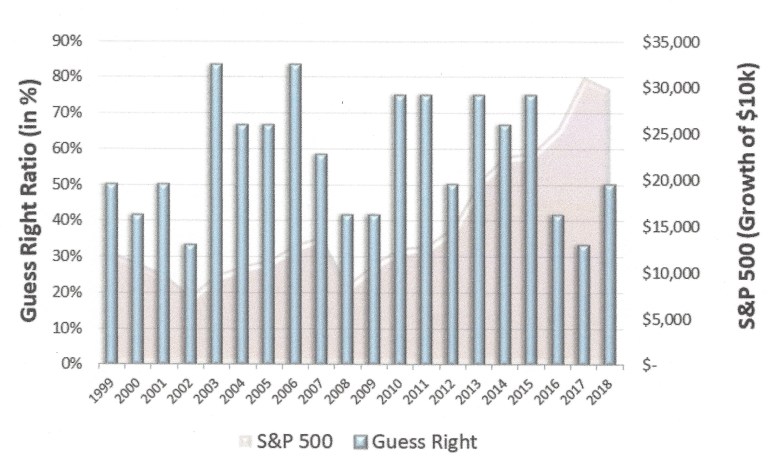
These results speak for themselves, but it shows that the greatest enemy to maximizing investor returns are not the fees, but the behavior of investors. Even when investors hold low cost index ETFs, they still underperform markets. The reasons for this are complex, but have much to do with the human mind and its limitations in facing an uncertain future (best captured by the growing field of behavioral economics). A good example of his is found in the report’s Guess Right Ratio, a ratio based around the inflows and outflows of funds to determine how often investors have correctly anticipated the direction of the market. You might be surprised to learn that investors have guessed correctly 50% of the time over the last 13 years, but that guessing right didn’t translate into more money, since investors guessed wrong in a larger magnitude than they ever guessed right (in other words people made bigger bets when guessing wrong) and one wrong guess would wipe out months of correct bets.

Dalbar 3

If there is a place where investors and advisors need to improve, it is how much work is being done for investors at all. The rise of “Robo-Advisors” seemed to solidify a type of investor experience, one in which 75% of investors admit to only communicating with their advisor once or twice a year, and up to 68% never spend more than an hour with their advisor a year, and 31% of investors have never discussed their investment goals. That gap seems one worth closing, and one that cannot be capably done through automated systems, or through impersonal financial practices. The cost of good financial planning seems to be worth it if it improves your returns, gives you comfort in your long term planning and helps make your retirement a success.

As always, if you have questions about fees, performance or your financial future, please don’t hesitate to give me a call or send a message.

Information in this commentary is for informational purposes only and not meant to be personalized investment advice. The content has been prepared  by Adrian Walker from sources believed to be accurate. The opinions expressed are of the author and do not necessarily represent those of ACPI.