
The Exciting New Field of Recession Prognostication

PsychicI wish to inform you about an exciting new profession, currently accepting applicants. Accurate recession prognostication and divination is an up and coming new business that is surging in these turbulent economic times! And now is your chance to get in on the ground floor of this amazing opportunity!

I am of course being facetious, but my satire is not without precedent. As 2018 has devolved into global market chaos, finally losing the US markets in October, experts have been marshalled to tell investors why they are wrong about markets and why they should be more bullish.

Specifically analysts and various other media friendly talking heads have been trying to convey to the general public that the negative market sentiment that has driven returns down is misplaced, and have pointed to various computer screens and certain charts as proof that the economy is quite healthy and that in this moment we are not facing an imminent recession. Market returns through the final quarter of 2018 indicate this message has yet to find fertile ground among the wider public.
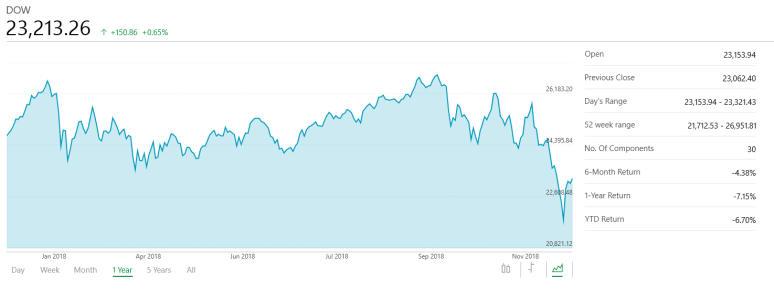
Dow Jones Dec 31
The Dow Jones has had a wild ride this year, with significant declines in February, October and finally in December when the markets ended the year lower than they began.

While these experts, analysts and financial reporter types may not be wrong, indeed the data they point to has some real merit, I don’t think that investors are wrong to heavily discount their advice. For the wider investing audience, being right 100% of the time is not a useful benchmark to strive towards with investments ear-marked for retirement. Instead a smarter approach is to be mindful about risks that can be ill-afforded. Investment specific risk, like that of an individual stock may be up to an investor (how much do I wish to potentially lose?). On the other hand, a global recession that is indiscriminate in the assets that suffer may be more risk than an investor can stomach.
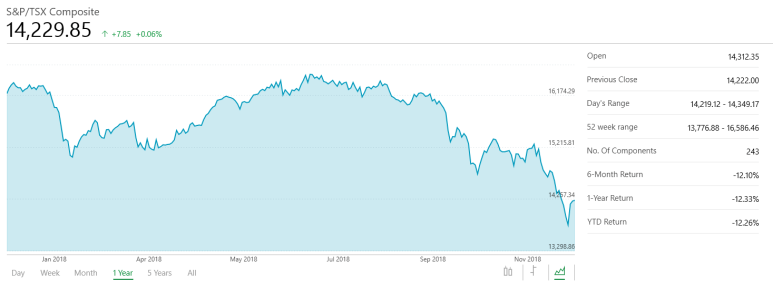
TSX Dec 31
The S&P TSX has had another dismal year, and is currently lower than it was in 2007, marking a lost decade. Making money in the Canadian markets has been a trading game, not a buy and hold strategy.

The experts have therefore made two critical errors. The first is assuming that what is undermining investor confidence is an insufficient understanding of economic data. The second is that there is a history, any history, of market analysts, economists and journalists making accurate predictions of recessions before they happen.

This last point is of particular importance. While I began this article with some weak humor on prognostication and divination, it’s worth noting that predicting recessions has a failure rate slightly higher than your local psychic and lottery numbers. That so many people can be brought forth on such short notice to offer confident predictions about the state of world with no shame is possibly the worst element of modern investment culture that has not been reformed by the events of 2008.

2008 Predictions vs reality
These are the economist predictions for economic growth at both the start of Q3 and Q4 in 2008. Even as the collapse got worse, economists were not gifted with any extra insight. 

This doesn’t mean that investors should automatically flee the market, listen to their first doubt or react to their gut instincts. Instead this is a reminder that for the media to be useful it must think about what investors need (guidance and smart advice) and not more promotion of headline grabbing prognostication. The markets ARE down, and this reflects many realities, including economic concerns, geopolitical concerns and a host of other factors outside of an individual’s control. It is not a question of whether markets are right or wrong in this assessment, but whether good paths remain open to those depending on market returns.

A Canadian Story of Woe


drowning
A Canadian homeowner going for a relaxing swim in his mortgage…


One of the challenges of being a financial advisor is finding ways to convey complex financial issues in simple ways to my clients and readers. I believe I do this to varying degrees of success, and I am informed of my failures by my wife who doesn’t hesitate to point out when I’ve written something boring or too convoluted.

One such subject where I feel I’ve yet to properly distill the essential material is around the housing market. While I’ve written a fair amount about the Canadian housing market, I feel I’ve been less successful in explaining why the current housing situation is eating the middle class.

In case you’re wondering, my thesis rests on three ideas:

1. The middle class as we know it has come about as a result of not simply rising wages but on sustained drops in the price of necessities.
2. The rise of the middle class was greatly accelerated by the unique historical situation at the end of the Second World War, which split the world into competing ideological factions but left the most productive countries with the highest output and technological innovation to flourish.
3. A global trend towards urbanization and a plateauing of middle-class growth has started reversing some of those economic gains, raising the cost of basic living expenses while reducing the average income.

The combination of these three trends has helped morph housing from an essential matter of accommodation into a major pillar of people’s investment portfolios and part of their retirement plan. The result is that homeowners are both far more willing to pay higher prices for a home in the belief that it will continue to appreciate into the future, while also attempting to undercut increases in density within neighborhoods over fears that such a change will negatively impact the value of the homes. In short, stabilizing the housing market is getting harder, while Canadians are paying too much of their income to pay for existing homes. All of this serves to make the Canadian middle class extremely vulnerable.


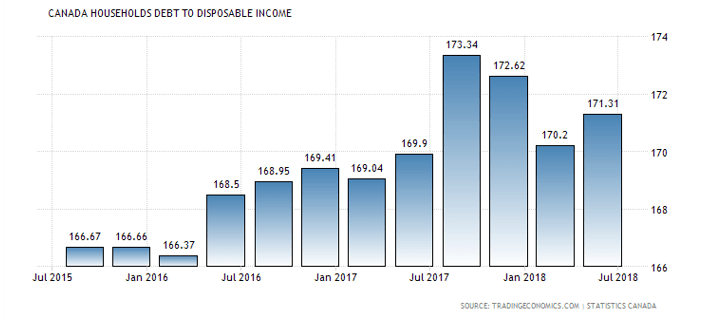
Household Debt
You may be tempted to think “Wow, debt levels really jumped through 2016” you should remind yourself that this chart STARTS at 166%!!!


Proving some of this is can be challenging, but there are some things we know. For instance, we know that Canadians are far more in debt than they’ve ever been before and the bulk of that debt is in mortgages and home equity lines of credit (HELOC), which means much of that debt is long-term and sensitive to hikes in interest rates. We also have abundant evidence that zoning restrictions and neighborhood associations have diligently fought against “density creep”. But to tie it all together we need the help of HSBC’s Global Research division and a recent article from the Financial Times.

FT Global Leverage

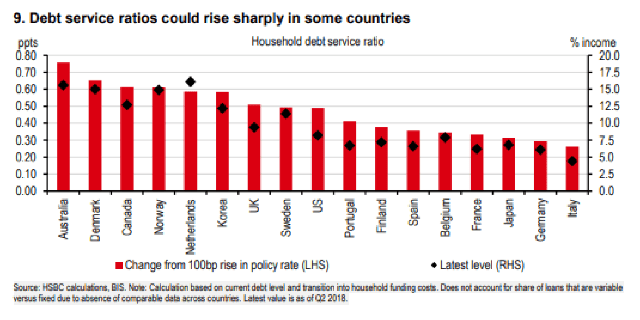
Last week, HSBC issued a research paper on global leverage. Providing more proof that since 2008 the world has not deleveraged one bit. In fact, global debt has settled just over 300% of global GDP, something that I wrote about in 2016. An interesting bit of information though came in terms of the country’s sensitivity to increasing interest rates. Charting a number of countries, including Canada, the report highlights that Canadians (on average) pay 12.5% of their income to service debt. A 1% increase in the lending rate would push that up over 13%. For a country already heavily in debt, a future of rising rates looks very expensive indeed.

It would be wrong to say that fixing our housing market will put things right. There is no silver bullet and to suggest otherwise is to reduce a complex issue to little more than a TED Talk. But the reality is that our housing market forms a major foundation of our current woes. A sustained campaign to grow our cities and reduce regulatory hurdles will do more to temper large debts that eat at middle-class security than anything I could name.