
The Rent is Too Damned High: Stop Stopping Condos!

Driving through mid-town the other day I caught a sign that said “Stop the Alaska Condo”. Not knowing anything about it I looked it up and was met with an inspiring, modern design to replace 28 family units with 130 new units of housing around Yonge and Strathgowan.

Image

The Proposed Alaska Condo

Of course there is a neighbourhood association who are protesting its development. Reasons to protest include “safety” (left considerably vague), that it will introduce a number of new people and cars and that it isn’t in keeping with the village’s rustic aesthetic. The Uptown Yonge Neighbourhood Alliance acknowledges the need of urban redevelopment, just not that urban redevelopment.

Cities are more than just crowded places that people live. They are the modern backbone of vibrant economies. Toronto itself accounts for 11% of Canada’s total GDP, and depends on a growing number of people to provide tax revenues, employment and businesses. In his book Triumph of the City, author Edward Glaeser outlines how cities provide networks that spawn a creative class and strengthen our economies.

But far more concerning is how in modern times cities have also become a mess of regulations that are stifling growth. Not economic growth, but residential growth. Urban density helps make neighbourhoods more prosperous and with a wider more successful variety of services. But as is the case with the Alaska Condo, proposals to increase density often face strong resistance. I tend to view this resistance as not only cutting off one’s nose, but as immoral too. Toronto is a bustling city, whose cost of living continues to skyrocket because of lack of housing. In the rush to try and prevent change to our city we are not only choking off our future economic vitality, but punishing people financially with ever increasing home ownership and rental costs, even as more and more of our economy depends on service sector work and less on manufacturing.

I have no doubt that the members of the Uptown Yonge Neighbourhood Alliance feel very passionately about their cause, but I’m afraid it boils down to little more than NIMBY-ism. People need places to live, and the Yonge & Strathgowan area will benefit from some lower cost housing and all the new residents, who will bring money, taxes and businesses to the area.

Further Reading: The Rent is Too Damn High by Matt Yglesias
Is the Internet Making Business Weirder?

Image

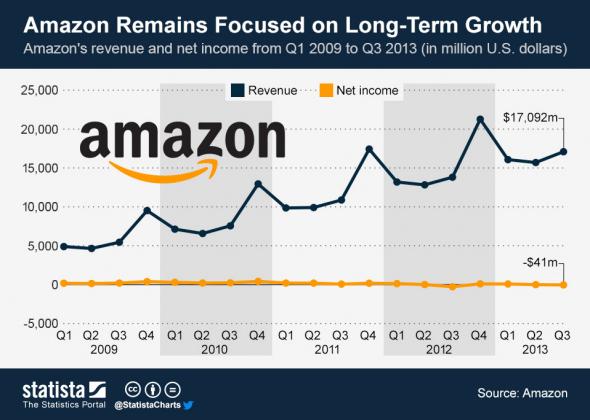
If there is any doubt about whether the internet is changing how we do business I think it is best summed up in the above chart from Statista.com, which highlights both how Amazon continues to grow its sales while simultaneously losing money.

The point here is not to criticize Amazon’s business practices. Its an enormously successful company, but its share price has continued to grow in the face of declining revenues. What other company could operate like this outside of the internet? Apple, who I’ve written about before, is uniquely profitable but is frequently criticized for not growing enough even while it crushes its competitors.

The other way to look at this is whether Walmart would be given similar considerations? Amazon is spending and investing everything that they make, and in the process some of those investments run at a loss. This is good for us, but its rare that the market rewards companies who ignore the shareholder so entirely for the sake of the consumer.

The question of what effect the internet is having on business only gets more confusing when you find out that Pinterest is valued at 3.8 billion with zero revenue and Twitter isn’t expected to make a profit until 2015. 

Taking a Second Look at Europe

One of the benefits of being a financial advisor is the occasional one-on-one meeting you get with Portfolio Mangers (PM) and the opportunities to pick their brains. This week began for me by sitting down with AGF manager Richard McGrath, a PM based in Dublin who helps manage some global and european funds.

This was great opportunity to get some first hand information about what is going on in Europe. Following 2008, the Eurozone, easily the largest economy in the world, has been hit pretty hard. Strict austerity measures and public unrest have long painted a picture of a Europe constantly on the brink of failure. 2011 was easily the worst year as Greece got perilously close to defaulting on its debt as Germany and the Troika (the European Commission, the EU Central Bank and the International Monetary Fund) played hardball looking for more political concessions from Greece.

The fact remains that big financial crises like 2008 have long tails, and Europe has been beaten-up very badly, with big reductions in their GDP, large unemployment figures and generally all-round bad economic news. And yet no storm lasts forever. Despite a difficult political structure, a burgeoning recovery seems to be underway.

Richard McGrath seems to think so at least, and I share many of his views. Some of the good news is really less bad news. For instance in Ireland continued austerity was expected to cut €3.6 billion from government spending, but as the economy improves that number has been dropped to €2.5 billion. There are lots of little stories like this helping to outline a general recovery in the Eurozone. Bloomberg reported on October 23rd that Spain had ended 9 consecutive quarters of negative economic growth, with an anemic 0.1% growth rate. Not great, but it still goes in the “good news column”.

It’s worth remembering that negative news abounds in the United States, but their stock markets have reached all time highs (again) and that after several bad years European markets have also done very well this year. But from the perspective of watching markets its important to take notice when GDP growth turns positive (Germany, France, Spain, UK – Societe Generale, September 9, 2013), investment flows start gaining (Societe Generale), all the while valuations are considerably lower, and therefore cheaper than other well performing markets (Thomson Reurters Datastream, October 21st, 2013). All of this points to one conclusion, you can’t trust the media. With it’s constant focus on negative news you might miss some of the best growth opportunities!