A Broken Clock That’s Right Only Once

Dalio
Ray Dalio: ‘We’re disappointed because we should have made money rather than lost money in this move the way we did in 2008’ © Reuters

In 2009 I was working for a large mutual fund company in Western Canada. It was the peak of the financial crisis and I was given the opportunity to take a promotion but had to move to Alberta. I was eager to move up (I was only 28) and jumped at the chance though I had no great desire to live in Edmonton. It was a difficult time. It was lonely in Alberta, and people weren’t eager to speak to a wet behind the ear’s wholesaler right after the biggest rout in modern financial history.

One particularly vivid memory for me was back in 2009, walking into an office at the tail end of conference call being given by Christine Hughes, a portfolio manager of some note during the crisis. Hughes was at the top of her game. She had outperformed much of the market by holding 50% cash weighting and had correctly predicted the financial crash. In later appearances she would complain that the company she worked for had prevented her from holding more and would have had been allowed to. But at this moment, in 2009, it was late summer, and markets had been rebounding for several months, having hit bottom in early March. Hughes was adamant that “the other shoe was going to drop” and that’s when things would really go wrong.

For much of my time in 2009 Hughes, and her fund, was the story that challenged me. Having made the correct call in 2008, advisors were eager to listen to what she had to say and believed that her correct prediction in 2008 meant she knew what was coming next. Many people followed Hughes and her advice, which led primarily nowhere.

Hughes’ time subsequent to 2008 was not nearly as exciting or as successful as you might have guessed. She left AGF, where she had made it big, and went on to another firm before finally starting her own company, Otterwood Capital. The last time I saw Hughes it was in 2013 and she was giving a presentation about how close we were to a near and total collapse of the global financial system. Her message hadn’t changed in the preceding four years, and to my knowledge never did.

Hughes may not have prospered as much as she hoped following her winning year, but others who made similar predictions did. One such person is Ray Dalio, the founder and manager of Bridgewater Associates. Dalio is a different creature, one with a long history on Wall Street who had built a successful business long before 2008. But 2008 was a moment that launched Dalio into the stratosphere with his “Alpha Fund” largely sidestepping the worst of that market and by 2009 his hedge fund was named the largest in the US. Since then Dalio has grown a dedicated following beyond his institutional investors, with a well watched YouTube video (How the Economic Machine Works – 13 million views) and a series of books including one on his leadership principles and a study on navigating debt crises (I, of course, own a copy!). Yet when the corona virus rolled through Dalio’s funds faired no better than many other products (I’m sorry, this is behind a paywall, but I recommend everyone have a subscription to the Financial Times). Once again past success was no indication of future returns.

I’m not trying to compare myself to a hedge fund manager like Dalio, a person undoubtably smarter than myself. However its important to remember that being right in one instance, even extreme and unpredictable events, seems to offer little insight into when they will be right again.

If you’ve read many of these posts you may know that I am a fan of Nassim Taleb, the author of The Black Swan and Antifragile. Early in the book Black Swan, Taleb makes the case that “Black Swan logic makes what you don’t know far more relevant than what you do know. Consider that many Black Swans can be caused and exacerbated by their being unexpected.” This is an important idea that I think can be extended to our portfolio mangers that gained notoriety for getting something right and then getting much else wrong.

A complaint I have long held about experts within the financial industry is both their desire to position themselves as outsiders while being likely to share many of the same views. Having a real contrarian opinion is more dangerous than being part of the herd, after all if things go wrong for you as a contrarian, they are likely to be going right for the herd. On the other hand, if things go wrong for the herd, the herd can use its size as a defense: “We were all wrong together.”

Some of this group think can be applied to the failure of governments to get a jump on the coronavirus situation. Far from not listening to experts, governments took the safest bet which was also the most conservative view, that the virus posed a low risk to the population of countries outside China. People who thought the virus was a large risk were taking a more extreme view; that the virus posed a serious risk and required extreme measures such as travel restrictions, aggressive testing, encouraging people to wear face masks and socially distance. As a politician which choice would you make?

The point for investors should be to treat the advice of financial experts who rise to prominence during outlier events as no more special than those that got big financial events wrong. This is not because their advice isn’t good, just that the thing they got right may not indicate wide ranging knowledge, but a moment when they understood something very well that other people did not. Investors should avoid personality cults and maintain a principle of uncertainty and scepticism to prophets of profit. The rise of COVID-19 and the global pandemic response, including the rapid change in the market, will produce a number of books and talking heads who will parlay their status as hedgehogs into that of a foxes! (If you don’t know what I’m referring to, please read this from 2016).

Dalio remains a very successful manager, but his correct reading of 2008 did not prepare him for 2020. In his own words: “We did not know how to navigate the virus and chose not to because we didn’t think we had an edge in trading it. So, we stayed in our positions and in retrospect we should have cut all risk.” Christine Hughes on the other hand seems to have disappeared, her fund gone and she in an early retirement. I know of no financial advisers eager to hear her views.

Information in this commentary is for informational purposes only and not meant to be personalized investment advice. The content has been prepared by Adrian Walker from sources believed to be accurate. The opinions expressed are of the author and do not necessarily represent those of ACPI.
The Catalonia Effect

03-catalonia1

Years ago I walked the Camino De Santiago, a holy pilgrimage across Spain that dates back to the 9th century. Not being Catholic I’m sure that a number of religious aspects of my month-long trek were lost on me, but what I did take away was a cursory understanding of Spain’s curious political instability. Everywhere I went there was graffiti calling for the independence of Catalonia, a movement that I had been completely ignorant of. In fact, other than the Basque region, it had never occurred to me to even question the essential makeup of the nation of Spain.

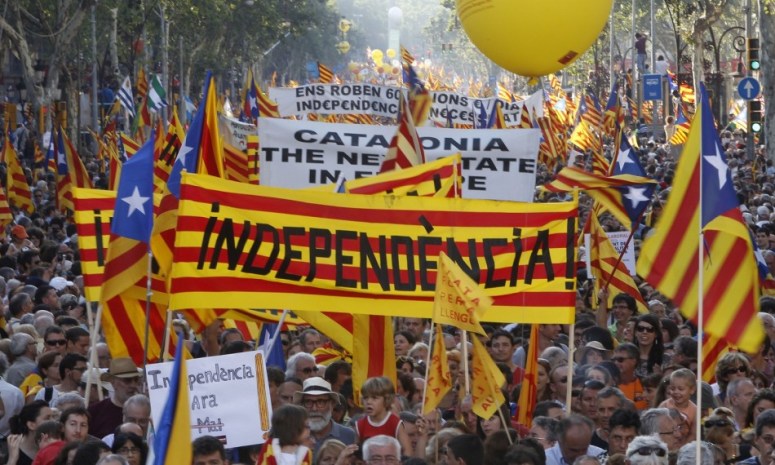
Last week Catalonia held a highly contentious referendum on its independence. Like Scotland and Wales, Catalonia has a devolved parliament and is a region with its own language and history distinct from (and forever tied to) Spain. Leading up to the referendum was a fair amount of heavy handedness from the government in Madrid that only made things worse. Strictly speaking the referendum is likely illegal, and the Spanish constitution does not recognize Catalonia’s decision to simply walk itself out the door on a whim. More puzzling has been the outcome of the vote, with the Catolinian government refusing to categorically claim independence. A deadline set for this Monday was meant to clarify Catalonia’s declaration of independence, but it seems to have lapsed without clarification.

In the universe of investing events like this seem poised to throw everything into chaos, and yet markets have shown themselves to be surprisingly resilient in the face of big political upheavals. Last year included a surprise win for the Brexit vote, which initially began with a market panic, but morphed into a prolonged rally for the British markets. The US too has had a surprising run in the Dow and S&P500 despite numerous concerns about the stability of the US government and its inability to pass any of it objectives.

So how should investors react when political chaos erupts? Is it a sign that we should hunt for safer shores, or should we simply brave the chaos?

One thing to consider is that we probably over estimate the importance of events as they unfold and assume that things that are bad in the real world are equally bad in the markets. War is bad objectively, but it isn’t necessarily bad for business. Protracted wars in Afghanistan and Iraq have been damaging to those involved but they haven’t slowed market rallies much, a depressing but necessary distinction.

Antifragile-bookOn the other hand chronic instability has a way of building in systems. One of the reasons that serious conflicts, political instability and angry populism haven’t done much to negate market optimism is because the nature of Western Liberal democracies is to be able to absorb a surprising amount of negative events. Our institutions and financial systems have been built (and re-built) precisely to be resilient and not fragile. Where as in the past bad news might have shut down lending practices or hamstrung the economy, we have endeavored to make our systems flexible and allow for our economies to continue even under difficult circumstances.

However there are limits. In isolation its easy to deal with large negative events, but over time institutions can be pushed to their breaking point. There are compelling arguments that the wave of reactionary populism that has captured elections over the past three years is a sign of how far stretched our institutions are. Central banks, democratic governments and the welfare state have been so badly stretched by a combination of forces; from a war on terror, a global financial crisis and extended economic malaise, that we shouldn’t find it surprising that 1 in 4 Austrians, 1 in 3 French and 1 in 8 Germans have all voted for a far right candidate in recent elections.

Equally we can see the presumed effects of Climate Change as large parts of the US have suffered under multiple hurricanes, torrential downpours, or raging forest fires. For how many years can a community or nation deal with the repeated destruction of a city before the economy or government can’t cope?

In this reading, markets have simply not caught up yet with the scope of the problems that we face and are too focused on corporate minutia to see the proverbial iceberg in our path.

While I believe there is some truth in such a view, I think we have to concede that it is us as citizens that are too focused on the minutia. The market tends to focus on things like earning reports, sales predictions and analyst takes on various companies before it considers major events in the valuation of stocks.

Consider, for instance, the election of Donald Trump. Trump rode a wave of dissatisfaction with free trade and promised to shake up the trade deals the US had with other nations. Superficially this threatens the future earnings of multinational firms that depend on trade deals like NAFTA. But how many people didn’t go and buy a car they had been intending to buy over the last year? As is often the case the immediacy of political craziness obscures the time it will take for those issues to become reality. Trump may end up canceling NAFTA, but that could be years away and has little impact on the price of companies now. That applies to events like Brexit and even the Catalonian vote. Yes, they create problems, but those problems are unlikely to be very immediate.

keepcalm

The lesson for investors is to remain calm and conduct regular reviews of your portfolio with your financial advisor (if you don’t have a financial advisor you should give me a call), to ensure that the logic behind the investment decisions still makes sense. Nothing will be more likely to keep you on track with your investment goals and sidestepping bad decisions than making sure you and your investment advisor remain on the same page.

Why It Matters If The Fed Raises Rates

628x471This summer might prove to be quite rocky for the American and global economies. The smart money is on the Federal Reserve raising its borrowing rate from a paltry 0.25% to something…marginally less paltry. But in a world where borrowing rates are already incredibly low even a modest increase has some investors shaking in their boots.

Why is this? And why do interest rates matter so much? And why should a small increase in the government borrowing rate matter so greatly? The answer has everything to do with that financial black hole 2008.

I asked NASA to use the Hubble telescope to take a photo of the 2008 financial crash. This is what it looks like from space.

No matter how much time passes we still seem to orbit that particular mess. In this instance it is America’s relative success in returning economic strength that is the source of the woes. Following the crash their was a great deal of “slack” in the economy. Essentially factories that didn’t run, houses that sat empty and office space that was unused. The problem in a recession is convincing 1. Banks to lend to people to start or expand businesses, and 2. to convince people to borrow. During the great depression the double hit of banks raising lending rates and people being unable to borrow created a protracted problem, and it was the mission of the Federal Reserve in 2008 to not let that happen again.
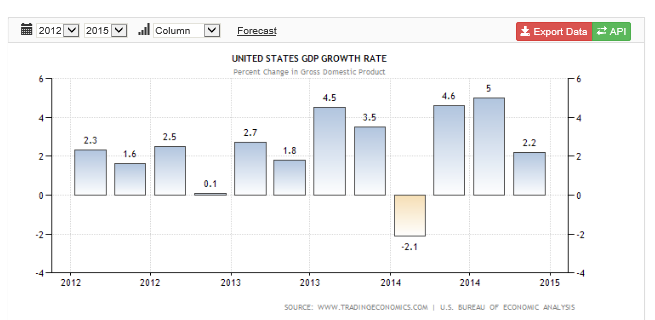
US GDP Growth 2012-2015 source: tradingeconomics.com

To do that the American government stepped in, first with bailouts to pick up the bad debt (cleaning the slate so to speak) and then with a two pronged attack, by lowering the overnight lending rate (the rate that banks can borrow at) and then promising to buy bonds indefinitely, (called Quantitative Easing). The effect is to print mountains of money, but in ways that should hopefully stimulate banks and corporations to lend and spend on new projects. But such a program can’t go on for ever. Backing this enormous expansions of the treasury requires borrowing from other people (primarily China) and the very reasonable fear is that if this goes on too long either a new financial bubble will be created, or the dollar will become worthless (or both!).

Today the Fed is trying to determine whether that time has come. And yet that answer seems far from clear. Investors are wary that the economy can survive without the crutch of cheap credit. Analysts and economists are nervous that raising rates will push the US dollar higher, making it less competitive globally. Meanwhile other countries are dropping interest rates. Germany issued a negative bond. Canada’s own key lending rates was cut earlier this year. People are rightly worried that a move to tighten lending is going in the exact opposite direction of global trends of deflation. If anything, some argue the US needs more credit.

The question of raising rates reveals just how little we really know about the financial seas that we are sailing. I often like to point to Japan, whose own economic problems are both vast and mysterious. Lots of research has gone into trying to both account for Japan’s economic malaise; it’s high debt, non-existent inflation, and how to resolve it. Currently the Japanese government is making a serious and prolonged attempt to change the country’s twenty year funk, but it is meeting both high resistance and has no guarantee of success.

Similarly we have some guesses about what might happen if the Fed raises its rates in the summer or fall. Most of the predictions are temporary instability, but generally the trend is good, raising rates usually correlates to a stronger and more profitable market.

But that’s the key word. Usually. Usually European countries aren’t issuing negative interest rates on their debt. Usually we aren’t in quite a pronounced deflationary cycle. Usually we aren’t buying billions of dollars of bonds every month. Usually.

The answer isn’t to ignore the bad predictions, or obsess over them. The best idea is to review your portfolio and make sure it’s anti-fragile. That means incorporating traditional investment techniques and keeping a steadfast watch over the markets through what are often considered the quiet months of the year.