
More Proof that “The Facebook” is Probably Terrible for Investors

social-media-logosI have been previously quite critical of the excitement around IPOs and Social Media. My major complaint is that most social media doesn’t make any money, but receive incredible valuations under the assumption that they might make money someday.

The reason for this is that two companies have made money this way, notably Facebook and Google. Both started out as free services with no revenue and have ballooned into mega-businesses busy shoving marketing at you everywhere you turn. This has, in turn, created a market of investors willing to buy into companies that seem to be doing big business for free on the hope that they can eventually turn a profit.

I’m critical here for a couple of reasons. First, there is little guarantee that any of these businesses can actually ever turn a profit. Social media has often been fickle, Myspace was going to be the next big thing until it was ultimately eclipsed by Facebook. And for every “Facebook” there are literally hundreds of other challengers vying for that attention. But how many Facebooks do we need? According to Pew research, not many.
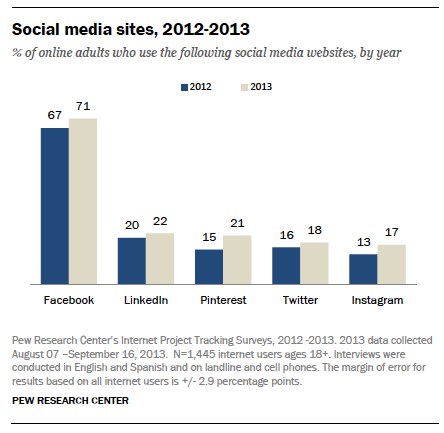
Use of Social Media Sites

Second, how success is judged should be given more scrutiny. Twitter, Facebook and other similar sites get paid by content creators to promote their material. This form of direct marketing (promoting to presumably interested parties) has really to do more with engagement than merely being seen. It’s the idea of engagement that makes these businesses viable platforms. But companies and their marketers have found making something go “viral” notoriously difficult. For every great viral video that turns out to be an ad, almost all the others fail. Estimates range from a 15% success rate, to even less.

Into this fray comes Veritasium, an entertaining science based web series that had an actual look at how Facebook might not be that useful a company to do business with. I’ll let you watch the video without spoiling his point, but I think that if you were looking for a place to spend money and understood how Facebook actually utilized your advertising dollars, you’d think twice.

Don’t Forget to Like This Market Bubble on Facebook!

Say No to FacebookHow much would you pay for something that is free? This is the basic question behind trying to value the many forms of social media that have dominated the business news over the last few years. Pinterest was valued earlier in 2013 at $3.8 billion. It makes no money. In Twitter’s initial pubic offering its share’s rose to over $45, giving the company a value in excess of $30 billion. It also has yet to turn a profit. Linkedin does make money, but it’s valued like a company that makes 100x more than it actually does. Facebook, which does turn a mighty profit, generates that money not from their user base, but from companies trying to engage its user base. While Facebook does have a lot of users, many of them don’t like advertising on their profile and click rates for advertising have been reported as lower than advertising on the web in general.

What we have then is an abnormal situation where investors appear to be willing to pay big money for companies that don’t seem to be even close to making any of that investment back (some companies don’t even seem interested). In contrast companies like Apple have seen huge fluctuations in their share value on the mere speculation that they may not make quite as much money as previously thought.

To my eyes this has all the makings of a market bubble. I’ve written about the absurd way we seem to value internet businesses that don’t make any money before. One theory for these valuations is that these businesses are highly scalable. Adding more users doesn’t cost much more in terms of effort. Other theories include the idea that while many of these businesses may yet to turn a profit, the sheer number of dedicated subscribers means that the business model simply needs to be worked out.

My view on this is that there is a lot of hope attached to a lot of uncertainty. Investment excitement behind companies like Pinterest, Linkedin or Twitter, which have high valuations and little to no earnings, is driven more by a “don’t miss out” attitude. In comparison businesses that have actual earnings, products and market presence are judged far more critically and by more rigorous standards.

I think a good acid test here is what investors are being encouraged to buy compared to say, an actual tech company. In the last few months Google has acquired both robotics maker Boston Dynamic and recently Nest, the innovative thermostat and smoke detector company. Both of these companies make things. Amazing things. None of these things require you to like, share, link to or visit a page. Instead they are making tangible things that people want, or will want. The same is true for Apple computers, Samsung, GM, Toyota, Coca-Cola and Proctor & Gamble.

As investors its important not to lose focus that the ideal investment is one that provides the steak, not just the sizzle.