
The Debt Ceiling Is Pointless

From the Washington Post, Tuesday February 11, 2014

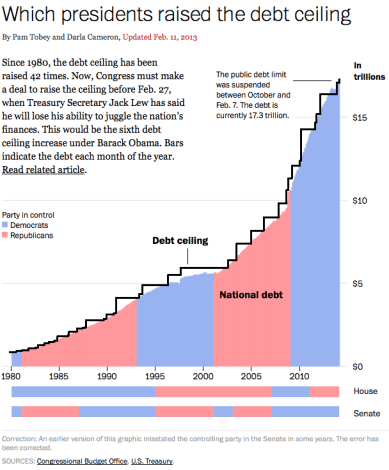
It would seem that the Republicans in the United States have been largely de-fanged when it comes to using the debt ceiling as a political lever. Yesterday Republicans agreed to a ‘clean’ debt ceiling vote, meaning that there were no poison pills for Democrats to swallow, and that political fighting and decisions would have to happen without the threat of a total global economic meltdown.

But the debt ceiling need not exist at all. As you may know, there aren’t any other major economies that have “debt ceilings” – instead the debt ceiling was a by-product of America’s involvement in the First World War, when Congress (the group authorized to allow for debt) needed to give the treasury room to borrow. The solution was the Debt Ceiling that we know today.

But the debt ceiling isn’t helpful and doesn’t do any of the things that people intend it to do. For instance, as a way of stopping or limiting borrowing it doesn’t work. Most of what the treasury is paying goes out automatically, like paycheques and benefits. Stopping borrowing doesn’t eliminate the debt obligation, it just puts you in default.

As a method to improve the financial health of the United States its hard to see how breaching the debt ceiling would improve the American economy. Far more likely it would tank the US and much of the global markets.

As a tool to fight for social change it is dangerous and undemocratic. The financial responsibilities of the United States sit on both party’s shoulders, not just one.

Lastly, the debt ceiling has prevented more useful conversations about how to help the American economy where both parties had something to offer. Have a look at this video by historian Niall Ferguson from 2011. The economy has improved since then and the economic outlook is better than before, but it is telling that the debt ceiling offers us little and distracts people from more useful political solutions.

It’s time to get rid of the debt ceiling.

It’s Official, Young Canadians Need Financial Help

I thought I had more saved!It must be terribly frustrating to be a twenty-something today. It’s hard to find work; you probably still live with your parents and a whole culture has developed around criticizing your generation. But beyond the superficial criticisms directed at twenty somethings, there are structural shifts going on within the economy that are making paupers of the next generation.

Some of these shifts do extend from things like a lack of good paying jobs in manufacturing and an increasingly reliance on service sector jobs. There are many university graduates that now find themselves in work that they are overqualified for and underpaid in. But some of the changes also come from an increasingly high cost of living that is making it financially untenable to move out of a parents’ home. This phenomenon has been dubbed “boomerang kids”, or “boomerang generation.”

The challenge that the Millennial generation is facing is that costs are rising as a proportion of their income. Consider the cost of a house in Toronto. In November of this year the average cost of a home sold in Toronto was $538,881, up 11.3% from November of last year. Assume you make the minimum downpayment to get a home, 5%, your downpayment would then be $26,944 (roughly).  Your monthly payment on a 25 year fixed rate mortgage would be $3,077 per month, or close to $36,924 per year. If we factor in real-estate tax and an average heating cost, that would bring annual costs to roughly $43,000 a year. That would mean that to qualify for the mortgage with a bank you would need to be earning at least $134,375 before taxes. The average income in Canada is $47,000.

We can quibble about how accurate these numbers are, but it would still amount to the same end. It costs a lot today to be like your parents. Buying a house for the first time is incredibly expensive and forces young people to make different choices about how to spend their money. For many millennials this has meant “postponing” growing up, financially as well as spiritually. But what today’s young generation actually need is a working budget that lets them get a big picture of their spending and allows them to set and reach financial goals. There are free services, like Mint.com (which I am very much in favour of), but even better is that young people should be encouraged to seek out professional financial help. People with a small amount of savings often feel discouraged about seeing a professional, but getting this guidance early on can lead to significantly better financial outcomes, comfort with the markets and wiser tax efficient planning!

Want to discuss your future planning?

← Back

Thank you for your response. ✨

From the Desk of Brian Walker – In Retirement Go Small

ImageFor many people approaching retirement, there may be mixed feelings about their house. Perhaps not their house, but their home. Homes are where important things happen for families and for many soon-to-be retiring couples there is sometimes some question about whether you should sell your home, or keep it in retirement.

While you may have lots of fond memories about your home however (and while your children may never forgive you for turning their room into a train model city) selling your family home in retirement can be liberating, financially and personally. Downsizing in retirement can represent an exciting new phase of your life, providing you with more leisure time, additional funds for travel and a considerable reduction in the amount of manual household chores.

I speak from experience, having recently moved from a country home of nearly 4,000 square feet and three acres of grounds to a modest 1000 sq ft condo in downtown Toronto. But deciding to make the move was difficult. I knew the benefits of parting with my home, the extra money I would have and the lack of physical work, etc. But I also recognized that I would also have to part with many things I had acquired in my life. In the end what finally drove my decision was the realization that caring for my home was now more a burden than a joy.

In most cases you will never be as healthy, or as in good shape as we are today. Retirement is no longer about spending your remaining years in your slippers. I have a bucket list of things I’d like to do, trips I’d like to take and a granddaughter I enjoy playing with. Your retirement should be about what you want, and while the decision to downsize our houses and change our lifestyles can be difficult, we shouldn’t be squandering our active years shackled to our homes.

It took me a year to make up my mind that it was time to downsize. Ultimately a pro and con list really helped crystallize my choice. There was lots of work to do, lots of emotion and stress associated with the move, but after six months in my new home I know I made the right decision.