
Canadians Losing the Battle to Save For Retirement

Money WorriesPeople sometimes ask why I seem to be so focused on housing and its costs as a financial advisor, and I think the answer is best summed up declining rates of RRSP contributions. Currently many Canadians seem to be opting out of making a RRSP contribution this year, with both Scotiabank and BMO conducting separate and disheartening surveys about likely RRSP contribution rates. Unsurprisingly the answer most Canadians gave to why they would not be contributing this year was because they “did not have enough money.” These surveys also found that 53% of Canadians did not yet have a TFSA either for similar reasons. The expectation is that by 2018 Canadians will have over a trillion dollars of unused contribution room.

These kinds of surveys invariably lead to a kind of financial “tut-tutting” by investment gurus.

http://youtu.be/1pQJxGIFzdo

As one member of BMO’s executes put it, an “annual contribution of $2,000 to an RRSP… costs less than $6 per day.” which is true but does not really spell out a viable path to a retirement, merely the ability to make a contribution to a RRSP. While there is nothing wrong with the Gail Vaz-Oxlade’s of the world handing out financial advice and directing people to live debt free, Canadians simply do not live in some kind of financial vacuum where all choices boil down to the simple mantra of “can I afford this?” Frequently debts are incurred either because they must be (educational reasons, car troubles, etc.) or because it is not feasible to partake in an economic activity without taking on debt (like buying a house). Similarly it is not practical to assume that every decision be governed exclusively by a simple weighing of financial realities. It’s true it would cost less to live in Guelph, but many people do not wish to live in Guelph and would rather live in Toronto (Nothing personal Guelph!)

What we do have though is a precarious situation where the economy is weak (but maybe improving), which sets government policy through low interest rates. Low interest rates means borrowing for big ticket items like homes in places where supply is limited, like the GTA, or Vancouver or Calgary. This in turn keeps both house prices and debt levels high. It’s telling as well that a growing number of Canadians are beginning to look at their homes as a source of potential income in retirement. All of this seems to be happening while different financial “experts” argue whether the Canadian housing market is actually over valued, or not

This is where I get a chance to make a personal plug for the benefits of my role. While I don’t have much say in government policy, or even directing housing development in big cities, it is rewarding to know that financial advisors like me have a significant impact on the savings rates of those Canadians that work with us. A study called Value of Advice Report 2012 reported that Canadians that had a personal wealth advisor (that’s me) were twice as likely to save for retirement, and that the average net worth of households was significantly higher when they had regular financial advice from an advisor (again, me). The RRSP deadline this year is March 3, so please give me a call if you haven’t yet made your RRSP contribution. 

Go back

Your message has been sent

Warning
Warning
Warning

Warning.

Be the Most Interesting Person at Christmas Dinner

Merry Christmas and Happy Holidays! We’ve been busy over here for the last couple of weeks and unfortunately I haven’t been able to update our blog as often as I would like. However lots of interesting and important things have been happening over the past two weeks and they are worth mentioning. Check them out below!

Bitcoin is maybe not going to survive. Maybe: There is an ongoing fight about whether Bitcoin, the digital currency, is in fact a real currency. Bitcoin has been criticized for being a tool of the criminal underworld, and praised for its inventiveness. But like all fiat currencies there is a lot of speculation about whether it is worth anything. After all, who is backing Bitcoin? There is no government that will guarantee it and not every government is happy with it, and its value fluctuates wildly. And yet Bitcoin persists, at least until today. China has just banned Bitcoin and its largest exchange will not accept any more deposits, sending the value of Bitcoin tumbling.

What’s good for the investor maybe bad for the economy: There is a demographic shift going on in the Western Developed nations. People are getting older. Not just older, but retirement older, and as a result the economy is feeling pressured to respond to needs arising out of this aging baby boomer trend. One of those shifts is towards dividends. Dividends are traditionally issued by companies to their shareholders when the companies have extra money lying around and can’t use it productively. However many companies, especially large ones that generate more cash flow than they can reasonably use issue regular dividends, such as banks and many utilities. This is useful to investors that are looking to retire or are retired already. Regular dividends help provide retirees with regular and predictable income. However dividends may be bad for the economy. CEOs are often rewarded for market performance, and markets tend to like companies that increase their dividends (Microsoft increased its dividend in September). But companies can be far more useful to the economy generally when they invest in growth rather than give money back to shareholders. That would mean hiring new people, building new factories and generally moving money through the economy. But as much of the population ages and looks for dividends this might undermine the both growth in economic terms and affect choices that CEOs make about the future of their companies.

Canadians are at record debt levels, again: This may not come as much of a surprise, but Canadians have record debt levels and nothing seems to be correcting it! This story began regularly occurring in 20102011, 2012, and of course 2013. What is more important about how high the debt of Canadians continues to rise, but what’s driving it. Not surprisingly it’s mortgages. The high cost of Canadian housing has worried the federal government, and many global organizations. But far worse would be a deflationary cycle on Canadian homes, driving down the price while saddling home owners with debts far in excess the value of their houses. Despite a number of efforts to limit the amounts that Canadians are borrowing, the very low interest rate set by the Bank of Canada is keeping Canadian’s interested in buying ever more expensive homes. The reality is that no one is really sure what is to be done, or what the potential fallout might be. What is clear is that this can’t continue forever.

We’re going to be taking next week off, but will be back in January!

Economists Worry About Canadian Housing Bubble, Canada Politely Disagrees

real-estate-investingThis week the Financial Times reported that “Canada’s housing market exhibits many of the symptoms that preceded disruptive housing downturns in other developed economies, namely overbuilding, overvaluation and excessive household debt.”

These comments made by economist David Madani have been repeated and echoed by a number of other groups, all of whom cite Canada’s low interest rates and large household debt (now 163% of disposable income according to Statistics Canada) as a source of significant danger to the Canadian economy.

This is not a view shared by Robert Kavic of BMO Nesbitt Burns who believes that the Canadian housing market has long legs, saying “Cue the bubble mongers!”

Since 2008 predicting the fall of housing markets has become a popular spectator sport. Canada seems to have sidestepped most of the downturn, which has only made calls for the failing of Canada’s housing markets greater. But the reality is that our housing markets are very hot, and we do have lots of debt.

So is Canada’s housing market heading for a crash? Maybe. And even if it was its hard to know what to do. Fundamentals in Canada’s housing sector remain strong (and have improved). People also want to live in Canadian cities, with 100,000 people moving annually to Toronto alone. In other words, there is lots of demand. In addition regulations in the Canadian financial sector prevent similar scenarios that were seen in the United States, Spain and Ireland from occurring.

But housing prices can’t go up forever, and the more burdensome Canadian debt becomes the more sensitive the Canadian economy will become to interest rate changes. Meanwhile I have grown far more weary of over confident economists assuring the general public that “nothing can go wrong.” 

The big lesson here is probably that your house is a bad financial investment, but a great place to live. Unless you own your home, a house tends to be the bank’s asset and not yours. In addition your home, like your car, needs constant maintenance to retain its value. So if you wanted to buy a house to live in, good for you. If you want to buy a house as an investment my question to you is, “Is this really expensive investment the best investment in a world of financial opportunities?”

The Real Economic Impact of Rob Ford

Whether you think that Mayor Ford is great at his job, some terrible buffoon or actually a buffoon that is great at his job, there’s no doubt that we are all paying attention to his antics. But while Rob Ford’s behaviour may be giving Toronto a “black eye” internationally the reality is that it probably isn’t going to make much of a difference when it comes to Toronto’s economy.

Image

Rob Ford – Toronto’s besieged mayor

The real economic impact of Rob Ford will likely have nothing to do with his drug use, but more to do with his continued fight for cars against LRTs and bicycles. Mayor Ford is a car enthusiast, and he isn’t alone. In many of Toronto’s sprawling suburbs cars are king and public transit is largely relegated to buses. But the real complaint that car drivers have is in their commute.

Toronto is said to have the worst commute times of 19 major cities in a study completed in 2010. On average a round trip commute in the GTA is 80 minutes long, 24 minutes longer than drivers in LA and 32 minutes longer than drivers in Barcelona. This gridlock comes with a cost. In 2006 that cost was estimated to be about $3.3 billion, a result of travel delays, stress on vehicles, increased likelihood of traffic collisions and impact on the environment. Additionally there was also a loss to GDP from travel delays, which amounted to an additional $2.7 billion.

Since 2006 these numbers only seem to increase. In 2011 Toronto’s Board of Trade said that gridlock was now the greatest threat to economic prosperity in the region and estimated that the cost of all the gridlock was $6 billion annually and growing. That cost was updated again this year by the C.D. Howe Institute, now estimated to be about $11 billion.

In the midst of this are politicians fighting over whether we should have subways or LRTs. This is all proving to be bad both for our financial health, but also just plain bad economics. Subways, it is argued are a great investment, though they come with a high price tag. But if a subway line operates at less than full capacity it also serves to suck money out of public coffers. Maintenance for subways are also high, and while subways move many more people around you need people to make them profitable. But the other bad economic idea is the love affair with the car. Cars receive enormous public subsidies, in the form of dedicated roadways, highways, public parking spaces and mandated parking spots in new buildings. While this cost seems largely invisible it is still there, hitting our pocket book.

All of this amounts to an economic failure for Rob Ford. An inability to rally the city to one transit vision, his or anyone else’s, means that Toronto is stuck in gridlock and that is a real embarrassment.

Great Further Reading: Straphanger: Saving our Cities and Ourselves from the Automobile by Taras Grescoe

Is the Internet Making Business Weirder?

Image

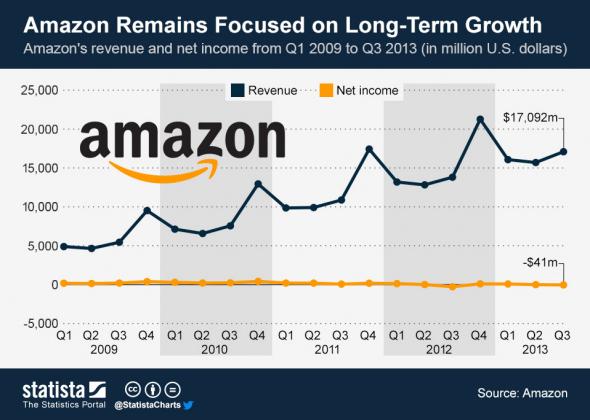
If there is any doubt about whether the internet is changing how we do business I think it is best summed up in the above chart from Statista.com, which highlights both how Amazon continues to grow its sales while simultaneously losing money.

The point here is not to criticize Amazon’s business practices. Its an enormously successful company, but its share price has continued to grow in the face of declining revenues. What other company could operate like this outside of the internet? Apple, who I’ve written about before, is uniquely profitable but is frequently criticized for not growing enough even while it crushes its competitors.

The other way to look at this is whether Walmart would be given similar considerations? Amazon is spending and investing everything that they make, and in the process some of those investments run at a loss. This is good for us, but its rare that the market rewards companies who ignore the shareholder so entirely for the sake of the consumer.

The question of what effect the internet is having on business only gets more confusing when you find out that Pinterest is valued at 3.8 billion with zero revenue and Twitter isn’t expected to make a profit until 2015.