
The Debt Ceiling Is Pointless

From the Washington Post, Tuesday February 11, 2014

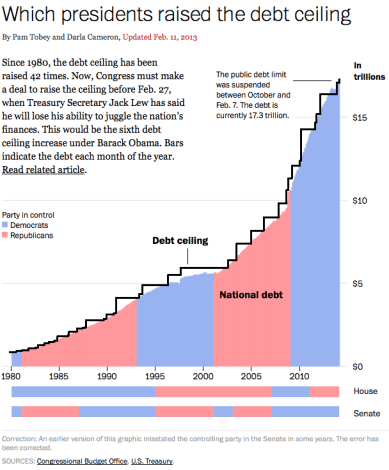
It would seem that the Republicans in the United States have been largely de-fanged when it comes to using the debt ceiling as a political lever. Yesterday Republicans agreed to a ‘clean’ debt ceiling vote, meaning that there were no poison pills for Democrats to swallow, and that political fighting and decisions would have to happen without the threat of a total global economic meltdown.

But the debt ceiling need not exist at all. As you may know, there aren’t any other major economies that have “debt ceilings” – instead the debt ceiling was a by-product of America’s involvement in the First World War, when Congress (the group authorized to allow for debt) needed to give the treasury room to borrow. The solution was the Debt Ceiling that we know today.

But the debt ceiling isn’t helpful and doesn’t do any of the things that people intend it to do. For instance, as a way of stopping or limiting borrowing it doesn’t work. Most of what the treasury is paying goes out automatically, like paycheques and benefits. Stopping borrowing doesn’t eliminate the debt obligation, it just puts you in default.

As a method to improve the financial health of the United States its hard to see how breaching the debt ceiling would improve the American economy. Far more likely it would tank the US and much of the global markets.

As a tool to fight for social change it is dangerous and undemocratic. The financial responsibilities of the United States sit on both party’s shoulders, not just one.

Lastly, the debt ceiling has prevented more useful conversations about how to help the American economy where both parties had something to offer. Have a look at this video by historian Niall Ferguson from 2011. The economy has improved since then and the economic outlook is better than before, but it is telling that the debt ceiling offers us little and distracts people from more useful political solutions.

It’s time to get rid of the debt ceiling.

From the Desk of Brian Walker – In Retirement Go Small

ImageFor many people approaching retirement, there may be mixed feelings about their house. Perhaps not their house, but their home. Homes are where important things happen for families and for many soon-to-be retiring couples there is sometimes some question about whether you should sell your home, or keep it in retirement.

While you may have lots of fond memories about your home however (and while your children may never forgive you for turning their room into a train model city) selling your family home in retirement can be liberating, financially and personally. Downsizing in retirement can represent an exciting new phase of your life, providing you with more leisure time, additional funds for travel and a considerable reduction in the amount of manual household chores.

I speak from experience, having recently moved from a country home of nearly 4,000 square feet and three acres of grounds to a modest 1000 sq ft condo in downtown Toronto. But deciding to make the move was difficult. I knew the benefits of parting with my home, the extra money I would have and the lack of physical work, etc. But I also recognized that I would also have to part with many things I had acquired in my life. In the end what finally drove my decision was the realization that caring for my home was now more a burden than a joy.

In most cases you will never be as healthy, or as in good shape as we are today. Retirement is no longer about spending your remaining years in your slippers. I have a bucket list of things I’d like to do, trips I’d like to take and a granddaughter I enjoy playing with. Your retirement should be about what you want, and while the decision to downsize our houses and change our lifestyles can be difficult, we shouldn’t be squandering our active years shackled to our homes.

It took me a year to make up my mind that it was time to downsize. Ultimately a pro and con list really helped crystallize my choice. There was lots of work to do, lots of emotion and stress associated with the move, but after six months in my new home I know I made the right decision.

Economists Worry About Canadian Housing Bubble, Canada Politely Disagrees

real-estate-investingThis week the Financial Times reported that “Canada’s housing market exhibits many of the symptoms that preceded disruptive housing downturns in other developed economies, namely overbuilding, overvaluation and excessive household debt.”

These comments made by economist David Madani have been repeated and echoed by a number of other groups, all of whom cite Canada’s low interest rates and large household debt (now 163% of disposable income according to Statistics Canada) as a source of significant danger to the Canadian economy.

This is not a view shared by Robert Kavic of BMO Nesbitt Burns who believes that the Canadian housing market has long legs, saying “Cue the bubble mongers!”

Since 2008 predicting the fall of housing markets has become a popular spectator sport. Canada seems to have sidestepped most of the downturn, which has only made calls for the failing of Canada’s housing markets greater. But the reality is that our housing markets are very hot, and we do have lots of debt.

So is Canada’s housing market heading for a crash? Maybe. And even if it was its hard to know what to do. Fundamentals in Canada’s housing sector remain strong (and have improved). People also want to live in Canadian cities, with 100,000 people moving annually to Toronto alone. In other words, there is lots of demand. In addition regulations in the Canadian financial sector prevent similar scenarios that were seen in the United States, Spain and Ireland from occurring.

But housing prices can’t go up forever, and the more burdensome Canadian debt becomes the more sensitive the Canadian economy will become to interest rate changes. Meanwhile I have grown far more weary of over confident economists assuring the general public that “nothing can go wrong.” 

The big lesson here is probably that your house is a bad financial investment, but a great place to live. Unless you own your home, a house tends to be the bank’s asset and not yours. In addition your home, like your car, needs constant maintenance to retain its value. So if you wanted to buy a house to live in, good for you. If you want to buy a house as an investment my question to you is, “Is this really expensive investment the best investment in a world of financial opportunities?”

Taking a Second Look at Europe

One of the benefits of being a financial advisor is the occasional one-on-one meeting you get with Portfolio Mangers (PM) and the opportunities to pick their brains. This week began for me by sitting down with AGF manager Richard McGrath, a PM based in Dublin who helps manage some global and european funds.

This was great opportunity to get some first hand information about what is going on in Europe. Following 2008, the Eurozone, easily the largest economy in the world, has been hit pretty hard. Strict austerity measures and public unrest have long painted a picture of a Europe constantly on the brink of failure. 2011 was easily the worst year as Greece got perilously close to defaulting on its debt as Germany and the Troika (the European Commission, the EU Central Bank and the International Monetary Fund) played hardball looking for more political concessions from Greece.

The fact remains that big financial crises like 2008 have long tails, and Europe has been beaten-up very badly, with big reductions in their GDP, large unemployment figures and generally all-round bad economic news. And yet no storm lasts forever. Despite a difficult political structure, a burgeoning recovery seems to be underway.

Richard McGrath seems to think so at least, and I share many of his views. Some of the good news is really less bad news. For instance in Ireland continued austerity was expected to cut €3.6 billion from government spending, but as the economy improves that number has been dropped to €2.5 billion. There are lots of little stories like this helping to outline a general recovery in the Eurozone. Bloomberg reported on October 23rd that Spain had ended 9 consecutive quarters of negative economic growth, with an anemic 0.1% growth rate. Not great, but it still goes in the “good news column”.

It’s worth remembering that negative news abounds in the United States, but their stock markets have reached all time highs (again) and that after several bad years European markets have also done very well this year. But from the perspective of watching markets its important to take notice when GDP growth turns positive (Germany, France, Spain, UK – Societe Generale, September 9, 2013), investment flows start gaining (Societe Generale), all the while valuations are considerably lower, and therefore cheaper than other well performing markets (Thomson Reurters Datastream, October 21st, 2013). All of this points to one conclusion, you can’t trust the media. With it’s constant focus on negative news you might miss some of the best growth opportunities!