
A Watched Pot With A Frog In It

Back in the spring, markets reeled after Trump announced a new round of unilateral tariffs. The April 2nd announcement triggered a week of panic selling until the administration promised a temporary 90-day pause to pursue trade negotiations. Nine months later, the U.S. now has the highest tariff levels in over a century, economic data is showing signs of weakening, and discussions of a market bubble are widespread. Why, then, is the stock market still so high?

The most immediate reason is the concentration of market leadership. The “Magnificent Seven” tech giants now account for more than 35% of the S&P 500, while the top ten companies make up nearly 40%. The gap between the S&P 500 and its equal-weighted equivalent is just shy of 10%, while the Magnificent Seven themselves have delivered a combined return of roughly 27.6% year-to-date. The comparison to the dot-com era is easy to make, but the fundamental difference is profitability: Apple, Google, Microsoft, Amazon, Meta and others continue to generate substantial earnings and hold enormous balance-sheet reserves. This profitability has helped anchor market confidence.

Figure 1 Growth of the Magnificent Seven as a part of  the S&P 500

Another factor is the lag in how economic data reflects policy changes. Despite the risks tariffs pose, the full impact has not yet shown up in backward-looking data like GDP or employment reports. Investors expecting an immediate shock instead found resilient quarterly numbers, reinforcing confidence rather than shaking it.

Figure 2 Effective tariff rates over time, from the Yale Budget Lab

There is also a deeper structural issue: the increasing concentration of economic power and spending. As wealth inequality widens, a large share of U.S. households are contributing less to measured economic activity. Recent consumer expenditure data suggests that the top 10% of households now account for roughly 50% of all consumer spending, while the bottom 60% contribute less than 20%. This means that economic stress among the majority of households may not meaningfully register in the headline data that markets rely on. Meanwhile, AI-related capital investment makes up a growing share of the remainder of measured economic activity.

Figure 3 Widening wealth disparities between households and consumer spending

This combination — delayed data effects, high concentration of consumption, and sustained AI investment — has helped keep investor sentiment resilient, even as negative signals accumulate beneath the surface. It has also masked the risks of allowing speculative dynamics to develop largely unchecked.

Figure 4 Growth of Personal Consumption as a percentage of GDP

Concerns about an AI bubble are growing. Estimates of total AI investment now exceed $3 trillion when considering capital expenditures, valuations, and related infrastructure spending. Commercial use cases outside of a few sectors remain limited. Some firms have begun participating in “circular funding arrangements,” where they invest in each other’s AI initiatives to reinforce perceived valuations. Even industry leaders acknowledge the speculative environment: Sam Altman, the CEO of Open AI has said there is likely a bubble, while Jeff Bezos has called this a “good bubble” that will still produce transformative breakthroughs.
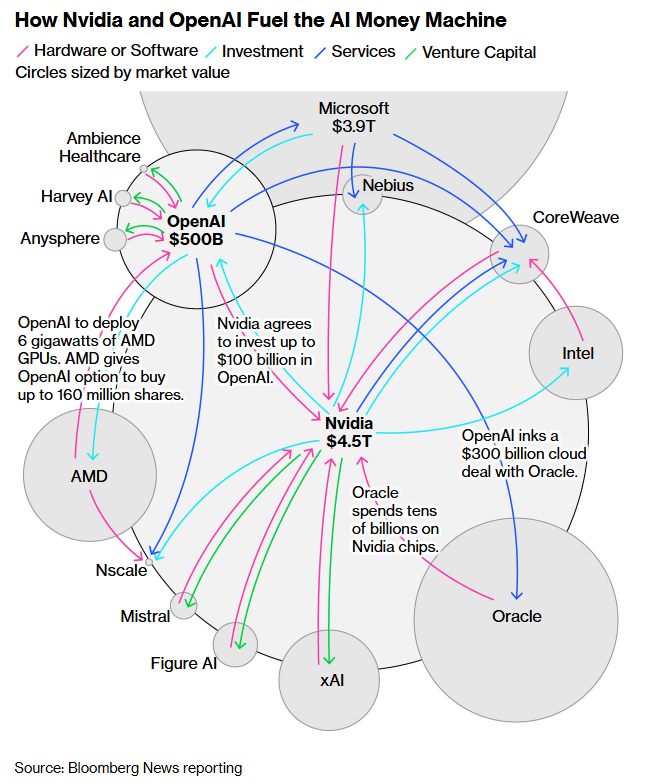
History suggests that speculative cycles are remarkably resistant to logic. They often convert skeptics into participants, including professional money managers who join in under client pressure. Market bubbles resemble the proverbial frog in a pot: the danger rises slowly enough to dull caution.

Yet they also resemble the “watched pot” that never seems to boil. As long as new capital continues to flow into AI-linked investments, momentum can persist. Predicting the end of a bubble is famously difficult — markets can remain irrational longer than investors can remain solvent.

So what should investors do? Awareness of rising risk is the starting point. We may not be able to time the end of the AI boom, but we can examine investor behavior for signs of speculative excess.

Consider Tesla. After the election, the stock surged nearly 98% in six weeks on enthusiasm linked to political alignment and narrative momentum. Since then, sales have weakened, profitability has declined, and competition has intensified — yet the stock remains 10% above its level on inauguration day and has more than doubled off its lows. Tesla’s valuation continues to reflect belief in future breakthroughs rather than current operational performance. It is a clear illustration of narrative overpowering fundamentals — a hallmark of speculative markets.
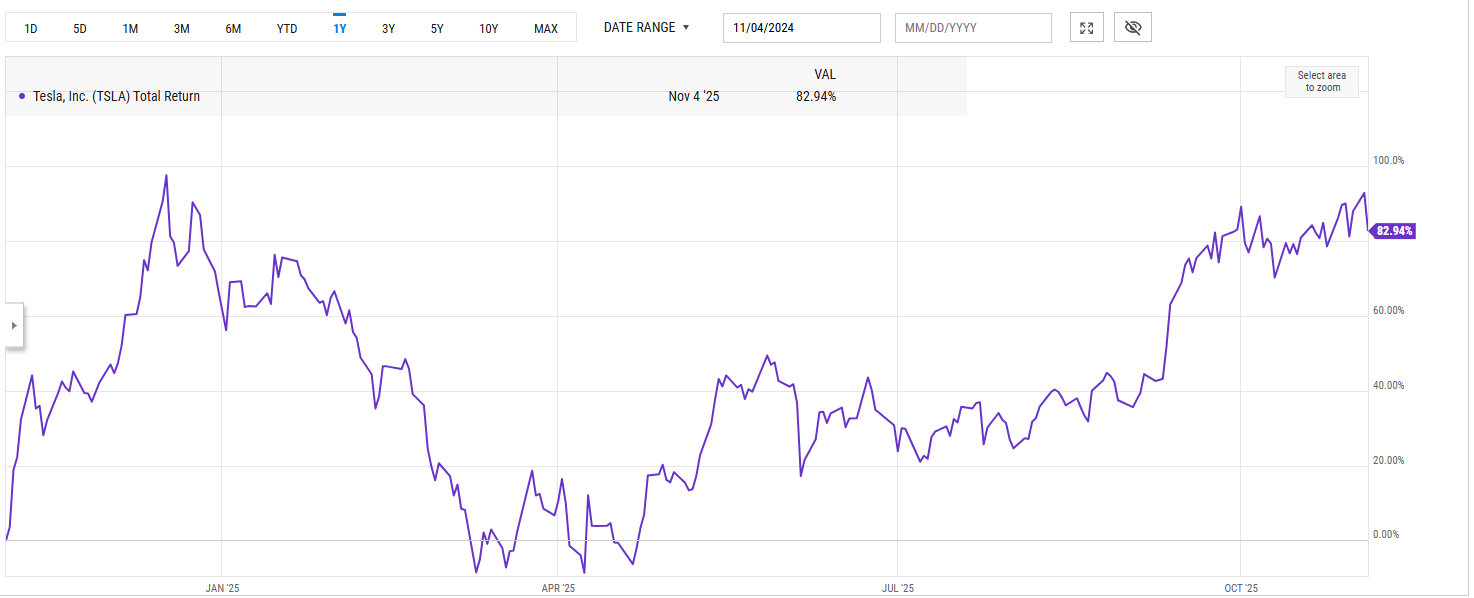
Figure 6 Tesla stock performance from November 4, 2024 to November 4, 2025

If this environment feels uncomfortable, it may be time to review portfolio risk exposure. Reducing equity risk comes with trade-offs — especially missing out on momentum-driven gains — but clarity on long-term goals can help prevent emotionally driven decision making.

Market manias are difficult to avoid and even harder to detach from when others are benefiting. The antidote is a disciplined investment plan that emphasizes long-term objectives over short-term excitement. In a world where the water may be warming around us, it is better to be a watcher than the frog.

Climate Change, Real Estate, & Markets – A Mid-summer Update!

Updates: Climate Change

In his book The Third Horseman: A Story of Weather, War, and the Famine That History Forgot, historian William Rosen recounts the effect of the regional climate change on Europe in the early 1300s. His recounting of the history of Europe (but mostly England) in the wake of the “Little Ice Age” is fascinating and frightening. Political upheaval, inflation and famine are all magnified by the effects of a changing climate, while the uncertainty it brings dramatically alters the European landscape and its political status quo.

The little ice age saw a general cooling across much of Europe, a shortening of the growing season, an increase in heavy rains that flooded land, rendered marginal farmland unusable, and a spiking in grain prices forcing cereals to be sourced from farther away (like the middle east) to feed the northern parts of the continent. It also saw the loss of some industries, like England’s wine producers. The reputation for terrific French and Spanish wines, and the English reputation for drinking them in great quantities is forged in the shadow of the this geographically specific climate alteration.

Until now.

According to the Financial Times Britain is seeing a surge of vineyards opening, as far south as Sussex and as far north as Scotland. In 2023 the country recorded its largest ever grape harvest, while the country’s largest winemaker, Chapel Down, is looking to sell more shares to fund further expansion of its business.

Over the last decade I’ve made the case that climate change is really about water and its predictability. It is interesting to note that in the mass of worrisome predictions, of the potential for war, for famine, and for a less secure and more fragile world, that one of the less expected outcomes might be a change in cultural identity of a whole nation; that one rainy little island may stop being rainy, and undo 700 years of a cultural identity.

Updates: Real Estate

In 2020, one of the first things I wrote in at the beginning of the lockdowns was about the Canadian real estate market, and whether lockdowns and a pandemic might unravel our condo market. Though the lockdowns were long lived, Canadian real estate survived helped in large part by the extension of emergency levels of interest rates. The cost of living crisis and the housing bubble, ever intertwined, got worse, not better.

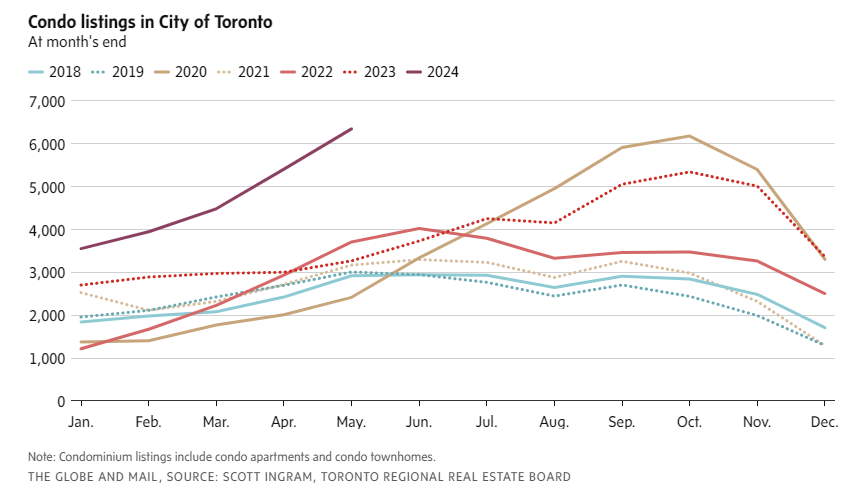
Condo prices reached their peak in January of 2023, and fell back to a current low by late April. Since then prices have fluctuated somewhat, but have been largely range bound. Reported by the Toronto Star on June 14th, “the number of new listings for condos has increased 30% since last May” the bulk of those in the investor size, ranging between 500 to 599 square feet. Urbanation, a trade publication for real estate states “In the past year, unsold new condominium supply increased 30%, rising 124% over the past two years.” In addition “projects in pre-construction during Q1-2024 were 50% presold, down from a 61% average absorption over a year ago, and 85% two years earlier.”

The Globe and Mail wrote on June 29th that “there were 6350 active condo listings in the city, an increase of 94% from the previous May” and that “condo inventory 70 per cent higher than the 10-year average for last month.” The deterioration in the condo market is being felt by existing owners and investors, as well as developers whose per square foot costs run roughly $500 higher than existing condo values.

All this seems to be aligning with a secondary real estate problem; office and commercial real estate. Across the United States as well as Canada office real estate is also struggling. Though not news, employees refusing to return to work and companies downsizing their real estate foot prints has had a significant impact on owners of office space. Banks are unloading office loans, REITs are trying to sell unprofitable assets, and some, like Slate Office RIET just defaulted on $158 million of debt. The story of real estate, once the most unflappable asset an investor could hold, continues to unfold in surprising and worrying ways.

Updates: Markets

With half the year behind us market performance has significantly diverged. US markets, being carried by the strong performance of NVIDIA as well as the handful of usual tech company suspects, have delivered shockingly great results. At the end of June the S&P 500 was up 14.48% so far. An impressive return, but 70% of those returns are from six companies, and 30% of the return is from just one. The S&P 500 Equal Weight return, an index that assigns each company a proportional weight, only has a return of 4.07%. That 70% difference in performance is down to Nvidia, Microsoft, Apple, Amazon, Google (Alphabet), and Facebook (Meta).

Figure 1 Performance data from Y Charts

The concentration of that performance makes the current rally fragile, though curiously other global indices, including Canada, are actually more concentrated than the US. This may account for why the TSX is only up 4.38% for the year, and had briefly dipped as low as 2.66% in June. Canadians are familiar with the feeling of having one of three industries (banking, energy, or materials) often set the tenor of a year’s returns. If the price of oil is climbing or falling, its often immediately reflected in our market index returns. In their own way the S&P 500 has taken on some of these characteristics.

Investors should know that markets continue to offer considerable upside, but those returns are coming from fewer and fewer parts of the economy.

Aligned Capital Partners Inc. (“ACPI”) is a full-service investment dealer and a member of the Canadian Investor Protection Fund (“CIPF”) and the Canadian Investment Regulatory Organization (“CIRO”).  Investment services are provided through Walker Welath Management, an approved trade name of ACPI.  Only investment-related products and services are offered through ACPI/Walker Wealth Management and covered by the CIPF. Financial planning services are provided through Walker Wealth Management. Walker Wealth Management is an independent company seperate and distinct from ACPI/Walker Wealth Management.

Why is Inflation So Hard to Beat?

April was a turbulent month for markets. Having begun 2024 with an abundance of enthusiasm about the prospect of (very near) interest rate cuts from central banks, an improving economy both domestically and abroad, and resilient employment, 2024 promised the fulfillment of a long-held dream; for the central banks of Canada and the United States to tackle inflation without causing a recession.

Though recessions seem to not be lurking in the immediate vicinity, the best-case scenario for the year is now fully off the table. Several months of higher-than-expected inflation numbers have caused markets to reconsider their earlier optimism and contemplate some of the more pessimistic predictions for economies.

In turn, US markets shed several percentage points through the first two weeks of April, not wiping out the year’s gains but reducing them by about half. Bond markets, having placed bets on rate cuts and longer duration bonds have retreated as well, wiping out gains for the year and forcing bond traders to retrench into safer, shorter duration positions.

Markets have steadied since then, and have been encouraged by Jerome Powell’s statements that the Fed still intends to cut rates, but the earlier optimism about many cuts totalling more than 1% for the year seem unlikely, and even now we will need more data in the coming months to trigger the first cut that had been anticipated for the early year.

Why is this, and why have markets been so easily convinced that rates were bound to fall so quickly?

There’s no obvious single answer. Like many issues surrounding complicated problems a multitude of events, including human bias and the best of intentions have formed the foundations for a great deal of misunderstanding. For the Fed’s part, it has remained committed that data will drive all interest rate decisions, a sensible argument but one that has tied their hands. Investors and analysts have shown a natural bias of optimism, and have assumed that with the bulk of inflation easily defeated through 2022 and 2023 that the final pieces would fall easily into place. This optimism has not learned from the recent past, as 2023 began in much a similar way, with anticipation of rate cuts happening in the second and third quarter of the year only to have rates start increasing in May.

But after these more human problems, what remains are a series of headwinds that will likely be with us for the foreseeable future. While prices of many commodities have fallen from their peaks, and “supply chain constraints” are no longer choking the global trade network, the world is fundamentally different than its was before 2020. China’s relationship with the West is now more openly antagonistic, and a combination of “reshoring” or “friend shoring” is ensuring that costs will be higher than they were in the past. Food prices have continued to rise, with sometimes opaque reasons. In some instances there are clear justifications for higher costs, like bird flu affecting American egg prices or higher gas charges pushing up the cost of shipping. But other times it seems that prices have risen because grocery stores simply can. Finally, commodity prices, while lower than they were in 2021/2022, remain above pre-covid levels. This applies especially to the price of energy, which seems set to stay elevated for the near term.

Performance of the 1 year WTI contract – Source: Bloomberg

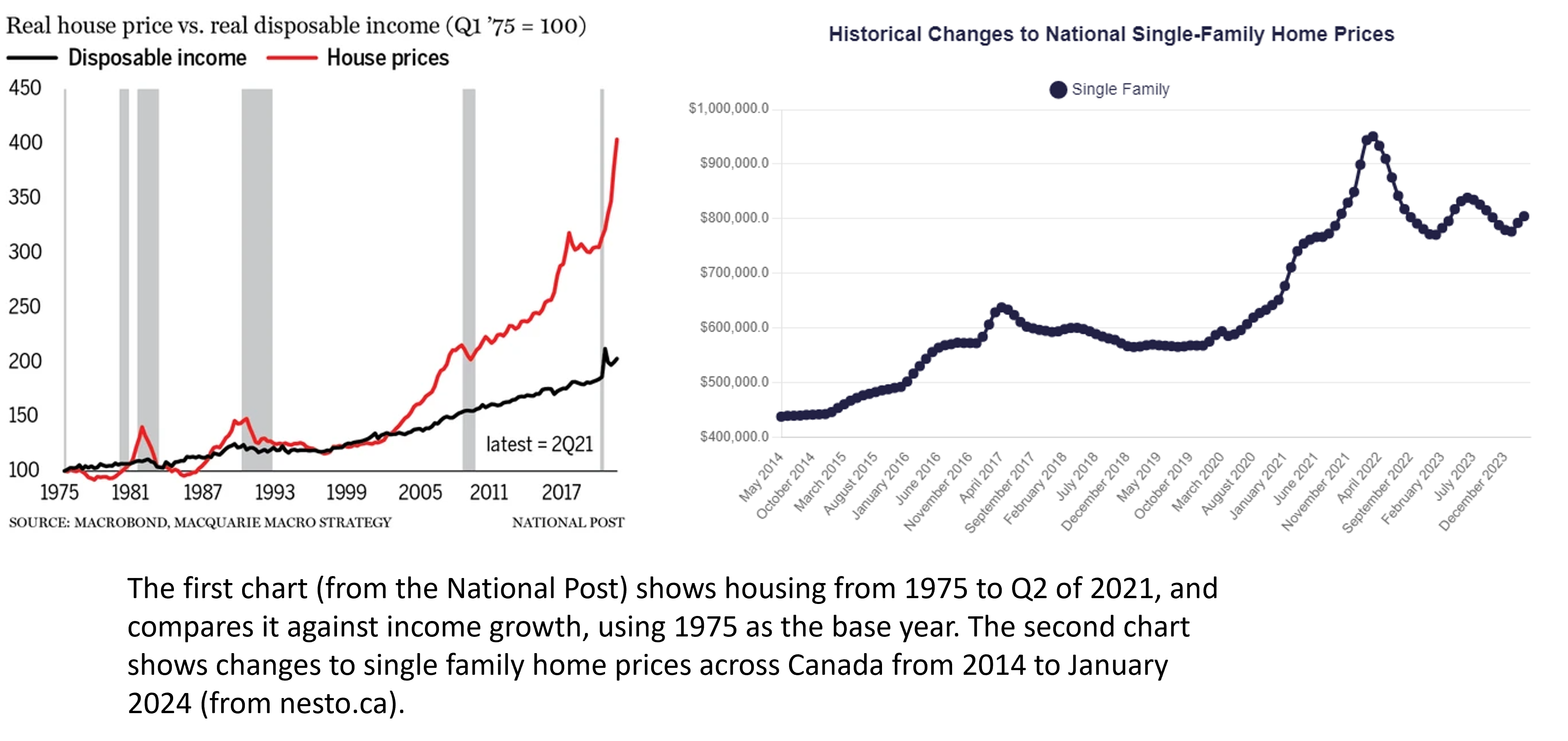
Underlying this remains some larger issues about inflation’s presence in our lives before 2020. As I’ve previously written, many parts of our society were experiencing inflation long before CPI began to worry economists and other experts. Prices of physical goods had been falling for decades, but price of homes, child care, education, and food had all been climbing over that same period. The price of housing might be better if governments took a more active role in getting the cost of development down, but permits and other government fees now account for anywhere between 20% (CMHC estimates) to 60% when all taxes, red tape, permit costs and development charges are accounted for, a lucrative source of funds for municipal budgets.

From blog Carpe Diem by Mark Perry:
Source: https://www.aei.org/carpe-diem/chart-of-the-day-or-century-8/

 Additionally, since 2008 interest rates had been at “emergency levels”, the lowest borrowing costs of any time in history. Those near zero rates, which were intended to help remove slack from the economy and encourage large capital expenditure instead stimulated enormous share buybacks among major corporations. Instead of new jobs and a hotter economy we got increasing share prices and more corporate debt.

Problems that take a long time to form do not get fixed quickly. Repeatedly markets have shown an impatience for corrections and are quick to assume that pauses in inflation must mean that the trend of higher prices has both been beaten and that interest rates can fall back to previous emergency levels. Even if interest rates are at sufficient levels to regain control over the direction of inflation, it still doesn’t mean that rates can fall quickly, and the longer rates stay elevated above the emergency levels of the past, the deeper and more costly current interest rates become to the economy.

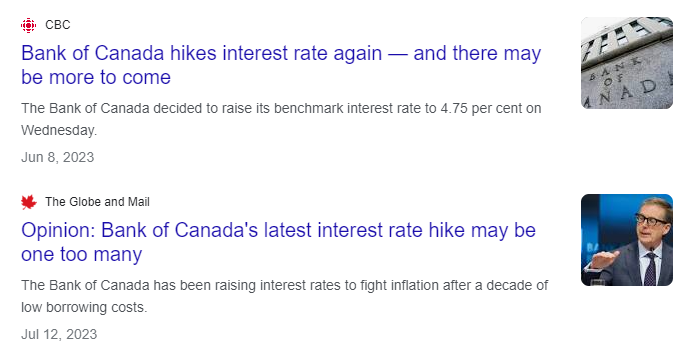
In Canada low interest rates helped stimulate an enormous increase in property values through the 2010s and into the pandemic. Higher interest rates threaten those gains and as we go through 2024, almost 60% of mortgages will have renewed into more expensive loans since rates began climbing. Even if interest rates begin to fall, homeowners can expect that the cost of borrowing will be much higher than they’ve been for many years. Between the desire of home owners to keep house values high, municipalities to keep their tax bases stable, and banks to ensure that the value of properties they’ve underwritten don’t move too much, the pressure to get inflation down runs squarely into our own self interest.

The urgency and desire for lower interest rates are real, but so are the headwinds that keeps inflation pressure high.

Walker Wealth Management is a trade name of Aligned Capital Partners Inc. (ACPI)* – if applicable ACPI is regulated by the Investment Industry Regulatory Organization of Canada (http://www.iiroc.ca) and a Member of the Canadian Investor Protection Fund (http://www.cipf.ca). (Advisor Name) is registered to advise in (securities and/or mutual funds) to clients residing in (List Provinces).

This publication is for informational purposes only and shall not be construed to constitute any form of investment advice. The views expressed are those of the author and may not necessarily be those of ACPI. Opinions expressed are as of the date of this publication and are subject to change without notice and information has been compiled from sources believed to be reliable. This publication has been prepared for general circulation and without regard to the individual financial circumstances and objectives of persons who receive it. You should not act or rely on the information without seeking the advice of the appropriate professional.

Investment products are provided by ACPI and include, but are not limited to, mutual funds, stocks, and

bonds. Non-securities related business includes, without limitation, fee-based financial planning services; estate and tax planning; tax return preparation services; advising in or selling any type of insurance product; any type of mortgage service. Accordingly, ACPI is not providing and does not supervise any of the above noted activities and you should not rely on ACPI for any review of any non-securities services provided by Adrian Walker.

Any investment products and services referred to herein are only available to investors in certain jurisdictions where they may be legally offered and to certain investors who are qualified according to the laws of the applicable jurisdiction. The information contained does not constitute an offer or solicitation to buy or sell any product or service.

Recapping Last Week’s Market

A quick video looking at the sudden rise in markets last week and what conclusions we can draw from it.

Information in this commentary is for informational purposes only and not meant to be personalized investment advice. The content has been prepared by Adrian Walker from sources believed to be accurate. The opinions expressed are of the author and do not necessarily represent those of ACPI.

Why Can’t Markets Be Calmed?

A series of bad days, a moment of respite, and then more selling. This was the story of 2008, and it lasted for months. The rout lasted until finally investors felt that enough was going to be done to save the economy that people stopped selling. Massive quantitative easing, an interest rate at 0%, aggressive fund transfers, bailouts to whole industries, and the election of a president who seemed to embody the idea of “hyper competence”. That’s what it took to save the economy in 2008. Big money, an unconditional promise to save businesses and people, and the rejection of a political party that oversaw the bungled early handling of a crisis and had lost the public confidence.

I don’t think Donald Trump has never had been viewed as hyper competent. I doubt even his most ardent supporters see him as incredibly clever, but instead a thumb in the eye of “elites” who have never cared to take their concerns seriously, and to an establishment that seemed incapable of making politics work. Trump was a rejection of the status quo and a “disruptor in chief”. A TV game show host who played the role of America’s most sacrosanct character, the self made man, asked now to play the same role in politics.

There’s nothing I need to cover here you don’t already know. A history of bad business dealings, likely foreign collusion to win an election, surrounded by sycophants and yes men with little interest or understanding of the machines they have been put in charge of, and an endless supply of criminal charges. Like a dictator his closest advisors are members of his own family, and perhaps more shockingly he fawns over and publicly admires the dedications of respect other dictators get from their oppressed populations. Never has a person been so naked in their desires and shortfalls as Donald Trump.

Markets have played along with this charade because Trump seemed, if anything, largely harmless to them. Indifference to the larger operation of the government and the laser like focus on reduced regulations and tax cuts made Trump agreeable to the Wall Street set. If he could simply avoid a war and keep the economy humming, Trump was a liveable consequence of “good times”. Until the coronavirus issue, Trump had not done terribly. The economy wasn’t exactly humming. It had a bad limp due to a trade war with China. It had a chest cold because wealth inequality was continuing to worsen despite decreasing unemployment. And its general faculties were diminished as issues around health care, deficit spending, and other aspects of the society began to languish. But as far as unhealthy bodies go, the American economy still had its ever strong beating heart, the American consumer.

Whatever name you prefer; COVID-19, the coronavirus, SARS-CoV-2, or the #Chinesevirus (as Trump is now busy trying to get it renamed) has exposed the fault lines in the administration and the danger of such blinkered thinking by Wall Street. Having spent the last few weeks downplaying the severity of the outbreak and hoping China would be able to contain it, until finally, grudgingly, acknowledging its seriousness. Markets have suddenly come face to face with a problem that bluster and bravado can’t fix. Trump is a political liability for markets, and his leadership style, which is heavy on cashing in on good times with little management for rainy days, means that markets may not really have any faith that he can properly address these problems.

Other efforts to calm markets, largely through the federal reserve, have not reassured anyone. Two emergency rate cuts are not going to fix the economy but did spook investors globally (it did signal to banks that they should take loans to cover potential shortfalls). The promise of a massive set of repo loans to provide liquidity will keep markets open and lubricated, but again won’t save jobs and won’t prop up the physical economy. What will fix markets is an end to the pandemic, a problem with the very blunt solutions of “social distancing”, “self isolation” and the distant hope of a vaccine.

What investors are facing are three big problems. First, that we don’t know when the virus will be contained. Optimistically it could be a month. Realistically it could be three. Pessimistically people are talking about the rest of the year. Even under the best conditions we are also likely facing a recession in most parts of the globe, and even then stimulus spending and financial help won’t be as effective until people can leave their homes and partake in the wider market (postponing tax filings and allowing deferrals on mortgages are good policies for right now, but at some point we need to spend money on things). But the last problem is one of politics. The Trump administration is uniquely incompetent, has shown little interest in the mechanisms of government, and in a particularly vicious form of having something come back to bite you, dismantled the CDC’s pandemic response team.

The best news came last week, when it seemed a switch had been flicked and the general population suddenly grasped the urgency of the situation and people began self isolating and limiting social engagements (I am now discounting Florida from this statement). Those measures have only been strengthened by government action over the last few days. Similarly, while I write this, Trudeau has announced a comprehensive financial package to come to the aid of small businesses and Canadian families. All this is welcome news, and I expect to see more like this over the coming weeks as Western governments take a more robust and wide ranging response to the crisis. So there is just one issue still unaddressed. The political mess in Washington.

I can’t say that markets will improve if Trump is voted out of office, but its hard to imagine that they could be made worse by his exit. Markets, and the investors that drive them, are emotional and it is confidence, the belief that things will be better tomorrow, that allow people to invest. Trump promised a return to “good times”, to Make America Great Again, and it is his unique failings that have left it, if anything, poorer.

Information in this commentary is for informational purposes only and not meant to be personalized investment advice. The content has been prepared by Adrian Walker from sources believed to be accurate. The opinions expressed are of the author and do not necessarily represent those of ACPI.

The Trump Effect

Over the weekend investors got a chance to read the fine print on the faustian bargain they had with President Donald Trump. Since Trump’s election night win, markets had jumped significantly. The promise of stimulus spending, tax cuts and a renewed focus on deregulation had given investors a “sugar rush”, and eclipsed the more basic concerns about Trump’s general lack of suitability to be president.

dow-jones-since-election

But with the stroke of a pen investors were being reminded about how quickly Trump’s essential character and the presidency he promised could bring chaos and confusion. On Friday Trump signed an executive order to temporarily restrict accepting refugees from seven predominantly muslim countries. The order was vague, poorly thought out, badly executed and quite possibly illegal. Confusion reigned and initially the order was applied to people with legal immigrant status in the United States, including those with green cards.

The weekend was filled with protests at airports, backtracking by members of the administration, and out and out insurrection by members of the government who believed that the order was unconstitutional. Very quickly the official story has descended into the kind of decontextualized factual minutia that has come to characterize attempts to grapple with the truth in the age of the internet. Did Obama do something similar? Is this a Muslim ban or something more restrained? Is it more or less reasonable than it was presented? Accusations or partisan hackery and racism powered the internet and every conversation everyone had over the weekend and well into today.

The answers to these questions are largely immaterial. Trump is a populist and is likely going to do exactly what he said he would do on the campaign trail. That his cabinet is a group of people with little understanding of the nuances of government and that he may in fact be heading up an administration that is kleptocratic on par with a South American government is part of his current appeal. This weekend won’t be the last time controversial and vague (or illegal) orders are issued by this president and it won’t be the last time that they are met with organized resistance.

airport-protest

2016 was a year in which great changes to the status quo were made without many of those changes having an impact. Investors may have come to believe that the rising tide of angry populism won’t have any negative repercussions, or may even be positive. But this weekend brought investors face to face with the reality of unpredictable populist outsiders calling the shots. Volatility is in the cards, and even if (as many believe) that Trump will be good for the economy, his style is not slow and deliberate, but fast and reckless. Investing in the US, which has a strong economy, is unlikely to be smooth even if the trajectory is up.

trumps-executive-order-on-immigration-includes-a-plan-to-publish-a-weekly-list-of-crimes-committed-by-aliens

That’s the problem with Faustian bargains. You get what you want but what you sacrifice has typically been undervalued. The future for the American markets still looks good; but NAFTA talks loom, there are threats of trade wars, and a stable and predictable government seems unlikely. Investors should take note; its day 11 and there are another 4 years ahead. Even if we can’t predict tomorrow, we should acknowledge that tomorrow’s unpredictability may be the thing that investors have to make peace with.

The Age of Breakable Things

With Brexit around the corner, the potential for a Donald Trump presidency and a host of other global problems (big problems), it’s hard not to talk about all the chaos and what it might mean to investors even when there is lots of other things to go over. For now, this will be our last article on the subject of Brexit until next week following the vote. I will take a look at some other issues later in the week.

One thing that jumps out at me about “Brexit” is how fragile much of our world is. Progress is most often thought of as making things stronger or better, but that is only true to a point. Progress also has the unfortunate downside of making things much more fragile. The more progress allows us to do, the more fragile each step makes us.

Freedom Tower
Beautiful tall buildings like this remain a testament to our progress and how profoundly fragile it all is.

Historically that fragility can frequently be seen during times of war. Britain, undoubtedly the world’s most powerful empire at the outset of the first and second world war, saw how quickly its strengths could be overcome by the weaknesses of a far flung empire. The supply lines, the distant resources and the broad reach of the war all exposed the underlying frailty of the British Empire. Two World Wars was all it took to end an empire that had been 500 years in the making.

What we hold in common with the British Empire is the causal assumption that things are the way they are naturally, that we cannot change the inherent status quo in our lives. Canada, the United States and Europe are rich nations because they are naturally rich nations, and not the result of a combination luck, science, philosophy and culture that have conspired to land us where we are today.

https://twitter.com/Walker_Report/status/727159709912825856

We live in a breakable society, one that doesn’t realize how fragile it is. In the past few years it has been tested in a multitude of ways, and this year is no exception. Brexit isn’t even the worst of how it can be. Syria has been reduced to rubble, Turkey has essentially lapsed into a dictatorship, with Russia having gone the same way. Venezuela, which I wrote about earlier, has moved from breadlines to mob violence.

https://twitter.com/Walker_Report/status/744955054520700928

Progress isn’t just uneven, it also isn’t guaranteed. Nations, empires and great civilizations have all come and gone, each of them burning brightly, however briefly, before being extinguished. The speed of a decline in Venezuela isn’t just a result of bad management, it is a reflection to just how much support our civilization needs. The rise of the new introverted nationalism doesn’t see this, and has sought an imagined self sufficiency as a way to relieve temporary difficulties. If people thought that the EU was difficult to deal with when you were a part fo it, wait until you aren’t.

Capture

Brexit is a choice that is both scary and appealing because it is scary. For an entire generation there may never be a choice like this again, a chance to permanently alter the geopolitical landscape, even with little understanding of what those changes can mean or do. Whether Britain will be poorer or richer over the next decade may ultimately hinge on the vote this Friday. Far more frightening is whether our ability to build something lasting, powerful but fragile will be permanently undone in the European sphere.

The Difference Between Mostly Dead, and Dead

8463430_origThe first (and so far only) good day in the markets for 2016 shouldn’t go by without instilling some hope in us investors. The latter half of 2015 and the first weeks of 2016 have many convinced that the market bull is thoroughly dead, having exited stage left pursued by a bear (appropriate for January). The toll taken by worsening news out of China, falling oil, and the rising US dollar have left markets totally exhausted and despondent. But is the bull dead, or just mostly dead? Because there’s a big difference between all dead and mostly dead. In other words, is there a case to be made for a resurgence?

I am, by nature, a contrarian. I have an aversion to large groups of people sharing the same opinion. It strikes me as lazy, and inevitably many of the adherents don’t ultimately know why they hold the views that they do. They’ve just gotten swept up in the zeitgeist and now swear their intellectual loyalty to some idea because everyone else has. And when I look at the market today, I do think there is a contrarian case for a market recovery. Not yet, it’s too early, but there are reasons to be hopeful.

Letters_to_a_Young_Contrarian
This book had a big impact on me growing up.

First, let’s consider the reasons we have for driving down the value of most shares. Oil prices. The price of oil has come to seemingly dictate much of the mood. Oil’s continued weakness speaks to deflation concerns, and stands in for China. It’s price is undermining the economies of many countries, not least of which is Canada. It’s eating into the profits of some of the biggest companies around. It’s precipitous fall has lent credence to otherwise outlandish predictions about the future value. Yet this laser like focus on oil has eclipsed anything else that could turn the tide in the market. Other news no longer matters, as the oil price comes to speak for wider concerns about China and growth prospects for the rest of the world. In the price of oil people now see the fate of the world.

That’s foolish, and precisely the kind of narrow mindset that leads to indiscriminate overselling. The very definition of babies and bathwater. And negativity begets more negativity. The more investors fear the worse the sentiment gets, leading to ever greater sell-offs. Better than expected news out of China, continued employment growth from the US, and the fundamental global benefit of cheap energy are being discounted by markets today, but still represent fundamental truths about economies that will bring life to our mostly dead bull tomorrow.

Don’t mistake me, I’m not trying to downplay the fundamental challenges that markets and economies are facing. Canada has real financial issues. They are not driven by sentiment, they are tangible and measurable. But they are also fixable, and they do not and will not affect every company equally. The same is true for China, just as it is true for the various oil producers the world over. What we should be wary of is letting the negative sentiment in the markets harden into an accepted wisdom that we hold too dear.

1799e31167498fe7c3eb4c577874873f

Put another way, are the issues we are facing today as bad or worse than 2011, or even 2008? I’d argue not, and becoming too transfixed by the current market sentiment, the panicked selling and the ridiculous declarations by some market analysts only plays into bad financial management and will blind you to the opportunities the markets will present when a bottom is hit and numbers improve.

So is the bull dead? No. He is only mostly dead and there is a big difference between mostly dead and all dead. We will navigate this downturn, being mindful of both the bad news and the good news. Investors should seek appropriate financial advice from their financial advisors and remember that being too negative is just another form of complacency, a casual acceptance of the world as it currently appears, but may not actually be.

Remember, the bull is slightly alive and there’s still lots to live for.

For over 20 years we have been helping Canadians navigate difficult markets like this, by meeting in their homes and discussing their personal situations around the kitchen table. If you are looking for help, would like a complimentary review of your portfolio, or simply want to chat about your finances, please contact us today.

Go back

Your message has been sent

Warning
Warning
Warning

Warning.

Walking the Tightrope

Tightrope-Graph_181538393_crop02As we bring this year to a close, markets continue to frustrate. The US markets, along with most global markets and especially Canada, are all negative. Over the past few weeks Canada has dipped as low as -13% on it’s year-to-date (YTD) return. In speaking with some people within my industry, expectations to finish flat for the year will be sufficient for a pat on the back and considered solid performance.
Years are ultimately an arbitrary way of organizing time. January 1st will simply be another day from the standpoint of the earth and the sun. Neither China’s nor Canada’s problems will have solved themselves when markets reopen in 2016, but from the perspective of investors a new year gives us a chance to reframe and contextualize opportunities and risks in the markets. The surprises of 2015 will now be part of the fabric of 2016, new stories will come to dominate investor news and new narratives will popup to explain the terrain for Canadians.

So when we do get to our first trades in January, what kind of world will we be looking at? What opportunities and risks will we be considering?

The risks are very real. After a steep sell off in Canada we may be tempted to think that the Canadian market is cheap and ideal for investment. I’ve had more than one conversation with market analysts that suggests that things could change very quickly. Cheap oil, a cheap dollar and rising consumer spending to the south could all spell big opportunities for Canada.

S&P TSX Index
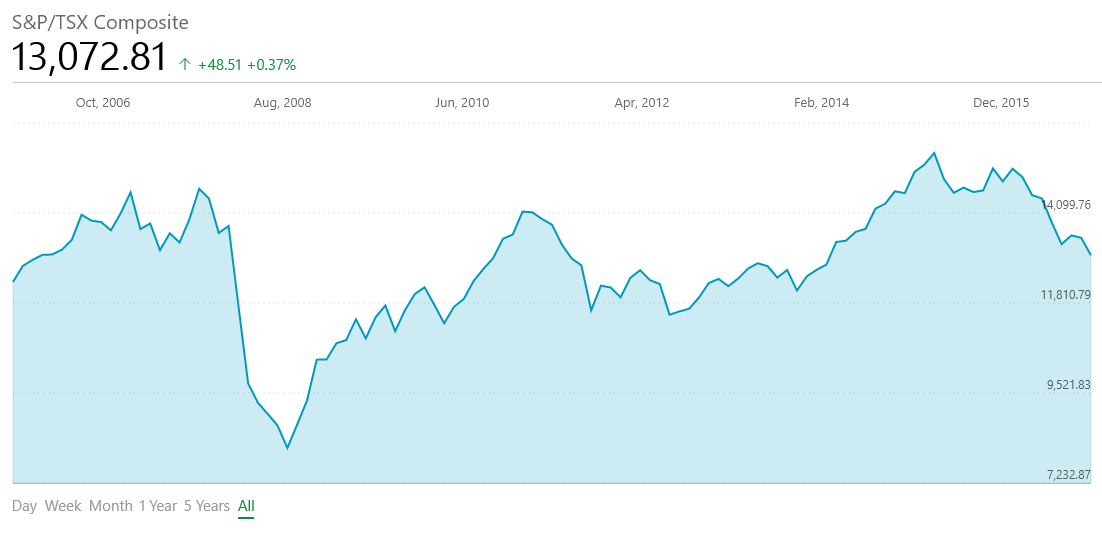
Though it has recovered substantially since the lows of early 2009, the TSX is a real underperformer. It’s last high was August of 2014, and since then has simply lost ground. It is also hovering now around its 2011 value.

But this argument has another side. Since 2007, despite lots of volatility, the TSX has barely moved. In February of 2007 the TSX was at 13083, and at close on Friday last week the market was 13024. The engines of Canada’s economic growth from the past few years have largely stalled. Commodity prices have fallen and may be depressed for some time, with exports of everything from timber to copper and iron being reduced significantly. Oil too, as we have previously said, is unlikely to bounce back quickly. Even if oil recovers to around $60, the growth of cheap shale energy will likely eclipse Canadian tar sands, and will not be enough to restart some previously canceled projects.


MSCI EM Chart
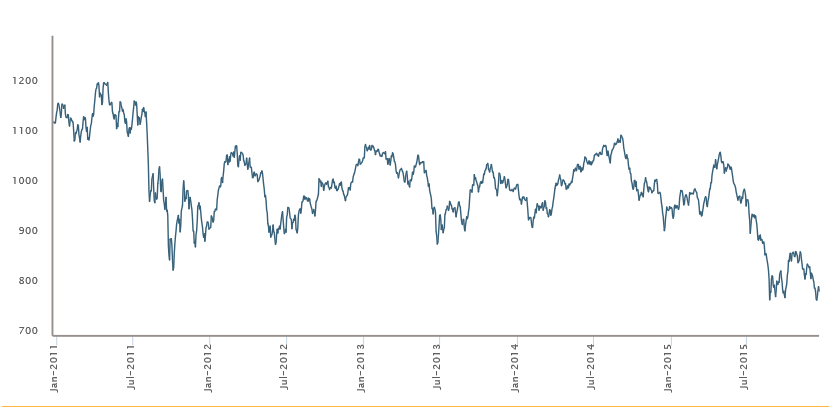
MSCI EM: The MSCI Emerging Markets index has shown solid losses this year, but has yet to regained it’s last high at the beginning of 2011, and has been sideways and volatile for the past few years.  

Similarly, the Emerging Markets have been badly beaten this year, driving down the MSCI EM Index to levels well below the early year highs. But those levels also reflect the ongoing and worrying trend. The MSCI EM Index (a useful tool to look at Emerging Markets) isn’t just lower than it’s previous year’s high, it’s lower than it was back in 2011, and in 2007. In other words we’ve yet to surpass any previous highs, and when faced with the reality that the United States will likely be raising rates for the next few years, the EM will likely continue to lose investments to safer and higher yielding returns in the United States.


MSCI EAFE
MSCI EAFE: The EAFE has faired better than some others, but closing in on the end of the year we look to be at roughly where we were at the beginning of 2011. The MSCI EAFE Index is a benchmark to measure international equity while excluding the United States and Canada.

In an ideal world a new year would be a chance to wipe the slate clean, mark the previous year’s failings as in the past and move forward. But what drives markets (in between bouts of panic selling and fevered buying) are the fundamentals of economies and the companies within them. So as celebrations of December 31st give way to a return of regular business hours, investors should temper any excitement they have about last year’s losers becoming the new year’s winners. The ground has shifted for the Canadian economy, as it has for much of the Emerging Markets. Weaknesses abound as debt levels are at some of their highest and global markets have largely slowed.

It is a core belief that investors should seek “discounts”. The old adage is buy low and sell high. That advice holds, but investors should be wary as they walk the tightrope between discounted opportunities, and realistic market danger. Faced with a world filled with worrying trends and negative news an even handed and traditional approach to investments should be at the top of every investor’s agenda for 2016.

Is Liquidity Worth the Price?

LiquidityLiquidity is a sacred cow among the investing professional class and the importance of being able to sell and redeem an investment at a moment’s notice is a cornerstone of presumed investor safety and a hallmark of modern investing. In fact, improving liquidity has been a goal of markets and it’s a major achievement that there isn’t a commonly held mutual fund, ETF or stock that can’t be sold at the drop of a hat.

But in the same way that we can overemphasize the benefits of some health trends to the point of excluding other good for you foods, (I’m looking at you gluten free diet) the assumed exclusive positive benefits of liquidity can crowd out some very reasonable reasons to seek investments with low or limited liquidity.

Why would you choose an investment that can’t be sold easily? It’s worth pointing out all the ways that liquidity make investing worse. Volatility is increased by liquidity. High frequency trading, ETFs and trading platforms that let novice investors monitor the ups and downs of the market provide liquidity while magnifying risk. Sudden events best ignored become focal points for sell-offs. Liquidity is almost always the enemy of cooler heads.

HFT

Liquidity also costs money. For investments that are traditionally illiquid, like some bonds and GICs, redeemable options often trade at a discount. According to RBC’s own website the difference between a redeemable and non-redeemable GIC is 25 bps ( a quarter of 1%), which doesn’t sound like much, but when rates are as low as 1.5% for a five year GIC that is a 16% reduction in return.

Picture of the early Dutch stock market

The principle of investing has been that buying and holding something over a period of time would result in returns in greater excess than the rate of inflation. That rate of return is based on the associated risk of the enterprise and how long the investment should be held for. But into this mix we have also come to value (greatly) the ease with which we can walk away from an investment. It is the underpinning of a stock market that your commitment to a corporate venture need not be you, but that your financial role can be assumed by someone else for a price (your share).But that feature has come to dominate much of what we both value and hate about investing. Canadians are relieved to know that can sell their investments on short notice, protecting them from bad markets or freeing up cash for personal needs. But by extension things like High Frequency Trading use that same liquidity to undermine fair dealings within markets.

Are there reasons to not choose a liquid investment (aside from your house)? I think the answer is yes. For one thing we may put an unnatural value on liquidity. We pay for its privilege but we rarely use it wisely. The moment we are tempted to use liquidity to our advantage we usually make the wrong choice. Selling low and buying high are the enemy of smart investing, but all too often that is exactly what happens. Every year DALBAR, a research firm, publishes a report detailing investor behavior and its results are sobering to say the least.

Poor investor decisions have led to chronic underperformance by “average investors”. The inability to separate emotions from investing, and the ease with which changes can be made have led to meager returns. In the 2014 study showed that the “average investor” 10 year return was a paltry 2.6%, nothing compared to the return of most indices. That return got surprisingly worse over time, with a 2.5% annualized return over 20yrs and 1.9% over 30. Reduced liquidity could inadvertently improve returns for investors by simply removing the temptation to sell in poor markets; in those moments when our doubt and emotions tell us to “run”.

This is from the 2014 DALBAR QIAB, or Quantitative Analysis of Investor Behavior.

So what types of investments are typically “illiquid”? Such products are normally reserved for “accredited investors”, or investors that have higher earnings or larger net savings. These deals are traditionally considered riskier and would be unsuitable for a novice investor (unfamiliar with the risks) or ill-suited to someone who might need to depend on their savings on short notice. That makes a lot of sense and any manager worth their salt would tell you that you shouldn’t tie up your savings if you might need them. But it is worth considering whether we have let our obsession with the convenience of liquidity undermine our goals as investors. Something to consider next time the urge to sell in bad markets comes upon you.