
The Interest Rate Awakens

Janet Yellen
Janet Yellen, of California, President Barack Obama’s nominee to become Federal Reserve Board chair, testifies on Capitol Hill in Washington, Thursday Nov. 14, 2013, before the Senate Banking Committee hearing on her nomination to succeed Ben Bernanke. (AP Photo/Jacquelyn Martin)

Today could be a big day. Today the Federal Reserve might finally raise interest rates.

If it does it will be the first time it has done so since 2006. Interest rates, which are precisely nobody’s preferred choice of water cooler conversation, are now the subject of such intense focus it’s hard to know whether we are making too big a deal of them, or not enough of a big deal.

To review, interest rates are used to either stimulate spending or increase savings. If rates are low, we argue that borrowing is cheap and it makes sense to spend money. If rates are high and it costs more to borrow, then people and businesses are likely to save. By this process we can increase or decrease the “cost” of money. Interest rates are therefore considered important in moderating an economy. If the economy is overheating and inflation is rising, raising interest rates should put a damper on it. If the economy is worsening or in recession, lowering rates could inspire companies to spend rather than save and encourage large purchases.

During 2008, in addition to bailouts and massive stimulus packages to the economy, the Federal Reserve in the United States heavily relied on the key interest rates to help stem the problems of the housing and banking crisis. Interest rates went from 5.25% in 2006 to 0.25% in 2008. And they’ve stayed there ever since.

US Fed Fund Rate
A short history of the Fed Fund Rate – since late 2008 the rate has been close to 0%


Officially the rate hasn’t moved up, although the Fed has “tightened” credit to the market. Slowing down its bond buying program and ending QE has helped nudge up long term borrowing costs. But eight years on the official interest rate is still near zero, effectively emergency levels, and the economy is (supposedly) vastly improved. So why hasn’t it moved before?
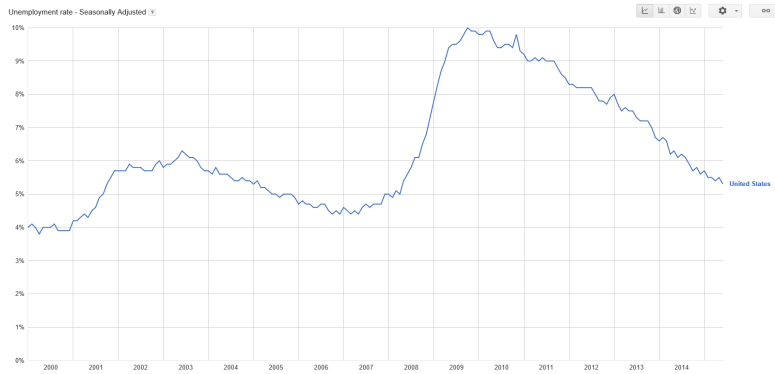
US unemployment
The US unemployment rate has dropped significantly. However there are lingering concerns that while there are fewer people now unemployed, many people are no longer looking for work and have dropped out of the labour force.


There is no simple answer to that question. Markets have been nervous, inflation expectations haven’t been met, the USD has risen too fast, unemployment has been too high, the global economy too weak; all of these reasons and more.
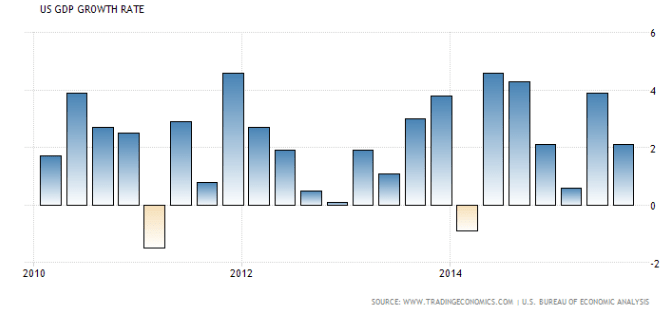
US GDP Growth
While it has fluctuated, US GDP growth has been reasonably strong, easily outpacing other global economies of the developed world.


But in the background has been a looming fear. That interest rates can’t stay at zero forever. That borrowing can’t be cheap forever. That if the market tumbles again we will have little room to maneuver. That eventually we will have to face significant inflation (and therefore significant interest rates). Those fears seem to have finally won over the largely dove-ish Federal Reserve.

But I want to posit a different thought with our readers. That maybe rates don’t matter as much as we like. Economies are large and complicated things. We only measure what we think is important and traditionally we’ve had to go back and reassess what makes economies work, especially in the face of serious recessions. Where once the Gold Standard was thought to underpin a strong economy, not a single country today relies on it. Where economies were thought to need to correct and businesses fail to right a recession, today we encourage large government spending. Where as we once thought that interest rates shouldn’t be factored into recessions, they are now our first line of defence.

Across the world interest rates are at historic lows to stimulate spending. The BoC recently suggested that interest rates could go negative, a startling and worrying sign for the Canadian economy, especially after two rate cuts this year. But behind this there must be some recognition that the use of interest rates to spur on an economy is at best logarithmic. Like slamming your foot on the gas pedal of a car the most power is delivered early on, not as the pedal reaches the floor.

Logs
Unlike exponential growth, logarithmic growth has a limit that it can not surpass.


And so it can be said that perhaps interest rates, currently at all time lows maybe don’t matter that much at all. Maybe you can’t trick people into spending money. Maybe there are limits to what we can do to help an economy. Maybe we have yet to truly identify what ails our economies.

I am of the opinion (in case you haven’t noticed) that the rise of big data may not foretell a future where we can know everything. Far from it, the abundance of data is at best showing that there is still much we don’t know. If the Fed hikes rates today, moving the rates up by 1/4 of a percent, I doubt that there will be any significant change to the economy. It will take years before we approach anything close to “normal” rates at around 2% or higher. In short, a rising rate today will likely mean more symbolically than it does tangibly to the economy.
Throwing Cold Water On Investor Optimism (Not That We Needed Too)

Screen Shot 2014-09-30 at 2.41.51 PM
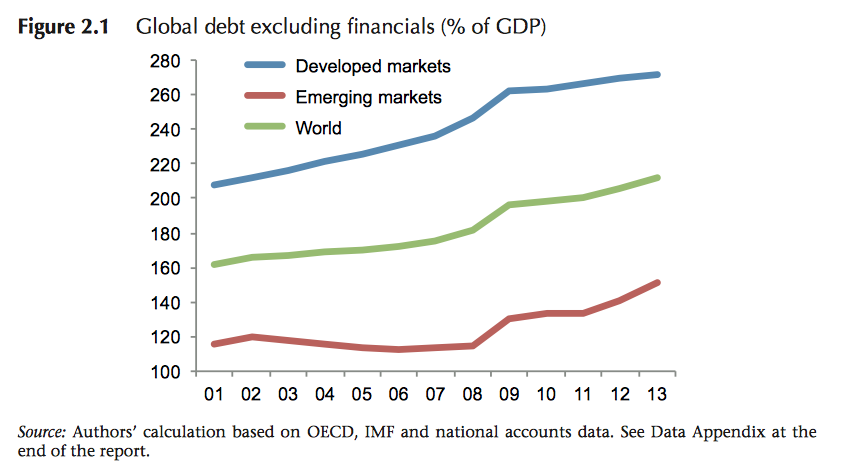
From The Geneva Report

Yesterday the 16th Geneva Report was released bearing bad news for everybody that was hoping for good news. The report, which highlighted that debt across the planet had continued to increase  and speed up despite the market crash of 2008, is sobering and seemed to cast in stone that which we already knew; that the global recovery is slow going and still looks very anemic.

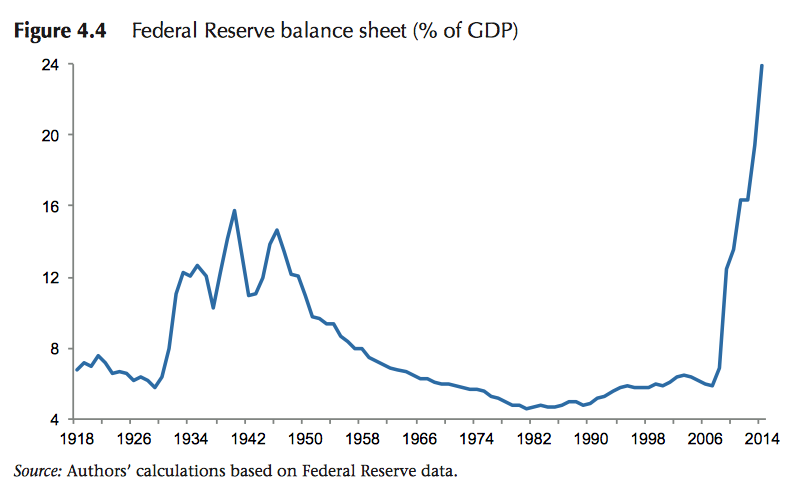
The report is detailed and well over a hundred pages and only came out yesterday, so don’t be surprised if all the news reports you read about it really only cover the first two chapters and the executive summary. What is interesting about the report is how little of it we didn’t know. Much of what the report covers (and in great detail at that) is that the Eurozone is still weak, that the Federal Reserve has lots of debt on its balance sheets, but that it has helped turn the US

A look at the Fed's Balance Sheet from the Geneva Report
A look at the Fed’s Balance Sheet from the Geneva Report

economy around, that governments have been borrowing more while companies and individuals borrow less, and that economic growth in the Emerging Markets has been accompanied by considerable borrowing. All of this we knew.

What stands out to me in this report are two things that I believe should matter to Canadian investors. First is the trouble with low interest rates. Governments are being forced to keep interest rates low, and they are doing that because raising rates usually means less economic growth. But as growth rates have been weak, nobody wants to raise rates. This leads to a Catch-22 where governments are having to take direct measures to curb borrowing because rates are low, because they can’t raise rates to curb borrowing.

This has already happened in Canada, where the Bank of Canada’s low lending rate has helped keep housing prices high, mortgage rates down and debt levels soaring. To combat this the government has attempted to change the minimal borrowing requirements for homes, but it hasn’t done much to curb the growing concern that there is a housing bubble.

The second is the idea of “Economic Miracles” which tend to be wildly overblown and inevitably lead to the same economic mess of overly enthusiastic investors dumping increasingly dangerous amounts of money into economies that don’t deserve it just to watch the whole thing come crashing down. Economic miracles include everything from Tulip Bulbs and South Sea Bubbles to the “Spanish Miracle” and “Asian Tigers”, all of which ended badly.

The rise of the BRIC nations and the recent focus on the Frontier Markets should invite some of the same scrutiny, as overly-eager investors begin trying to fuel growth in Emerging Markets through lending and direct investment, even in the face of some concerning realities. It’s telling that the Financial Times reported both the Geneva Report on the same day that the London Stock Exchange was looking to pursue more African company listings, even as corruption and corporate governance come into serious question.

All of this should not dissuade investors from the markets, but it should be seen as a reminder about the benefits of diversification and it’s importance in a portfolio. It is often tempting to let bad news ruin an investment plan, but as is so often the case emotional investing is bad investing.

I’ve added an investment piece from CI Investments which has been floating around for years. It pairs the level of the Dow Jones Industrial Average  with whatever bad news was dominating the market that year. It’s a good way to look at how doom and gloom rarely had much to do with how the market ultimately performed. Have a look by kicking the link! I don’t want to Invest Flyer


***I’ve just seen that the Globe and Mail has reported on the Geneva Report with the tweet “Are we on the verge of another financial crisis” which is not really what the report outlines.