When Only One Thing Matters

iStock-968895338.jpg

In my head is the vague memory of some political talking head who predicted economic ruin under Obama. He had once worked for the US Government in the 80s and had predicted a recession using only three economic indicators. His call that a recession was imminent led to much derision and he was ultimately let go from his job, left presumably to wander the earth seeking out a second life as political commentator making outlandish claims. I forget his name and, so far, Google hasn’t been much help.

I bring this half-formed memory up because we live in a world that seems focused on ONE BIG THING. The ONE BIG THING is so big that it clouds out the wider picture, limiting conversation and making it hard to plan for the future. That ONE BIG THING is Trump’s trade war.

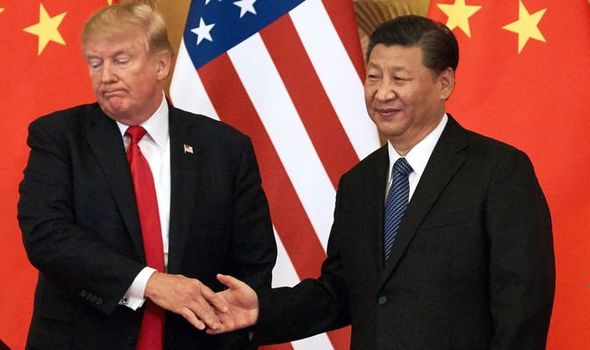
I get all kinds of financial reports sent to me, some better than others, and lately they’ve all started to share a common thread. In short, while they highlight the relative strength of the US markets, the softening of some global markets, and changes in monetary policy from various central banks they all conclude with the same caveat. That the trade war seems to matter more and things could get better or worse based on what actions Trump and Xi Jinping take in the immediate future.
Donald-Trump-Xi-Jinping-1127037

Now, I have a history of criticizing economists for making predictions that are rosier than they should be, that predictions tend towards being little more than guesses and that smart investors should be mindful of risks that they can’t afford. I think this situation is no different, and it is concerning how much one issue has become the “x-factor” in reading the markets, at the expense of literally everything else.

What this should mean for investors is two-fold. That analysts are increasingly making more useless predictions since “the x-factor” leaves analysts shrugging their shoulders, admitting that they can’t properly predict what’s coming because a tweet from the president could derail their models. The second is that as ONE BIG THING dominates the discussion investors increasingly feel threatened by it and myopic about it.

This may seem obvious, but being a smart investor is about distance and strategy. The more focused we become about a problem the more we can’t see anything but that problem. In the case of the trade war the conversation is increasingly one that dominates all conversation. And while the trade war represents a serious issue on the global stage, so too does Brexit, as does India’s occupation of Kashmir (more on that another day) , the imminent crackdown by the Chinese on Hong Kong (more on that another day), the declining number of liberal democracies and the fraying of the Liberal International order.

This may not feel like I’m painting a better picture here, but my point is that things are always going wrong. They are never not going wrong and that had we waited until there were only proverbial sunny days for our investing picnic, we’d never get out the door. What this means is not that you should ignore or be blasé about the various crises afflicting the world, but that they should be put into a better historical context: things are going wrong because things are always going wrong. If investing is a picnic, you shouldn’t ignore the rain, but bring an umbrella.
181025-Tani-Republican-Party-Press-tease_zr23lf

The trade war represents an issue that people can easily grasp and is close to home. Trump’s own brand of semi-authoritarian populism controls news cycles and demands attention. Its hard to “look away”. It demands our attention, and demands we respond in a dynamic way. But its dominance makes people feel that we are on the cusp of another great crash. The potential for things to be wiped out, for savings to be obliterated, for Trump to be the worst possible version of what he is. And so I caution readers and investors that as much as we find Trump’s antics unsettling and worrying, we should not let his brash twitter feuds panic us nor guide us. He is but one of many issues swirling around and its incumbent on us to look at the big picture and act accordingly. That we live in a complex world, that things are frequently going wrong and the most successful strategy is one that resists letting ONE BIG THING decide our actions. Don’t be like my half-remembered man, myopic and predicting gloom.

Information in this commentary is for informational purposes only and not meant to be personalized investment advice. The content has been prepared by Adrian Walker from sources believed to be accurate. The opinions expressed are of the author and do not necessarily represent those of ACPI.

What’s Next? (And When Will It Happen)

economyis bad

Talk of recession is in the air and amongst my clients and readers of this blog the chief question is “when”?

Ever since Trump was elected, questions about when “it’s going to happen” have been floating about. Trump, an 800-pound gorilla with a twitter addiction, has left a predictable path of destruction and the promise of more chaos always seems on the horizon. It should not be surprising then that investors have been waiting with bated breath for an inevitable correction.

Those predicting imminent doom got a little taste of it last week when markets convulsed and delivered the worst day of the year so far, shedding a dramatic 800 points off the Dow Jones. Globally the news hasn’t exactly been stellar. Germany, Italy and France are all showing a weakening economic outlook, which is to say nothing of Great Britain. Despite three Prime Ministers and two deadline extensions, the nation has yet to escape its Brexit chaos and is no closer to figuring out what to do about Northern Ireland. China too is facing a myriad of problems. Trump’s tariffs may be making American’s pay more for things, but it does seem to be hurting the Chinese economy. Coupled with the persistent Hong Kong protests and its already softening market, last week the Chinese central bank opted to weaken the Yuan below the 7 to 1 threshold, a previously unthinkable option aimed at bolstering economic growth.

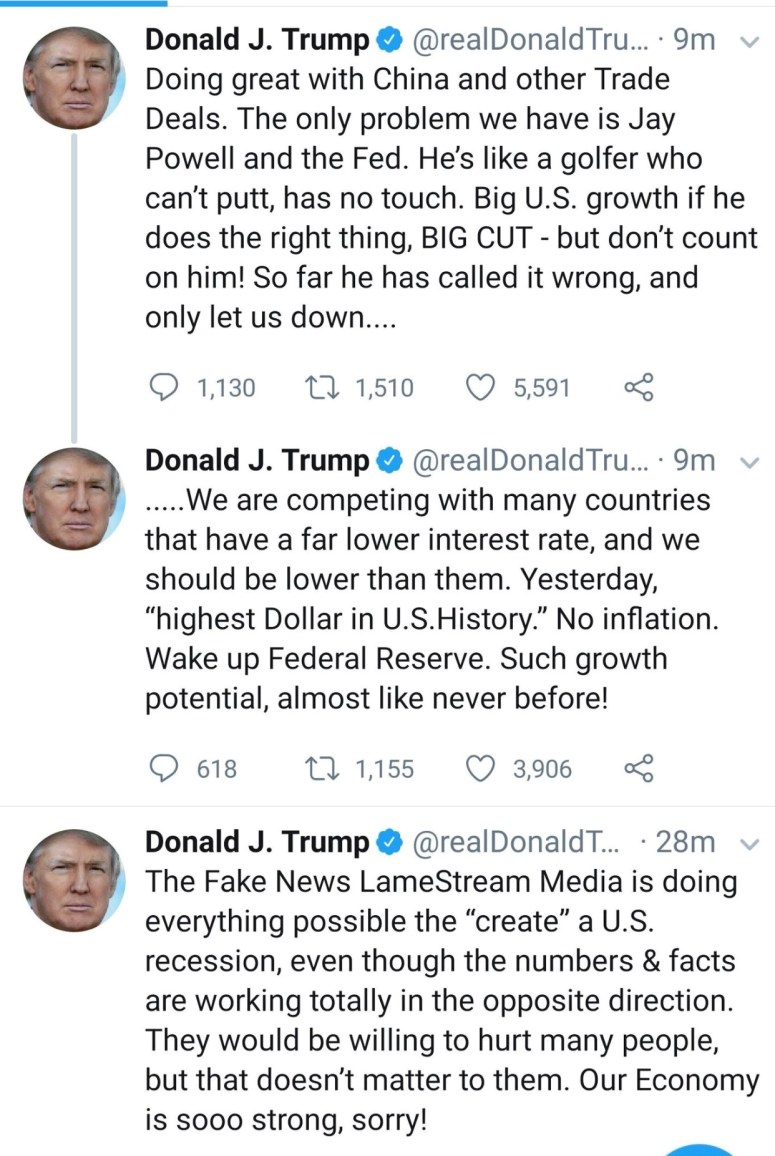
In all of this it is the American economy that looks to be in the best shape. Proponents of the “U.S. is strong” story point to the historic low unemployment and other economic indicators like consumer spending and year over year GDP growth. But this news comes accompanied with its own baggage, including huge subsidies for farmers hit by Chinese import bans and other trade related self-inflicted wounds. This issue is best summarized by Trump, who himself has declared that everything is great, but also now needs a huge rate cut.

Trump TweetThe temptation to assume that everything is about to go wrong is therefore not the most far-fetched possibility. Investors should be cautious because there are indeed warning signs that the economy is softening and after ten years of bull market returns, corrections and recessions are inevitable.

But if there is an idea I’ve tried to get across, it is that prognostication inevitably fails. The real question that investors should be asking is, “How much can I risk?” If markets do go south, it won’t be forever. But for retirees and those approaching retirement, now ten years older since the last major recession, the potential of a serious downturn could radically alter planned retirements. That question, more than “how much can I make?”, or “When will the next recession hit?”, should be central to your conversations with your financial advisor.

As of writing this, more chaotic news has led Trump to acknowledge that his tariff war may indeed cause a recession, but he’s undeterred. The world is unpredictable, economic cycles happen, and economists are historically bad at predicting recessions. These facts should be at the center of financial planning and they will better serve you as an investor than the constant desire to see ever more growth.

So whether Donald Trump has markets panicked, or a trade war, or really bad manufacturing numbers out of Germany, remember that you aren’t investing to do as well as the markets, or even better. You’re investing to secure a future, and ask your financial advisor (assuming it isn’t me) how much risk do you need, not how much you’ve got.

Information in this commentary is for informational purposes only and not meant to be personalized investment advice. The content has been prepared by Adrian Walker from sources believed to be accurate. The opinions expressed are of the author and do not necessarily represent those of ACPI.
Making Kids Money Smart, Reprise

Little girl withdrawing money form ATM with help of mother.

Some time back I had written about how we could better prepare children to handle money responsibly, how to help establish good financial habits and why that was important. You might have thought that banks would have played a role in that education, but I failed to talk about them and what positive (and negative) aspects they can play when it comes to a child’s money intelligence.

In theory banks should be the obvious first stop when it comes to talking about money and yet they rarely are. They may not even be helpful. This is partly because banks have long since given up being a waystation for protecting money from the general economy. While banks themselves have always had a central part to play in lending and growing the economy, the roll of doing that off the back of people who are housing their savings for a rainy day has been replaced by the desire to more quickly facilitate economic activity. Whereas banks were once a speedbump on the road to making a purchase, today they occupy the chief role of facilitating that purchase. No one would dare deposit money with a bank that did not provide debit cards, credit cards and easy online financial transactions.

Being money smart though has a lot more to do with instilling patience and setting goals, not immediately reacting to every consumer temptation. But a teenager with a bank account is not going to find that he or she is hindered much by their savings account. Furthermore, they are unlikely to see the benefits of keeping money in a savings account since there is little growth to be offered. This gives banks a paradoxical role in your child’s financial education, one that offers little incentive to save while facilitating bad financial choices.

For instance, TD Bank offers a Youth Account, a basic savings account for children up to the age of 18. There’s no fees, unlimited transactions per month and minimal interest rates for savers at 0.05%, or 50₡ for every $100. However, a child of 12 will receive a debit card with the Visa Debit system and a daily limit of $25 or $50/day. Meanwhile Scotiabank’s Getting There Savings Account offers similar low fees and minimal interest, but throws in 2 free Interac transactions per month and Scene Reward Points for the movies. The lesson banks teach kids is that putting money in the bank helps buy things they want whenever they want it.

For parents who opened an account for their children when they were small it may be a surprise that banks will send teens and pre-teens bank cards. And even approaching a bank about what can and cannot be done with a bank card may not offer up much help. I went to three separate banks to ask about their youth accounts and was frequently met with several “umms” and “ahhs” when I pressed for details. At one bank I was assured that even though the bank card was a “Visa Debit” that card could not be used to buy items online (which is what the Visa Debit system does). When I pressed for confirmation that this was the case the person disappeared to consult with other employees before returning and confirming that online purchases would be allowed. Financial limits are also not particularly inspiring. A $25 limit per day totals pretty quickly, and parents may not realize what that money is going towards since online purchases can be easily overlooked.

And yet.

This is also the system that we live in. Children should be raised to understand that there will be few breaks when it comes to making bad financial choices. Banks and credit card companies will happily provide debt to those who can barely afford it and defend themselves with impenetrable multi-page legal documents. Engaging with this system is essential to beating it.

So what can parents do?

As I wrote back in 2015 the best course of action is to do planning with kids to help establish good habits. Giving kids an allowance in exchange for chores isn’t a bad idea, but it might make more sense to both expand the money that is given, and then set up automatic withdrawals to cover expenses. Rather than receive $20/week as an allowance, consider $50/week and automatically take $30 back for RESP contributions. Or up it even further and charge them room and board. The experience of seeing financial responsibilities coming ahead financial luxury would establish a good habit of the real costs of living.

Another idea would be to sit and plan the purchase of a large item together that a child wants. Maybe it’s a video game system or a subscription of some kind. Go through the budgeting process together and figure out how many weeks it would take to get the item while also factoring money in that time for usual expenses like eating out with friends and going to movies (people still go to the movies right?). Invariably good budgeting forces us to question what we’re doing and whether it makes sense, so the action of picking an item and working towards it will go a long way to either validating those wants or rethinking what to do with that cash.

If you can convince your child to save and budget, help them as well consider alternative things to do when it comes time and they’re tempted to spend the money they were meant to be saving. Budgeting should help provide a passage to success and being left home alone while their friends are out having a good time will be hard.

Lastly, take your kids to the bank and have a meeting with someone together about the ins and outs of their youth account. Parents should know what is and is not allowed and not assume that simply because they opened the account 8 or 9 years ago, they understand what that account does or does not allow.

Financial planning remains an unpopular pastime, and few enjoy the responsibility of dealing with money. This may have more to do with how out of control Canadians feel with regard to their expenses and how much debt we carry. But as parents we should be looking for every opportunity to teach our children some of the bitter truths about money, debt, banks and budgets. Nobody else is.

As always, if you have questions about fees, performance or your financial future, please don’t hesitate to give me a call or send a message.

Information in this commentary is for informational purposes only and not meant to be personalized investment advice. The content has been prepared  by Adrian Walker from sources believed to be accurate. The opinions expressed are of the author and do not necessarily represent those of ACPI.

The Cost of Advice

Everyone’s focused on the cost of investing, they should be looking at the cost of not having help.

iStock-1058690454

I regular question I receive is whether fees are to high. This isn’t a perplexing question, it always makes sense to see whether you could, or perhaps should, be paying less. But from a financial planning perspective the questions seem to dominate an awful lot of initial meetings that I have.

For clarity, I think its important to point out that within my own practice we’ve done a lot to increase transparency about our fees and have done what we can to make costs explicit and earn our keep. Years ago, while working for a mutual fund company, I was shocked to learn that some advisors never wanted their clients to know how they were getting paid, or how much. This always struck me as a poor business practice and given the public focus on the expense of financial advice means that I’m not alone in that assessment.

The focus on fees has also paid results to investors. While I have no data on Canada, in the United States mutual fund fees have dropped by nearly 50% since 2000. Canada has been following suit (to what degree I don’t know) but I haven’t had a meeting with a mutual fund company in the last few years that hasn’t spent time highlighting the cost of the investments, or a recent cut to MERs. Much of this has been aided by the arrival of ETFs (Exchange Traded Funds) which have also been on a mad rush to cut costs. Today there are even 0% cost ETFs, although the true costs of those products remains opaque.

And yet, much of this seems like a secondary problem. Costs have rapidly dropped but little attention is being paid to more worrying trends. Investors do badly without help, and financial advice is worth a great deal more than the cost of receiving it.

Dalbar 1

The 2019 Quantitative Analysis of Investor Behavior is the most recent annual report produced by Dalbar (Dalbar is an independent provider of business practices in the financial space – you can learn about them HERE), which looks to compare investor behavior against market returns. Produced annually the report stretches back decades and its findings are conclusive. People do badly as investors, and frequently stay just ahead of inflation and well behind market returns. For instance, in 2018 the S&P 500 had a -4.38% return, while the average equity fund investor averaged -9.42%, and the Average Equity Index Fund Investor returned -7.22%.

Dalbar 2

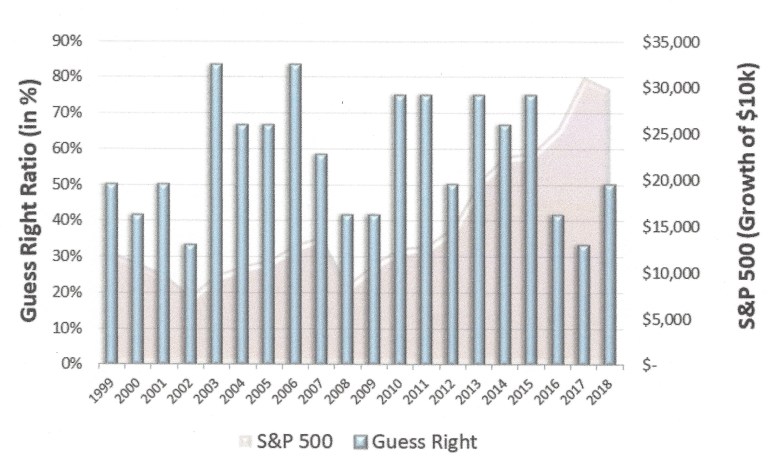
These results speak for themselves, but it shows that the greatest enemy to maximizing investor returns are not the fees, but the behavior of investors. Even when investors hold low cost index ETFs, they still underperform markets. The reasons for this are complex, but have much to do with the human mind and its limitations in facing an uncertain future (best captured by the growing field of behavioral economics). A good example of his is found in the report’s Guess Right Ratio, a ratio based around the inflows and outflows of funds to determine how often investors have correctly anticipated the direction of the market. You might be surprised to learn that investors have guessed correctly 50% of the time over the last 13 years, but that guessing right didn’t translate into more money, since investors guessed wrong in a larger magnitude than they ever guessed right (in other words people made bigger bets when guessing wrong) and one wrong guess would wipe out months of correct bets.

Dalbar 3

If there is a place where investors and advisors need to improve, it is how much work is being done for investors at all. The rise of “Robo-Advisors” seemed to solidify a type of investor experience, one in which 75% of investors admit to only communicating with their advisor once or twice a year, and up to 68% never spend more than an hour with their advisor a year, and 31% of investors have never discussed their investment goals. That gap seems one worth closing, and one that cannot be capably done through automated systems, or through impersonal financial practices. The cost of good financial planning seems to be worth it if it improves your returns, gives you comfort in your long term planning and helps make your retirement a success.

As always, if you have questions about fees, performance or your financial future, please don’t hesitate to give me a call or send a message.

Information in this commentary is for informational purposes only and not meant to be personalized investment advice. The content has been prepared  by Adrian Walker from sources believed to be accurate. The opinions expressed are of the author and do not necessarily represent those of ACPI.

Brexit & My Writer’s Block

TTLNZGXBMZHEJERP6DP2AOTYVU

I hate to admit it, but I’m stuck.

I have writers block, and not being a professional writer have had no experience to force myself through it.

Time and again I sit down to write something, only to find that the subject has changed, some new development has altered the facts and the effects are so sudden that I have to discard everything that I thought I was going to write and start over.

Its demoralizing.

Take Brexit for instance. Several times I’ve sat down to write something on it, but Brexit is now best explained like a Homeric poem, involving political intrigue, shadowy figures manipulating citizens for their own ends, and battles for leadership. That’s not how this began, but over time a politically mismanaged attempt to lance a populist boil from within the conservative party ranks has metastasized into a full blown crisis. To date Brexit has cost two Prime Minister’s their job, it has left one of the oldest democratic institutions in complete gridlock and has fractured the two leading political parties in Britain.

Currently the Tory party in England is choosing the next head of the party (and next Prime Minister of the country) with high expectations that it will fall to a man who spent the bulk of the Brexit campaign lying about the benefits of a leave vote and who had no intention that his side should actually win.

stream_img
This is Boris. Boris is a politician. Here is Boris standing in front of a bus with a promise to put more money in the NHS if Britain votes to leave the EU. Boris was lying about putting this money into the NHS. Lie Boris lie

Meanwhile the core issues surrounding Brexit remain unresolved. So badly has this been handled that the British government has been granted two extensions so they don’t leave the EU without a deal (which would be bad for everybody). However having been granted those extensions Britain remains no closer to resolving the core matters that divide the various camps of various Brexiteers.

I could go on like this for some time, but there are whole books written about Brexit now (I recommend “A Short History of Brexit” by Kevin O’Rourke), covering in far greater detail all of the issues surrounding the attempts to leave the EU, how it has come about as a movement, and why the problems remain intractable and will likely not end well.

What I think we are witnessing is how political issues become political crises, and how it becomes increasingly difficult to predict what happens next. In functioning democracies political disputes resolve in a compromise in which neither group gets precisely what they want but recognize that not reaching a compromise would be worse. Today’s current political climate has become anathema to compromise and various groups would rather risk everything and get nothing than lose some of their standing. Historically this hasn’t been a good sign for countries.

Currently Brexit is scheduled for October 31st. That extension was granted because Theresa May had begun negotiating with Jeremy Corbyn (another populist) and the Labour Party to find votes for her Brexit deal. This negotiation looked to find votes for May’s existing deal with the EU, which would have resolved the issue surrounding the Irish border and kept Britain in the Common Market while also opening the door to a second referendum. Her party balked at this treachery and thus ended her tenure as PM. Boris Johnson, the man currently on track to replace Theresa May has said that he wouldn’t “rule out” proroguing parliament if MPs attempted to block a “No Deal” or “Hard Brexit.” I imagine that the EU wonders why it has invested all the time it has trying to help the UK.

All of this is silly, dangerous and maddening. For investors it means that there continues to be a ticking time bomb on the global stage, and like Donald Trump and his tariffs, anything could happen. And amazingly it continues on unabated, no closer to a compromise and no closer to a solution.

Hopefully this means I’m over my writers block.

“The opinions expressed are those of the author and may not necessarily be those of Aligned Capital Partners Inc (ACPI).  ACPI is regulated by the Investment Industry Regulatory Organization of Canada (www.IROC.ca) and member of the Canadian Investor Protection Fund (www.CIPF.ca).  This commentary is for general information only and not meant to be personalized investment advice.”

Wealth in all Stages of Life

597EF3CB-F153-4C43-8AF5-7093721039FA

My associate, Kimber, frequently points out that my bookshelves contain a number of real “downer” books on death. She’s not wrong: I have an abiding interest in what it means to grow old and how we die. My bookshelves creak under the weight of Greek and Roman philosophy texts, medical studies about aging, and financial guides for estate planning and preparing heirs. This interest goes back years for me, as part of a philosophical question about what it means to not just live, but also die well.

I’m not alone in this seemingly macabre fascination. Many others, including other philosophically minded people, ask similar questions regarding the difference between being rich and being wealthy. In simple terms, being rich is relatively easy (okay, maybe not easy – but certainly easier to define) while being wealthy asks us to consider what it is that makes us happy beyond material acquisition.

In one respect, this has been the great achievement of Western societies. By enshrining a key number of rights and making them central to our society, we have removed barriers to free association, free movement, freedom of religion and freedom from oppressive institutions. To get up every morning and know that the government isn’t going to seize your lands, punish you for your beliefs or race, or force you to pick up and flee your home in the night is the path towards building wealth. It’s possible to be rich in China, but it is not possible to be wealthy in the same way.

Being wealthy in life also grants the possibility of being wealthy in death. To know that your affairs are in order, to choose what happens to your physical remains, to be able to bequeath in confidence your assets to another generation and even help your children or grandchildren are all things that, until relatively recently, did not always reside in one’s control.

When we were choosing our new trade name, I briefly toyed with the name Walker FINANCIAL Management. But given our 25 year history, the things we’ve helped people do or try to do, limiting our scope to merely the finances of our clients seemed narrow and imprecise. While its true that my role in people’s lives is to help accumulate and save, my job is to help people save for things. I manage money so that children can get an education without leaving school encumbered by massive debt;to help people buy homes and pay down mortgages faster; to help families travel; to help retirees enjoy their time free from worry; and even to facilitate one generation helping another. We’re in the wealth business, not the financial business.

Which brings me back to my abiding interest in dying. I periodically like to point out that we, as a society, are getting older. Demographically, we will feel the effects of a population age across multiple aspects of our society. From health care to real estate, our greying society will challenge us in unique and surprising ways. How we face those challenges will determine how well we preserve our wealth, and it will mean tackling tough questions around independence, lifestyle, and even death.

So, while Kimber looks at my bookshelf and thinks I’m a bit of a downer, I look at it as the next big stage in building and preserving wealth. That’s why we’re Walker Wealth Management of ACPI.

If you have questions about wealth and aging, please give us a call! We can provide retirement planning, help you to find good solutions for Wills, Trusts, and Estates, and walk you through the different questions you should consider when considering passing on assets to heirs.

The Exciting New Field of Recession Prognostication

PsychicI wish to inform you about an exciting new profession, currently accepting applicants. Accurate recession prognostication and divination is an up and coming new business that is surging in these turbulent economic times! And now is your chance to get in on the ground floor of this amazing opportunity!
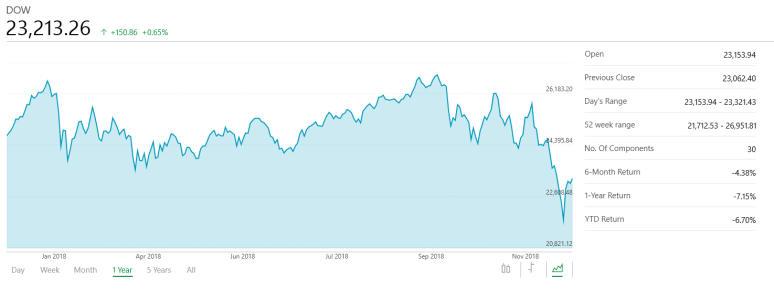
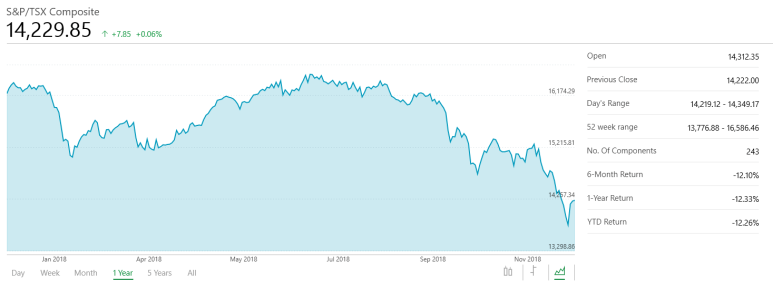
I am of course being facetious, but my satire is not without precedent. As 2018 has devolved into global market chaos, finally losing the US markets in October, experts have been marshalled to tell investors why they are wrong about markets and why they should be more bullish.

Specifically analysts and various other media friendly talking heads have been trying to convey to the general public that the negative market sentiment that has driven returns down is misplaced, and have pointed to various computer screens and certain charts as proof that the economy is quite healthy and that in this moment we are not facing an imminent recession. Market returns through the final quarter of 2018 indicate this message has yet to find fertile ground among the wider public.

Dow Jones Dec 31
The Dow Jones has had a wild ride this year, with significant declines in February, October and finally in December when the markets ended the year lower than they began.

While these experts, analysts and financial reporter types may not be wrong, indeed the data they point to has some real merit, I don’t think that investors are wrong to heavily discount their advice. For the wider investing audience, being right 100% of the time is not a useful benchmark to strive towards with investments ear-marked for retirement. Instead a smarter approach is to be mindful about risks that can be ill-afforded. Investment specific risk, like that of an individual stock may be up to an investor (how much do I wish to potentially lose?). On the other hand, a global recession that is indiscriminate in the assets that suffer may be more risk than an investor can stomach.

TSX Dec 31
The S&P TSX has had another dismal year, and is currently lower than it was in 2007, marking a lost decade. Making money in the Canadian markets has been a trading game, not a buy and hold strategy.

The experts have therefore made two critical errors. The first is assuming that what is undermining investor confidence is an insufficient understanding of economic data. The second is that there is a history, any history, of market analysts, economists and journalists making accurate predictions of recessions before they happen.

This last point is of particular importance. While I began this article with some weak humor on prognostication and divination, it’s worth noting that predicting recessions has a failure rate slightly higher than your local psychic and lottery numbers. That so many people can be brought forth on such short notice to offer confident predictions about the state of world with no shame is possibly the worst element of modern investment culture that has not been reformed by the events of 2008.

2008 Predictions vs reality
These are the economist predictions for economic growth at both the start of Q3 and Q4 in 2008. Even as the collapse got worse, economists were not gifted with any extra insight. 

This doesn’t mean that investors should automatically flee the market, listen to their first doubt or react to their gut instincts. Instead this is a reminder that for the media to be useful it must think about what investors need (guidance and smart advice) and not more promotion of headline grabbing prognostication. The markets ARE down, and this reflects many realities, including economic concerns, geopolitical concerns and a host of other factors outside of an individual’s control. It is not a question of whether markets are right or wrong in this assessment, but whether good paths remain open to those depending on market returns.

A Canadian Story of Woe


drowning
A Canadian homeowner going for a relaxing swim in his mortgage…


One of the challenges of being a financial advisor is finding ways to convey complex financial issues in simple ways to my clients and readers. I believe I do this to varying degrees of success, and I am informed of my failures by my wife who doesn’t hesitate to point out when I’ve written something boring or too convoluted.

One such subject where I feel I’ve yet to properly distill the essential material is around the housing market. While I’ve written a fair amount about the Canadian housing market, I feel I’ve been less successful in explaining why the current housing situation is eating the middle class.

In case you’re wondering, my thesis rests on three ideas:

1. The middle class as we know it has come about as a result of not simply rising wages but on sustained drops in the price of necessities.
2. The rise of the middle class was greatly accelerated by the unique historical situation at the end of the Second World War, which split the world into competing ideological factions but left the most productive countries with the highest output and technological innovation to flourish.
3. A global trend towards urbanization and a plateauing of middle-class growth has started reversing some of those economic gains, raising the cost of basic living expenses while reducing the average income.

The combination of these three trends has helped morph housing from an essential matter of accommodation into a major pillar of people’s investment portfolios and part of their retirement plan. The result is that homeowners are both far more willing to pay higher prices for a home in the belief that it will continue to appreciate into the future, while also attempting to undercut increases in density within neighborhoods over fears that such a change will negatively impact the value of the homes. In short, stabilizing the housing market is getting harder, while Canadians are paying too much of their income to pay for existing homes. All of this serves to make the Canadian middle class extremely vulnerable.


Household Debt
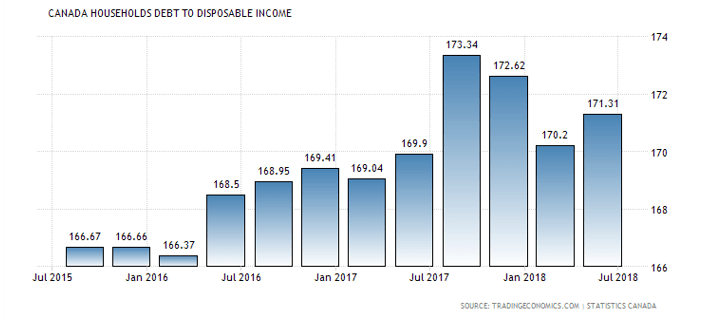
You may be tempted to think “Wow, debt levels really jumped through 2016” you should remind yourself that this chart STARTS at 166%!!!


Proving some of this is can be challenging, but there are some things we know. For instance, we know that Canadians are far more in debt than they’ve ever been before and the bulk of that debt is in mortgages and home equity lines of credit (HELOC), which means much of that debt is long-term and sensitive to hikes in interest rates. We also have abundant evidence that zoning restrictions and neighborhood associations have diligently fought against “density creep”. But to tie it all together we need the help of HSBC’s Global Research division and a recent article from the Financial Times.

FT Global Leverage

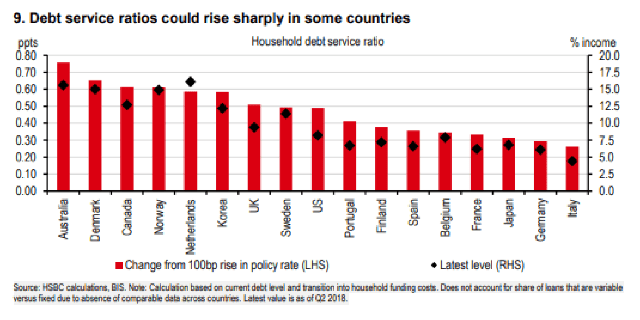
Last week, HSBC issued a research paper on global leverage. Providing more proof that since 2008 the world has not deleveraged one bit. In fact, global debt has settled just over 300% of global GDP, something that I wrote about in 2016. An interesting bit of information though came in terms of the country’s sensitivity to increasing interest rates. Charting a number of countries, including Canada, the report highlights that Canadians (on average) pay 12.5% of their income to service debt. A 1% increase in the lending rate would push that up over 13%. For a country already heavily in debt, a future of rising rates looks very expensive indeed.

It would be wrong to say that fixing our housing market will put things right. There is no silver bullet and to suggest otherwise is to reduce a complex issue to little more than a TED Talk. But the reality is that our housing market forms a major foundation of our current woes. A sustained campaign to grow our cities and reduce regulatory hurdles will do more to temper large debts that eat at middle-class security than anything I could name.

Beware the Rally

*At the time that I wrote this markets had just finished several positive sessions, however by the time it was ready markets had once again changed directions!

US-STOCKS-DOW JONES-RECORD

I’m going to potentially embarrass myself and go on the record as saying we shouldn’t place too much trust in the current market rally, though the upturn is welcomed.

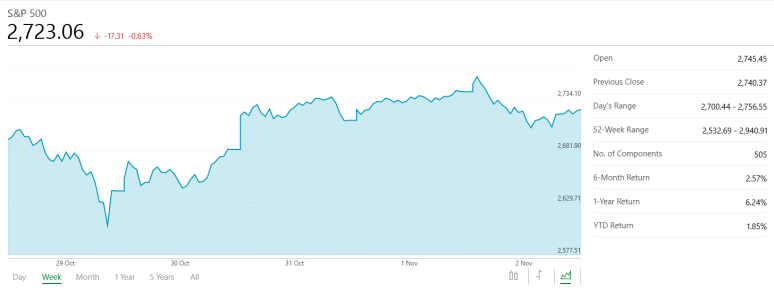
Rallies present opportunities for potential short-term gain, and with markets having shed roughly 10% over the month of October, there is certainly money to be made if you’re feeling sufficiently opportunistic and have a plan. For the rest of us, the rally is a welcome break the punishment the market has been delivering, and an opportunity to see portfolios stabilize and regain some ground.

S&P 500 Rally

The long-term viability of a rally, its ability to transition from opportunistic buying to sustained growth, very much depends on the fundamentals of that rally. Are markets sound, but oversold? Or are fundamentals deteriorating and represents more hopefulness than anything else?

Readers of this blog will not be surprised to find out I have no set answer to this question. As always, “it depends”. But as I look over the news that has supposedly rekindled the fire in the markets much of it seems at best temporary, perhaps even fanciful. Up against the wall of risk that investors are currently starring down, the best news currently available is that Trump had a phone call with Xi Jinping and has asked for a draft to be prepared to settle the trade disputes between the two countries.

FGIS_fig_2

I’m of the opinion that a recession isn’t imminent, but it should be obvious that recessions happen and the longer we go without one, the more likely one becomes. That seems especially true in a world that is undergoing a seminal shift when it comes to international trade and multilateral deals. To take one example, in the last year U.S. soybean exports to China have dropped by 97%, with no exports for the last quarter. This is a trade war still in its infancy. Other market data is mixed. Even as job growth exceeds expectations it will also keep the Fed raising rates. Housing starts have dropped significantly below expectations, driven in part by rising costs.

image002_0

All this is to say that market rallies like the one we’ve just seen should be treated with trepidation. Investors should be cautious that a bottom has been reached and that this is a good time to rush into the market looking for deals, and we should keep an eye on the fundamentals. Rallies falter precisely because they can be based more on hope than on reality.

So what should investors do if they want to invest but are unsure about when to get into the markets? Come talk to us! Give us a call and help get a plan together that makes sense for your needs! Check out our new website: www.walkerwealthmgmt.com or give us a call at 416-960-5995!

The Mystery of Market Volatility

GTY 460643338 A FIN MAX USA NY

This past week markets had a sudden and sustained sell off that lasted for two days, and though they bounced back a little on Friday, US markets had several negative sessions. The selloff in US markets, which began on Wednesday and extended into Thursday, roiled global markets as well, with extensive selling through Asia and Europe on Wednesday evening/Thursday morning. At the end of the week Asian, European and Emerging markets looked worse than they already were for the year, and US markets had been badly rattled. This week has seen an extension of that volatility.

Explanations for sudden downturns bloom like flowers in the sun. Investors and business journalists are quick to latch onto an explanation that grounds the unexpected and shocking in rational sensibility. In this instance blame was handed to the Federal Reserve, where members had been quoted recently talking about higher than expected inflation forcing up lending rates at an accelerated pace. This account was so widely accepted that Donald Trump was quoted as saying that “The Fed has gone crazy”, a less than surprising outburst.

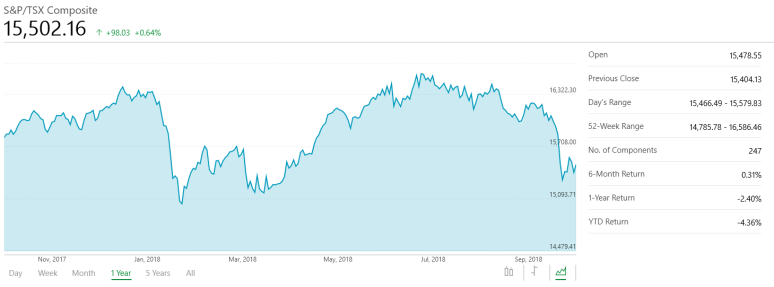
TSX YTD
TSX year to date performance is currently just over -4.3%

I tend to discount such explanations about market volatility. For one, it seeks to neuter the truth of markets as large complex institutions that are subject to multiple forces of which many are simply invisible. Second, by pretending that the risk in markets is far more understandable than it really is, investors are encouraged to take up riskier positions and strategies than they rightly should and ignore advice that has proven effective in managing risk. Finally, I have a personal dislike for the façade of “all-knowingness” that comes along after the fact by people who have parlayed luck into “expertise”. Markets are risky and complex, and it would be better if we treated them like a vicious animal that’s only partially domesticated.

Dow YTD
The Dow Jones performance has been quite good this year, but in the past week lost just over 5%, bringing year to date returns to 2.94%

In fact, as markets continue to grow with technology and various new products, complexity continues to expand. At any given time markets are subject to small investors, professional brokers, pension funds, algorithm driven trading programs, mutual fund managers, exchange traded funds and even governments, all of whom are trying to derive profits.

So what does that tell us about markets, and what should we take from the recent spike in volatility? One way to think about markets is that they operate on two levels, a tangible level based on real data and expectations set by analysts, and another that trades on sentiment. On the first level we tend to find people who advocate for “bottom up investing”, or the idea that corporate fundamentals should be the sole governor of stock’s price. If you’ve ever heard someone discuss a stock that’s “under-performing,” “undervalued,” “out of favor,” or that they are investing on the “principles of value” this is what they are referring to. People who invest like this believe that the market will eventually come around to realizing that a company hasn’t been priced correctly and tend to set valuations that tell them when to buy and sell.

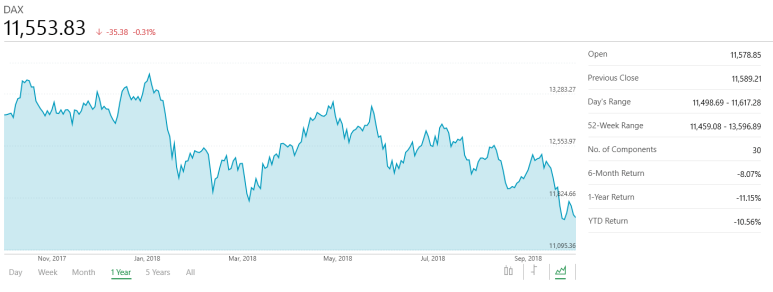
DAX YTD
Germany, the strongest economy in EUrope has already struggled this year under the burden of the EU fight with Italy’s populist government and ongoing BREXIT negotiations. YTD performance is -10.56%

The second level of investing is based on sentiment, informed by the daily influx of headlines, rumour and conspiracy that clogs our news, email inboxes and youtube videos. This is where most investors tend to hang their hat because its where the world they know meets their investments. Most people aren’t analyzing a specific bank, but they may be worried a housing bubble in Canada, or the state of car loans, or the benefits of a recent tax cut or trade war. The sentiment might be best thought of as the fight between good and bad news informing optimism and pessimism. If a bottom up investor cares about a company they may ignore general worry that might overwhelm a sector. So if there is a change in in the price of oil, a value investor may continue to own a stock while the universe of sentiment sees a widespread selling of oil futures, oil companies, refining firms and downstream products.

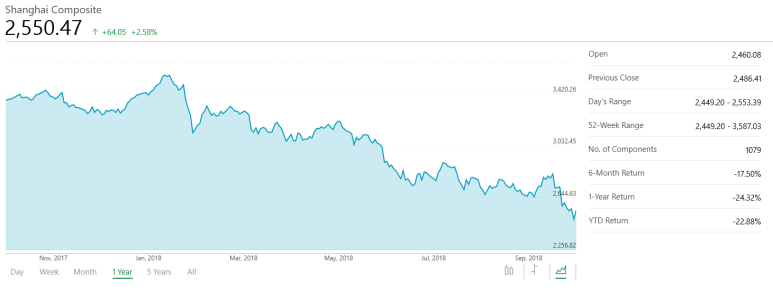
Shanghai Comp YTD
China is the world’s second largest economy and the biggest market among the emerging markets. Having struggled with Trump’s tariffs, YTD performance is a whopping -22.8%

As you are reading this you may believe you’ve heard it before. Indeed you have, as our advice has remained consistent over the years. Diversification protects investors and retirement nest eggs better than advice that seeks to “beat the market” or chases returns. However, it seems to me that the market sentiment is undoubtedly a stronger force now than its ever been before. As more investors come to participate in the market and passive investments have grown faster than other more value focused products, sentiment easily trumps valuations. Since we’re always sitting atop a mountain of conflicting information, some good and some bad, whichever news happens to dominate quickly sets the sentiment of the markets.

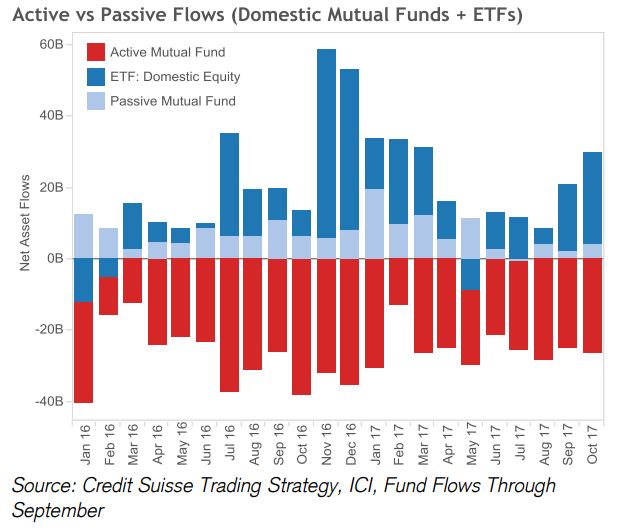
You don’t have to take my word for it either. There is some very interesting data to back this up. Value investing, arguably the earliest form of standardized profit seeking from the market, has remained out of favor for more than a decade. Meanwhile the growth of ETFs has continued to pump money into the fastest growing parts of the market, boosting their returns and attracting more ETF dollars. When the market suddenly changed direction on Wednesday, the largest ETF very quickly went from taking in new dollars to a mass exodus of money, pushing down its value and the value of the underlying assets. At the same time some of the worst performing companies went to being some of the best performing in a day.

MW-FZ971_CSetff_20171211161201_NS
This chart shows that actively managed mutual funds have hemorrhaged money oer the past few years, while passive ETFs have been the chief beneficiaries, radically altering the investment landscape.

So what’s been going on? The markets have turned negative and become much more volatile because there is a lot of negative news at play, not because interest rates are set to go up too quickly. Sentiment, that had been positive on tech stocks like Amazon and Google gave way to concern about valuations, and with it opened the flood gates to all the other negative news that was being suppressed. Brexit, the Italian election, the rise of populism, currency problems in Turkey, a trade war with China and rising costs everywhere came to define that sentiment. As investors begin to feel that no where was safe, markets reflected that view.

Our advice remains steadfast. Smart investing is less about picking the best winner than it is about having the smartest diversification. A range of solutions across different sectors and styles will weather a storm better, and investors should be wary of simplistic answers to market volatility. Markets always have the potential to be volatile, and investors should always be prepared.