2017 – The Year Ahead

dad-jump-2

Many of you won’t know this, but my father used to sky dive. He’d stopped by the time I was born (reportedly because my mom had a natural aversion to life threatening hobbies) but in many ways his hobby would be a reoccurring source of guidance for life lessons.

For instance, whenever I was nervous about doing some BIG THING, my dad would let me know that once you were doing THE BIG THING, your anxiety would drop considerably. Sky divers know this, as they are only nervous until they jump out of the plane, and then get very calm. The fear is in the anticipation, not the actual doing.

2016 had a lot of anticipation, but not an actual lot of doing. Brexit happened, but hasn’t really happened. Donald Trump has been elected, but hasn’t been sworn in. The Canadian housing market continued its horrific upward trend and news stories began to abound about the looming robot job-pocalypse. 2016 was full of anticipation, but little action.

donald-twitterbot2017 will begin to rectify some of these issues. Next week we will see the arrival of President Donald Twitterbot™, finally ending speculation about what kind of president Donald Trump will be and seeing what he actually does. So far markets have been reasonably calm in the face of the enormous uncertainty that Trump represents, but his pro-business posture seems to have got traders eager for a more unregulated market with greater earnings for the future. Right now bets are that Trump might really jump start the economy, but there are real questions as to what that might mean. Unemployment is already very low and inflation looks like it is actually beginning to creep up. Housing prices (amazingly) are back to 2007 levels and the economy seems to be moving into the later stages of a growth cycle.

2017 will likely not be the year that the Canadian housing bubble/debt situation comes crashing down, but its also unlikely to be the year that the situation improves. Economically the short term outlook for Canada is already kind of bad. The oil patch is already running second to a more robust energy story from the United States. Canadian financials had a very healthy year last year, but as we’ve previously written while the TSX was the best returning developed market over 2016, in a longer view it has only recently caught up with its previous high from 2014.

2017 may be the year that automation starts being a real issue in the economy. Already much of Donald Trump’s anger towards globalisation is being challenged by analysis that shows its not Mexico that steals jobs, but robots. But as robots continue to be more adept at handling more complicated tasks there is simply less need for humans to do much of that work. Case in point is Amazon’s new store Amazon Go, currently being opened in Seattle.

While many point to this as Amazon’s foray into the world of groceries (and a better shopping experience) Amazon’s real business is in supply management. The algorithms they use and the new technology they’ve developed are not designed to be one offs, but ways to handle high volumes of business traffic with as few people, and as low a cost as possible. Combined with driverless cars (currently being tested in multiple cities & countries)and our growing app economy, we will be pushing more people out of steady work across multiple sectors of the economy in coming years.

brexit

2017 will also be the year that Brexit will begin, though it will be two years before it is complete. Many people will be watching on how Teresa May’s government handles the Brexit negotiations, how confident England looks on its position, and how hostile or open Europe seems to be to conceding to Britain’s views. Either way it should provide lots of turbulence as it unfolds over the coming years.

But despite all this, there is a kind of calm in the markets. We’ve crossed the line on these issues and there’s nothing to do but continue ahead. Trump will be President Donald Twitterbot™, Brexit will happen, regardless of how many people remain opposed and markets will either go up or down as a response. Perhaps the new normal is a great deal more similar to the old normal than we all thought.

Then again…


Why Apple is a Good Lesson on Investing

Over the last few years some elements of the stock market have seemed fairly crazy. Tech stocks, often belonging to social networking sites like Twitter, have had an unbelievable run. Meanwhile Apple Computers (a favourite of mine) have frequently been heavily criticized for declining revenue growth and slowing sales numbers. Business commentators like to point to the growth in Google’s Android phone platform and its large share of the mobile phone market as proof that Apple’s days as a global leader are past.

However with Apple’s most recent earnings report out there are some important things to take note of. The chief reason that we invest in companies is because they make money, and Apple is currently one of the most profitable companies around. How profitable? Take these statistics published today in Slate.com.

If Apple’s iPhone was it’s own company it would be larger than 474 companies on the S&P 500 index and would have revenues in excess of Amazon, Coca-Cola, McDonalds, Google and E-bay. iphone.png.CROP.promovar-mediumlargeThat’s just its phone division. The iPad, whose sales numbers are definitely plateauing if not declining is still a valuable business netting $5.9 billion in revenues, greater than Facebook, Twitter, Yahoo, Groupon, and Tesla combined. ipad_1.png.CROP.promovar-mediumlargeMac Computers, which earned less than the iPad division, still garnered an impressive $5.5 billion. Even the iPod, now almost totally forgotten in the midst of smartphones and iPads still earned an impressive $442 million, 77% than Twitter’s $250 million in quarterly revenues.

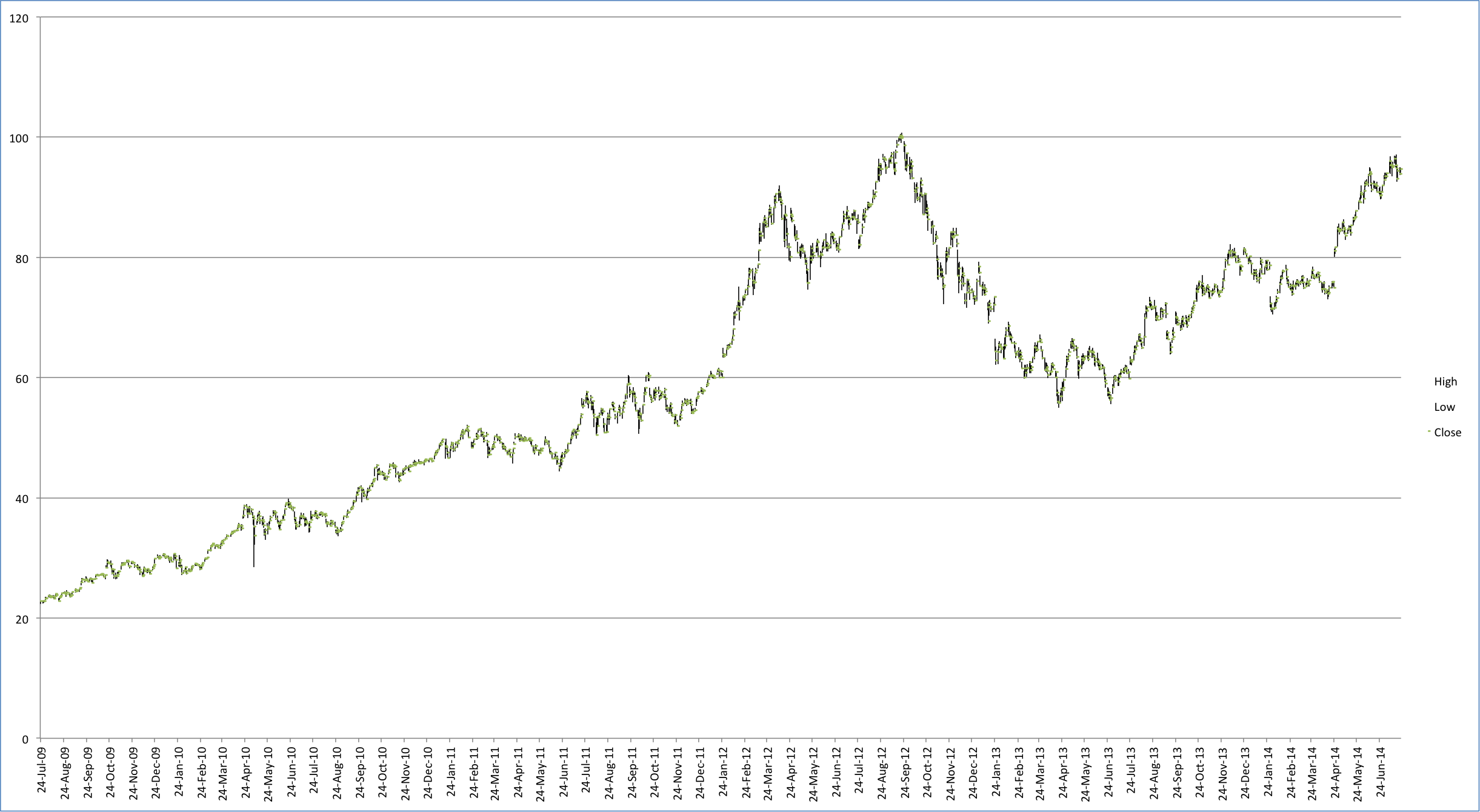
Apple’s stock has periodically taken a licking, but has been beating its way back to its previous high (partly due to a recent stock split and dividends periodically being paid), but its story is an important cautionary tale.

Apple Stock Price
Apple Share Price History

Good investing comes from choosing companies that produce revenue and retain growth potential, in other words focusing on the fundamentals of investing. Despite naysayers, that’s exactly the kind of company Apple has been. So why does Apple get so much negative attention? Because predicting the fall of a Goliath is exactly the kind of thing that makes news. Whether it’s true or not is irrelevant in the news cycle, but it is a source of bad investor advice, and should serve as a cautionary tale to investors considering taking financial advice from business news.

More Proof that “The Facebook” is Probably Terrible for Investors

social-media-logosI have been previously quite critical of the excitement around IPOs and Social Media. My major complaint is that most social media doesn’t make any money, but receive incredible valuations under the assumption that they might make money someday.

The reason for this is that two companies have made money this way, notably Facebook and Google. Both started out as free services with no revenue and have ballooned into mega-businesses busy shoving marketing at you everywhere you turn. This has, in turn, created a market of investors willing to buy into companies that seem to be doing big business for free on the hope that they can eventually turn a profit.

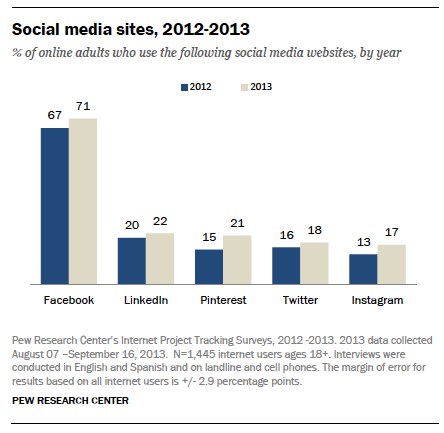
I’m critical here for a couple of reasons. First, there is little guarantee that any of these businesses can actually ever turn a profit. Social media has often been fickle, Myspace was going to be the next big thing until it was ultimately eclipsed by Facebook. And for every “Facebook” there are literally hundreds of other challengers vying for that attention. But how many Facebooks do we need? According to Pew research, not many.

Use of Social Media Sites

Second, how success is judged should be given more scrutiny. Twitter, Facebook and other similar sites get paid by content creators to promote their material. This form of direct marketing (promoting to presumably interested parties) has really to do more with engagement than merely being seen. It’s the idea of engagement that makes these businesses viable platforms. But companies and their marketers have found making something go “viral” notoriously difficult. For every great viral video that turns out to be an ad, almost all the others fail. Estimates range from a 15% success rate, to even less.

Into this fray comes Veritasium, an entertaining science based web series that had an actual look at how Facebook might not be that useful a company to do business with. I’ll let you watch the video without spoiling his point, but I think that if you were looking for a place to spend money and understood how Facebook actually utilized your advertising dollars, you’d think twice.

Don’t Forget to Like This Market Bubble on Facebook!

Say No to FacebookHow much would you pay for something that is free? This is the basic question behind trying to value the many forms of social media that have dominated the business news over the last few years. Pinterest was valued earlier in 2013 at $3.8 billion. It makes no money. In Twitter’s initial pubic offering its share’s rose to over $45, giving the company a value in excess of $30 billion. It also has yet to turn a profit. Linkedin does make money, but it’s valued like a company that makes 100x more than it actually does. Facebook, which does turn a mighty profit, generates that money not from their user base, but from companies trying to engage its user base. While Facebook does have a lot of users, many of them don’t like advertising on their profile and click rates for advertising have been reported as lower than advertising on the web in general.

What we have then is an abnormal situation where investors appear to be willing to pay big money for companies that don’t seem to be even close to making any of that investment back (some companies don’t even seem interested). In contrast companies like Apple have seen huge fluctuations in their share value on the mere speculation that they may not make quite as much money as previously thought.

To my eyes this has all the makings of a market bubble. I’ve written about the absurd way we seem to value internet businesses that don’t make any money before. One theory for these valuations is that these businesses are highly scalable. Adding more users doesn’t cost much more in terms of effort. Other theories include the idea that while many of these businesses may yet to turn a profit, the sheer number of dedicated subscribers means that the business model simply needs to be worked out.

My view on this is that there is a lot of hope attached to a lot of uncertainty. Investment excitement behind companies like Pinterest, Linkedin or Twitter, which have high valuations and little to no earnings, is driven more by a “don’t miss out” attitude. In comparison businesses that have actual earnings, products and market presence are judged far more critically and by more rigorous standards.

I think a good acid test here is what investors are being encouraged to buy compared to say, an actual tech company. In the last few months Google has acquired both robotics maker Boston Dynamic and recently Nest, the innovative thermostat and smoke detector company. Both of these companies make things. Amazing things. None of these things require you to like, share, link to or visit a page. Instead they are making tangible things that people want, or will want. The same is true for Apple computers, Samsung, GM, Toyota, Coca-Cola and Proctor & Gamble.

As investors its important not to lose focus that the ideal investment is one that provides the steak, not just the sizzle.

Is the Internet Making Business Weirder?

Image

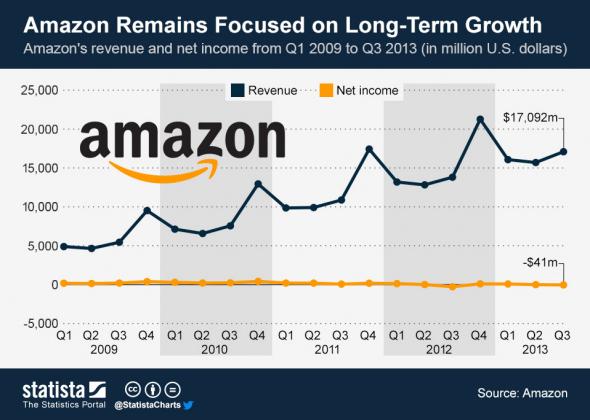
If there is any doubt about whether the internet is changing how we do business I think it is best summed up in the above chart from Statista.com, which highlights both how Amazon continues to grow its sales while simultaneously losing money.

The point here is not to criticize Amazon’s business practices. Its an enormously successful company, but its share price has continued to grow in the face of declining revenues. What other company could operate like this outside of the internet? Apple, who I’ve written about before, is uniquely profitable but is frequently criticized for not growing enough even while it crushes its competitors.

The other way to look at this is whether Walmart would be given similar considerations? Amazon is spending and investing everything that they make, and in the process some of those investments run at a loss. This is good for us, but its rare that the market rewards companies who ignore the shareholder so entirely for the sake of the consumer.

The question of what effect the internet is having on business only gets more confusing when you find out that Pinterest is valued at 3.8 billion with zero revenue and Twitter isn’t expected to make a profit until 2015.