When It Comes to Trump, Investors Must Be Patient

This piece was meant to come out last week before the most recent tariff announcement. It was delayed, but the points it makes remain relevant.

Donald Trump’s actions since taking office have failed to deliver the kind of economic and market stimulation people had been imagining. For many professionals, business owners, and financial analysts, the assumption was that Trump would be good for markets and good for the economy. His other political views, like isolationism, tariffs, and sense of personal grievance weren’t great features, but he would fundamentally be bound by market and economic performance.

That faith eroded quickly as it seemed that Trump was intent on widespread and indiscriminate tariffs, targeting first America’s closest trading partners, and then reciprocal tariffs on the European Union, Great Britain, Australia, and Taiwan. Concerns that this might damage the American economy may have bought time on when those tariffs were to be implemented (as of writing Canadian and Mexican tariffs have been deferred twice, though Steel and Aluminium tariffs have gone ahead) but April 2nd remains “liberation day” according to Trump, a day when America stops getting “ripped off”.

Trump’s administration have pivoted away from the idea that Trump will be good for the immediate economy, and that a “period of transition” is on the way. During his speech to Congress (officially not a State of the Nation) Trump also said that farmers will sell more of their food to Americans, ostensibly a populist message but one more likely grounded in further declines of American agricultural export.

Alongside Trump is Elon Musk, a man who seems possibly genuinely befuddled by the animosity his actions have garnered. Between possible nazi salutes, his outsized time on Twitter, his heading up of D.O.G.E (which he both officially and unofficially runs, for legal reasons), his direct intervention with Germany’s far right party the AFD, and the poor sales of his Tesla cars, TESLA stock has dropped considerably from its highs. Many have thought that this heralds the end of his company, and certainly would deal a blow to his personal fortune, about a third of which is in the form of TESLA stock.

The markets peaked around February 19th, with the S&P 500 up 4.46% since January 1st. The Dow Jones had peaked a little earlier at 5.5%, and the Nasdaq Composite was up 3.86%, all respectable numbers for the first 45 days of a year, especially following a very strong 2024. Over the subsequent weeks markets began losing steam and saw a significant drop. From mid February to March 12th, a period of three weeks, the Nasdaq lost 13.05%, the S&P 500 9.31%, and the Dow 7.16%. Investors were worried, a recession seemed looming, and consumer confidence had plummeted.
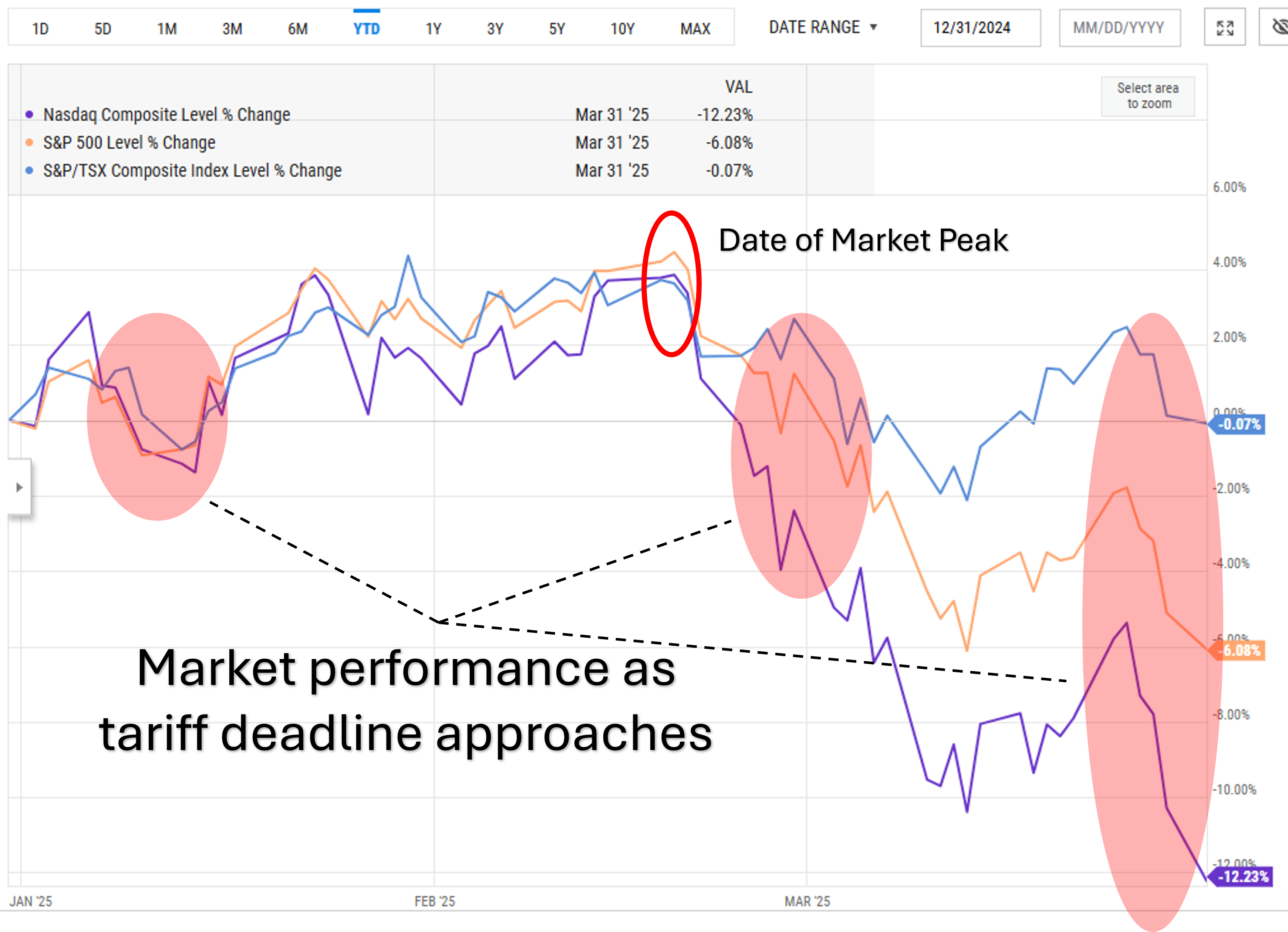
Figure 1Market data provided by Y Charts. Data is until March 31, 2025

Yet only two weeks later markets seemed to have stabilised. Commentators were more confident and expected Trump’s tariffs to be more “focused”. Following some fairly significant government intervention, even Tesla’s shares regained some of their lost ground, and the bond market had retreated as investor enthusiasm seemingly returned. And then, at the end of last week the enthusiasm sputtered once again.

What’s going on?

Whether you support Trump or not, his policies if fully enacted promise to reduce the size of the US economy. His expressed understanding of tariffs, how they work, what they can do, and how easily they can rewrite the global order of trade are objectively poor. Global supply chains are complicated things, and some of the most complicated aspects of them are tied up in semi-conductor manufacturing, making tariffs an expensive tax on top of essential components of the economy. His handling of international relationships has also been poor, and the seeming unravelling of the NATO alliance under his administration threatens not just global security, but also America’s defence industries, particularly the F-35 joint strike fighter, a multi-purpose fifth gen fighter whose economics only worked if it became the standard across NATO. His stated aims of building a coalition to contain China’s global ambitions run counter to his animosity towards global trade. Australia has been slapped with steel tariffs despite having a trade deficit with the United States, all while Australia now does three times as much trade with China as it does with America. Japan and South Korea are rapidly reorienting themselves towards China and seeking better relations with them for protection. The sudden rise of a hostile border force, detaining Canadian and European’s alike, seems to be shrinking the US’s tourism by up to 15%.

But these things have not yet fully come to pass. Trump’s way of engaging with government is dictatorial with a reality show slant. Rarely does he spell out what a policy will be and frequently defaults to the phrase “we’ll see what happens.” This level of uncertainty gives Trump room to maneuver, and allows the market to engage in its most common behavior; optimism. Trump may seem to be heading towards a recession, but there remains a chance he may change his mind. The market sell-off through February and March was not an indictment of Trump’s government. It was a reset on the risk for investors and an opportunity to reevaluate what might happen next. That leaves considerable latitude for Trump’s administration to back away from damaging policies, or double down on them.

Heading into 2025 it looked like the US economy was the strongest globally, and while the early days of the new administration seemed to have changed some of that math, what it means is that there is still lots of different ways that the year could still unfold. The United States may back away from its trade war, claiming victory with whatever concessions can be finagled. Elon Musk might be kicked out of the Trump inner circle, something that would certainly change the calculus about how the government would be run. Voters, which look considerably less impressed with Trump’s early policies, might be so angry that Republican members of the house find the nerve to push back on the administration. There are lots of potential futures.

For investors the challenge is to find a path that will allow them to navigate between the pessimism of Trump’s detractors and the optimism of his own administration. After so many positive years in the markets there is real wisdom in taking some of those profits off the table, and good investment policy hasn’t changed. Given the very strong performance out of the United States for the past five years, its likely that those investments have grown, especially relative to other equity positions. This is a good time to ensure that portfolios are well diversified and that assets are not too concentrated. Lastly, safety is something that should be given real thought to. Rob Carrick of the Globe and Mail wrote a piece arguing that if you need your money in the next five years, you should pull it out now. That advice should be tempered with a conversation with your actual financial advisor, but what all investors should be looking for is a blend of the following:

  1. Enough equities to participate in good markets across the globe.
  2. Enough safety that they won’t panic if markets do worse.
  3. Enough cash to be able to take advantage of bad markets when they come up.

These three principles will look different for everyone, but should be balanced by the amount of risk you can absorb, and the ability to continue to meet your financial goals.

As we get closer to Trump’s “liberation day”, how much of Donald Trump’s policy agenda is well understood by investors is up for debate. According to Bloomberg, as well as some other news sources, retail investors followed a “buy the dip” mentality over March, while big institutional investors backed away. The market is not settled on what is going to happen, and while its tempting to say that little investors might take the biggest losses, there have been many instances of mistakes by large institutional investors. At the same time, there are many reasons to be cautious now. Though markets are off their all-time highs, they remain still at historic levels, and while the news has been quick to discuss “market panics” and “market crashes”, in truth we’ve only gone back to where we were in September. Investors should be on guard that markets can still go in either direction.
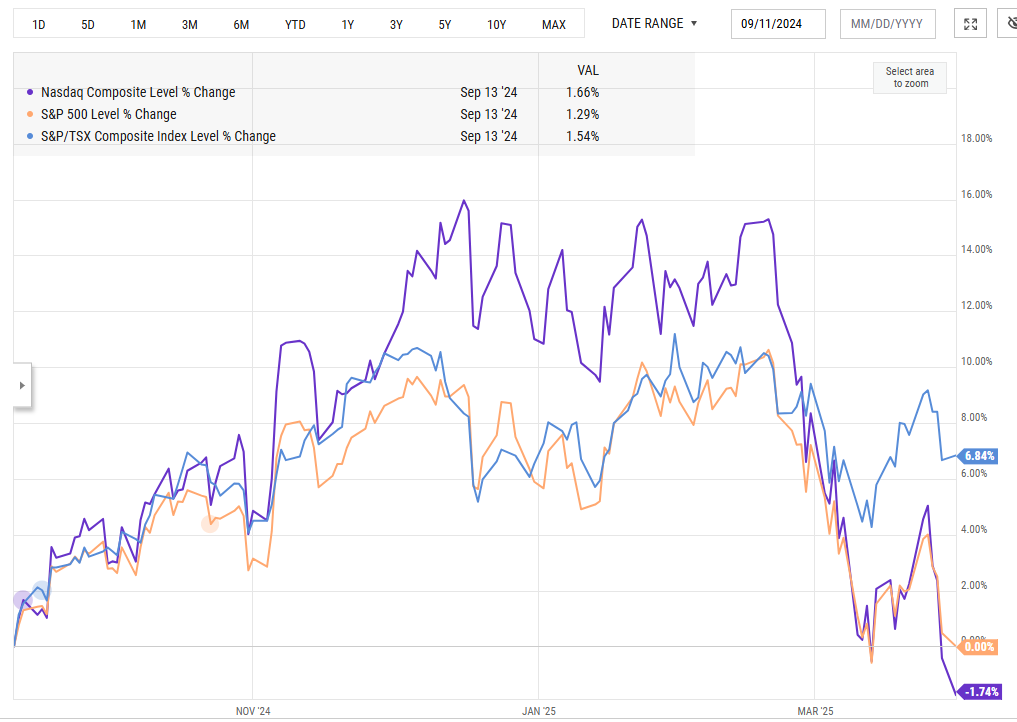
This leads to my final point. Investors will need to show patience in the face of the uncertainty. Followed to their natural ends, as I’ve outlined, many of his most aggressive policies don’t bode well for the future. But many of these policies may simply not come to pass. Markets may surprise people expecting the worst, and our own personal feelings about Trump and his administration’s actions may cloud our judgement about reality. What investors need to be is patient, and prepared.

Aligned Capital Partners Inc. (“ACPI”) is a full-service investment dealer and a member of the Canadian Investor Protection Fund (“CIPF”) and the Canadian Investment Regulatory Organization (“CIRO”).  Investment services are provided through Walker Wealth Management, an approved trade name of ACPI.  Only investment-related products and services are offered through ACPI/Walker Wealth Management and covered by the CIPF. Financial planning services are provided through Walker Wealth Management. Walker Wealth Management is an independent company separate and distinct from ACPI/Walker Wealth Management.

Seriously and Literally

In 2016, Donald Trump supporters said that you should take him seriously, but not literally. His first press secretary, Anthony Scaramucci said “don’t take him literally, take him symbolically.” This defense of Trump was meant to highlight that while he may have said incredibly controversial things, much of that was just talk, and it was his message behind the words that you should really pay attention to.

But Trump himself has contradicted this view more than once, frequently saying “I don’t kid” when challenged on policy (the exact comment came about in 2020 over coronavirus testing). In other words, Trump has let people know that you shouldn’t be surprised when he does do things that seemed initially outrageous. For the wider world this has meant that you should take Trump at his word, and that even if some of his rhetoric is just that, rhetoric, you would be foolish to ignore the substance of his messages.

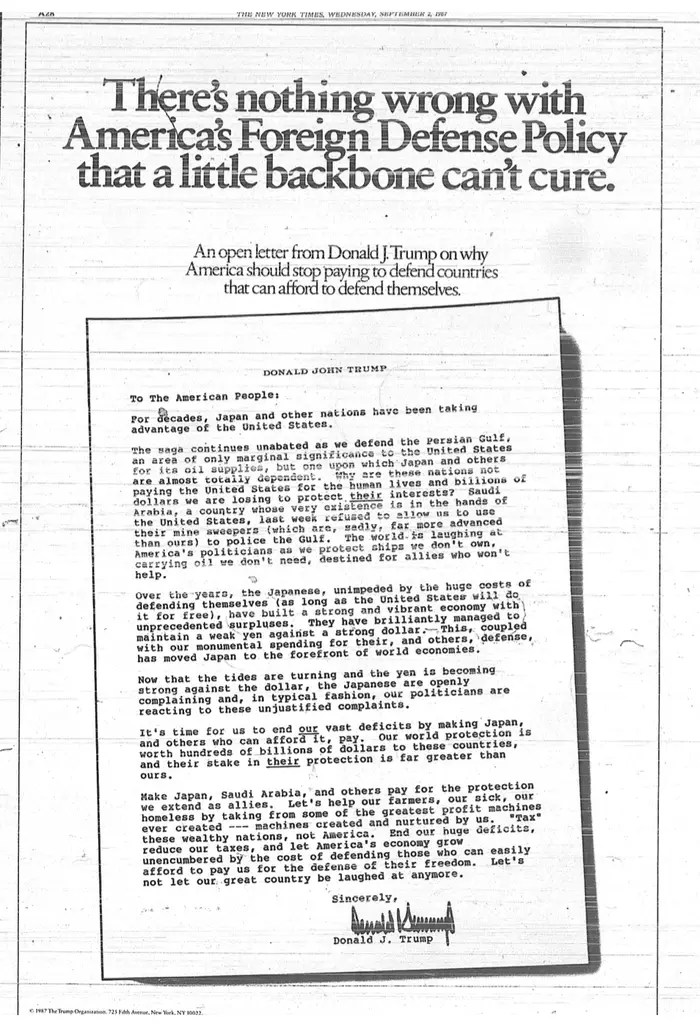
Since his re-election Trump’s focus has been squarely on tariffs, promising them on China (a further 10%), on BRIC nations (100%) and Canada and Mexico (25% each). He’s suggested that some of the tariffs can be avoided for Canada and Mexico over better border controls on drugs and illegal immigrants, but whether this is true is unknown. Political commentators like David Frum have pointed out that Trump’s views on trade have been consistent since his first considered run for the presidency in 1987, that he is hostile to trade and sees it as a zero-sum game.

A close-up of a piece of paper

Description automatically generatedIn 2025 world leaders and policy shapers believe Trump should be taken both seriously and literally. While the current political situation in Canada has been turbulent, the view of the government and provinces is almost unanimous (Quebec and Alberta remain the perennial opponents to joining the band wagon). Doug Ford took the initiative to announce that Ontario could stop energy exports to the US in the event of a trade fight, a position seconded by BC’s premier David Eby.

But in the United States the threat of aggressive and expanding tariffs have also been taken literally, notably by Jerome Powell of the Federal Reserve. On December 18th, in a move that shook markets, Jerome Powell did announce a final rate cut for 2024, but stressed that future cuts were heavily dependent on inflation, which will likely rise if Trump enacts his regime of trading tariffs. Markets were quick to react, and though 2024 will be remembered as a pretty good year for investors, the speed and size of the market sell-off was newsworthy, being the largest since August.

The next morning and markets began on a relatively positive note, continuing a trend of brief panics followed by long yawns as markets simply resume their upward momentum. Little seems to have dissuaded the bull market since 2022 and with the US economy still showing itself to be very strong there’s every chance that the brief panic on December 18th was just that, a moment of panic at the end of 2024. But Trump, like the rest of us, doesn’t live in longer and slower news cycles. Instead market panics live on in social media, and run the risk of coalescing into counter narratives that Trump might hurt the economy more than help it (its notable that the economy has been very strong under Biden, but that didn’t change the perception that Trump had been the better economic steward).

In 2018 Jerome Powell began raising rates to blunt the sharper edges of a hot economy and return interest rates to somewhere near a historic norm. Since 2008 rates had remained at emergency low levels, and there was a genuine concern that markets were becoming addicted to cheap cash. In October of that year Jerome Powell made clear that rate hikes would continue until the Fed felt they’d reached a neutral rate, news not well received by the stock market. From October to the end of the year the S&P 500 lost 18% by December 24th, before rebounding slightly by the New Year. Markets had posted decent returns to the end of September, but wiped out those gains and finished the year -6.24% . During the last months of the year Trump made repeated efforts to pressure Powell to halt or cut rates, often publicly over Twitter.

My opinion is that Trump likes the ambiguity surrounding his pronouncements. Whether he actually intends to implement all the tariffs he’s discussed, whether they are bargaining positions, or whether he can be talked out of them is a grey area that offers him a position of strength. Politicians may be particularly vulnerable to his vagaries since they often wish to protect the status quo while Trump feels free to be a disruptor. But that grey area only works as a negotiating tactic so long as people believe that deals can be reached. If nations come to believe that Trump is serious and literal about tariffs and don’t believe they can be avoided, you are only left with a trade war. Similarly if you are in charge of the Federal Reserve and believe that Trump will do what he says, then you have every reason to pursue positions that curb inflation.

Following Trump’s election Jerome Powell was asked whether he would resign as the Federal Reserve chair, and was clear in his response; he will not, he is not required to leave, and cannot be compelled to. Trump already has a difficult and publicly hostile history with Powell, and its easy to imagine that if Powell is taking Trump seriously, he will move into direct conflict with Trump because of his policies, not in spite of them. Similarly conflict may be around the corner on diplomatic issues for the exact same reason. If Mexico feels it can’t avoid a trade fight with the US, you can assume that Mexico might be less interested in working to curb migrants at the US border. In Canada the same might be true, negotiating with someone who has no intent to make a deal (or honor the one already made) is not likely to build support for concessions.

Today Trump will take office following his inauguration, and he’s expected to sign a number of executive orders kicking off his next term. He has posed as a disruptor, and has nominated a number of other unusual thinkers and people opposed to the status quo to make up his cabinet. Whether they all take those roles and can do what they say they plan too is yet to be seen, but on December 18th we may have gotten some insight into what that future might look like, a future where Donald Trump is taken at his word, both seriously and literally.  

Aligned Capital Partners Inc. (“ACPI”) is a full-service investment dealer and a member of the Canadian Investor Protection Fund (“CIPF”) and the Canadian Investment Regulatory Organization (“CIRO”).  Investment services are provided through Walker Welath Management, an approved trade name of ACPI.  Only investment-related products and services are offered through ACPI/Walker Wealth Management and covered by the CIPF. Financial planning services are provided through Walker Wealth Management. Walker Wealth Management is an independent company seperate and distinct from ACPI/Walker Wealth Management.

Climate Change, Real Estate, & Markets – A Mid-summer Update!

Updates: Climate Change

In his book The Third Horseman: A Story of Weather, War, and the Famine That History Forgot, historian William Rosen recounts the effect of the regional climate change on Europe in the early 1300s. His recounting of the history of Europe (but mostly England) in the wake of the “Little Ice Age” is fascinating and frightening. Political upheaval, inflation and famine are all magnified by the effects of a changing climate, while the uncertainty it brings dramatically alters the European landscape and its political status quo.

The little ice age saw a general cooling across much of Europe, a shortening of the growing season, an increase in heavy rains that flooded land, rendered marginal farmland unusable, and a spiking in grain prices forcing cereals to be sourced from farther away (like the middle east) to feed the northern parts of the continent. It also saw the loss of some industries, like England’s wine producers. The reputation for terrific French and Spanish wines, and the English reputation for drinking them in great quantities is forged in the shadow of the this geographically specific climate alteration.

Until now.

According to the Financial Times Britain is seeing a surge of vineyards opening, as far south as Sussex and as far north as Scotland. In 2023 the country recorded its largest ever grape harvest, while the country’s largest winemaker, Chapel Down, is looking to sell more shares to fund further expansion of its business.

Over the last decade I’ve made the case that climate change is really about water and its predictability. It is interesting to note that in the mass of worrisome predictions, of the potential for war, for famine, and for a less secure and more fragile world, that one of the less expected outcomes might be a change in cultural identity of a whole nation; that one rainy little island may stop being rainy, and undo 700 years of a cultural identity.

Updates: Real Estate

In 2020, one of the first things I wrote in at the beginning of the lockdowns was about the Canadian real estate market, and whether lockdowns and a pandemic might unravel our condo market. Though the lockdowns were long lived, Canadian real estate survived helped in large part by the extension of emergency levels of interest rates. The cost of living crisis and the housing bubble, ever intertwined, got worse, not better.

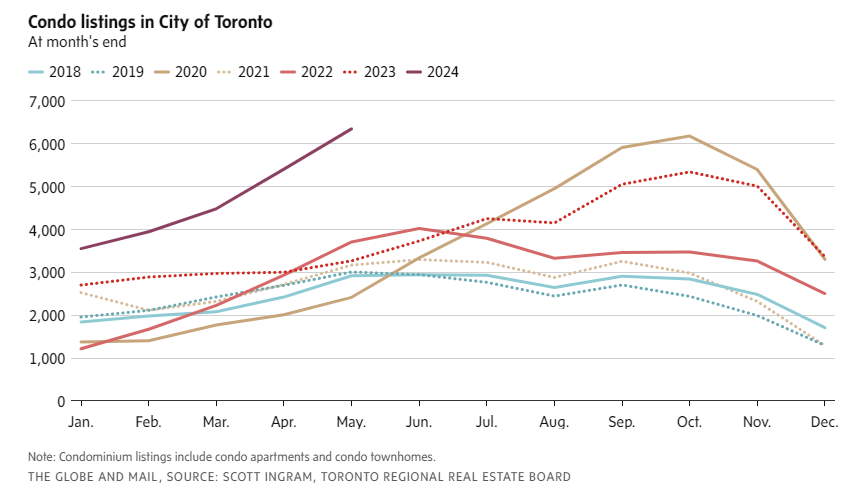
Condo prices reached their peak in January of 2023, and fell back to a current low by late April. Since then prices have fluctuated somewhat, but have been largely range bound. Reported by the Toronto Star on June 14th, “the number of new listings for condos has increased 30% since last May” the bulk of those in the investor size, ranging between 500 to 599 square feet. Urbanation, a trade publication for real estate states “In the past year, unsold new condominium supply increased 30%, rising 124% over the past two years.” In addition “projects in pre-construction during Q1-2024 were 50% presold, down from a 61% average absorption over a year ago, and 85% two years earlier.”

The Globe and Mail wrote on June 29th that “there were 6350 active condo listings in the city, an increase of 94% from the previous May” and that “condo inventory 70 per cent higher than the 10-year average for last month.” The deterioration in the condo market is being felt by existing owners and investors, as well as developers whose per square foot costs run roughly $500 higher than existing condo values.

All this seems to be aligning with a secondary real estate problem; office and commercial real estate. Across the United States as well as Canada office real estate is also struggling. Though not news, employees refusing to return to work and companies downsizing their real estate foot prints has had a significant impact on owners of office space. Banks are unloading office loans, REITs are trying to sell unprofitable assets, and some, like Slate Office RIET just defaulted on $158 million of debt. The story of real estate, once the most unflappable asset an investor could hold, continues to unfold in surprising and worrying ways.

Updates: Markets

With half the year behind us market performance has significantly diverged. US markets, being carried by the strong performance of NVIDIA as well as the handful of usual tech company suspects, have delivered shockingly great results. At the end of June the S&P 500 was up 14.48% so far. An impressive return, but 70% of those returns are from six companies, and 30% of the return is from just one. The S&P 500 Equal Weight return, an index that assigns each company a proportional weight, only has a return of 4.07%. That 70% difference in performance is down to Nvidia, Microsoft, Apple, Amazon, Google (Alphabet), and Facebook (Meta).

Figure 1 Performance data from Y Charts

The concentration of that performance makes the current rally fragile, though curiously other global indices, including Canada, are actually more concentrated than the US. This may account for why the TSX is only up 4.38% for the year, and had briefly dipped as low as 2.66% in June. Canadians are familiar with the feeling of having one of three industries (banking, energy, or materials) often set the tenor of a year’s returns. If the price of oil is climbing or falling, its often immediately reflected in our market index returns. In their own way the S&P 500 has taken on some of these characteristics.

Investors should know that markets continue to offer considerable upside, but those returns are coming from fewer and fewer parts of the economy.

Aligned Capital Partners Inc. (“ACPI”) is a full-service investment dealer and a member of the Canadian Investor Protection Fund (“CIPF”) and the Canadian Investment Regulatory Organization (“CIRO”).  Investment services are provided through Walker Welath Management, an approved trade name of ACPI.  Only investment-related products and services are offered through ACPI/Walker Wealth Management and covered by the CIPF. Financial planning services are provided through Walker Wealth Management. Walker Wealth Management is an independent company seperate and distinct from ACPI/Walker Wealth Management.

Control Your Soul’s Thirst for Freedom

Since late February the bulk of global attention has been focused on the Russian invasion of Ukraine. The invasion remains ongoing, and will likely last for months, potentially even years, and represents the most dangerous geopolitical situation we are likely to face until China tries to enforce control over the South China Seas or invades Taiwan.

But while our attention has been narrowly focused, interest is growing about how the world’s second largest economy is choosing to mange the late stages of the pandemic, a series of choices that have ramifications for much of the world.

China has had mixed luck with Covid. By the end of 2020 it looked as though China might be the only winner economically from the pandemic, but 2021 turned out to be a year for the West. First, Western vaccines, particularly the mRNA vaccines were highly effective, while the Chinese vaccine produced domestically had only a 50% success rate. The Chinese government also was hyper critical of the more effective Moderna and Pfizer vaccines, essentially precluding them from Chinese use. This has left the country in a difficult spot. Chinese mandated lockdowns have been brutal but effective, leading to uneven vaccine use. The low infection rates that the “Covid Zero” policy has delivered has also robbed the country of natural immunity. Today China, already struggling economically, is still locking down whole cities in the hopes of containing outbreaks.

Shanghai is the current major city to be shut down, but the lockdowns are spreading. Complaints about food shortages and people trapped in apartment buildings, offices, and closed off from their places of work have led to some fairly strange places, including protests and at least once the use of “speaking drones” urging citizens to comply with rules and reprimanding the citizens singing in protest one night to “Control your soul’s thirst for freedom. Do not open your windows and sing.”

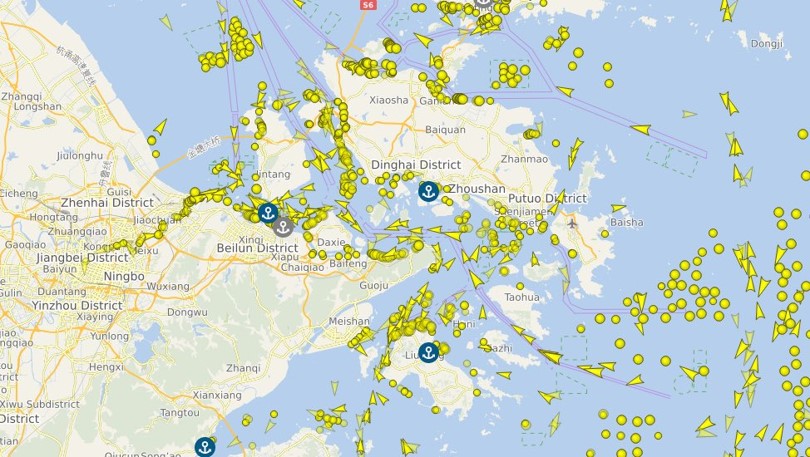
This image came from early April

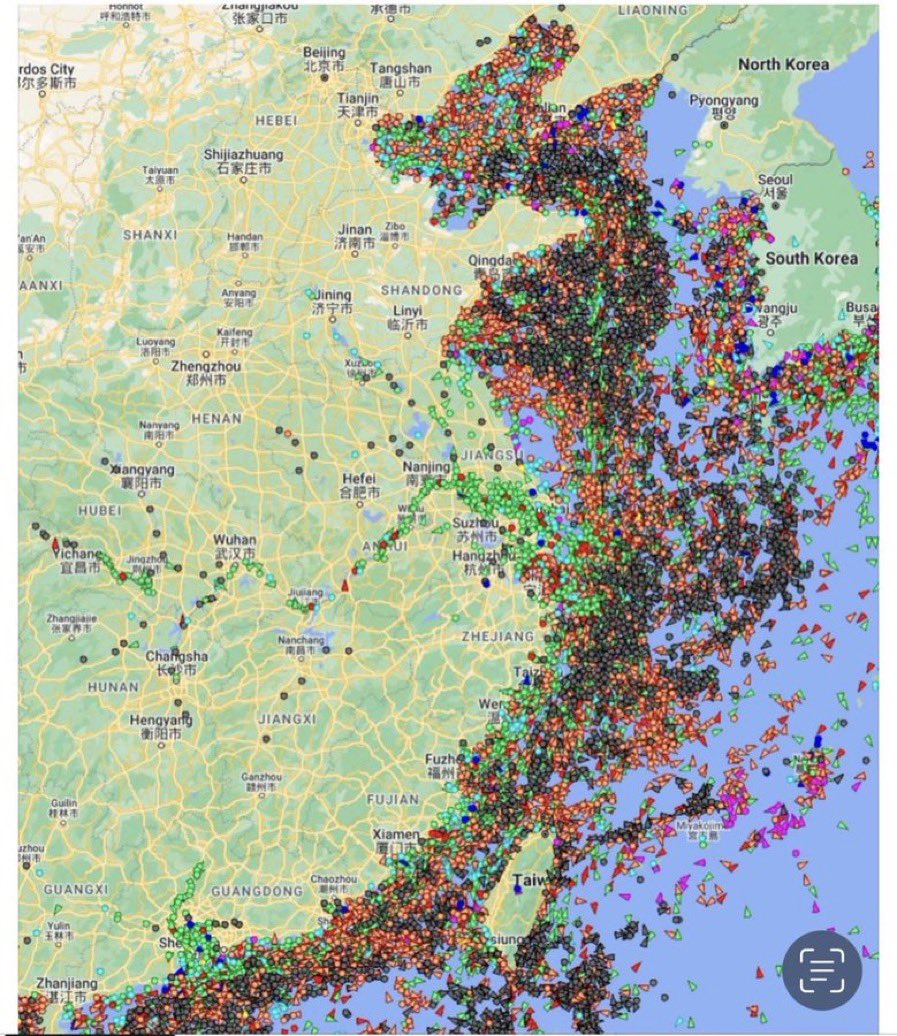
Chinese lockdowns are also worsening global inflation. The supply chain disruptions caused by the most recent lockdowns in Shanghai are dramatic to say the least. In the above picture each yellow dot represents one cargo ship waiting to be docked and unloaded. Supply chains were already deeply stressed when Shanghai went into lockdown last month, and the global impact of further supply disruptions is something we’re very likely to notice.

This image came from early May

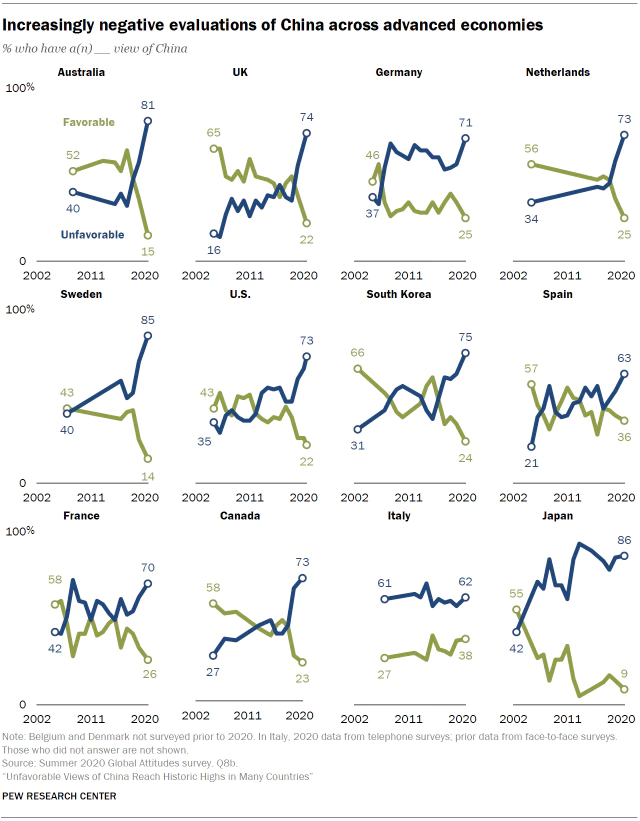
Lastly, some months ago (October 2020) I had detailed how China’s foreign policy, which was heavy handed and often petulant, was angering nations all across the globe. China may not view the world the way its geopolitical rivals do, but its inability to grasp at least what might be considered fair or just by other nations is damaging its own ability to wield soft power, an essential part of being a global hegemon. China’s decision to back Russia in its invasion of Ukraine likely reflected China’s near-term goals of retaking Taiwan and its general contempt for the current world order. However, the global resistance to the Russian invasion, the support shown Ukraine and the barrage of negative publicity (as well as realizing that an untested military in countries with lots of corruption may not be able to score quick military victories) must serve as a wake-up call to China’s ruling class. As of 2022 China seems to have squandered much of its international good will and is unlikely to find many willing allies for its global ambitions.

China seems to be suffering on all fronts. 2021 was a bad year for China’s economy, cumulating in the public meltdown of one of its biggest developers in November. But everything, from its politics to its public health policies are working against it. The world’s second largest economy, one that is the largest trading partner to 130 countries, can’t seem get out of its own way, and as it falters it can’t help but impact us.

Walker Wealth Management is a trade name of Aligned Capital Partners Inc. (ACPI)*

ACPI is regulated by the Investment Industry Regulatory Organization of Canada (www.iiroc.ca) and a Member of the Canadian Investor Protection Fund (www.cipf.ca). (Advisor Name) is registered to advise in (securities and/or mutual funds) to clients residing in (List Provinces).

This publication is for informational purposes only and shall not be construed to constitute any form of investment advice. The views expressed are those of the author and may not necessarily be those of ACPI. Opinions expressed are as of the date of this publication and are subject to change without notice and information has been compiled from sources believed to be reliable. This publication has been prepared for general circulation and without regard to the individual financial circumstances and objectives of persons who receive it. You should not act or rely on the information without seeking the advice of the appropriate professional.

Investment products are provided by ACPI and include, but are not limited to, mutual funds, stocks, and bonds. Non-securities related business includes, without limitation, fee-based financial planning services; estate and tax planning; tax return preparation services; advising in or selling any type of insurance product; any type of mortgage service. Accordingly, ACPI is not providing and does not supervise any of the above noted activities and you should not rely on ACPI for any review of any non-securities services provided by Adrian Walker.

Any investment products and services referred to herein are only available to investors in certain jurisdictions where they may be legally offered and to certain investors who are qualified according to the laws of the applicable jurisdiction. The information contained does not constitute an offer or solicitation to buy or sell any product or service. 16 Past performance is not indicative of future performance, future returns are not guaranteed, and a loss of principal may occur. Content may not be reproduced or copied by any means without the prior consent of the author and ACPI.

Chaos Unleashed

Two weeks ago Russia began its invasion of the Ukraine in earnest. What had begun in 2014 following the ouster of a corrupt pro-Russian government was followed by the annexation of the Crimea and then the fermenting of a civil war in the Donbas region of eastern Ukraine, finally cumulating in his goal of retaking the entire country and bringing it back under Russian purview, most likely in the form of a puppet government.

No one has been more successful at undoing Russian strategic goals than the Russian government. Putin had once hoped to establish a new Warsaw style pact, he hoped to undermine NATO, he’d longed to set up an Eastern European economic zone to compete with the EU. To imagine that any of these goals could today be defined as likely is to dabble in fantasy. His ultimate goal, at least defined by his own comments, was to restore Russia to its previous status as a respected superpower like it was under the Soviet Union. Today it seems as though his army, impressive and large though it is, has already met its match in conventional warfare in the early days of its Ukrainian adventure.

While the military side of his invasion doesn’t seem to be going according to plan, something that must have really taken him by surprise was the resolve he faced globally. Though NATO has said it won’t get involved, weapons are flowing into the country. Nations, like Finland and Sweden whom Russia has treated as extensions of its old empire, are making loud noises that they too would like to join NATO. Germany, long a NATO laggard has promised to increase its military spending above the target 2% of GDP for NATO members. The notoriously neutral Switzerland has said it will freeze Russian assets, and throughout the world condemnation has been swift, especially on the financial front.

In the space of a few days Russia didn’t just find itself diplomatically isolated, but financially as well. The international banking system has been effectively closed to Russia and its central bank, putting a stop on many of its rainy day funds it will need to sustain its campaign. I won’t endeavor to explain the full range of how the global bank sanctions work, as the process is complicated and other better versed people can explain it more succinctly, but the truth is that the Russian state is deeply isolated and in financial chaos.

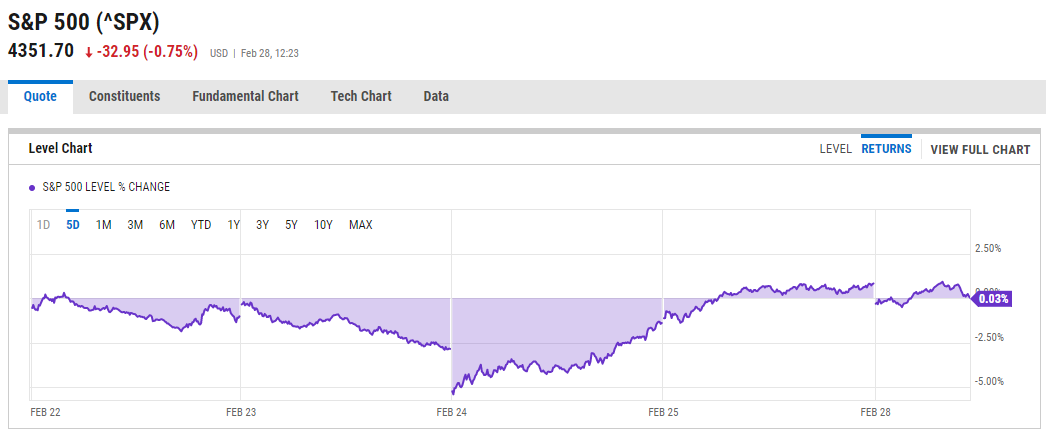
Markets have responded to this chaos with a fair amount of volatility, with some big swings both up and down since the invasion began. This is understandable, but what comes next will be more unpredictable. Russia does not have many face-saving ways to undo its situation, a fact that has not gone unnoticed by many. Stuck in heavy fighting in Ukraine, a collapsing economy, a restless population at home and a kleptocratic network of military officials and billionaire oligarchs who hide their assets in Western nations, Putin may find himself backed into a corner with few options open to him, some of which were likely previously unthinkable.

Sun Tzu, famed military strategist and author whose book sits unread on the shelves of tedious hedge fund managers.

I’m reminded of a saying from Sun Tzu, the famed military strategist of ancient China, whose book on strategy is often “required reading” for a certain type of hedge fund manager. “When you surround your enemies, leave an opening; do not push too hard on the enemies who are desperate.” Even if Putin is ultimately successful in Ukraine it’s hard to see what kind of victory can be cobbled together on the world stage. Russia will need a way out, an opportunity to exit and with walls closing in our own “Western” victory of aiming to contain Putin may create more chaos than we are expecting or can anticipate.  

I don’t want to be alarmist, but the nature of war is to be unpredictable, and cautious investors should take note that we are still in the early days of what could prove to be a long, protracted, and ultimately surprising conflict that has many unknowable outcomes, some of which may leave the world order changed, for better and worse. Putin has unleashed something, and what that is can not be fully guessed.

Looking Back on 2021

Its traditional that the end of a year should stimulate some reflection on the past and the future, and so in the spirit of tradition I thought I’d take some time to look over some of the stranger and more surprising aspects of 2021.

China

While 2021 brought the pandemic *closer* to an end through the distribution of vaccines, markets underwent some fairly dramatic reversals over the course of the year. For instance China looked to be the principal economy in January. Following its own strict enforcement of Covid restrictions and solid economic performance, China seemed to be an earlier winner by the beginning of 2021, and set to enjoy robust growth through the year.

By March the tide was shifting however. China’s leader, Xi Jinping, proved to be every bit committed to his past comments about protecting and strengthening the CCP over free market concerns. Several billionaires, notably Jack Ma the founder of Alibaba, disappeared for long periods before reemerging only to publicly announce that they would be stepping down from their roles.

However, even while China was shaking down its billionaires and upsetting foreign nations, a new economic threat appeared in the form of a housing bubble looking ready to burst. Evergrande, one of the country’s largest property developers announced that it could not finance its debt anymore and looked likely to default. This news was unwelcome for markets, but for China hawks it fit their long standing belief that China’s strength has been built on a mountain of unsustainable debt, with property one of the most vulnerable sectors of the economy.

The finer points of China’s housing market are too nuanced to get into here, but it’s enough to know that the property bubble in China is large, built on sizeable debt and could take some time to deflate (if it does) and no one is sure what the fallout might be. Combined with China’s ongoing policy of “Covid Zero” – an attempt to eradicate the virus as opposed to learning to live with and manage it, we head into 2022 with China now a major outlier in the Asian region.

Inflation

Inflation was probably the other most discussed and worrying trend of 2021. Initially inflation sceptics seemed to win the argument, as central banks rebuffed worries over rising prices and described inflation as transitory. That argument seemed to wane as we entered late Q3 and prices were indeed a great deal higher and didn’t seem to be that “transitory” anymore. Inflation hawks took a victory lap while news sites began to fill up with worrying stories about rising prices on household goods.

The inflation story remains probably the worst understood. Inflation in Canada, as in other Western nations has been going on for sometime, and its effects have been under reported due to the unique nature of the CPI. But some of the concern has also been overwrought. Much of the immediate inflation is tied to supply chains, the result of “Just-in-time” infrastructure that has left little fat for manufacturers in exchange for lower production costs. Bottlenecks in the system will not last forever and as those supply chains normalize that pressure will recede.

The other big pressure for inflation is in energy costs, but that too is likely to recede. Oil production isn’t constrained and prices, while higher than they were at the beginning of the pandemic are lower than they were in 2019. In short, many of the worries with inflation will not be indefinite, while the issues most worrying about inflation, specifically what it costs to go to the grocery store, were important but underreported issues before the pandemic. Whether they prove newsworthy into the future is yet to be seen.

*Update – at the time of writing this we were still waiting on more inflation news, and as of this morning the official inflation rate for the US over the past year was 7%. Much of this is still being chalked up to supply chains squeezed by consumer demand. An unanswered question which will have a big impact on the permanence of inflation is whether this spills into wages.

This political advertisement from the Conservatives ruffled many feathers in late November

Housing and Stocks – Two things that only go up!

If loose monetary policy didn’t make your groceries more expensive, does that mean that central bankers were right not to worry about inflation distorting the market? The answer is a categorical “No”. As we have all heard (endlessly and tediously) housing prices have skyrocketed across the country, particularly in big cities like Toronto and Vancouver, but also in other countries. The source of this rapid escalation in prices has undoubtedly been the historically low interest rates which has allowed people to borrow more and bid up prices.

In conjunction with housing, we’ve also seen a massive spike in stock prices, with even notable dips lasting only a few days to a couple of weeks. The explosion of new investors, low-cost trading apps, meme-stocks, crypto-currencies, and now NFTs has shown that when trapped at home for extended periods of time with the occasional stimulus cheque, many people once fearful of the market have become quasi “professional” day traders.

Market have been mercurial this past year. Broadly they’ve seemed to do very well, but indexes did not reveal the wide disparities in returns. Last year five stocks were responsible for half the gains in the S&P 500 since April, and for the total year’s return (24%), Apple, Microsoft, Alphabet Inc, Tesla and Nvidia Corp were responsible for about 1/3 of that total return. This means that returns have been far more varied for investors outside a tightly packed group of stocks, and also suggests markets remain far more fragile than they initially appear, while the index itself is far more concentrated due to the relative size of its largest companies.

Suspicious Investment Practices In addition to a stock market that seems bulletproof, houses so expensive entire generations worry they’ve been permanently priced out of the market, the rapid and explosive growth of more dubious financial vehicles has been a real cause for concern and will likely prompt governments to begin intervening in these still unregulated markets.

Crypto currencies remain the standout in this space. Even as Bitcoin and Etherium continue to edge their way towards being mainstream, new crypto currencies trading at fractions of the price, have gotten attention. Some have turned out to be jokes of jokes that inadvertently blew up. Others have been straight-up scams. But all have found a dedicated group of investors willing to risk substantial sums of money in the hope of striking it rich.

NFTs, or non-fungible tokens have also crept up in this space, making use of the blockchain, but instead of something interchangeable (like a bitcoin for a bitcoin, i.e. fungible) these tokens are unique and have captured tens of thousands, sometimes hundreds of thousands of dollars for unique bits of digital art. Like cryptocurrencies, much of the value is the assumed future value and high demand for a scarce resource. However, history would show that this typically ends poorly, whether its housing, baseball cards or beanie babies.  

Lastly, there has been a number of new investment vehicles, the most unusual of which is “fractional ownership”. The online broker Wealth Simple was the first to offer this in Canada and it has been targeted to younger investors. The opportunity is that if your preferred stock is too expensive, you can own fractions of it. So if you wanted to invest in Amazon or Tesla, two stocks that are trading at (roughly) $3330 and $1156 respectively at the time of writing, those stocks might be out of reach if you’re just getting started.

This is a marketing idea, not a smart idea. The danger of having all your assets tied up in one investment is uncontroversial and well understood. The premise behind mutual funds and exchange traded funds was to give people a well-diversified investment solution without the necessity of large financial position. The introduction of fractional ownership ties back to the market fragility I mentioned above, with younger investors needlessly concentrating their risk in favour of trying to capture historic returns.

The End

For most investors this year was largely a positive one, though markets went through many phases. But while the pandemic has remained the central news story, the low market volatility and decent returns has kept much of us either distracted or comfortable with the state of things. And yet I can’t help but wonder whether the risks are all the greater as a result. Many of these events, the large returns in an ever tightening group of stocks, the growth of investors chasing gains, the sudden appearance of new asset bubbles and the continued strain on the housing market and household goods add up to a worrying mix as we look ahead.

Or maybe not. Market pessimists, housing bears, and bitcoin doubters have garnered a lot of attention but have a bad track record (I should know!) Many of the most pressing issues feel as though they should come to a head soon, but history also teaches us that real problems; big problems that take years to sort out and lead to substantial changes are often much longer in the making than the patience of their critics. The test for investors is whether they can stand by their convictions and miss out on potential windfalls, or will they become converts right as the market gives way?

Next week, we’ll examine some of the potential trends of 2022.   

Recapping Last Week’s Market

A quick video looking at the sudden rise in markets last week and what conclusions we can draw from it.

Information in this commentary is for informational purposes only and not meant to be personalized investment advice. The content has been prepared by Adrian Walker from sources believed to be accurate. The opinions expressed are of the author and do not necessarily represent those of ACPI.

Why Can’t Markets Be Calmed?

A series of bad days, a moment of respite, and then more selling. This was the story of 2008, and it lasted for months. The rout lasted until finally investors felt that enough was going to be done to save the economy that people stopped selling. Massive quantitative easing, an interest rate at 0%, aggressive fund transfers, bailouts to whole industries, and the election of a president who seemed to embody the idea of “hyper competence”. That’s what it took to save the economy in 2008. Big money, an unconditional promise to save businesses and people, and the rejection of a political party that oversaw the bungled early handling of a crisis and had lost the public confidence.

I don’t think Donald Trump has never had been viewed as hyper competent. I doubt even his most ardent supporters see him as incredibly clever, but instead a thumb in the eye of “elites” who have never cared to take their concerns seriously, and to an establishment that seemed incapable of making politics work. Trump was a rejection of the status quo and a “disruptor in chief”. A TV game show host who played the role of America’s most sacrosanct character, the self made man, asked now to play the same role in politics.

There’s nothing I need to cover here you don’t already know. A history of bad business dealings, likely foreign collusion to win an election, surrounded by sycophants and yes men with little interest or understanding of the machines they have been put in charge of, and an endless supply of criminal charges. Like a dictator his closest advisors are members of his own family, and perhaps more shockingly he fawns over and publicly admires the dedications of respect other dictators get from their oppressed populations. Never has a person been so naked in their desires and shortfalls as Donald Trump.

Markets have played along with this charade because Trump seemed, if anything, largely harmless to them. Indifference to the larger operation of the government and the laser like focus on reduced regulations and tax cuts made Trump agreeable to the Wall Street set. If he could simply avoid a war and keep the economy humming, Trump was a liveable consequence of “good times”. Until the coronavirus issue, Trump had not done terribly. The economy wasn’t exactly humming. It had a bad limp due to a trade war with China. It had a chest cold because wealth inequality was continuing to worsen despite decreasing unemployment. And its general faculties were diminished as issues around health care, deficit spending, and other aspects of the society began to languish. But as far as unhealthy bodies go, the American economy still had its ever strong beating heart, the American consumer.

Whatever name you prefer; COVID-19, the coronavirus, SARS-CoV-2, or the #Chinesevirus (as Trump is now busy trying to get it renamed) has exposed the fault lines in the administration and the danger of such blinkered thinking by Wall Street. Having spent the last few weeks downplaying the severity of the outbreak and hoping China would be able to contain it, until finally, grudgingly, acknowledging its seriousness. Markets have suddenly come face to face with a problem that bluster and bravado can’t fix. Trump is a political liability for markets, and his leadership style, which is heavy on cashing in on good times with little management for rainy days, means that markets may not really have any faith that he can properly address these problems.

Other efforts to calm markets, largely through the federal reserve, have not reassured anyone. Two emergency rate cuts are not going to fix the economy but did spook investors globally (it did signal to banks that they should take loans to cover potential shortfalls). The promise of a massive set of repo loans to provide liquidity will keep markets open and lubricated, but again won’t save jobs and won’t prop up the physical economy. What will fix markets is an end to the pandemic, a problem with the very blunt solutions of “social distancing”, “self isolation” and the distant hope of a vaccine.

What investors are facing are three big problems. First, that we don’t know when the virus will be contained. Optimistically it could be a month. Realistically it could be three. Pessimistically people are talking about the rest of the year. Even under the best conditions we are also likely facing a recession in most parts of the globe, and even then stimulus spending and financial help won’t be as effective until people can leave their homes and partake in the wider market (postponing tax filings and allowing deferrals on mortgages are good policies for right now, but at some point we need to spend money on things). But the last problem is one of politics. The Trump administration is uniquely incompetent, has shown little interest in the mechanisms of government, and in a particularly vicious form of having something come back to bite you, dismantled the CDC’s pandemic response team.

The best news came last week, when it seemed a switch had been flicked and the general population suddenly grasped the urgency of the situation and people began self isolating and limiting social engagements (I am now discounting Florida from this statement). Those measures have only been strengthened by government action over the last few days. Similarly, while I write this, Trudeau has announced a comprehensive financial package to come to the aid of small businesses and Canadian families. All this is welcome news, and I expect to see more like this over the coming weeks as Western governments take a more robust and wide ranging response to the crisis. So there is just one issue still unaddressed. The political mess in Washington.

I can’t say that markets will improve if Trump is voted out of office, but its hard to imagine that they could be made worse by his exit. Markets, and the investors that drive them, are emotional and it is confidence, the belief that things will be better tomorrow, that allow people to invest. Trump promised a return to “good times”, to Make America Great Again, and it is his unique failings that have left it, if anything, poorer.

Information in this commentary is for informational purposes only and not meant to be personalized investment advice. The content has been prepared by Adrian Walker from sources believed to be accurate. The opinions expressed are of the author and do not necessarily represent those of ACPI.

When Only One Thing Matters

iStock-968895338.jpg

In my head is the vague memory of some political talking head who predicted economic ruin under Obama. He had once worked for the US Government in the 80s and had predicted a recession using only three economic indicators. His call that a recession was imminent led to much derision and he was ultimately let go from his job, left presumably to wander the earth seeking out a second life as political commentator making outlandish claims. I forget his name and, so far, Google hasn’t been much help.

I bring this half-formed memory up because we live in a world that seems focused on ONE BIG THING. The ONE BIG THING is so big that it clouds out the wider picture, limiting conversation and making it hard to plan for the future. That ONE BIG THING is Trump’s trade war.

I get all kinds of financial reports sent to me, some better than others, and lately they’ve all started to share a common thread. In short, while they highlight the relative strength of the US markets, the softening of some global markets, and changes in monetary policy from various central banks they all conclude with the same caveat. That the trade war seems to matter more and things could get better or worse based on what actions Trump and Xi Jinping take in the immediate future.

Donald-Trump-Xi-Jinping-1127037

Now, I have a history of criticizing economists for making predictions that are rosier than they should be, that predictions tend towards being little more than guesses and that smart investors should be mindful of risks that they can’t afford. I think this situation is no different, and it is concerning how much one issue has become the “x-factor” in reading the markets, at the expense of literally everything else.

What this should mean for investors is two-fold. That analysts are increasingly making more useless predictions since “the x-factor” leaves analysts shrugging their shoulders, admitting that they can’t properly predict what’s coming because a tweet from the president could derail their models. The second is that as ONE BIG THING dominates the discussion investors increasingly feel threatened by it and myopic about it.

This may seem obvious, but being a smart investor is about distance and strategy. The more focused we become about a problem the more we can’t see anything but that problem. In the case of the trade war the conversation is increasingly one that dominates all conversation. And while the trade war represents a serious issue on the global stage, so too does Brexit, as does India’s occupation of Kashmir (more on that another day) , the imminent crackdown by the Chinese on Hong Kong (more on that another day), the declining number of liberal democracies and the fraying of the Liberal International order.

This may not feel like I’m painting a better picture here, but my point is that things are always going wrong. They are never not going wrong and that had we waited until there were only proverbial sunny days for our investing picnic, we’d never get out the door. What this means is not that you should ignore or be blasé about the various crises afflicting the world, but that they should be put into a better historical context: things are going wrong because things are always going wrong. If investing is a picnic, you shouldn’t ignore the rain, but bring an umbrella.

181025-Tani-Republican-Party-Press-tease_zr23lf

The trade war represents an issue that people can easily grasp and is close to home. Trump’s own brand of semi-authoritarian populism controls news cycles and demands attention. Its hard to “look away”. It demands our attention, and demands we respond in a dynamic way. But its dominance makes people feel that we are on the cusp of another great crash. The potential for things to be wiped out, for savings to be obliterated, for Trump to be the worst possible version of what he is. And so I caution readers and investors that as much as we find Trump’s antics unsettling and worrying, we should not let his brash twitter feuds panic us nor guide us. He is but one of many issues swirling around and its incumbent on us to look at the big picture and act accordingly. That we live in a complex world, that things are frequently going wrong and the most successful strategy is one that resists letting ONE BIG THING decide our actions. Don’t be like my half-remembered man, myopic and predicting gloom.

Information in this commentary is for informational purposes only and not meant to be personalized investment advice. The content has been prepared by Adrian Walker from sources believed to be accurate. The opinions expressed are of the author and do not necessarily represent those of ACPI.