

The Blind Men & The Elephant

1280px-Blind_monks_examining_an_elephantMarkets have reached six or seven week highs, (HIGHS I say!) and questions are arising as to whether this represents a sustained recovery.

The crystal ball is decidedly opaque on that question, not simply because there is an abundance of conflicting data, but because more of it is produced everyday. Add to that the fact that the “mood” often dictates much of the day’s trading, plus the often counter-intuitive reality that sometimes sufficiently bad news is considered good news in its own right.

Take for example China’s financial woes. China’s economy is definitely slowing, and the tools used in the past to spur Chinese growth are no longer useful in the same way. To summarize, the Chinese economy got big by building big things; cities, ports, factories, and other big infrastructure to facilitate its role as a manufacturer to the world. In turn the world sold China many of the resources needed to do that. Now the Chinese are up their eyeballs in highways and empty cities they must “transition” to a service economy, essentially an economy that now serves its people rather than the rest of the planet.

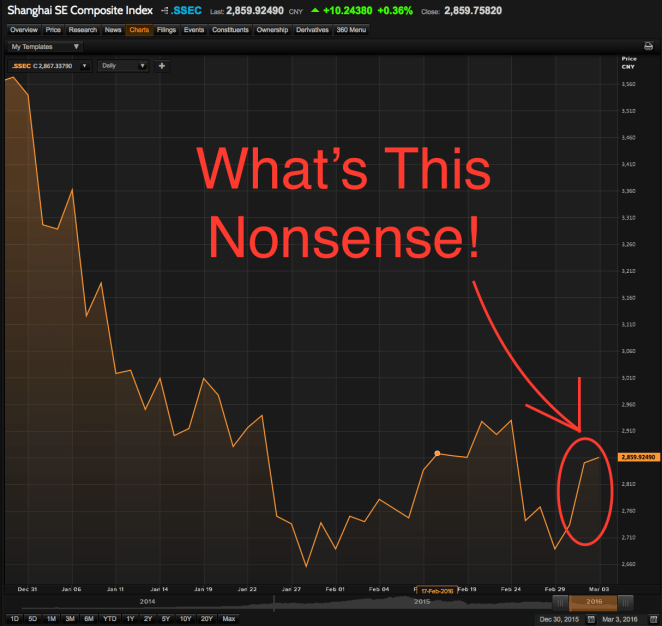
Such a transition is no easy thing, and to the best of my knowledge there is no law that says the Chinese government is somehow more adept at managing such a transition. But every bit of bad news may either make investors nervous, or give them hope that the Chinese government may be encouraged to do more economic stimulus. Moody’s, the ratings agency, recently downgraded their outlook on Chinese debt from stable to negative, and downgraded their credit rating. The market’s response?
Screen Shot 2016-03-03 at 10.33.51 AM

That big jump is after they received the downgrade! We see similar patterns out of Europe and the United States. Raising US interest rates has been widely decried by various financial types and talking heads, urging the Federal reserve chairman Janet Yellen to either reverse, stop or even consider negative rates to help the economy. Why such panicked response? Because it has become a common thought that raising rates is now more damaging that the requirement of lowering them!

This has less to do though with distortions in the market and more to do with people trying to accurately read and project from various data points, even when many of those reports conflict. In the short term the abundance of conflicting news creates a blind men and the elephant relationship between investors and economies. Everybody is feeling their way around but all coming back with wildly different descriptions of what is happening.

Janet Yellen
Janet Yellen has raised interest rates and has said she expects to raise rates four more times this year. She has met serious opposition on this matter from many within the financial sector.

What we do know is that there are some big problems in the markets and economies, and the threat of a global recession is very real. What day traders and analysts are looking for is confirmation on whether this threat is easing or not. So, if we suddenly read that managers see a contraction in oil production we might see a sudden rise in the value of crude oil. That news has to be weighed against that fact that global oil supply is still growing, and whether it still makes sense to price oil by its available supply, or against its expected future reduced production.

And that is the challenge. Big problems take time to sort out, and in the intervening period as they are addressed the blind men of the markets make lots of little moves trying to bet on early outcomes, attempting to assess the correct value of a thing often before a clear picture is actually there. For investors the message is to be cautious, both in making large bets or by trying to avoid risk all together. It is a mantra here in our office on the benefits of diversification and risk management, precisely because it reminds us to hold positions even when the mood has soured greatly, and shy away from investments that have become too popular. The goal of investors should to not be one of the blind men, guessing about what they touch, but to make irrelevant that shape of the markets altogether.



Sunlight Is Still The Best Disinfectant

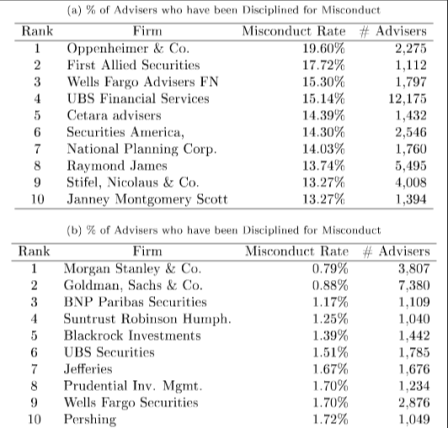
Yesterday a disturbing article came across my desk. From Bloomberg, it was titled “It Just Got Even Harder to Trust Financial Advisors” and is a brief summary of a new report out of the United States that suggests that there is wide spread misconduct within financial services. Far from being an isolated number of financial advisors, the scale of the disciplinary actions is extensive and has encompassed some of the largest banking institutions in the United States (for those mistrustful of the Wall Street crowd that may not be a big shock) including some well known names like Wells Fargo and UBS.

Being disciplined within the world of financial services is controversial and being reprimanded does not necessarily denote contrition from advisors. The two chief complaints from investors, both in Canada and the United States, revolves around suitability of investments and subsequent fees. Those might seem like straight forward complaints to have, but many investors have a difficult time wrapping their heads around “risk”, showing great comfort in investments that can rapidly rise, while expressing dismay when they fall just as rapidly back to earth. Thus investors and advisors can mistakenly assume that they are on the same page with each other, only to find that at a later point that they have badly misunderstood one another.

shutterstock_108464105
This will be so awesome if I don’t fall!

Regulators have correctly understood that the problem is a misalignment of education and comfort. If investors knew more about investing they would be better at understanding risk. If that were the case though investors would be unlikely to need the services of financial advisors. Thus financial advisors are expected to treat their clients as though they know little, and should be expected to challenge investors, even reject investor requests if the investment is deemed too risky by the advisor.

What regulators want is for advisors to understand their role now as “risk managers” rather than product floggers and order takers. In an industry where the average age is north of 55, most advisors got their start and built their business around exactly that, selling interesting and exciting ideas. The transition from that to telling investors that they can’t do what they want with their money (it’s their money after-all) has not been simple.

Screen Shot 2016-03-02 at 1.53.16 PMOne move, cited in the article, is to move to a fiduciary model to rectify outstanding issues around fees in particular. There is a persistent fear that advisors might choose high fee-low returning investments when cheaper and better performing options exist. Curiously, in Canada at least, there is not much evidence to suggest that this happens. But even if this avenue resolves such a problem many within the industry fear that “high fee/low return” will not be apparent until well after the fact, opening up practitioners to hindsight litigation.

The simple fact is though that regardless of the nuances and difficulties that surround properly managing and regulating the financial services industry, no good can come from a growing sense of mistrust in an industry that has become so essential to the retirement plans of so many. So what should investors know that will protect them from bad decisions or unfair fees?

First, be familiar with the nature of fees:

  • There is a tendency to assume that the best fee is the lowest, but costs frequently correspond to the complexity of the investments, the size of the assets under management and the support around the product. Be sure to find out what the MER (management expense ratio) is and find out whether it is comparable to other similar products. It’s fair to have questions about what products cost and whether those costs make sense.

Second, be more than a number:

  • The article contains one of those slights of hand when people try and diffuse blame, pointing out that it isn’t “just small dealers” that have been guilty of misconduct. This suggestion that small is typically the problem seems challenged by evidence. Big problems require scale, and it isn’t uncommon for some brokers in the banks to have thousands of clients. Brokers aren’t happy with that arrangement and neither are investors, but it is very common. It shouldn’t be surprising that misconduct can come from large banks seeking easy solutions with proprietary product.

Third, independent options are better than proprietary ones:

Fourth, be Canadian:

  • The concerns of America and Canadian regulators are very similar, but the good news is that Canadians have a better system. Despite complaining Canadians have some clear advantages. First, performance disclosure rules favour investors here. Rather than show returns with costs yet to be deducted, returns in Canada are shown net of all costs, meaning you see accurate performance. Second, the use of commissions and deferred sales charges, the source of ire for regulators and critics, have been dropping for years. Many financial advisors now rely on exclusively trailers or disclosed fees. Third, even trailers aren’t that bad. Where as there has been an outstanding concern is that embedded trail fees could unduly influence advisors to make poor choices. But while there is some truth to this statement, the vast bulk of investments within Canada have standardized their fees, with companies paying bigger payouts to entice sales having become the outlier.

Fifth, be with us:

  • As part of a small and independent firm one of the things we pride ourselves most on is to be in the right place to help Canadians. An open shop, we have both the luxury of picking the best investments from across the industry while offering investors competitive fees. But most importantly, we value transparency and clarity in managing your retirement savings.

As a family business that has been around for nearly a quarter of a century, the essential difference between being a number and receiving personal care is whether you have someone to work with that doesn’t just know your name, but comes to know you as well.

Also they should have a blog.

Give us a call if you are looking for some personal guidance in dealing with difficult markets or have questions about protecting your accounts.

← Back

Thank you for your response. ✨