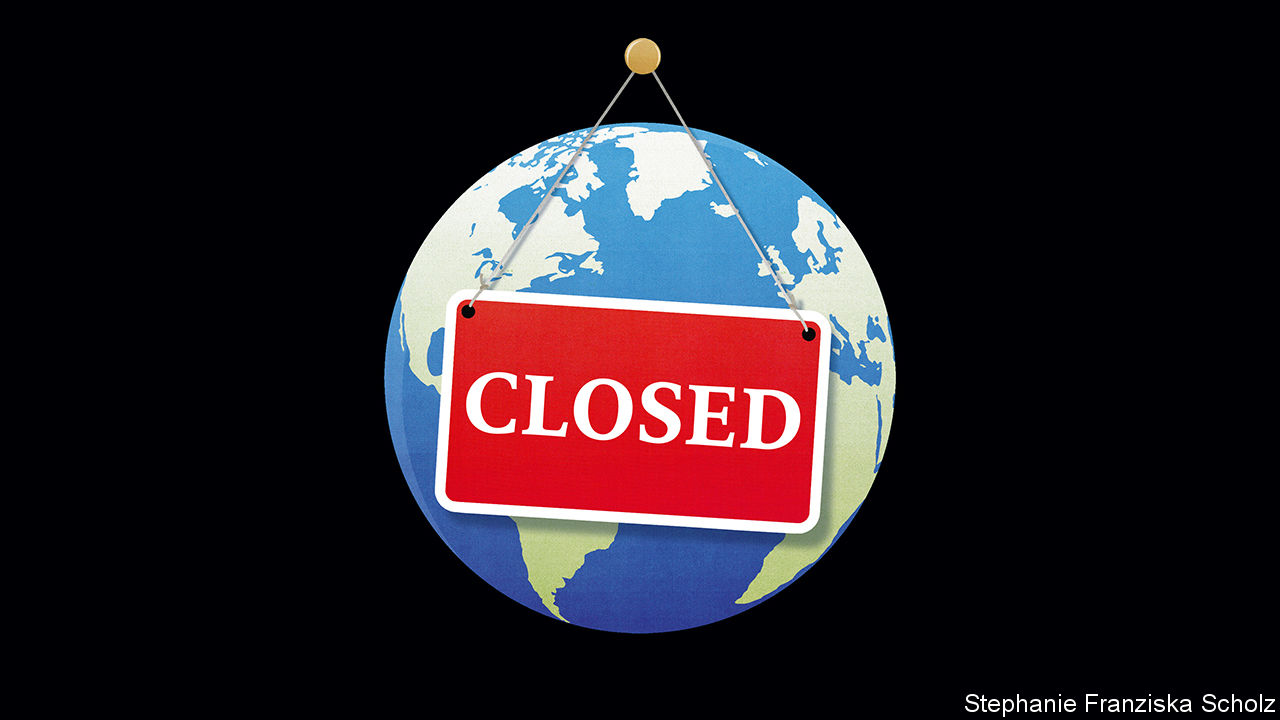
The End of Globalization?

Globalization End

I’m not one to indulge in predicting radical transformations to the world order. As a rule, change remains slow and while its end can’t always be guessed, its direction is often telegraphed. So, while I’m reluctant to make any grand pronouncements about the future after the lockdowns and life resumes a more normal trajectory (like people no longer working in offices!), I think there is enough evidence today to say that the globalized world is under heavy threat.

The COVID-19 global pandemic has highlighted some strategic weaknesses that must be addressed, and that governments will be unlikely to tolerate into the future. Chief among them is the large dependence on China as a source of medical supplies, including 80% of global face mask supplies and (at least in the US) 30% of personal protective equipment.

We might assume that this is a problem with China, but it isn’t. This is actually a problem with globalization and how dependent it is on a global leadership structure. As supply chains have become global their operation depends on a strong global framework that keeps trade open and coordinates needs across borders. That means that there must also be leadership that can fight (more metaphorically than literally) to keep those chains open in a crisis. That role has been traditionally occupied by the United States, but under Trump’s management the country has taken a big step back from such a global leadership role with other nations making a similar retreat.

As the coronavirus was starting to make inroads in Europe and North America it became impossible to get masks from China, regardless of which factories made them (Medicom, a Canadian manufacturer has three factories in China but none of those masks ever made it back to our borders) as the Chinese government simply requisitioned all masks for their population. Other countries have also taken similar steps, restricting the transportation of some drugs and medical supplies. Finally, in a moment of clarity for Canadians regarding their relationship with the US, Trump invoked a Korean War era law to halt the sale of N95 masks to Canada. That was eventually rescinded, but the message was received loud and clear. Nations have no friends, only interests.

This is true with large international organizations as well. The World Health Organization is facing a lot of scrutiny over its early handling of the pandemic and for its perceived subservience towards China. The WHO, which can only operate in China with the government’s permission, had limited access to people on the ground in Wuhan, accepted the Chinese explanation of no “human to human” transmission, and in respecting the Chinese position on Taiwan can not engage or work with the Taiwanese government to understand how they have very successfully curbed the outbreak. All this has raised eyebrows about how useful this group is. In the past this might prompt more engagement from its largest backers, the United States, and fought for reforms to improve its responses. That’s not the case today, as instead Trump has opted to cease funding to the WHO as both a retaliatory act and a way to shift focus from his own administration.

For sometime globalization has been coming under increasing pressure as a result of the erosion of industrial domestic manufacturing, inequality, and populism. But the pandemic seems to be hastening that process as opposed to repairing it. At a time when a global coordinated effort is desperately needed, no nation is inclined to fill that role. This effect has been described by political scientist Ian Bremmer in his book Every Nation For Itself as a “G-Zero World”, a world with no global leader.

That role has traditionally fallen to the United States, which has seen its own prosperity connected to considerable soft power. But as domestic issues and populism have risen voters of wealthy Western nations have become increasingly inward turning. Some might think that China would fill that role, but China is too nakedly self-interested in its own ambitions, making it difficult for nations to embrace the country’s “help”. Meanwhile, as other nations continue to develop economically they are growing less willing to accept the terms of IMF and World Bank help, and more committed to their own national wants.

Whenever the world begins its return to normal we should expect countries to decouple some of their supply chains from China purely for the public good when it comes to health and medical supplies. But other businesses are taking note that during this crisis they have also been held hostage by China. Apple intends to have its new budget phone assembled in Brazil, and the ongoing trade war with China (now rapidly turning into a cold war) is unlikely to be eased when this is put behind us. Instead we should expect it to accelerate.

Information in this commentary is for informational purposes only and not meant to be personalized investment advice. The content has been prepared by Adrian Walker from sources believed to be accurate. The opinions expressed are of the author and do not necessarily represent those of ACPI.

A Future Filled With Seniors, A Risk Yet Considered

*From Adrian: I began writing this on the weekend when I first learned of the conditions of the retirement residence in Dorval. Since then it has been revealed that nearly 50% of COVID-19 deaths in Canada are in long term care facilities. You can read more about that here from The Globe And Mail: Outbreak at senior’s homes linked…

Senior's Risk

Canada’s demographic story is neither unique nor surprising. Like many other nations (most nations in fact) its largest demographic is rapidly aging and requiring an increasing number of services in both health care and assisted/retirement living. Like many other nations its only population growth is through immigration as people have largely stopped having enough kids to grow the next generation. It is a slow moving story, but also an inevitable one.

This is both well known and uncontroversial. Long before John Ibbitson and Darrell Bricker had written Empty Planet, before Hans Rosling was using a clever moving chart at TED Talks to explain population trends, Canadian professor David K. Foot had written his book Boom Bust and Echo, detailing the future of the Canadian population. Finally those predictions are starting to be realised, and investors like myself are eagerly looking for ways to capitalize on an enormous demographic change.

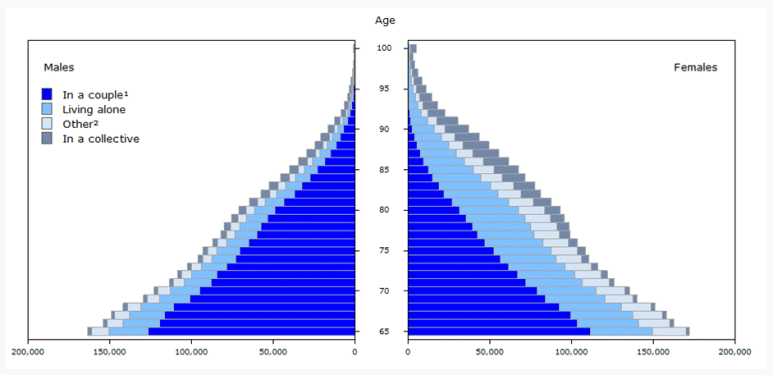
One such way will be in Senior’s Residences, Assisted Living and Long Term Care Facilities. With Canadians living longer Statistics Canada points out that 7.1% of Canadians over 65 live in “collective dwellings” like retirement residences, a number that jumps to 31.1% for people 85 and older. That number holds true when we look at special care facilities, with 29.6% of people 85 and over.

Senior Demographics

The logic is appealing and direct. In 2016 16.9% of Canadian were 65 or older, and 2.2% were 85 or older. That was a 20% increase since 2011. With more Canadians approaching 65 and 85 than ever before the need for retirement residences, assisted living and long term care facilities will be greater than ever. Given the time it takes to secure and build new facilities, resistance at local levels to having them built and the high costs of creating and managing these businesses plus the government oversight, the business is as close to a sure thing that investors could hope to find. How could this go wrong?

I’ve been writing about demographics for a while. Here are some of the other things I’ve had to say:

The OHIP Gambit (October 23, 2015) – How an aging population will likely impact the province’s finances and imperil our health care.

The Demographic Deformation (October 9, 2015) – Lots of old people means an outsized impact on financial markets.

4 Reasons Why Planning for Retirement is Getting Harder (October 22, 2014) – People living longer means planning for longer with more uncertainty. Here’s four things impacting that planning.

Is It Time To End The “Senior” Citizen (April 27, 2015) – Being a senior comes with lots of perks, but increasingly meaningless when you’re likely to be a senior for two decades.

Enter 2020, a year that continues to feel like being slapped in the face by a large fish. Investors are accustomed to thinking very little about the business practices and oversight of the companies they invest in, but perhaps that should change, especially when they invest directly. Scandals, abuse and personal harm are matters for owners, and owners, even if removed from the daily running of a business should remain engaged. This remains especially true if the business deals in the wellness of people.

To my point, behold the unfolding scandal at a privately run senior’s residence in Montreal. I apologize at how graphic these details are and if you are at all squeamish please feel free to jump to the next paragraph. When health officials were finally called into the residence it was described as a “concentration camp”. Some residents had fallen on the floor and been left there. Others hadn’t been fed. Two people were found dead in their beds and hadn’t been recognized as such. Reportedly there were only two orderlies for the entire 134 bed facility. Some patients were so dehydrated they were unable to speak. Patients had been left in diapers, unchanged for several days. One in triple diapers with feces leaking out. These details are beyond horrific and have no place in a story about a Canadian senior’s residence. In total there had been 31 deaths over the previous few weeks.

As an investor, what should you think about such a discovery? Beyond its horror show details, more suited to a zombie apocalypse movie than real life, how should a lone investor think about their role in this?

One thing to consider is that due diligence should begin to increase the more certain an investment looks. Businesses with very high barriers to entry (the ease or difficulty of getting involved in a sector of the market), that are part of effective oligopolies or are essential services are not “set it and forget it” services. If anything the risk of abuse, neglect or corruption is higher the more essential and irreplaceable the businesses becomes. For the average person at home this may not be a feasible or realistic thing to do, and an individual investor may not be in a position to attend annual general meetings, or even be aware  of how to solicit and get answers from corporate boards.

This is one reason to consider using a mutual fund, or an investment that functions like a mutual fund that dedicates energy to analyzing and understanding businesses. It is also a reason for investors working with a financial advisor to ask questions about the nature of the investments they are buying, especially if they seem like “no lose” scenarios. If something makes intuitive sense to do, we should be clear as to why more aren’t doing it. Lastly, if you are investing in a private investment sold through an offering memorandum you should make sure someone is paying close attention to the details. There will always be blind corners in businesses, things you can not know, but you should have comfort that someone is providing verifiable oversight.

An aging population creates new investment opportunities, and senior’s living will be one of them. A business that’s cash rich and necessary, the appeal is obvious. But businesses that are responsible for providing care and looking after people’s well being also have the pull to maximize their profits, squeezing returns wherever they can. That push and pull should sit on everyone’s mind as they consider the new opportunities coming into focus.

Information in this commentary is for informational purposes only and not meant to be personalized investment advice. The content has been prepared by Adrian Walker from sources believed to be accurate. The opinions expressed are of the author and do not necessarily represent those of ACPI.

COVID-19 & Canadian Financial Health

The future for Canadians will not be one that is free of crises. Pandemics, financial collapses and acts of God continue to lurk around every corner. But the biggest danger is how Canadians have mismanaged their finances and how vulnerable that makes them when the unexpected happens. Today I’m ranting about what comes next, and how our physical health may be more closely tied to our financial health.

Information in this commentary is for informational purposes only and not meant to be personalized investment advice. The content has been prepared by Adrian Walker from sources believed to be accurate. The opinions expressed are of the author and do not necessarily represent those of ACPI.
 

A Case For the Best Case

A Case for the Best Case

*In an act of hubris I have written this before companies have begun releasing their earnings reports. I can only assume I will be punished by the animal spirits for such reckless predictions!

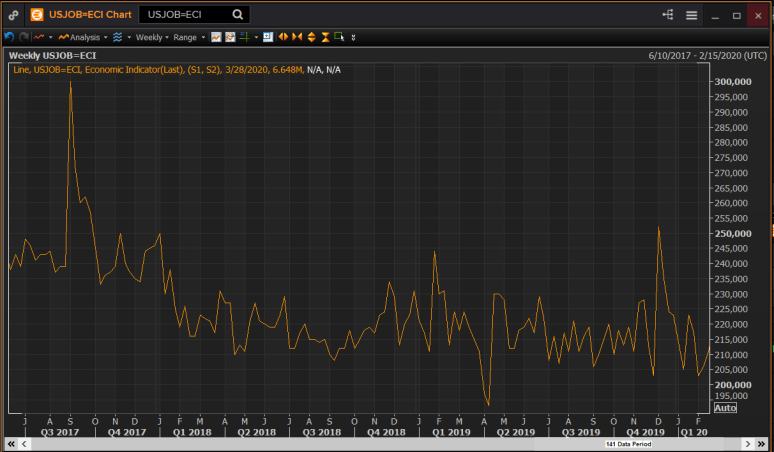
The news has been grim. The number of people seeking EI has spiked so much, so quickly that it reduces the previous unemployment numbers to a flat line (this is true in both Canada and the United States, US EI graph below). Countries remain in lockdown and some of the worst hit countries like Italy and Spain are starting to plateau, adding ONLY between 500 to 1000 deaths a day. In Canada the numbers continue to climb and the economy has been largely shut down, with governments rolling out unprecedented quantities of money to stem the worst of this. Talk of a deep economic depression has been making rounds, while the Prime Minister has reluctantly suggested that we may be in a restricted environment until July.

Us Jobless Claims - Q3 2017 - Feb Q1 2020
These two charts show the unemployment rate in the US just before the coronavirus, and after. From Refinitiv
US Jobless Claims Including April 2020
These two charts show the unemployment rate in the US just before the coronavirus, and after. From Refinitiv

And yet.

And yet.

And yet, I suspect we may be too negative in our outlook.

First, just how restricted is the economy? Despite the wide-ranging efforts to restrict the social interaction that daily economic activity produces, much of the economy continues to function. Office and white-collar jobs have quickly adapted to remote working. Few have been laid off in that respect. Industrial production is down, unless they are deemed essential, but the essential label has applied to a lot of businesses. Until the recent additional restrictions applied on Sunday April 5, 2020 in Ontario, Best Buy, Canadian Tire, Home Depot and a number of other stores remained open to the public. Those businesses have had to restrict access to their stores, but remain functioning through curb pick and online delivery.

Even the service economy is still largely functioning. Most restaurants remain open providing take out and delivery. Coffee shops, gas stations, grocery stores, convenience stores are all open, as are local grocery providers like butchers and bakers (and candle stick makers). Its’ true that large retail spaces like Yorkdale or the Eaton Centre are closed but this too tells us something.

The government has helped make it easier to get money since people have been laid off, and many of the people who have been let go will only be out of work for a short time. They are the waiters, union employees and airline pilots who will be rehired when the society begins to reopen. Even in the period I began writing this, Air Canada rehired 16,500 employees, West Jet will be rehiring 6,500 employees, and Canadians applying for the new CERB (Covid-19 Emergency Response Benefit) have reportedly already begun receiving it.

You might be reading this and thinking that I’m being callous or simply ignoring the scope of the problem that we are facing, but I want to stress that I am not. I recognize just how many people have found themselves out of work, how disruptive this has been, how scared people are and how this pandemic and its response has hit the lower income earners disproportionately more. But just as few people correctly saw the scale of the impact of the coronavirus, we should remain cautious about being too certain that we can now anticipate how long the economic malaise may last, or how permanent it will likely be, and what its lasting impacts will look like.

Labour work

The sectors of the economy worst hit will likely be those already suffering a negative trend line. The auto sector, for instance, is one that has been hemorrhaging money for a while, with global car sales in a serious slump. Some retail businesses, already on the ropes from Amazon’s “retail apocalypse” may find they no longer can hold on, though government aid may give them a limited second life. Hotels and travel will likely also suffer for a period as they carry a high overhead and have been entirely shut down through this process (sort of).

Longer term economic problems may come about from mortgage holders who have struggled to fulfill their financial obligations to banks, and it may take several months to see the full economic fallout from the efforts to fight the pandemic, so some of the effects may be staggered over the year.

Economist image

But even if that’s the case, the current thinking is that the market must retest lows for a considerable period, with few people calling for a rapid recovery and many more calling for a “W” shape (initial recovery then a second testing of previous market lows) and in the Economist this week “one pessimistic Wall Street banker talks of a future neither v-shaped, u-shaped or even w-shaped, but ‘more like a bathtub’”.

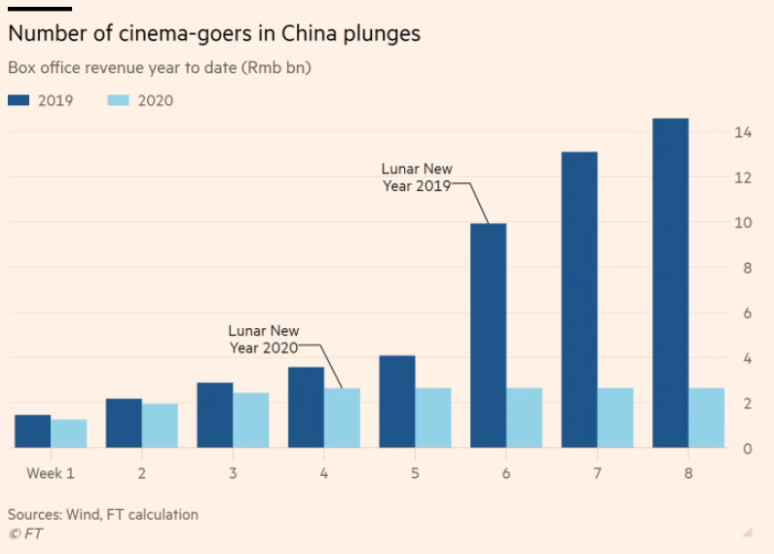
FT China Cinema

That pessimism is well warranted, and I count myself among those expecting markets to have a second dip. But I admit to having my doubts about the full scale of the impact to the real economy. There will no doubt be some fairly scary charts, like thre were from China, showing the drop off in cinema goers and people eating out. But the more certain, the more gloomy, the more despairing the outlooks get, the more I wonder if this is an over compensation for having overlooked the severity of the virus, or if it is the prevailing mood biasing these predictions? Only time will tell, but I am taking some comfort in knowing that there is still a case for the best possible case.

Information in this commentary is for informational purposes only and not meant to be personalized investment advice. The content has been prepared by Adrian Walker from sources believed to be accurate. The opinions expressed are of the author and do not necessarily represent those of ACPI.

A Broken Clock That’s Right Only Once

Dalio
Ray Dalio: ‘We’re disappointed because we should have made money rather than lost money in this move the way we did in 2008’ © Reuters

In 2009 I was working for a large mutual fund company in Western Canada. It was the peak of the financial crisis and I was given the opportunity to take a promotion but had to move to Alberta. I was eager to move up (I was only 28) and jumped at the chance though I had no great desire to live in Edmonton. It was a difficult time. It was lonely in Alberta, and people weren’t eager to speak to a wet behind the ear’s wholesaler right after the biggest rout in modern financial history.

One particularly vivid memory for me was back in 2009, walking into an office at the tail end of conference call being given by Christine Hughes, a portfolio manager of some note during the crisis. Hughes was at the top of her game. She had outperformed much of the market by holding 50% cash weighting and had correctly predicted the financial crash. In later appearances she would complain that the company she worked for had prevented her from holding more and would have had been allowed to. But at this moment, in 2009, it was late summer, and markets had been rebounding for several months, having hit bottom in early March. Hughes was adamant that “the other shoe was going to drop” and that’s when things would really go wrong.

For much of my time in 2009 Hughes, and her fund, was the story that challenged me. Having made the correct call in 2008, advisors were eager to listen to what she had to say and believed that her correct prediction in 2008 meant she knew what was coming next. Many people followed Hughes and her advice, which led primarily nowhere.

Hughes’ time subsequent to 2008 was not nearly as exciting or as successful as you might have guessed. She left AGF, where she had made it big, and went on to another firm before finally starting her own company, Otterwood Capital. The last time I saw Hughes it was in 2013 and she was giving a presentation about how close we were to a near and total collapse of the global financial system. Her message hadn’t changed in the preceding four years, and to my knowledge never did.

Hughes may not have prospered as much as she hoped following her winning year, but others who made similar predictions did. One such person is Ray Dalio, the founder and manager of Bridgewater Associates. Dalio is a different creature, one with a long history on Wall Street who had built a successful business long before 2008. But 2008 was a moment that launched Dalio into the stratosphere with his “Alpha Fund” largely sidestepping the worst of that market and by 2009 his hedge fund was named the largest in the US. Since then Dalio has grown a dedicated following beyond his institutional investors, with a well watched YouTube video (How the Economic Machine Works – 13 million views) and a series of books including one on his leadership principles and a study on navigating debt crises (I, of course, own a copy!). Yet when the corona virus rolled through Dalio’s funds faired no better than many other products (I’m sorry, this is behind a paywall, but I recommend everyone have a subscription to the Financial Times). Once again past success was no indication of future returns.

I’m not trying to compare myself to a hedge fund manager like Dalio, a person undoubtably smarter than myself. However its important to remember that being right in one instance, even extreme and unpredictable events, seems to offer little insight into when they will be right again.

If you’ve read many of these posts you may know that I am a fan of Nassim Taleb, the author of The Black Swan and Antifragile. Early in the book Black Swan, Taleb makes the case that “Black Swan logic makes what you don’t know far more relevant than what you do know. Consider that many Black Swans can be caused and exacerbated by their being unexpected.” This is an important idea that I think can be extended to our portfolio mangers that gained notoriety for getting something right and then getting much else wrong.

A complaint I have long held about experts within the financial industry is both their desire to position themselves as outsiders while being likely to share many of the same views. Having a real contrarian opinion is more dangerous than being part of the herd, after all if things go wrong for you as a contrarian, they are likely to be going right for the herd. On the other hand, if things go wrong for the herd, the herd can use its size as a defense: “We were all wrong together.”

Some of this group think can be applied to the failure of governments to get a jump on the coronavirus situation. Far from not listening to experts, governments took the safest bet which was also the most conservative view, that the virus posed a low risk to the population of countries outside China. People who thought the virus was a large risk were taking a more extreme view; that the virus posed a serious risk and required extreme measures such as travel restrictions, aggressive testing, encouraging people to wear face masks and socially distance. As a politician which choice would you make?

The point for investors should be to treat the advice of financial experts who rise to prominence during outlier events as no more special than those that got big financial events wrong. This is not because their advice isn’t good, just that the thing they got right may not indicate wide ranging knowledge, but a moment when they understood something very well that other people did not. Investors should avoid personality cults and maintain a principle of uncertainty and scepticism to prophets of profit. The rise of COVID-19 and the global pandemic response, including the rapid change in the market, will produce a number of books and talking heads who will parlay their status as hedgehogs into that of a foxes! (If you don’t know what I’m referring to, please read this from 2016).

Dalio remains a very successful manager, but his correct reading of 2008 did not prepare him for 2020. In his own words: “We did not know how to navigate the virus and chose not to because we didn’t think we had an edge in trading it. So, we stayed in our positions and in retrospect we should have cut all risk.” Christine Hughes on the other hand seems to have disappeared, her fund gone and she in an early retirement. I know of no financial advisers eager to hear her views.

Information in this commentary is for informational purposes only and not meant to be personalized investment advice. The content has been prepared by Adrian Walker from sources believed to be accurate. The opinions expressed are of the author and do not necessarily represent those of ACPI.

What To Do When You Need To Sell in Bad Markets?


Following up from a previous video (Why investors are told to stay invested in bad markets), we must recognize that we can’t always pick and choose when we need money from our savings. So how should we pick what investments to sell in a poorly performing market? Here’s one strategy to consider and help guide you!

As always, I’m available to talk any time and can be reached on my cell phone, through our office number or via email!

Sincerely,

Adrian Walker


Information in this commentary is for informational purposes only and not meant to be personalized investment advice. The content has been prepared by Adrian Walker from sources believed to be accurate. The opinions expressed are of the author and do not necessarily represent those of ACPI.

All Eyes Are On China

People in China

China, the first hit by the coronavirus and the first to emerge from its enforced hibernation, is the global centre of attention as people watch to see how fast its economy can recover from the from the pandemic chaos unleashed in January. If China is able to bounce back quickly it will be good news for other countries and should raise spirits of investors, businesses, and governments that a global shut down may not lead to the worst of all worlds.

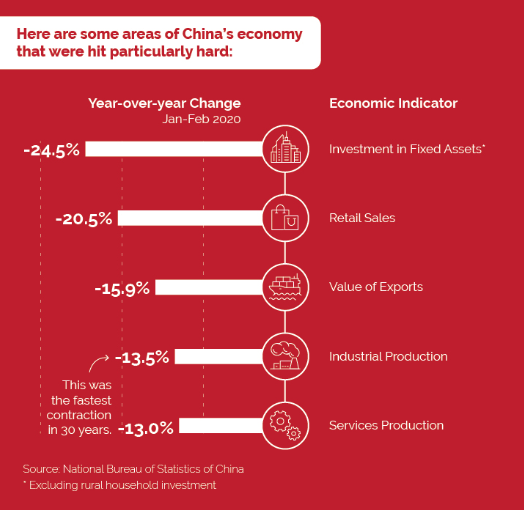
Early economic data is both more and less reassuring than one might expect. The impact of the lockdown in China took a sizeable bite out of the economy. The one year change in the value of exports is -15.9% (down already since the trade war began), industrial production was -13.5%, the fastest contraction in 30 years, while retail sales in China were down -20.5%.

China Data

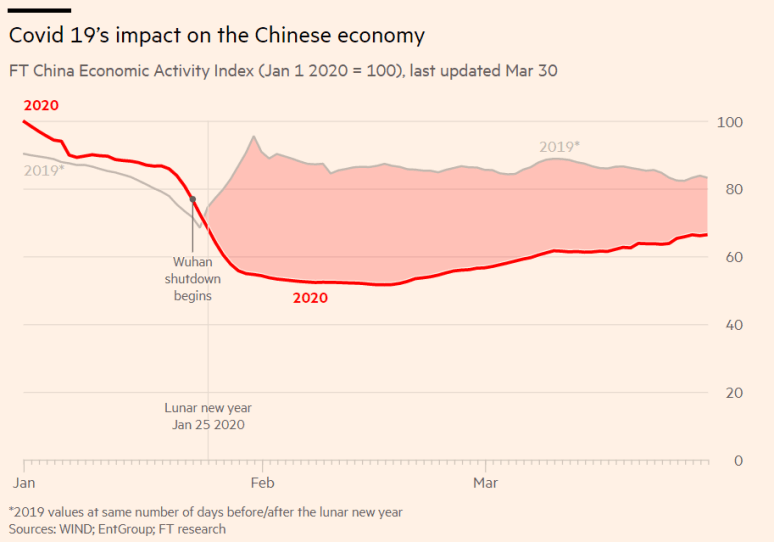
But as things return to normal in the shadow of the pandemic, numbers may also be improving faster than we thought. Reported in the Financial Times on March 20, of the 80% of restaurants that had been closed in February, less than 40% are closed now. That’s good news for small businesses watching from across the Pacific. There is good news in manufacturing as well. The Purchasing Manager’s Index (PMI) has been officially reported at 52.0, which indicates that manufacturing is growing and not contracting. In February the PMI for China was 35.7, a record low for the country. That positive PMI result is helping extend gains today (March 31st) and giving hope to governments and markets that the worst of this pandemic may be shaken off faster than economists have predicted.

PMI China March

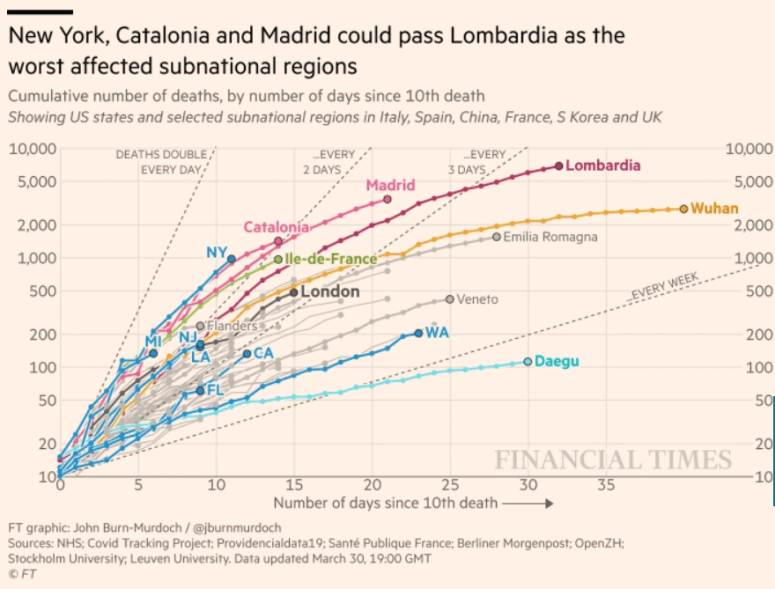
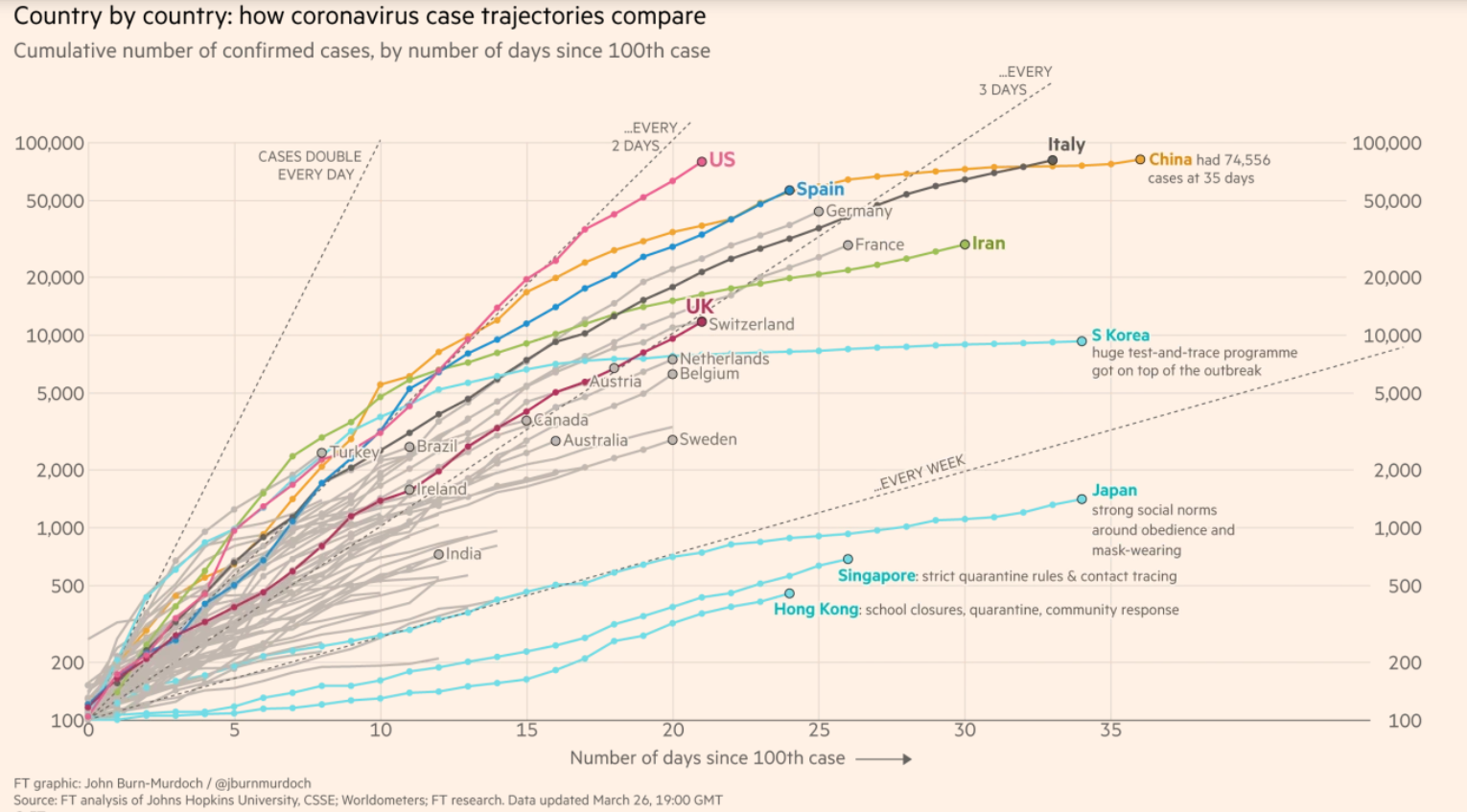
But economic activity is still well below 2019 levels and have a way to recover. In addition, China is one nation, the Western economy is made up of many, and the countries worst hit by the COVID-19 outbreaks have yet to peek and plateau. Italy, Spain and the United States are all fairing poorly, with Italy and Spain perhaps just finally reaching peak of cases now. The United States on the other hand now has more officially recorded cases than any other country, while New York, Catalonia, and Madrid are on track to pass Lombardia as the worst affected cities both in infections and mortalities.

Ft Capture Countries

The coronavirus remains the central unknown in this story. If tamed, can it be permanently subdued? If not, can new cases be dealt with on a case by case basis, or will we have to revert to aggressive forms of social distancing? Concerns remain about whether there will be a second wave of infections in Asia, while China has maintained that all new cases are being imported and can be dealt with proactive screening and testing.

FT Corona City Mortality

In Europe and North America the best news has been to see production of ventilators, masks and the deployment of field hospitals ramp up to deal with the threat. In the wider Asian region, wide testing and a willingness to follow government dictates and a focus on personal protection through the adoption of wide mask usage has had a direct impact on taming the virus in Taiwan, South Korea and Japan (the exception here might be Japan, which seems to have relaxed prematurely and now is considering shutting down Tokyo). But the best news may still be from China and a sudden and rapid improvement in their economy as restrictions are lifted. If prolonged the early rally than began last week, and has continued yesterday and through overnight trading may become the foundation for a more sustained recovery. If not markets may be thrown back into turmoil.*(Please note, markets seem to be in turmoil again.)

Covid-19 CHina Economy

Today, at the end of March, I think the potential for a slower recovery remains possible. Huge stimulus packages have been put in place by governments to help ease the worst of the economic fallout. Governments and their citizens seem to be facing the challenge head on, even if they have been late to the game. America’s enormous manufacturing capacity is being used usefully to deal with the pandemic (better late than never) and early economic news from China is encouraging, but should be treated with caution.

Information in this commentary is for informational purposes only and not meant to be personalized investment advice. The content has been prepared by Adrian Walker from sources believed to be accurate. The opinions expressed are of the author and do not necessarily represent those of ACPI.
Recapping Last Week’s Market

A quick video looking at the sudden rise in markets last week and what conclusions we can draw from it.

Information in this commentary is for informational purposes only and not meant to be personalized investment advice. The content has been prepared by Adrian Walker from sources believed to be accurate. The opinions expressed are of the author and do not necessarily represent those of ACPI.

Will COVID-19 Make Real Estate Sick?

TSX Friday march 27

Markets have been bullish the last few days, moving off the most recent lows and easing the strain on investors who have watched their savings tumble by up to 35% since the beginning of the year. Any enthusiasm that this will be a sustained recovery should be tempered by the sheer scope of the economic disruption that we are facing, how early into the problem we currently are, or the potential for a pandemic disaster in the United States, which now has officially more cases than China ever did.

FT Capture

While I remain grateful for the respite we’ve seen, however fleeting, the problem that sticks out in my mind is that of the tangled web of Canadian debt, growing insolvencies, and hundreds of empty condos in downtown Toronto.

Problems rarely exist in isolation, and a problem’s ability to fester, grow and become malignant to the health of the wider body requires an interconnected set of resources to allow its most pernicious aspects to be deferred. In Canada the problem has been long known about, a high level of personal debt that has grown unabated since we missed the worst of 2008. What has allowed this problem to become wide ranging is a banking system more than happy to continue to finance home ownership, a real estate industry convinced that real estate can not fail, and a political class that has been prepared to look the other way on multiple issues including short term rental accommodation, in favour of rising property values to offset stagnant wages.

G&M Canada's Household Debt Burden

Recently I was at a round table event on Toronto real estate shortly after the COVID-19 situation started to gain real traction in late February. Benjamin Tal, Deputy Chief Economist for CIBC Capital Markets, described the Canadian real estate scene as “having 9 lives”, every time it seems like house prices can go no higher, something happens to prop up the market. At that moment it was the likely cut in interest rates and an easing of the stress test for mortgages which might breathe more life into the over heated housing market. But that was before international travel dropped off, before national states of emergency, before social distancing, before borders were closed, before essential services, before #lockdowns and #quarantinelife. Tal may not have been wrong conceptually, he simply hadn’t considered that the world might close for business.

Economist Cover

Canadian debt has been kept afloat because nothing could conceivably undermine it. And now, in downtown Toronto, condos sit empty. Airbnb hosts have no customers. Costs are mounting and there is no immediate end in sight to the pandemic, no end date that people can bank on. This week 3.3 million Americans filed for EI. In Canada the number was around 1 million. Even the most generous stimulus packages are unlikely to fix a debt problem as big as Canada’s.

True, there is some hope in mortgage deferrals, but scuttlebutt is that banks aren’t very liberal on this matter, telling many that they don’t qualify regardless of political pronouncements. This problem isn’t limited to Toronto. In Dublin rental accommodation jumped by 64% as COVID-19 became a crisis and people began looking for long term tenants to replace the short term ones. Short term thinking by investors, banks, and politicians has facilitated a serious economic problem. But to its enablers it seemed unlikely that there was a scenario that could conceivably expose its flaws.

It is becoming ever clearer that the focus for citizens in the 21st century should be on resilience. Expedience and an assumption that the stability of the recent past is prologue is now a dangerous and toxic combination, creating risks and magnifying bad decisions. Whether the coronavirus ushers in a fiscal reckoning for Canadians, or somehow we sidestep the worst of the crisis through quick action and nimble minds remains to be seen. But how much easier would life be for all had politicians adopted a more hostile stance to Airbnb pushing into the traditional rental markets? Had investors not eagerly dumped savings into condo developments, and had banks been more willing to question the wisdom of lending into what most acknowledged was a real estate bubble.

In December I wrote that the Canadian insolvency rate was the highest it had been in a decade. The city of Toronto recently took action to curb the growth of payday advance loan businesses, as though the problem was the businesses and not people in general need of credit to make ends meet. Whatever is coming in the wake of the COVID-19 shutdown, the issue long predates it. And if insolvencies go up and, for the first time in a long time, a portion of the Canadian real estate sector comes under real pressure there will be a lot of finger pointing at the individuals who have over extended themselves with an illiquid pool of investments. But the truth will be that this problem will have had many facilitators; enablers that were happy to ignore the problem, even help grow it, because they didn’t want to believe that things could go wrong or didn’t see it was their responsibility curb its malignancy.

Information in this commentary is for informational purposes only and not meant to be personalized investment advice. The content has been prepared by Adrian Walker from sources believed to be accurate. The opinions expressed are of the author and do not necessarily represent those of ACPI.

The Quest to be 30% Richer

*A quick note – next week I will be discussing the recent market events, but had this written already last week and didn’t want it to go to waste. 

** Performance numbers presented here all come from Questrade’s own website. They also represent the most recent numbers available.

Money Can 

Questrade is Canada’s fastest growing online advisory service that has built its business on the back of a catchy refrain: “Retire up to 30% richer”. There ads are everywhere and the simple and straightforward message has landed with a punch. The principle behind their slogan is that, over enough time, the amount of money you can save in fees by transferring to their online platform can be worth a substantial amount when that saved money is able to compound.

https://youtube.com/watch?v=Zll_hAY58Qw%3Ffeature%3Doembed

Competing on the price of financial advice has become common place, especially as people have become increasingly comfortable doing more online. Online “robo-advisors” dispense with all that pesky one-on-one business through your bank and have focused on providing the essentials of financial planning with a comfortable interface. Champions of lowering the costs of investing have hailed the arrival of companies like Questrade and Wealth Simple, believing that they would unsure in an era of low-cost financial advice.

Such a time has yet to materialize. For one thing, traditional providers of investments, like mutual fund companies, have learned to compete heavily in price, while an abundance of comparable low-cost investment solutions have given financial advisors a wider range of investments to choose from while being mindful of cost. Meanwhile, because internet companies have a business model called “scaling” which encourages corporations to rapidly expand on the backs of investors before they become profitable, its not clear whether robo-advisors are actually all that successful. Wealthsimple, one of the earliest and most prominent such services has broadened their business to include actual advisors meeting actual people, a decidedly more retrograde approach in the digital age.

Nevertheless, efforts to win over Canadians to these low cost model continue apace, and the market leader today is Questrade. So, what should investors make out of Questrade’s signature line? Can they really retire 30% richer?

Probably not.

First we should understand the mechanics of the claim. Looking through Questrade’s website we can see through their disclaimers that for each of their own portfolios they have taken the average five year returns for categories that align with each portfolio, the average fees for those categories and added back the difference in the costs. So, for their Balanced Portfolio they refer to the “Global Neutral Balanced Category” and the five-year number associated with that group of funds (the numbers seem to be drawn from Morningstar, the independent research firm that tracks stocks, mutual funds and ETFs).

Questrade assumptions
Figure 1 https://www.questrade.com/disclosure/legal-notice-and-disclosures/2018/08/08/questwealth-portfolios-calculator

Thus, they arrive at an assumed ROR of 6.21% for five years, and then project that number into the future for the next 30 years. They also calculate the fee of 2.22% (the average for the category) and subtract that from the returns. And using those assumptions Questrade isn’t wrong. Assuming you received the average return and saved the difference in fees, over 30 years you’d be 30% richer.

Except you probably wouldn’t.

Questrade actually already has a five year performance history on their existing investments, and we can go and check to see how well they’ve actually done. Unfortunately for Questrade, their actual performance in practice is not considerably better than the average return against the categories they are comparing. For the last five years, Questrade’s 5 year annualized performance is 4.92%, less than 0.3% better than the category average of 4.66%.

But wait, there’s more!

Questrade Balanced Portfolio Performance
Figure 2 https://www.questrade.com/questwealth-portfolios/etf-portfolios#balanced

Keep in mind that Questrade’s secret sauce is not the intention to outperform markets, merely to get the average return and make up the difference in fees, but when put into practice it isn’t even 1%, let alone 2% ahead of their average competitors. In fact, we could go so far as to say the Questrade is a worse than average performer since if we assumed the same fees were to apply, Questrade’s performance would be significantly below the average return. In fact, for the purposes of their own history the above performance is shown GROSS of fees. Yes, if you read the fine print you discover that Questrade has not deducted its own management costs from these returns, meaning that the real rate of return would be 4.54%, officially below the average they are trying to beat!

Questrade Extra Disclaimer
Figure 3 https://www.questrade.com/questwealth-portfolios/etf-portfolios#balanced

Fidelity Global Neutral Comparison
Figure 4 This has been taken from Morningstar and compares the B Series Fidelity Global Balanced Portfolio performance against its category, Global Neutral Balanced. Performance for the individual fund is better than the 5 year average of Questrade’s comparable investment, and ahead of the five year average for the category of 4.66%. This should not be construed as an endorsement of Fidelity or any investment they have.

There is a temptation towards smugness and finger wagging, but I think its more important to ask the question “Why is this the case?” The argument for passive index ETFs has been made repeatedly, and its argument makes intuitive sense. Getting the market returns at a low price has shown to beat active management over some time periods. So why would Questrade underperform, particularly when markets have been relatively stable and trending up? I have my theories, but it should really be incumbent on Questrade to explain itself. What does stand out about this situation is that if you are unhappy with your performance THERE IS NOTHING YOU CAN DO ABOUT IT! Questrade’s portfolios represent their best mix, and do not allow you to make substitutions or even really get an explanation for the under-performance. The trade off in low cost alternatives is all the personalization, flexibility and face to face conversations that underpin the traditional advisor client relationship.

Given all the regulations that surround investing, I remain surprised that Questrade is able to advertise a hypothetical return completely detached from their actual returns, but that is yet another question that should be settled by people who are not me. Questrade has some benefits, not least is their low fees, but investors should be honest with themselves about how beneficial low fees are in a world when there are many options and the cost of navigating those options represents their best chance at retiring happy and secure.

As always, if you have questions, need some guidance or just a second opinion, please contact me directly at adrian@walkerwealthmgmt.com

Information in this commentary is for informational purposes only and not meant to be personalized investment advice. The content has been prepared by Adrian Walker from sources believed to be accurate. The opinions expressed are of the author and do not necessarily represent those of ACPI.