4 Reason Why Planning for Retirement is Getting Harder

How expensive is this Big Mac? More expensive than you might think...
How expensive is this Big Mac? More expensive than you might think…

For the enormous wave of Canadians that are on course to retire over the coming few decades, retiring and planning for retirement is getting harder.

Here are the four big reasons why!

1. Inflation

Inflation is the scary monster under the bed when it comes to one’s retirement. People living off of fixed pensions can be crippled by runaway costs of living, and naturally retirees dread the thought that their savings won’t keep pace with the cost of their groceries. But while historic inflation rates have been around 3.2% over the last hundred years, and have been around 2% (and less) over the past few years, inflation has been much higher in all the things that matter. Since the inflation rate is an aggregate number made up of a basket of goods that include big things like computers, fridges and televisions that have been dropping in price over time, those drops offset the rising price of gas, food and home costs. Since you buy food all the time and fridges almost never, the rate of inflation is skewed lower than your pocket book reflects.

You can show this in a simple way by comparing the price of a McDonald’s Big Mac over time. When the Big Mac was first introduced to Canada the price was .45¢, today that price is $5.25. Inflation has fluctuated a great deal since then, but let’s assume the historic rate of 3.2% was an accurate benchmark. If you apply that rate the price of a  Big Mac today would be $1.91, in reality the inflation rate on a Big Mac has been  much closer to 5.5%.

Canadian Inflation Rate from 2008 - 2014
Canadian Inflation Rate from 2008 – 2014

2. Interest Rates

The business of central bankers has gained greater attention since 2008, but for many making the connection between interest rates, the broader economy and their retirement is tenuous at best. The short story is that weak economies means low interest rates to spur borrowing. Borrowing, or fixed income products, have been the typical go-to engine for creating sustainable income in retirement, and low borrowing costs means low fixed income rates. The drying up of low risk investments that pay livable, regular income streams have left many retirees scratching their heads and wondering how they can keep market volatility at bay while still drawing an income. But as rates have stayed low, and will likely do into the future, bonds, GICs and annuities won’t be enough to cover most living costs, forcing retirees into higher risk sectors of the market.
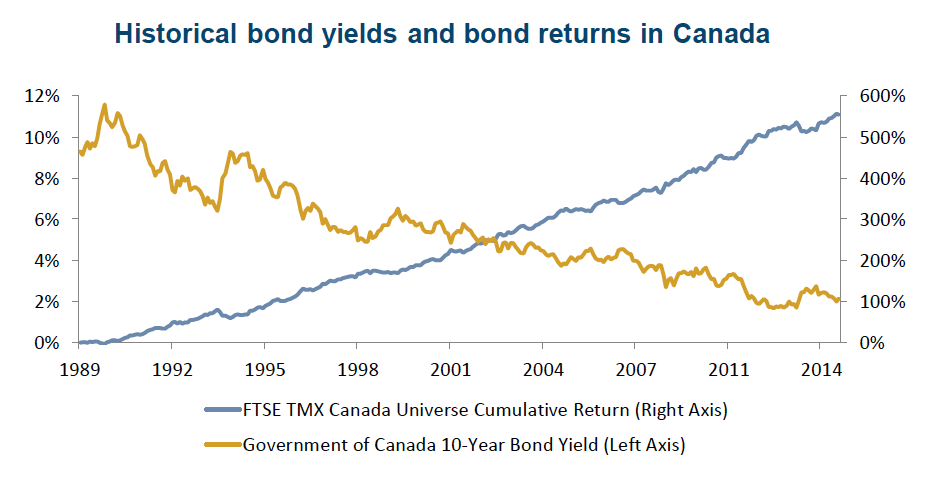
Source: Bloomberg and FTSE TMX Global Debt Capital Markets, monthly data from July 31, 1989 to September 30, 2014, Courtesy of NEI Investments

3. Living Cost Creep

Guess what, the cost of living is going up, not just in real dollars, but because what we consider to be a “normal” number of things in our life keep expanding. Don’t believe me? When your parents retired they probably had a tv and an antenna for it. The cost of their tv was whatever they paid for it, and whatever it might be to replace it if it broke. By comparison most people today have moved into the realm of digital television, PVRs, and digital cable subscriptions. It’s almost unheard of today to not have a smartphone with a data plan and our homes are now filled with a wide assortment of goods and products that would have been inconceivable to a previous generation. The same is true for cars. While cars themselves cost less, prices are kept high by the growing feature creep that have slowly moved into the realm of necessity.

4. You Aren’t Dying Fast Enough

This appointment is wayyyy out in the future...
This appointment is wayyyy out in the future…

Don’t get me wrong, I’m not in a rush or anything; but the reality is that you are going to live a long time, and in good health. Where as retirement was once a brief respite before the angel of death swooped in to grab you maybe a year or two later, living into your 90s is going to be increasingly common, putting a beneficial, but very real strain on retirement plans.

In short, retirement is getting harder and harder to plan. You’re living longer, with higher costs and fewer low risk options to generate a steady income.

What Should You Do?

Currently the market itself has been responding to the low interest rate environment. A host of useful  products have been launched in the past few years that are addressing things like consistent and predictable income for those currently transitioning into retirement. Some of these products are able to reduce risk, while others explore non-traditional investments to generate income. But before you get hung up on what product you should have you should ensure that your retirement plan is meeting your needs and addressing the future. There is no product that can substitute for a comprehensive retirement and savings plan, so call your financial advisor today if you have questions (and yes, that includes us!)

Want to discuss your retirement? Send us an email and we’ll be in touch right away!

← Back

Thank you for your response. ✨

The Media is Turning Market Panic up to 11 – Learn to Tune Them Out

The current market correction is about as fun as a toothache. Made up of a perfect storm of negative sentiment, a slowing global economy and concerns about the end of Quantitative Easing in the US have led to a broad sell-off of global markets, pretty much wiping out most of their gains year-to-date.

Screen Shot 2014-10-15 at 3.38.09 PM
This is what my screen looked like yesterday (October 15th, 2014). The little 52L that you see to the left of many stock symbols means that the price had hit a 52 week low. The broad nature of the sell off, and indiscriminate selling of every company, regardless of how sound their fundamentals tells us more about market panic than it does about the companies sold.

One of the focal points of this correction has been the price of oil, which is off nearly 25% from its high in June. Oil is central to the S&P/TSX, making up nearly 30% of the index. Along with commodities, energy prices are dependent on the expectation of future demand and assumed levels of supply. As investor sentiment have come to expect that the global demand will drop off in the coming year the price of oil has taken a tumble in the last few weeks. Combined with the rise of US energy output, also known as the Shale Energy Revolution, or fracking, the world is now awash in cheap (and getting cheaper oil).

Screen Shot 2014-10-16 at 12.32.36 PM
The price of Brent Crude oil – From NASDAQ

But as investors look to make sense out of what is going on in the markets they would be forgiven if all they learned from the papers, news and internet sites was a barrage of fear and negativity masquerading as insight and knowledge. The presumed benefit of having so much access to news would be useful and clear insight that could help direct investors on how to best manage the current correction. Instead the media has only thrown fuel on the fire, fanning the flames with panic and fear.

WTI & BrentContrast two similar articles about the winners and losers of a dropping price of oil. The lead article for the October 15th Globe and Mail’s Business section was “Forty Day Freefall”, which went to great lengths to highlight one big issue and then cloak it in doom. The article’s primary focus is the price war that is developing between OPEC nations and North American producers. Even as global demand is reportedly slowing Saudi Arabia is increasing production, with no other OPEC nations seemingly interested in slowing the price drop or unilaterally cutting production. The reason for this action is presumably to stem the growth of oil sand and shale projects, forcing them into an unprofitable position.


This naturally raises concerns for energy production in Canada, but it is not nearly the whole story. The Financial Times had a similar focus on what a changing oil price might mean to nations, and its take is decidedly different. For instance, while oil producing nations may not like the new modest price for oil, cheap oil translates into an enormous boon for the global economy, working out to over $600 billion a year in stimulus. In the United States an average household will spend $2900 on gas. Brent oil priced at $80 turns into a $600 a year tax rebate for households. Cheaper oil is also hugely beneficial to the manufacturing sector, helping redirect money that would have been part of the running costs and turning them into potential economic expansion. It’s useful as well to Emerging Economies, many of which will be find themselves more competitive as costs of production drop on the back of reduced energy prices.

A current map of shale projects, and expected shale opportunities within the United States and Canada.

Business Reporting isn’t about business, it’s about advertising revenues.

While Canada may have to take it on the chin for a while because of our market’s heavy reliance on the energy sector, weakening oil prices also tends to mean a weakening dollar, both of which are welcomed by Canadian manufacturers. Corrections and changing markets may expose weaknesses in economies, but it should also uncover new opportunities. How we report these events does much to help investors either take advantage of market corrections, or become victims of it. As we wrote back in 2013, business reporting isn’t about business, it’s about advertising revenues. Pushing bad news sells papers and grabs attention, but denies investors guidance they need.

If I Tell You This is Just a Correction, Will You Feel Better?

19_6_origA correction is typically defined as a drop of roughly 10% in the markets over a very short period of time. It’s often “welcomed” by investment professionals because it creates opportunities for new investments into liked companies that were previously trading above valuations considered appealing. Corrections are talked about as being necessary, beneficial and part of a normal and healthy market cycle, which all makes it sound somewhat medical. But in medical terms it falls under the category of being told your are about to receive 5 injections in short order and they are all going to hurt.

Screen Shot 2014-10-02 at 7.22.55 AM
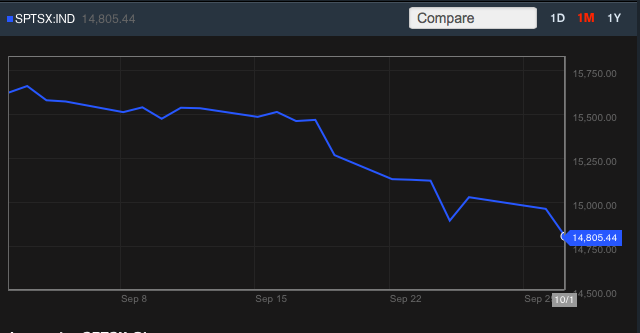
S&P TSX From Bloomberg – October 2, 2014

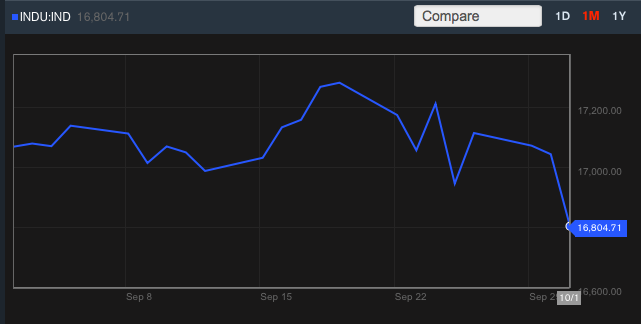
For investors the past couple of weeks in the market has felt like many such injections. The US markets have had a significant sell off, as have the global, emerging, and Canadian markets. All of it very quickly. The sudden drop has erased many of the gains in an already slow year and eaten dramatically into the TSX’s return which had been one of the best.

From Bloomberg - October 2, 2014
Dow Jones Industrial From Bloomberg – October 2, 2014

For many investors any sudden change in the direction of the markets can immediately give the sense that we are heading into another 2008. As Canadian (and American) investors are now 6 years older and closer to retirement the stakes also seem much higher. So here are some reasons why you shouldn’t be concerned about the most recent market volatility, and what you can do to make them work to your advantage.

1. Everyone is nervous.

For several months people have been calling for a correction. Investor sentiment is neutral and consumer confidence has dipped, meaning that overall atmosphere is somewhat negative for the markets. But that can be a good thing. Market crashes and bust cycles typically show up when people are exuberant and feel euphoric about markets. Bad news is swept aside and the four most dangerous words in investing “This time it’s different” become the hallmark of the new bubble. It’s rare that negativity breeds an over exuberant market.

2. The Economy isn’t running on all cylinders.

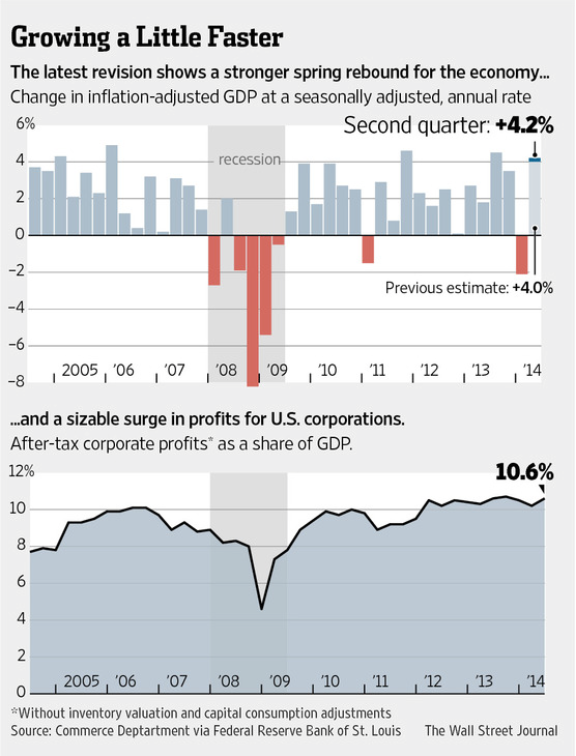
There certainly have been encouraging numbers in the United States, and even recently Canada has had some improved economic numbers, but by and large there hasn’t been a big expansion yet in the economy. Unemployment is still high, especially in Europe and the labour force has shrunk (which can skew the unemployment numbers) while corporations continue to sit on enormous piles of cash, to their detriment. A market crash usually follows an overheated economy that begins to over-produce based on faulty views about future growth potential. That isn’t where we are yet.

3.  Corporations are really healthy, and so are investors.

Canadians may still have bundles of debt, but the US is a different story. American corporations and households have been heavily deleveraging since 2008. In fact corporations in the US look to be some of the healthiest in decades, showing better earnings to debt ratios than previously thought. Crashes have as much to do with over-production as they do with out-of-control borrowing. The two go hand in hand and both factors are currently missing from the existing economic landscape.

4. Energy is cheap. Like, really cheap. 

Remember when oil was more than $100 a barrel? High energy prices, and the expectation of future high energy prices can really put the kibosh on future returns and throw cold water all over the market. As we’ve previously said, energy is the lifeblood of civilizations and a steady supply of affordable energy is what separates great economies from poor ones. (Look, we tweeted this earlier! See, twitter is useful. Follow us @Walker_Report)

https://twitter.com/Walker_Report/status/517604263493894145

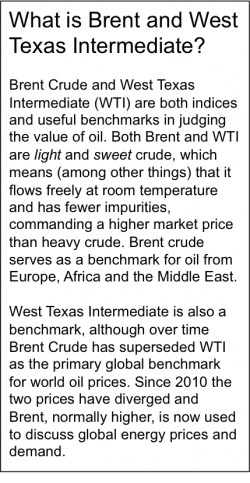
West Texas Crude Oil Price over the last 3 months - from NASDAQ - October 2, 2014
West Texas Crude Oil Price over the last 3 months – from NASDAQ – October 2, 2014

The arrival and growth of American gas production combined with changing technologies and increasing efficiencies on existing energy use means that global demand is slowing, while global supply is increasing. In fact in March of last year, the head analyst for energy at Citigroup published a paper describing exactly this trend of improved efficiency with new sources as a mix for lower energy prices in the long term. Whether this proves true over the next two decades is hard to say, but what is true is that cheap energy helps economies while expensive energy hinders it. Since economies have already adjusted to the higher price over the last few years, a declining price is a tailwind for growth.

Does this mean that there aren’t any risks in the market? Absolutely not. Europe is having a terrible year as a result of persistent economic problems and Russian intransience, and many Emerging Markets are showing the strain of continued growth, either through corruption or exceeding optimism about the future. Those pose real risks, but taken in the grand scheme of things our outlook remains positive for the markets.

How can I make this all work for me?

So what can you do as an investor to make a correction benefit you? The first piece of advice is always the same. Sit tight. Dramatic changes to your investments when they are down tends to lead to permanent losses. Secondly, rebalance your account periodically as the market declines. On the whole equity funds will lose a greater proportion of their value than fixed income, leaving a balanced portfolio heavier in conservative than growth investments. Rebalancing gives you a chance to buy more units of growth funds at a lower price while adding greater potential for upside as the market recovers. Lastly, if you have money sitting on the sidelines, down markets are great opportunities to begin Dollar-Cost-Averaging. For nervous investors this is a great way to ease into the markets even as markets look unstable. You can read about it here, but I recommend watching the movie below for a nice visual explanation. Now, take your medicine.

Throwing Cold Water On Investor Optimism (Not That We Needed Too)

Screen Shot 2014-09-30 at 2.41.51 PM
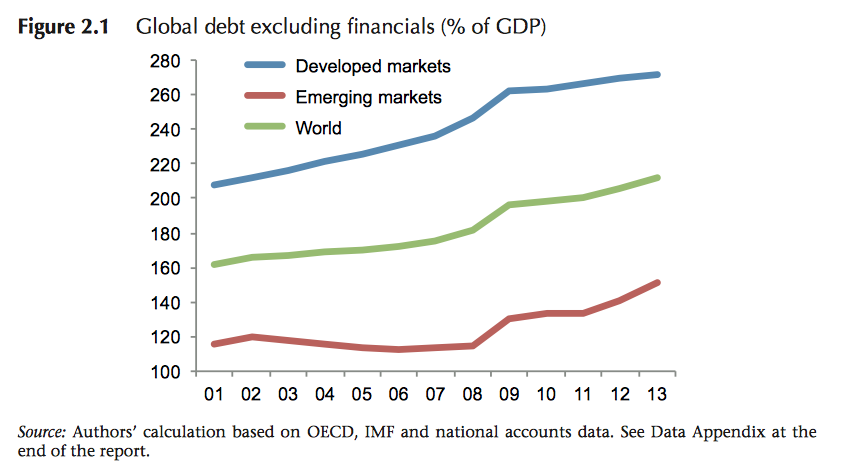
From The Geneva Report

Yesterday the 16th Geneva Report was released bearing bad news for everybody that was hoping for good news. The report, which highlighted that debt across the planet had continued to increase  and speed up despite the market crash of 2008, is sobering and seemed to cast in stone that which we already knew; that the global recovery is slow going and still looks very anemic.

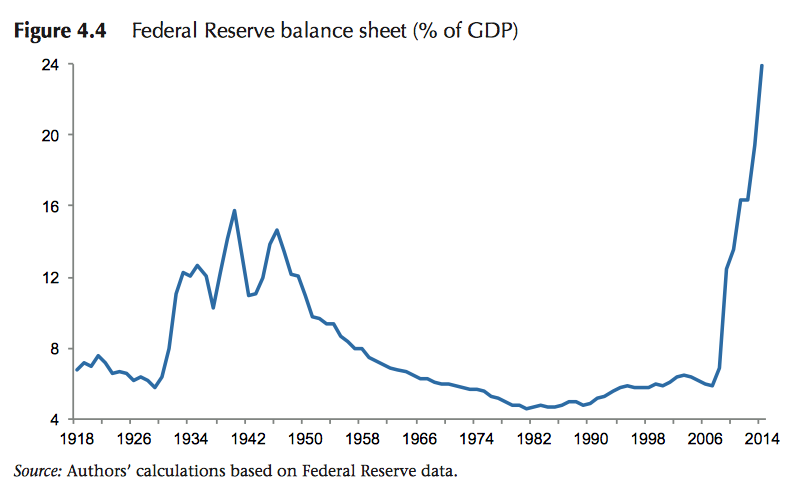
The report is detailed and well over a hundred pages and only came out yesterday, so don’t be surprised if all the news reports you read about it really only cover the first two chapters and the executive summary. What is interesting about the report is how little of it we didn’t know. Much of what the report covers (and in great detail at that) is that the Eurozone is still weak, that the Federal Reserve has lots of debt on its balance sheets, but that it has helped turn the US

A look at the Fed's Balance Sheet from the Geneva Report
A look at the Fed’s Balance Sheet from the Geneva Report

economy around, that governments have been borrowing more while companies and individuals borrow less, and that economic growth in the Emerging Markets has been accompanied by considerable borrowing. All of this we knew.

What stands out to me in this report are two things that I believe should matter to Canadian investors. First is the trouble with low interest rates. Governments are being forced to keep interest rates low, and they are doing that because raising rates usually means less economic growth. But as growth rates have been weak, nobody wants to raise rates. This leads to a Catch-22 where governments are having to take direct measures to curb borrowing because rates are low, because they can’t raise rates to curb borrowing.

This has already happened in Canada, where the Bank of Canada’s low lending rate has helped keep housing prices high, mortgage rates down and debt levels soaring. To combat this the government has attempted to change the minimal borrowing requirements for homes, but it hasn’t done much to curb the growing concern that there is a housing bubble.

The second is the idea of “Economic Miracles” which tend to be wildly overblown and inevitably lead to the same economic mess of overly enthusiastic investors dumping increasingly dangerous amounts of money into economies that don’t deserve it just to watch the whole thing come crashing down. Economic miracles include everything from Tulip Bulbs and South Sea Bubbles to the “Spanish Miracle” and “Asian Tigers”, all of which ended badly.

The rise of the BRIC nations and the recent focus on the Frontier Markets should invite some of the same scrutiny, as overly-eager investors begin trying to fuel growth in Emerging Markets through lending and direct investment, even in the face of some concerning realities. It’s telling that the Financial Times reported both the Geneva Report on the same day that the London Stock Exchange was looking to pursue more African company listings, even as corruption and corporate governance come into serious question.

All of this should not dissuade investors from the markets, but it should be seen as a reminder about the benefits of diversification and it’s importance in a portfolio. It is often tempting to let bad news ruin an investment plan, but as is so often the case emotional investing is bad investing.

I’ve added an investment piece from CI Investments which has been floating around for years. It pairs the level of the Dow Jones Industrial Average  with whatever bad news was dominating the market that year. It’s a good way to look at how doom and gloom rarely had much to do with how the market ultimately performed. Have a look by kicking the link! I don’t want to Invest Flyer


***I’ve just seen that the Globe and Mail has reported on the Geneva Report with the tweet “Are we on the verge of another financial crisis” which is not really what the report outlines. 

Why I Just Bought A BlackBerry

passport_desk

In the hunt for returns in the jungle of investing we rarely talk about “quality of life”, but it should be remembered that the whole reason for investing is precisely that; to preserve and improve one’s quality of life, either through retirement savings, covering and planning for education or making purchasing a house feasible. That’s what this is all for.

So it’s easy then to get lost in the mechanics of investing. At the charts (see #MarketGlance) the news and the conferences:

https://twitter.com/Walker_Report/status/515164444604006400

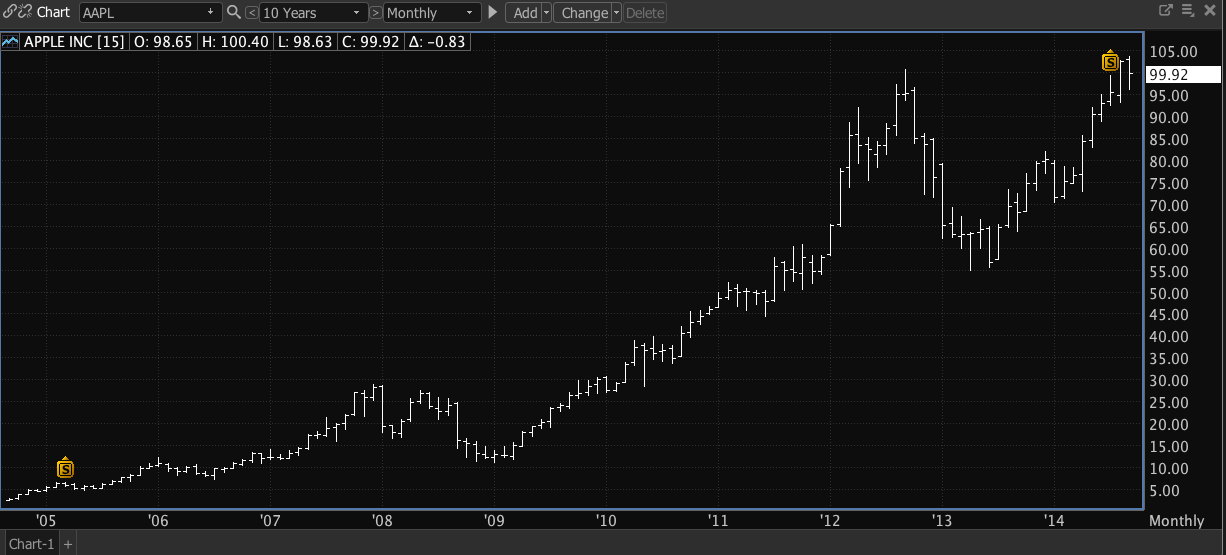
This tends to create a disconnect between how we experience the world and how we want our investments to work. For instance I am a big believer in Apple products. (AAPL). I like their phones and computers, I’m in their ecosystem, and as an investor I am impressed at their success as a company. But as a user of an iPhone I’ve started to wonder just how much time I waste under the pretence  of having a highly capable phone.

Apple Stock over the last ten years

When the iPhone first came to Canada I was struck by the idea that I could look up directions easily, check the internet quickly for information and have access to my emails. When first introduced the iPhone was a tool of productivity. Since then the smart phone market has been flooded and “feature creep” is definitely a term I would use to describe what many of these phones can now do. Meanwhile productivity has taken a backseat to a host of other competing and primarily entertaining functions. In short, I was tired of wasting time on my phone doing nothing.

And along came Blackberry offering, in some ways, a phone that promises to do less fun stuff, and do more work stuff. And while I had shunned Blackberry for years, based largely on my own terrible experience with the older models and their tiny screens, the new Passport seemed to offer me not simply a useful phone for doing work, but also terrible one to watch Netflix on. Because why am I watching Netflix on my phone in the first place?

Are angry birds really the best use of your time on a $1000 phone?

We live in an age of giant flat TVs with instant movie watching capabilities, but for reasons beyond me I’ve taken to watching stuff on my phone. So while I love Apple, and believe that they have a great company, I’m hoping that I can improve my quality of life by degrading my phone experience somewhat.

Maybe there is hope for Blackberry yet.

Recommended Read: The End of Absence: What We’ve Lost in a World of Connection by Michael Harris

51BrEAxPAHL

Don’t Be Surprised That No One Knows Why The Market Is Down

Money CanLast Friday I watched the TSX start to take a precipitous fall. The one stock market that seemed immune to any bad news and had easily outperformed almost every other index this year had suddenly shed 200 points in a day.

Big sell-offs are common in investing. They happen periodically and can be triggered by anything, or nothing. A large company can release some disappointing news and it makes investors nervous about similar companies that they hold, and suddenly we have a cascade effect as “tourist” investors begin fleeing their investments in droves.

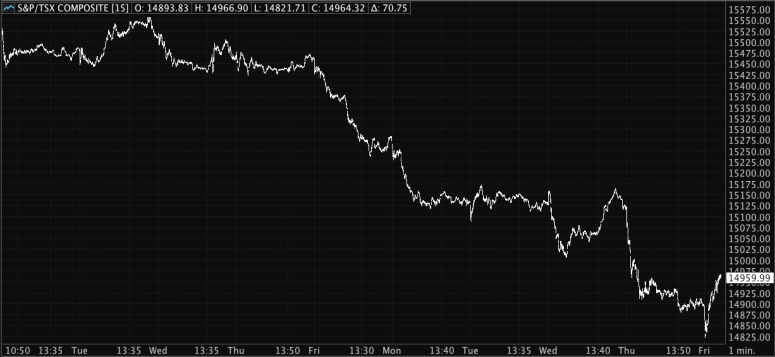
This past week has seen a broad sell-off across all sectors of the market in Canada, with Financials (Read: Banks), Materials (Read: Mining) and Energy (Read: Oil) all down several percentage points. In the course of 5 days the TSX lost 5% of its YTD growth. That’s considerable movement, but if you were looking to find out why the TSX had dropped so much so quickly you would be hard pressed to find any useful information. What had changed about the Canadian banks that RBC (RY) was down 2% in September? Or that TD Bank (TD) was down nearly 5% in a month? Oil and gas were similarly effected, many energy stocks and pipeline providers found themselves looking at steep drops over the last month. Enbridge (ENB) saw significant losses in their stock value, as did other energy companies, big and small, like Crew Energy (CR).

Screen Shot 2014-09-26 at 11.08.02 AM
The S&P TSX over the last five days

All this begs the question, what changed? The answer is nothing. Markets can be distorted by momentum investors looking to pile on to the next hot stock or industry, and we can quibble about whether or not we think the TSX is over valued by some measure. But if you were looking for some specific reason that would suggest that there was something fundamentally flawed about these companies you aren’t going to have any luck finding it. Sometimes markets are down because investors are nervous, and that’s all there is to it.

Market panic can be good for investors if you stick to a strong investment discipline, namely keeping your wits about you. Down markets means buying opportunities and only temporary losses. It help separates the real investors from the tourists, and can be a useful reminder about market risk.

Screen Shot 2014-09-26 at 11.19.50 AM

So was last Friday the start of a big correction for Canada? My gut says no. The global recovery, while slow and subject to international turmoil, is real. Markets are going to continue to recover, and we’ve yet to see a big expansion in the economy as companies deploy the enormous cash reserves they have been hoarding since 2009. In addition, the general trend in financial news in the United States is still very positive, and much of that news has yet to be reflected in the market. There have even been tentative signs of easing tensions between Russia and the Ukraine, which bodes well for Europe. In fact, as I write this the TSX is up just over 100 points, and while that may not mean a return to its previous highs for the year I wouldn’t be surprised if we see substantial recoveries from the high quality companies whose growth is dependent on global markets.

Forget Scotland, Canada is Playing Its Own Dangerous Economic Game

house-of-cardsIn a few hours we will begin finding out the future of Scotland and the United Kingdom, and we may be witness to one of the most incredible social and economic experiments  in the history of the Western World.

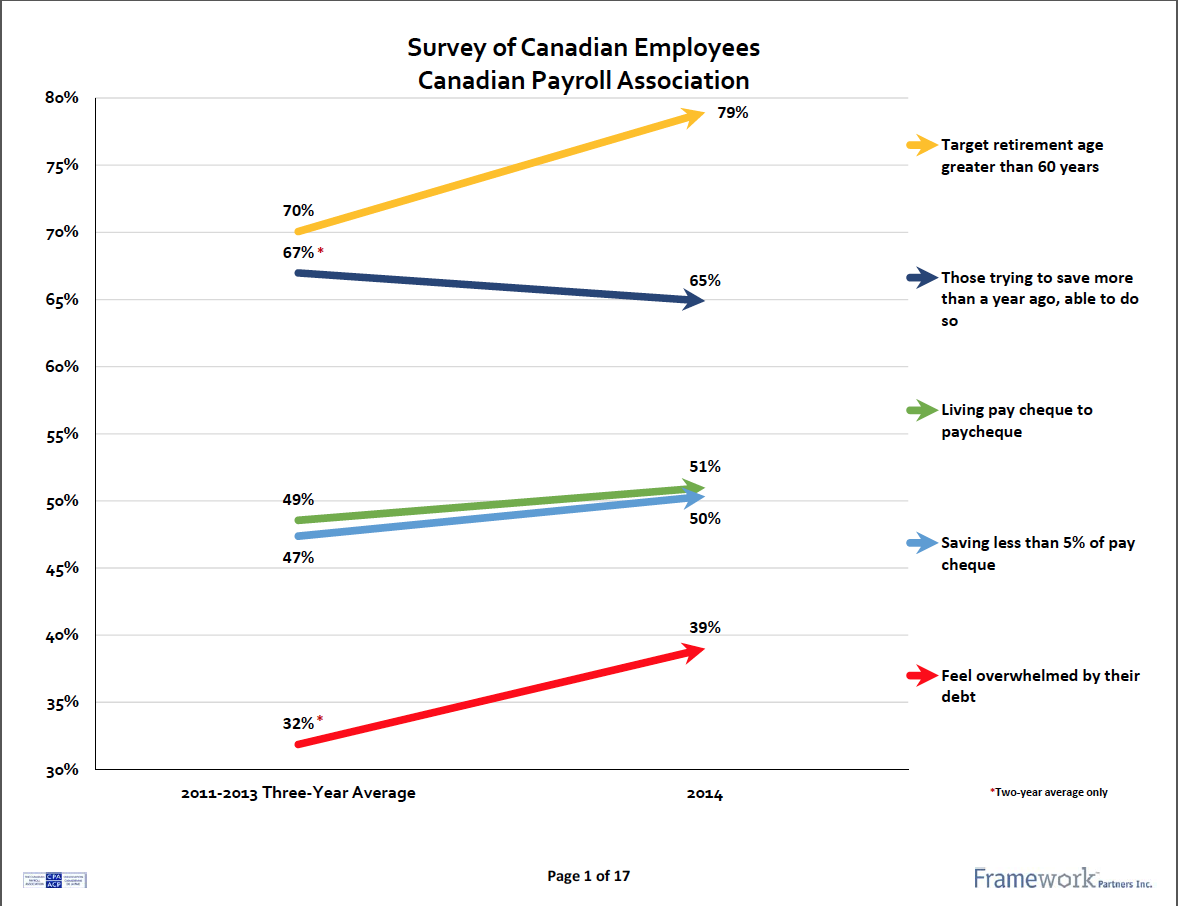
But while many suspect that a yes vote for Scottish independence may cast an uncertain economic future, it shouldn’t be forgotten that as Canadians we are also going through our own uncertain economic experiment. According to a survey conducted by Canadian Payroll Association and released this month, 25% of Canadians are living paycheque to paycheque, with nothing left in their accounts once their bills have been paid for.

Screen Shot 2014-09-18 at 4.57.44 PM

In addition, the majority of Canadians have less than $10,000 set aside for emergencies and these numbers get (unsurprisingly) worse as you look at various age groups. Young Canadians are the worst off, with 63% saying they are living paycheque to paycheque between the ages 18 to 29.

But when it comes to planning for retirement, the numbers are significantly more dire. More and more Canadians are expecting to delay their retirement, citing insufficient funds for their retirement nest egg. Even as people (correctly) assume that they will need more money to last them through retirement, 75% of those surveyed said they had put away less than a quarter of what they will need, and for those Canadians getting closer to retirement (north of 50), 47% had yet to get to even a quarter of their needed savings.

None of this is good news, and it undercuts much of the success of any economic growth that is being reported. While the survey found that people were trying to save more than they had last year it also highlights that many people felt that their debt was overwhelming, that their debt was greater than last year and that mortgages and credit cards by far accounted for the debt that was eating into potential savings.

The report has a few other important points to make and you can read the who thing HERE. But what stands out to me is how economies and markets can look superficially healthy even when the financial health of the population is being eroded. This is a subject we routinely come back to, partly because its so important, and partly because no one seems to be talking about it past the periodic news piece. Our elections focus on jobs, taxes and transit, but often fail to begin addressing the long term financial health of those voting.

← Back

Thank you for your response. ✨

From The Desk of Brian Walker: The Hardest Part of Retirement

rrsp-eggThe moment you retire you are expected never work again.

Think about that for a minute. Every dollar you’ve ever EARNED has been EARNT. Your bank accounts will never be replenished again from your toil. All of your income from here on will be the result of your Canada Pension and OAS, any private pensions you are a part of and your savings. This is your life and your future boiled down to a number.

And as most companies stopped defined benefit pensions, many Canadians have had to turn (usually out of necessity) to investing in the market to grow and fund their retirement.

I have yet to retire, although I admit to being closer to it now than I was 20 years ago when I started this business, and I have to acknowledge that I find the prospect of retiring frightening. Work has occupied most of my life, and while I enjoy travelling and have a number of hobbies I have developed over the years I wonder if they can fill my days. But the thing that always sits at the back of my mind is about the money.

Because regardless of how well you have done in life there is always the potential to lose money in the markets, but so long as you are working you can replenish some of those losses. Once you have retired however, that’s all there is. A financial loss can be permanent in retirement and its impact will last the rest of you life, defining all your future decisions.

photoFor my currently retired and retiring clients the thing that has surprised me the most is that while these concerns are very present, they sit alongside a concern that should really be receding: market growth. For all the worry about protecting their retirement nest egg from severe downturns and unforeseen financial disasters, many investors are still thinking like they are accumulating wealth and have twenty years until they retire.

When it comes to investing, retirees need to be looking at investments that fit the bill of dependability and repeatability. Dividend paying stocks, balanced income funds and certain guaranteed products offer exactly that type of solution, kicking out regular, consistent income that you can rely on regardless of the market conditions. And as more and more Canadians head towards retirement we are seeing a growing base of useful products that fit these needs beyond the limited yield of GICs and Annuities.

The downside of these products is that they are all but certain to be constrained when it comes to growth. They simply will never grow at the rates of some companies, certain investments or aggressive markets by design. That’s a good thing, but nearly a quarter of a century of investing have instilled in many Canadians a Pavlovian response to the idea that investing must equal growth. But investors will be much better served by looking past desire for an ever expanding portfolio and towards investments that secure their long term income.

I’m not suggesting that once you retire you stop participating in the market, or that having any growth in your portfolio is wrong, or that it represents some kind of fault in your retirement planning. What is at stake though is controlling and protecting your savings and lifestyle by making your investment portfolio subservient to those needs over growth focused market participation. Your retirement could last almost as long as your entire working life, and easily as long as the amount of time you saved for your retirement. There will be plenty of things to worry about in retirement, and lots of other financial needs that must be addressed; from comprehensive estate planning to out-of-pocket health care costs. Why complicate your retirement needs by worrying about whether your are participating fully in bull markets, or worse, bear markets?


If you would like to discuss how we can help your retirement needs, or how we can re-tune an account for retirement please send us a note!

← Back

Thank you for your response. ✨

Super Cool New Device Won’t Fix the Economy

Apple just unveiled its new watch (called the Apple Watch no less) and briefly I watched the stock price climb quickly as the promise of Apple’s great new thing came to life. But before Apple had its big webcast yesterday, I was actually having a look at this nifty thing called NAVDY.

NAVDY seems like a great idea and its one of many many great things that is regularly and constantly being developed by an increasingly connected world that funds great ideas through websites like kickstarter.com. But like many new great things that I see, most of them won’t dramatically change the economy in any significant way. Specifically, none of these new businesses will create a great number of new jobs.

This may seem like a small point to quibble over, however when we look through the prominent industries that tend to occupy the business sections of newspapers, like Apple Computers, you begin to realize that very few of these businesses do much in the way of employment. Improvements in productivity, automation and robotics continue to eat away at an industrial base that forces young people into retail sectors, and an older generation into early retirement.

More people are employed in Canada year-over-year, however it has involved net losses in high employment sectors combined with net gains in high-education sectors.
More people are employed in Canada year-over-year, however it has involved net losses in high employment sectors combined with net gains in high-education sectors. Many of the jobs that employ lots of Canadians present opportunities for automation. Click on the image to view a larger version.
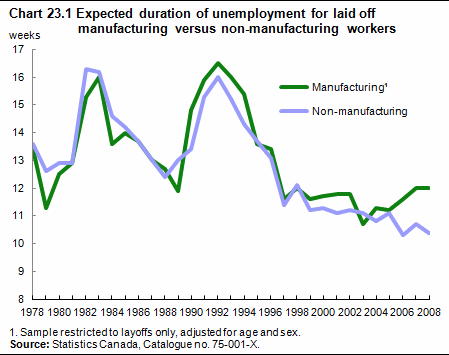
From Stats-Can - the widening gap in unemployment spells. Being employed in manufacturing meant you could be out of work longer in Canada than in non-manufacturing based jobs.
From Stats-Can – the widening gap in unemployment spells. Being employed in manufacturing meant you could be out of work longer in Canada than in non-manufacturing based jobs.

Where there were once middle class factory jobs for thousands of Canadians they are now increasingly rare, and often exist through substantial subsidization from the provincial or federal government.

This story isn’t new. In fact it’s so old now that the first real impact of it dates back to the 1980s. But as time marches on and we are increasingly numb to this reality it may have escaped our attention just how great a challenge this is posing to our society.

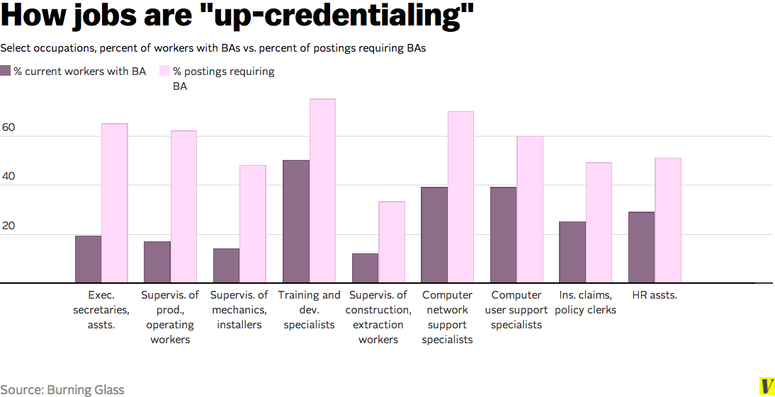
For instance, today, Vox.com posted an article about “Why you need a bachelor’s degree to be a secretary“, focusing on how many jobs are “up-credentialing”.

Screen_Shot_2014-09-09_at_11.31.55_AM.0

Industrial decline also plays an indirect role in rising housing markets in cities. It’s easy to see that falling employment in traditionally well paying blue-collar sectors may contribute to higher crime rates and stagnant wages, but it also tells us where it makes the most sense to live. Young Canadians finishing university are unlikely to move back to Windsor when the best jobs are now in Toronto, fuelling a condo boom while raising housing prices across the city to the point of being unaffordable to new families.

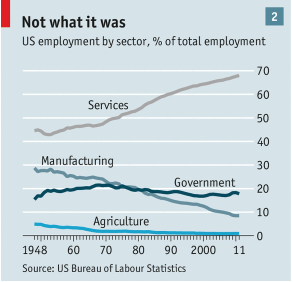
From the Economist, January 18, 2014: Briefing: The Future of Jobs - Retail services continue to grow as other market sectors decline.
From the Economist, January 18, 2014: Briefing: The Future of Jobs – Retail services continue to grow as other market sectors decline.

All of this speaks to a larger and more looming issue for Canadians, which is that continued improvements in automation place long term pressure on things like infrastructure and wealth distribution and raise other questions about middle class viability. In other words, we seem eager to introduce new technologies into our lives, but each of these technologies doesn’t just reduce jobs, they reduce jobs that employ lots of people. The January 18th, 2014 Economist ran a frightening story about this kind of automation and that up to 47% of existing jobs could come under pressure by new forms of cost effective robotics and computers.

It’s often hard to see changes that are incrementally slow, but changes are occurring, and over the coming years and decades these changes will likely shake out in ways that we aren’t expecting. But for Canadians looking to save and retire in the future, many of these trends are coming together in worrying ways. In the form of higher educational costs, more limited job opportunities, higher costs of living and potential unemployability, and sadly the new industries and businesses we are quick to promote won’t likely be enough to stave off a society that is undergoing a significant shift in how it employs people.

All of this is a lot to explain in a single article. But if you’d like a simple video that does a good job of scaring you, please watch this video by Youtuber CPG Grey, whose excellent video from a few weeks ago got widely picked up and shared on the web. Otherwise, if you’d like to talk about getting set-up with a savings plan, either for yourselves and kids please give me a call!

← Back

Thank you for your response. ✨

Why The ALS Ice Bucket Challenge Made Economic Sense

This week it seemed that much of the media hype around the ALS Ice Bucket Challenge died down as it gradually became eclipsed with other news. In case you somehow missed what this viral sensation was, it went something like this. What started as a youtube video of someone giving $100 to an ALS charity instead of having a bucket of cold water dumped on your head, spread quickly into having a bucket of cold water dumped on your head and also giving money to an ALS charity, followed by the donator/victim challenging several other people. These were filmed and placed on Facebook and youtube and people have been following it.

For the several charities that raise money for ALS research, the challenge has proved to be an enormous windfall, netting more than $100 million in donations in excess of their normal annual fund raising. But all of the cheering and success  brought in the professional cynical class of journalists. There must be a downside, and by god they would report it.

I’m not going to go into the details of the criticisms here, but here are some articles you can read if you are so inclined. Instead I want to show why the economics of which charities we give to makes more sense than critics often believe.

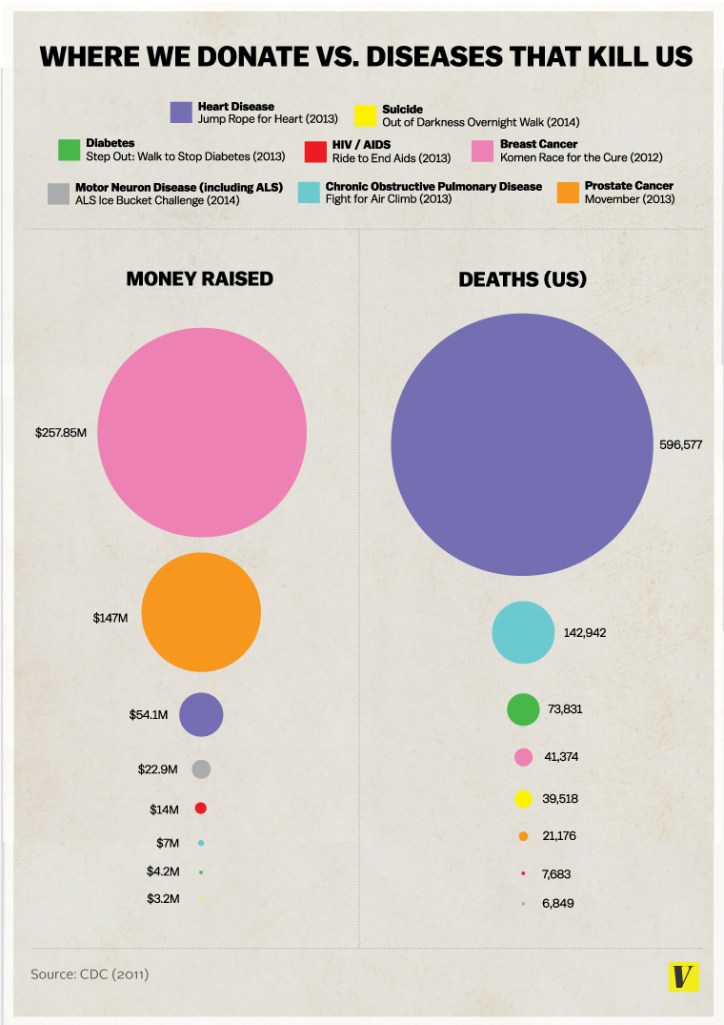
The standard argument goes something like this: We contribute far more money to diseases that won’t likely kill us than the ones that do. Humans are clearly illogical and if they had any sense we would direct all our money into charities that dealt with the things most likely to wipe us off the planet. This misalignment of money versus danger is similar to why we are so scared of terrorists than swimming pools, even though you are far more likely to drown in a swimming pool than be killed by terrorists.

Donating.vs.Death-Graph.0

Except that it’s all wrong! People give money to the charities that matter most to them because they understand something about diseases that kill you better than people who just look at statistics.

For instance, Heart Disease is the number one killer in almost every western country, with (I believe) the exception of Portugal. So why aren’t we more scared of heart disease? Because it typically doesn’t kill you until you are already old. While your odds of getting and dying from heart disease start to rise significantly when you reach 60, since 1952 the cardiovascular death rate in Canada has dropped by 75% and nearly 40% in the last decade due to improvements in medicines, surgical procedures and prevention efforts according to Statistics Canada. In other words we’ve already made great strides in reducing unnecessary death from heart disease, and reducing the likelihood that heart disease will strike early is as easy as simply eating a healthier more balanced diet.

Cancer on the other hand isn’t fully understood. We don’t know why some people get it, and why some do not. We don’t know why some people have cancer go into remission and why some do not. If you have survived cancer you have likely been through a hell of an ordeal, as almost every known treatment is as bad as the disease you are fighting. If you’ve watched a loved one pass away from the disease you know how difficult it was and had to watch someone slip away, often in pain and great discomfort, losing control of their bodies and losing even their sense of self.

The mistake that the statistics cover up is this. You must die of something. People do not simply get old and die. They get old, weaker with time, and finally susceptible to something far more likely to kill them. Increasingly heart disease is something that you die of when you are old. Cancer by comparison can strike you down in the prime of your life. You can get cancer in your 20s, 30s, 40s, 50s, 60s, or 70s. Its a difficult disease to overcome, survivors are acutely aware that they have a high chance of reoccurrence and people who have lost a loved one feel the pain of a prolonged illness. In that context we give money to charities that fight diseases that leave a strong emotional scar, like cancer or in this case ALS, and that does make economic sense.

We took a little time off this week following labour day. We’ll be back next week with regular postings!