What Could a Faltering Condo Market Mean?

As summer has worn on there have been a growing number of headlines focused on Toronto’s stagnant condo market. In short, the number of units for sale continues to grow as buyers refuse to pay the elevated prices being demanded by sellers. Interestingly sale activity has been stagnant and prices haven’t really moved despite the growing inventory.

The knock on effect has been a significant slow down in new developments. This has led to growing concern that prices will rise in the future as new supply is postponed or canceled, and pressure is growing to get interest rates lowered to help stimulate buyers.

All of this sounds a touch too convenient for me. One of the reasons (not the only reason, but a significant one) we face a “cost of living crisis” is that housing has increasingly been seen as an investment, one that people have had greater faith in than other traditional assets. But housing booms aren’t new, and it seems odd to me that our chief concern about a growing glut of over-priced condos will be that condo prices will be higher in five to ten years. A more pressing concern is likely that condo investors, and the banks that have provided the mortgages, are deeply concerned that if buying doesn’t resume property prices could take a serious decline, erasing Canadian wealth and forcing Canadian banks to write down balance sheets.

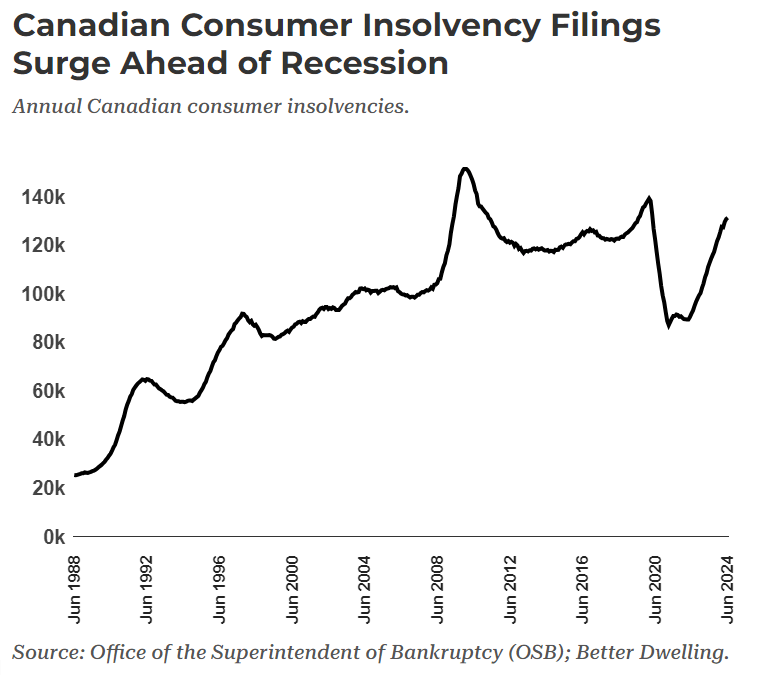
For many this would be a welcome relief, potentially opening Toronto’s property ladder and easing some of the burden of the cost of living. But property ownership has been the source of growth of Canadian wealth over the past twelve years. According to Credit Suisse, Canadian wealth rose by two thirds from 2010 to 2022, however Canadian economic growth was quite weak, with income only rising by 15% over the same period. In other words, if Canadians are richer today than they’ve been in the past, its because they owned homes, not because the economy was paying more. Independently, we might conclude that there was something unique happening with Toronto’s condo market, but this news goes hand in hand with other worrying economic trends in the country. Notably, Canadian consumer insolvencies have been steadily climbing while unemployment has also been climbing. The unsold condo inventory is the highest it’s been since 2008, while data shows that household credit growth has been decelerating. Other disturbing news includes the expansion of the public sector, which now accounts for 1 in every 4 employed Canadians while public sector growth accounted for 49% of our most recent GDP growth.

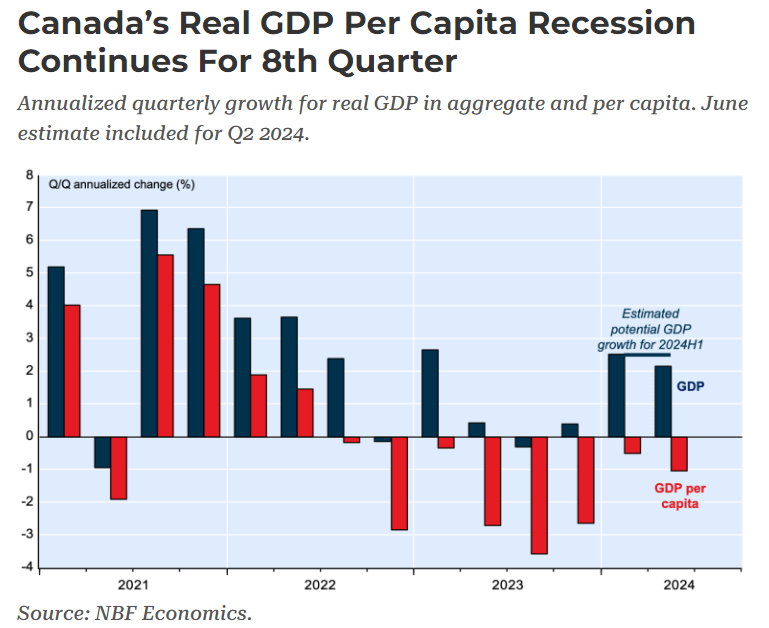
2024 has been a disappointing year for Canadian economic news. Aside from the headlines above, one of the most striking statistics is that Canada is losing economic ground per capita. Much of our GDP growth is coming from high immigration, in effect importing new economic activity but at a rate below what is needed to expand the economy on a per person basis, and it has been doing so for more than 2 years. We are, in effect, in a “per capita recession”.

Since 2022, interest rate increases have pummeled the economy, particularly real estate, which has grabbed a lot of headlines. But Canada’s real estate market has shown considerable resilience through the first few years. However, investors that over are extended and feel the building pain from higher borrowing costs are starting to exit their investments. That hasn’t been altered by the recent interest rate cut which has yet to stimulate much new buying activity. Pressure is building from sectors of the economy to see rates fall and hopefully ease or reverse the effects of higher borrowing costs, but it remains to be seen whether rate cuts can happen at a pace both responsibly and fast enough to substantially change the direction of Canada’s economy (if it can at all).

On Monday, August 5th, changes in interest rates from the Bank of Japan reportedly triggered an unwinding of a popular “carry trade”, in which large institutions borrowed money in Japan for low cost, and then invested that money in US stocks. A hike in the BoJ’s lending rate had forced up the value of the yen, forcing the sale of those same US investments to pay back the now more expensive Japanese loans. Markets have recovered quickly, but it shook investor confidence, and while the explanation may not be wholly accurate, it’s a useful reminder that debt, which offers real value when used in moderation, can make economies extremely fragile. For years Canada has had the highest level of household debt to disposable income of any G7 country, and much of that was tied up in housing. What happens next is anybody’s guess.

Aligned Capital Partners Inc. (“ACPI”) is a full-service investment dealer and a member of the Canadian Investor Protection Fund (“CIPF”) and the Canadian Investment Regulatory Organization (“CIRO”).  Investment services are provided through Walker Welath Management, an approved trade name of ACPI.  Only investment-related products and services are offered through ACPI/Walker Wealth Management and covered by the CIPF. Financial planning services are provided through Walker Wealth Management. Walker Wealth Management is an independent company seperate and distinct from ACPI/Walker Wealth Management.

Looking Back on 2021

Its traditional that the end of a year should stimulate some reflection on the past and the future, and so in the spirit of tradition I thought I’d take some time to look over some of the stranger and more surprising aspects of 2021.

China

While 2021 brought the pandemic *closer* to an end through the distribution of vaccines, markets underwent some fairly dramatic reversals over the course of the year. For instance China looked to be the principal economy in January. Following its own strict enforcement of Covid restrictions and solid economic performance, China seemed to be an earlier winner by the beginning of 2021, and set to enjoy robust growth through the year.

By March the tide was shifting however. China’s leader, Xi Jinping, proved to be every bit committed to his past comments about protecting and strengthening the CCP over free market concerns. Several billionaires, notably Jack Ma the founder of Alibaba, disappeared for long periods before reemerging only to publicly announce that they would be stepping down from their roles.

However, even while China was shaking down its billionaires and upsetting foreign nations, a new economic threat appeared in the form of a housing bubble looking ready to burst. Evergrande, one of the country’s largest property developers announced that it could not finance its debt anymore and looked likely to default. This news was unwelcome for markets, but for China hawks it fit their long standing belief that China’s strength has been built on a mountain of unsustainable debt, with property one of the most vulnerable sectors of the economy.

The finer points of China’s housing market are too nuanced to get into here, but it’s enough to know that the property bubble in China is large, built on sizeable debt and could take some time to deflate (if it does) and no one is sure what the fallout might be. Combined with China’s ongoing policy of “Covid Zero” – an attempt to eradicate the virus as opposed to learning to live with and manage it, we head into 2022 with China now a major outlier in the Asian region.

Inflation

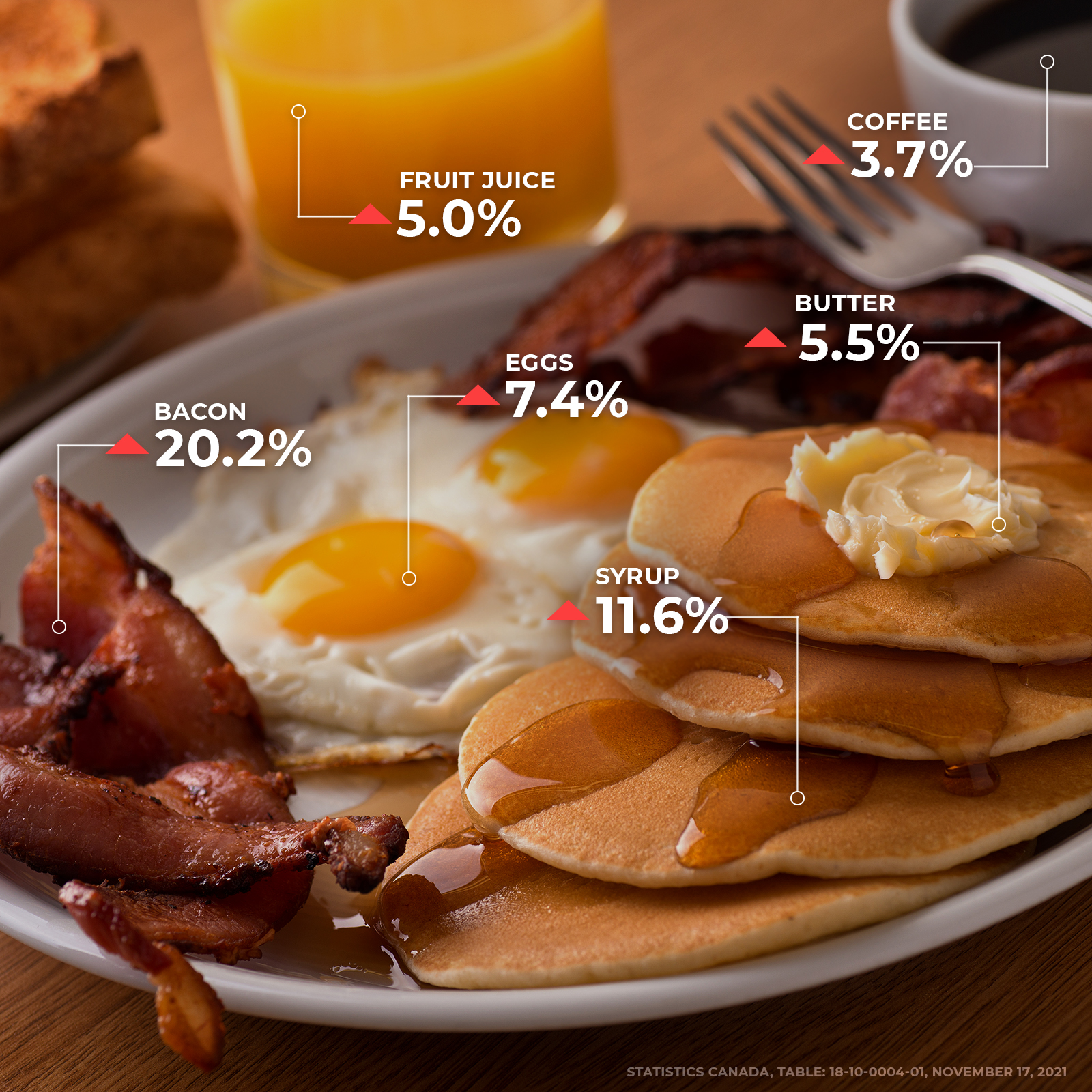
Inflation was probably the other most discussed and worrying trend of 2021. Initially inflation sceptics seemed to win the argument, as central banks rebuffed worries over rising prices and described inflation as transitory. That argument seemed to wane as we entered late Q3 and prices were indeed a great deal higher and didn’t seem to be that “transitory” anymore. Inflation hawks took a victory lap while news sites began to fill up with worrying stories about rising prices on household goods.

The inflation story remains probably the worst understood. Inflation in Canada, as in other Western nations has been going on for sometime, and its effects have been under reported due to the unique nature of the CPI. But some of the concern has also been overwrought. Much of the immediate inflation is tied to supply chains, the result of “Just-in-time” infrastructure that has left little fat for manufacturers in exchange for lower production costs. Bottlenecks in the system will not last forever and as those supply chains normalize that pressure will recede.

The other big pressure for inflation is in energy costs, but that too is likely to recede. Oil production isn’t constrained and prices, while higher than they were at the beginning of the pandemic are lower than they were in 2019. In short, many of the worries with inflation will not be indefinite, while the issues most worrying about inflation, specifically what it costs to go to the grocery store, were important but underreported issues before the pandemic. Whether they prove newsworthy into the future is yet to be seen.

*Update – at the time of writing this we were still waiting on more inflation news, and as of this morning the official inflation rate for the US over the past year was 7%. Much of this is still being chalked up to supply chains squeezed by consumer demand. An unanswered question which will have a big impact on the permanence of inflation is whether this spills into wages.

This political advertisement from the Conservatives ruffled many feathers in late November

Housing and Stocks – Two things that only go up!

If loose monetary policy didn’t make your groceries more expensive, does that mean that central bankers were right not to worry about inflation distorting the market? The answer is a categorical “No”. As we have all heard (endlessly and tediously) housing prices have skyrocketed across the country, particularly in big cities like Toronto and Vancouver, but also in other countries. The source of this rapid escalation in prices has undoubtedly been the historically low interest rates which has allowed people to borrow more and bid up prices.

In conjunction with housing, we’ve also seen a massive spike in stock prices, with even notable dips lasting only a few days to a couple of weeks. The explosion of new investors, low-cost trading apps, meme-stocks, crypto-currencies, and now NFTs has shown that when trapped at home for extended periods of time with the occasional stimulus cheque, many people once fearful of the market have become quasi “professional” day traders.

Market have been mercurial this past year. Broadly they’ve seemed to do very well, but indexes did not reveal the wide disparities in returns. Last year five stocks were responsible for half the gains in the S&P 500 since April, and for the total year’s return (24%), Apple, Microsoft, Alphabet Inc, Tesla and Nvidia Corp were responsible for about 1/3 of that total return. This means that returns have been far more varied for investors outside a tightly packed group of stocks, and also suggests markets remain far more fragile than they initially appear, while the index itself is far more concentrated due to the relative size of its largest companies.

Suspicious Investment Practices In addition to a stock market that seems bulletproof, houses so expensive entire generations worry they’ve been permanently priced out of the market, the rapid and explosive growth of more dubious financial vehicles has been a real cause for concern and will likely prompt governments to begin intervening in these still unregulated markets.

Crypto currencies remain the standout in this space. Even as Bitcoin and Etherium continue to edge their way towards being mainstream, new crypto currencies trading at fractions of the price, have gotten attention. Some have turned out to be jokes of jokes that inadvertently blew up. Others have been straight-up scams. But all have found a dedicated group of investors willing to risk substantial sums of money in the hope of striking it rich.

NFTs, or non-fungible tokens have also crept up in this space, making use of the blockchain, but instead of something interchangeable (like a bitcoin for a bitcoin, i.e. fungible) these tokens are unique and have captured tens of thousands, sometimes hundreds of thousands of dollars for unique bits of digital art. Like cryptocurrencies, much of the value is the assumed future value and high demand for a scarce resource. However, history would show that this typically ends poorly, whether its housing, baseball cards or beanie babies.  

Lastly, there has been a number of new investment vehicles, the most unusual of which is “fractional ownership”. The online broker Wealth Simple was the first to offer this in Canada and it has been targeted to younger investors. The opportunity is that if your preferred stock is too expensive, you can own fractions of it. So if you wanted to invest in Amazon or Tesla, two stocks that are trading at (roughly) $3330 and $1156 respectively at the time of writing, those stocks might be out of reach if you’re just getting started.

This is a marketing idea, not a smart idea. The danger of having all your assets tied up in one investment is uncontroversial and well understood. The premise behind mutual funds and exchange traded funds was to give people a well-diversified investment solution without the necessity of large financial position. The introduction of fractional ownership ties back to the market fragility I mentioned above, with younger investors needlessly concentrating their risk in favour of trying to capture historic returns.

The End

For most investors this year was largely a positive one, though markets went through many phases. But while the pandemic has remained the central news story, the low market volatility and decent returns has kept much of us either distracted or comfortable with the state of things. And yet I can’t help but wonder whether the risks are all the greater as a result. Many of these events, the large returns in an ever tightening group of stocks, the growth of investors chasing gains, the sudden appearance of new asset bubbles and the continued strain on the housing market and household goods add up to a worrying mix as we look ahead.

Or maybe not. Market pessimists, housing bears, and bitcoin doubters have garnered a lot of attention but have a bad track record (I should know!) Many of the most pressing issues feel as though they should come to a head soon, but history also teaches us that real problems; big problems that take years to sort out and lead to substantial changes are often much longer in the making than the patience of their critics. The test for investors is whether they can stand by their convictions and miss out on potential windfalls, or will they become converts right as the market gives way?

Next week, we’ll examine some of the potential trends of 2022.   

Will COVID-19 Make Real Estate Sick?

TSX Friday march 27

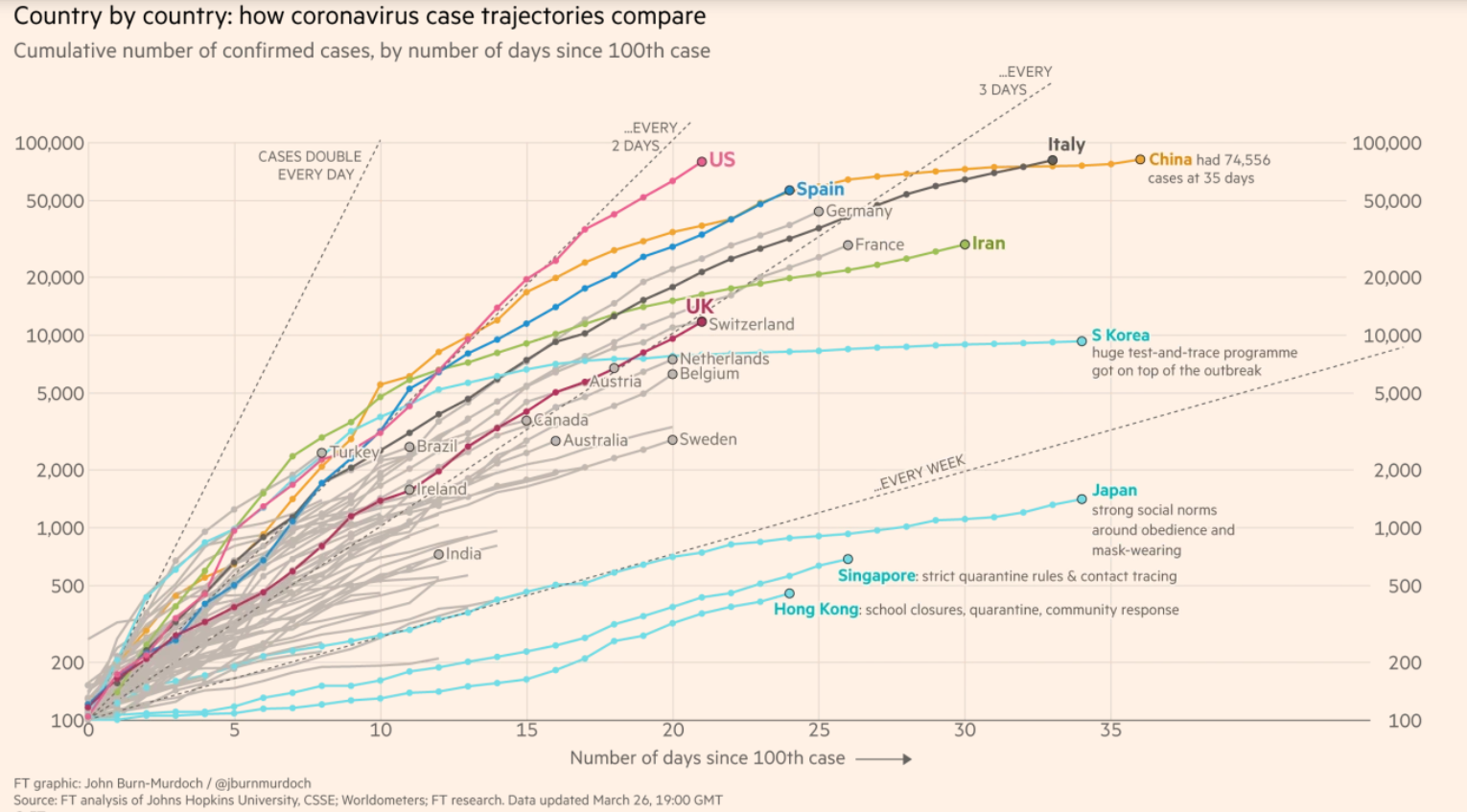
Markets have been bullish the last few days, moving off the most recent lows and easing the strain on investors who have watched their savings tumble by up to 35% since the beginning of the year. Any enthusiasm that this will be a sustained recovery should be tempered by the sheer scope of the economic disruption that we are facing, how early into the problem we currently are, or the potential for a pandemic disaster in the United States, which now has officially more cases than China ever did.

FT Capture

While I remain grateful for the respite we’ve seen, however fleeting, the problem that sticks out in my mind is that of the tangled web of Canadian debt, growing insolvencies, and hundreds of empty condos in downtown Toronto.

Problems rarely exist in isolation, and a problem’s ability to fester, grow and become malignant to the health of the wider body requires an interconnected set of resources to allow its most pernicious aspects to be deferred. In Canada the problem has been long known about, a high level of personal debt that has grown unabated since we missed the worst of 2008. What has allowed this problem to become wide ranging is a banking system more than happy to continue to finance home ownership, a real estate industry convinced that real estate can not fail, and a political class that has been prepared to look the other way on multiple issues including short term rental accommodation, in favour of rising property values to offset stagnant wages.

G&M Canada's Household Debt Burden

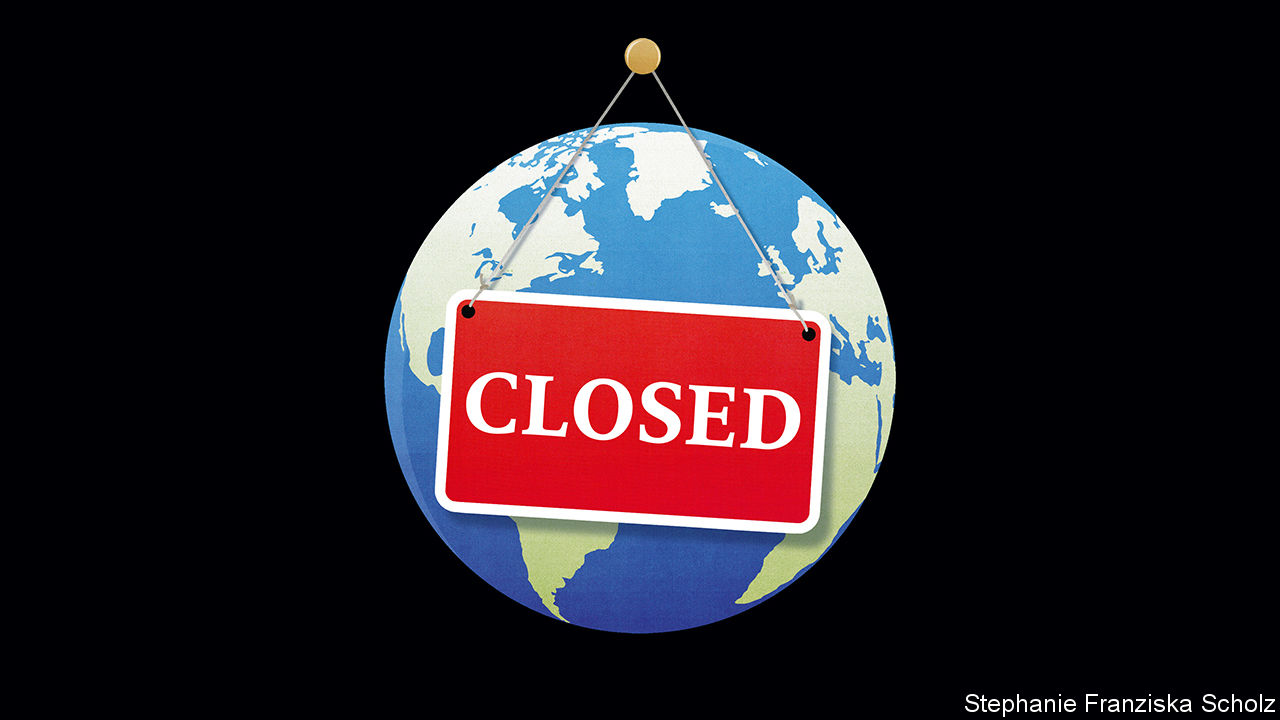
Recently I was at a round table event on Toronto real estate shortly after the COVID-19 situation started to gain real traction in late February. Benjamin Tal, Deputy Chief Economist for CIBC Capital Markets, described the Canadian real estate scene as “having 9 lives”, every time it seems like house prices can go no higher, something happens to prop up the market. At that moment it was the likely cut in interest rates and an easing of the stress test for mortgages which might breathe more life into the over heated housing market. But that was before international travel dropped off, before national states of emergency, before social distancing, before borders were closed, before essential services, before #lockdowns and #quarantinelife. Tal may not have been wrong conceptually, he simply hadn’t considered that the world might close for business.

Economist Cover

Canadian debt has been kept afloat because nothing could conceivably undermine it. And now, in downtown Toronto, condos sit empty. Airbnb hosts have no customers. Costs are mounting and there is no immediate end in sight to the pandemic, no end date that people can bank on. This week 3.3 million Americans filed for EI. In Canada the number was around 1 million. Even the most generous stimulus packages are unlikely to fix a debt problem as big as Canada’s.

True, there is some hope in mortgage deferrals, but scuttlebutt is that banks aren’t very liberal on this matter, telling many that they don’t qualify regardless of political pronouncements. This problem isn’t limited to Toronto. In Dublin rental accommodation jumped by 64% as COVID-19 became a crisis and people began looking for long term tenants to replace the short term ones. Short term thinking by investors, banks, and politicians has facilitated a serious economic problem. But to its enablers it seemed unlikely that there was a scenario that could conceivably expose its flaws.

It is becoming ever clearer that the focus for citizens in the 21st century should be on resilience. Expedience and an assumption that the stability of the recent past is prologue is now a dangerous and toxic combination, creating risks and magnifying bad decisions. Whether the coronavirus ushers in a fiscal reckoning for Canadians, or somehow we sidestep the worst of the crisis through quick action and nimble minds remains to be seen. But how much easier would life be for all had politicians adopted a more hostile stance to Airbnb pushing into the traditional rental markets? Had investors not eagerly dumped savings into condo developments, and had banks been more willing to question the wisdom of lending into what most acknowledged was a real estate bubble.

In December I wrote that the Canadian insolvency rate was the highest it had been in a decade. The city of Toronto recently took action to curb the growth of payday advance loan businesses, as though the problem was the businesses and not people in general need of credit to make ends meet. Whatever is coming in the wake of the COVID-19 shutdown, the issue long predates it. And if insolvencies go up and, for the first time in a long time, a portion of the Canadian real estate sector comes under real pressure there will be a lot of finger pointing at the individuals who have over extended themselves with an illiquid pool of investments. But the truth will be that this problem will have had many facilitators; enablers that were happy to ignore the problem, even help grow it, because they didn’t want to believe that things could go wrong or didn’t see it was their responsibility curb its malignancy.

Information in this commentary is for informational purposes only and not meant to be personalized investment advice. The content has been prepared by Adrian Walker from sources believed to be accurate. The opinions expressed are of the author and do not necessarily represent those of ACPI.

If I were the minister of Middle-Class Prosperity

Save the Middle Class

Launched to much derision and the collective snort of Canada’s journalist class, the government introduced a new cabinet position, “Minister of Middle-Class Prosperity”. Shockingly the new minister seemed incapable of defining what the middle class actually is, and in an effort to clarify her earlier non-position, went on TV to describe understanding the middle class as different things to different people that needs to be viewed through different lenses.

This answer, such as it was, was uniquely terrible since any applied thought to the question of “middle class prosperity” should yield several interesting ideas that deserve close examination.

For instance, an office focused on middle class prosperity might provide a useful take on inflation in terms of how it affects the middle class. Rather than relying on the aggregate rate that economists talk about at national levels, some clarity might come in about where that inflation is felt, like in housing, child rearing and education. We might also find something useful to say about savings and retirement, both of which are going to be increasingly serious questions into the very near future.

But let’s start with the basics. What is a middle class? First, the middle class is a result of an industrialized society. Though there is evidence of times of improving and deteriorating living conditions for humans in our pre-industrialized past, sustained and persistent improvements in living standards exist as a result of industrialization. This is not just because people got richer (and skills became more specialized) but because the cost of things dropped.

This really picked up steam after the Second World War when Western nations went toe to toe with Soviet command economies and showed, despite all their inequality, that more prosperity for more people came about as a result greater innovation in production in the pursuit of reducing prices. Yes, many people had good jobs, but luxury items like refrigerators, dishwashers, and microwaves all became standard kitchen appliances, as did (in time) TVs, cell phones and computers because prices for those items have been in free fall since the 1950s.

Historical and Predicted Prices

If we are looking for a definition of the middle class we could do worse than something along these lines: “The middle class represents a working sector of our society that is sufficiently monetarily rewarded to save for future financial stability, retains ample discretionary income in the present, and can reasonably aspire to help their future generations.” Threats to the middle class, both to people trying to enter it and to those trying to maintain their status within it, come from the erosion of the cost effectiveness of certain services. Housing, education and long retirements threaten this class of people and some of their ills are obscured by how we understand and talk about the economy.

Consider for instance why we talk so much about taxes. Taxes represent one of the few and very clear levers that a government can pull to change personal finances. They can take less money, or they can take more. As of this week the Liberal government has promised another “middle class tax cut” that should leave an average middle class Canadian $300 richer every year, or $600 for a family. Not bad, and for an individual that works out to being 25% of one month’s rent in Toronto for a single bedroom (average) or three weeks of groceries for the average Canadian family! If you are struggling as a Canadian family despite two good jobs, its hard to imagine that this will make or break a retirement or fund a university tuition.

In a survey done by BDO, 2047 Canadians were asked about their personal finances. The results were less than encouraging. 57% were carrying credit card debt and a third couldn’t pay off their short-term credit. 39% said they had no savings for retirement and 69% said they didn’t have enough savings to get through retirement. These findings match repeated surveys and studies done over the past decade that continue to suggest that Canadians are simply not saving enough and are drowning in debt.

Debt Issues

Small tax cuts seem unlikely to fix problems that look like this, and I think its important to note that solutions to these problems are not readily apparent. It should also be noted that being middle class should not mean that you are always financially whole and never struggle. Part of the reason that the middle class has financial issues is because it strives for a life above mere subsistence. Its goals are materially aspirational, and people live their lives according to that aspiration.

A more productive focus should be on helping people enter the middle class. Far too much energy has been dedicated to using houses to boost middle class wealth, both through restricting development to preserve neighbourhoods, and relying on the equity within homes to boost standards of living. This is the wrong place to hoard wealth and it should be replaced with more aggressive home development within cities to boost density, improve services, and reduce the price of homes. Just as importantly the role of higher education should go under a microscope. The costs of University have jumped as more Canadians get degrees and those degrees are worth less in the market. Canadian parents regularly save for children’s education, to the detriment of their retirement savings. The cost of that education is expected to be over $120,000 for a four year degree very soon. Attacking the issue of education head-on would be an enormous help in easing access to middle class security.

Lastly, dealing with debt should be a priority. Lending should have tighter restrictions, especially for younger Canadians in their early 20s when their financial needs are lower, and a state run bank set up to help Canadians get out of debt (the use of which should preclude any other financial lending) would be an enormous asset in terms of allowing Canadians get on going debt help and learn to better manage budgets and connect people to financial help.

Far from having little idea of what constitutes the middle class, we are, if anything, too certain of what a middle-class life looks like and the path to getting there. This is a moment when we should be experimenting with how we create a growing middle class, not calcifying a particular version of life that no longer fits a world that has dramatically changed since the 1950s. A minister for “Middle Class Prosperity” need not be a pointless fluff position making vague pronouncements. Instead it could be a cabinet position that spearheads exciting new ways to improve access to financial security and create paths to long term growth.

Information in this commentary is for informational purposes only and not meant to be personalized investment advice. The content has been prepared by Adrian Walker from sources believed to be accurate. The opinions expressed are of the author and do not necessarily represent those of ACPI.

A Canadian Story of Woe


drowning
A Canadian homeowner going for a relaxing swim in his mortgage…


One of the challenges of being a financial advisor is finding ways to convey complex financial issues in simple ways to my clients and readers. I believe I do this to varying degrees of success, and I am informed of my failures by my wife who doesn’t hesitate to point out when I’ve written something boring or too convoluted.

One such subject where I feel I’ve yet to properly distill the essential material is around the housing market. While I’ve written a fair amount about the Canadian housing market, I feel I’ve been less successful in explaining why the current housing situation is eating the middle class.

In case you’re wondering, my thesis rests on three ideas:

1. The middle class as we know it has come about as a result of not simply rising wages but on sustained drops in the price of necessities.
2. The rise of the middle class was greatly accelerated by the unique historical situation at the end of the Second World War, which split the world into competing ideological factions but left the most productive countries with the highest output and technological innovation to flourish.
3. A global trend towards urbanization and a plateauing of middle-class growth has started reversing some of those economic gains, raising the cost of basic living expenses while reducing the average income.

The combination of these three trends has helped morph housing from an essential matter of accommodation into a major pillar of people’s investment portfolios and part of their retirement plan. The result is that homeowners are both far more willing to pay higher prices for a home in the belief that it will continue to appreciate into the future, while also attempting to undercut increases in density within neighborhoods over fears that such a change will negatively impact the value of the homes. In short, stabilizing the housing market is getting harder, while Canadians are paying too much of their income to pay for existing homes. All of this serves to make the Canadian middle class extremely vulnerable.


Household Debt
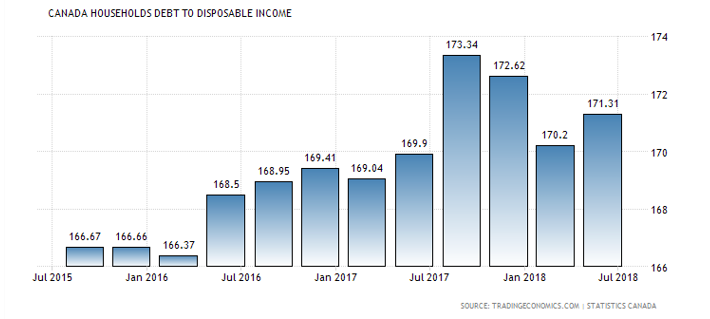
You may be tempted to think “Wow, debt levels really jumped through 2016” you should remind yourself that this chart STARTS at 166%!!!


Proving some of this is can be challenging, but there are some things we know. For instance, we know that Canadians are far more in debt than they’ve ever been before and the bulk of that debt is in mortgages and home equity lines of credit (HELOC), which means much of that debt is long-term and sensitive to hikes in interest rates. We also have abundant evidence that zoning restrictions and neighborhood associations have diligently fought against “density creep”. But to tie it all together we need the help of HSBC’s Global Research division and a recent article from the Financial Times.

FT Global Leverage

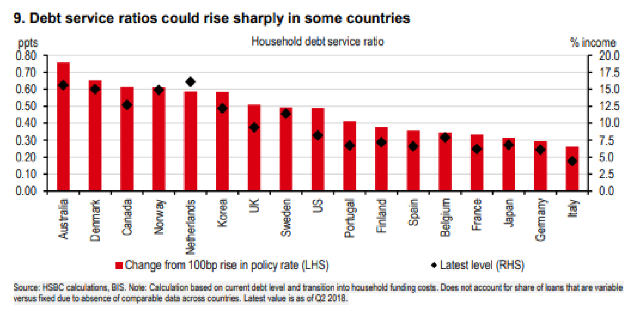
Last week, HSBC issued a research paper on global leverage. Providing more proof that since 2008 the world has not deleveraged one bit. In fact, global debt has settled just over 300% of global GDP, something that I wrote about in 2016. An interesting bit of information though came in terms of the country’s sensitivity to increasing interest rates. Charting a number of countries, including Canada, the report highlights that Canadians (on average) pay 12.5% of their income to service debt. A 1% increase in the lending rate would push that up over 13%. For a country already heavily in debt, a future of rising rates looks very expensive indeed.

It would be wrong to say that fixing our housing market will put things right. There is no silver bullet and to suggest otherwise is to reduce a complex issue to little more than a TED Talk. But the reality is that our housing market forms a major foundation of our current woes. A sustained campaign to grow our cities and reduce regulatory hurdles will do more to temper large debts that eat at middle-class security than anything I could name.