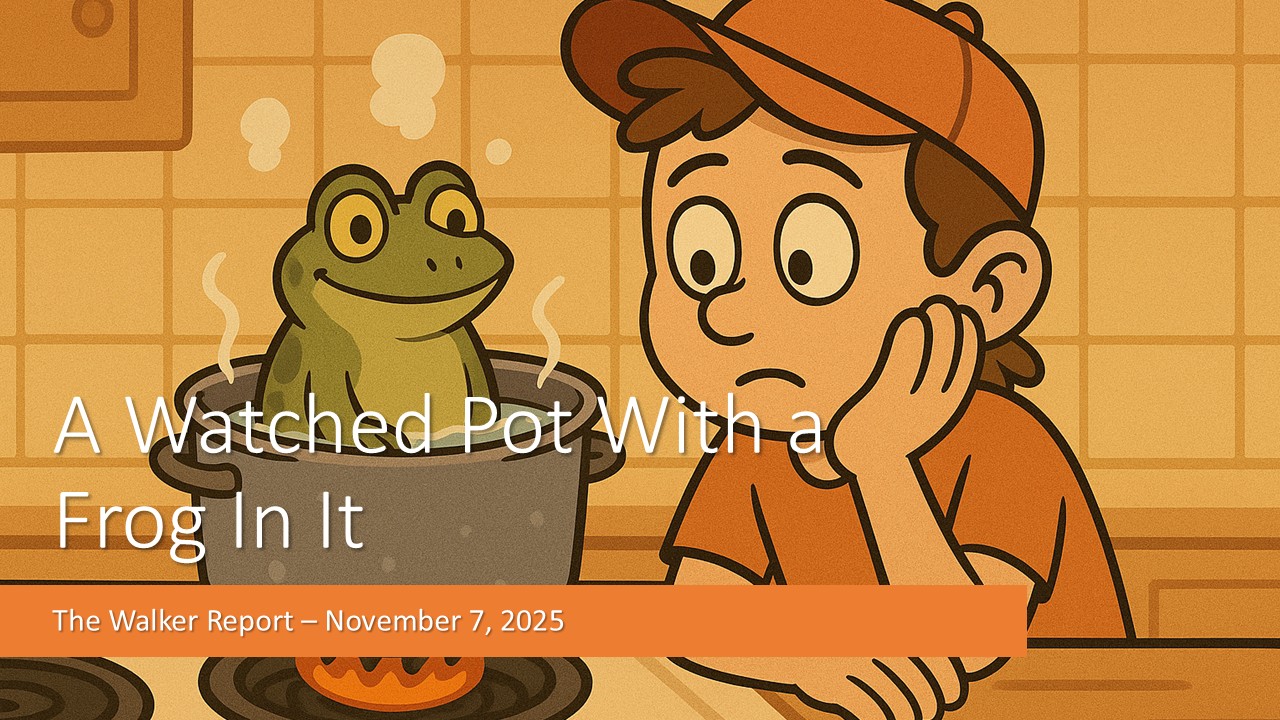
A Watched Pot With A Frog In It

Back in the spring, markets reeled after Trump announced a new round of unilateral tariffs. The April 2nd announcement triggered a week of panic selling until the administration promised a temporary 90-day pause to pursue trade negotiations. Nine months later, the U.S. now has the highest tariff levels in over a century, economic data is showing signs of weakening, and discussions of a market bubble are widespread. Why, then, is the stock market still so high?

The most immediate reason is the concentration of market leadership. The “Magnificent Seven” tech giants now account for more than 35% of the S&P 500, while the top ten companies make up nearly 40%. The gap between the S&P 500 and its equal-weighted equivalent is just shy of 10%, while the Magnificent Seven themselves have delivered a combined return of roughly 27.6% year-to-date. The comparison to the dot-com era is easy to make, but the fundamental difference is profitability: Apple, Google, Microsoft, Amazon, Meta and others continue to generate substantial earnings and hold enormous balance-sheet reserves. This profitability has helped anchor market confidence.

Figure 1 Growth of the Magnificent Seven as a part of  the S&P 500

Another factor is the lag in how economic data reflects policy changes. Despite the risks tariffs pose, the full impact has not yet shown up in backward-looking data like GDP or employment reports. Investors expecting an immediate shock instead found resilient quarterly numbers, reinforcing confidence rather than shaking it.

Figure 2 Effective tariff rates over time, from the Yale Budget Lab

There is also a deeper structural issue: the increasing concentration of economic power and spending. As wealth inequality widens, a large share of U.S. households are contributing less to measured economic activity. Recent consumer expenditure data suggests that the top 10% of households now account for roughly 50% of all consumer spending, while the bottom 60% contribute less than 20%. This means that economic stress among the majority of households may not meaningfully register in the headline data that markets rely on. Meanwhile, AI-related capital investment makes up a growing share of the remainder of measured economic activity.

Figure 3 Widening wealth disparities between households and consumer spending

This combination — delayed data effects, high concentration of consumption, and sustained AI investment — has helped keep investor sentiment resilient, even as negative signals accumulate beneath the surface. It has also masked the risks of allowing speculative dynamics to develop largely unchecked.

Figure 4 Growth of Personal Consumption as a percentage of GDP

Concerns about an AI bubble are growing. Estimates of total AI investment now exceed $3 trillion when considering capital expenditures, valuations, and related infrastructure spending. Commercial use cases outside of a few sectors remain limited. Some firms have begun participating in “circular funding arrangements,” where they invest in each other’s AI initiatives to reinforce perceived valuations. Even industry leaders acknowledge the speculative environment: Sam Altman, the CEO of Open AI has said there is likely a bubble, while Jeff Bezos has called this a “good bubble” that will still produce transformative breakthroughs.
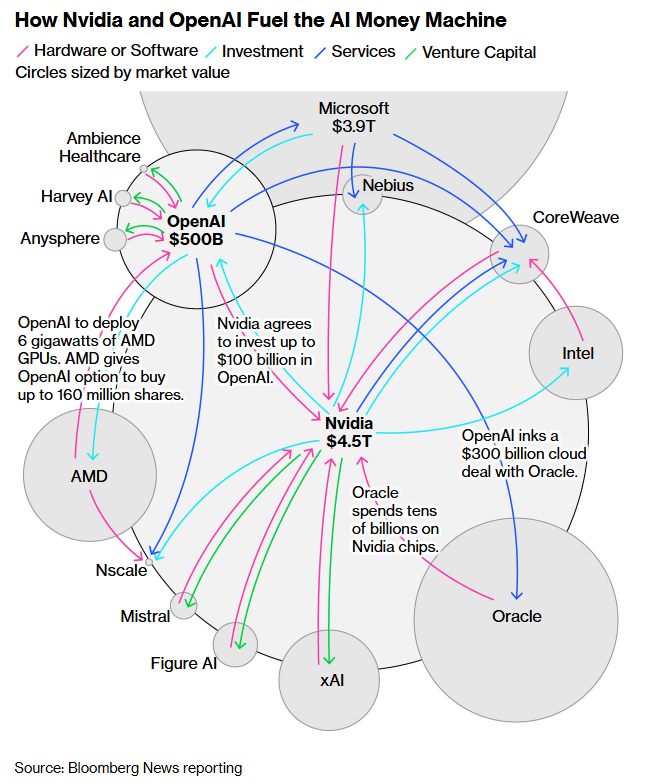
History suggests that speculative cycles are remarkably resistant to logic. They often convert skeptics into participants, including professional money managers who join in under client pressure. Market bubbles resemble the proverbial frog in a pot: the danger rises slowly enough to dull caution.

Yet they also resemble the “watched pot” that never seems to boil. As long as new capital continues to flow into AI-linked investments, momentum can persist. Predicting the end of a bubble is famously difficult — markets can remain irrational longer than investors can remain solvent.

So what should investors do? Awareness of rising risk is the starting point. We may not be able to time the end of the AI boom, but we can examine investor behavior for signs of speculative excess.

Consider Tesla. After the election, the stock surged nearly 98% in six weeks on enthusiasm linked to political alignment and narrative momentum. Since then, sales have weakened, profitability has declined, and competition has intensified — yet the stock remains 10% above its level on inauguration day and has more than doubled off its lows. Tesla’s valuation continues to reflect belief in future breakthroughs rather than current operational performance. It is a clear illustration of narrative overpowering fundamentals — a hallmark of speculative markets.
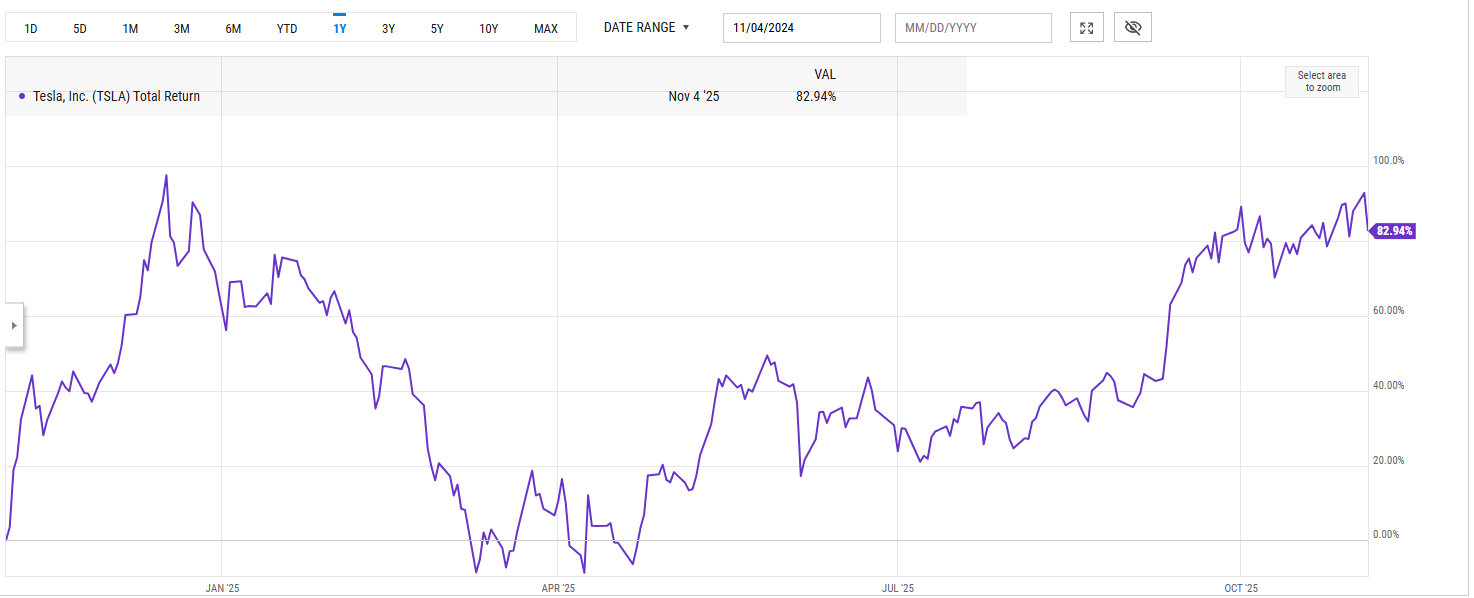
Figure 6 Tesla stock performance from November 4, 2024 to November 4, 2025

If this environment feels uncomfortable, it may be time to review portfolio risk exposure. Reducing equity risk comes with trade-offs — especially missing out on momentum-driven gains — but clarity on long-term goals can help prevent emotionally driven decision making.

Market manias are difficult to avoid and even harder to detach from when others are benefiting. The antidote is a disciplined investment plan that emphasizes long-term objectives over short-term excitement. In a world where the water may be warming around us, it is better to be a watcher than the frog.

When It Comes to Trump, Investors Must Be Patient

This piece was meant to come out last week before the most recent tariff announcement. It was delayed, but the points it makes remain relevant.

Donald Trump’s actions since taking office have failed to deliver the kind of economic and market stimulation people had been imagining. For many professionals, business owners, and financial analysts, the assumption was that Trump would be good for markets and good for the economy. His other political views, like isolationism, tariffs, and sense of personal grievance weren’t great features, but he would fundamentally be bound by market and economic performance.

That faith eroded quickly as it seemed that Trump was intent on widespread and indiscriminate tariffs, targeting first America’s closest trading partners, and then reciprocal tariffs on the European Union, Great Britain, Australia, and Taiwan. Concerns that this might damage the American economy may have bought time on when those tariffs were to be implemented (as of writing Canadian and Mexican tariffs have been deferred twice, though Steel and Aluminium tariffs have gone ahead) but April 2nd remains “liberation day” according to Trump, a day when America stops getting “ripped off”.

Trump’s administration have pivoted away from the idea that Trump will be good for the immediate economy, and that a “period of transition” is on the way. During his speech to Congress (officially not a State of the Nation) Trump also said that farmers will sell more of their food to Americans, ostensibly a populist message but one more likely grounded in further declines of American agricultural export.

Alongside Trump is Elon Musk, a man who seems possibly genuinely befuddled by the animosity his actions have garnered. Between possible nazi salutes, his outsized time on Twitter, his heading up of D.O.G.E (which he both officially and unofficially runs, for legal reasons), his direct intervention with Germany’s far right party the AFD, and the poor sales of his Tesla cars, TESLA stock has dropped considerably from its highs. Many have thought that this heralds the end of his company, and certainly would deal a blow to his personal fortune, about a third of which is in the form of TESLA stock.

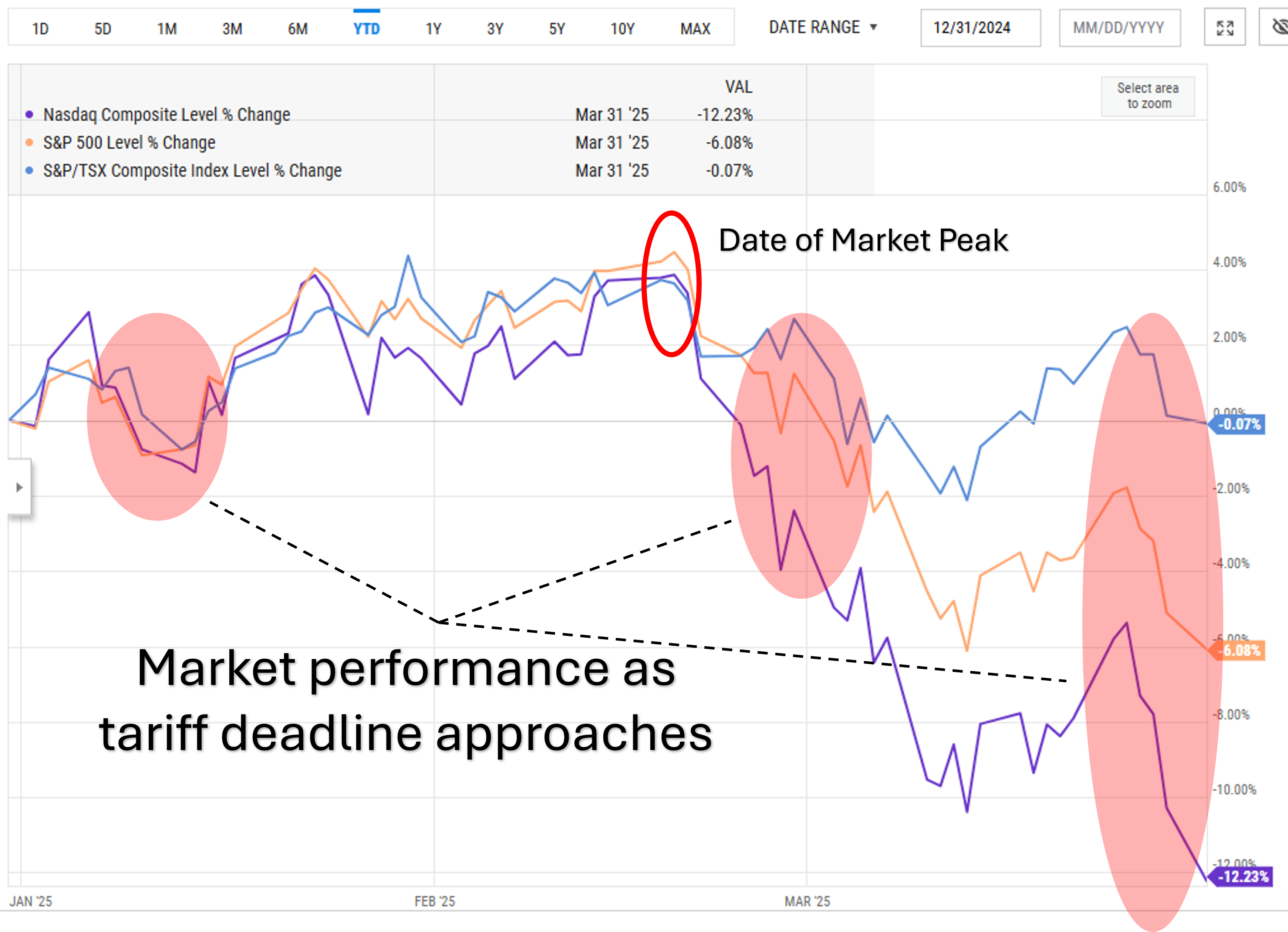
The markets peaked around February 19th, with the S&P 500 up 4.46% since January 1st. The Dow Jones had peaked a little earlier at 5.5%, and the Nasdaq Composite was up 3.86%, all respectable numbers for the first 45 days of a year, especially following a very strong 2024. Over the subsequent weeks markets began losing steam and saw a significant drop. From mid February to March 12th, a period of three weeks, the Nasdaq lost 13.05%, the S&P 500 9.31%, and the Dow 7.16%. Investors were worried, a recession seemed looming, and consumer confidence had plummeted.

Figure 1Market data provided by Y Charts. Data is until March 31, 2025

Yet only two weeks later markets seemed to have stabilised. Commentators were more confident and expected Trump’s tariffs to be more “focused”. Following some fairly significant government intervention, even Tesla’s shares regained some of their lost ground, and the bond market had retreated as investor enthusiasm seemingly returned. And then, at the end of last week the enthusiasm sputtered once again.

What’s going on?

Whether you support Trump or not, his policies if fully enacted promise to reduce the size of the US economy. His expressed understanding of tariffs, how they work, what they can do, and how easily they can rewrite the global order of trade are objectively poor. Global supply chains are complicated things, and some of the most complicated aspects of them are tied up in semi-conductor manufacturing, making tariffs an expensive tax on top of essential components of the economy. His handling of international relationships has also been poor, and the seeming unravelling of the NATO alliance under his administration threatens not just global security, but also America’s defence industries, particularly the F-35 joint strike fighter, a multi-purpose fifth gen fighter whose economics only worked if it became the standard across NATO. His stated aims of building a coalition to contain China’s global ambitions run counter to his animosity towards global trade. Australia has been slapped with steel tariffs despite having a trade deficit with the United States, all while Australia now does three times as much trade with China as it does with America. Japan and South Korea are rapidly reorienting themselves towards China and seeking better relations with them for protection. The sudden rise of a hostile border force, detaining Canadian and European’s alike, seems to be shrinking the US’s tourism by up to 15%.

But these things have not yet fully come to pass. Trump’s way of engaging with government is dictatorial with a reality show slant. Rarely does he spell out what a policy will be and frequently defaults to the phrase “we’ll see what happens.” This level of uncertainty gives Trump room to maneuver, and allows the market to engage in its most common behavior; optimism. Trump may seem to be heading towards a recession, but there remains a chance he may change his mind. The market sell-off through February and March was not an indictment of Trump’s government. It was a reset on the risk for investors and an opportunity to reevaluate what might happen next. That leaves considerable latitude for Trump’s administration to back away from damaging policies, or double down on them.

Heading into 2025 it looked like the US economy was the strongest globally, and while the early days of the new administration seemed to have changed some of that math, what it means is that there is still lots of different ways that the year could still unfold. The United States may back away from its trade war, claiming victory with whatever concessions can be finagled. Elon Musk might be kicked out of the Trump inner circle, something that would certainly change the calculus about how the government would be run. Voters, which look considerably less impressed with Trump’s early policies, might be so angry that Republican members of the house find the nerve to push back on the administration. There are lots of potential futures.

For investors the challenge is to find a path that will allow them to navigate between the pessimism of Trump’s detractors and the optimism of his own administration. After so many positive years in the markets there is real wisdom in taking some of those profits off the table, and good investment policy hasn’t changed. Given the very strong performance out of the United States for the past five years, its likely that those investments have grown, especially relative to other equity positions. This is a good time to ensure that portfolios are well diversified and that assets are not too concentrated. Lastly, safety is something that should be given real thought to. Rob Carrick of the Globe and Mail wrote a piece arguing that if you need your money in the next five years, you should pull it out now. That advice should be tempered with a conversation with your actual financial advisor, but what all investors should be looking for is a blend of the following:

  1. Enough equities to participate in good markets across the globe.
  2. Enough safety that they won’t panic if markets do worse.
  3. Enough cash to be able to take advantage of bad markets when they come up.

These three principles will look different for everyone, but should be balanced by the amount of risk you can absorb, and the ability to continue to meet your financial goals.

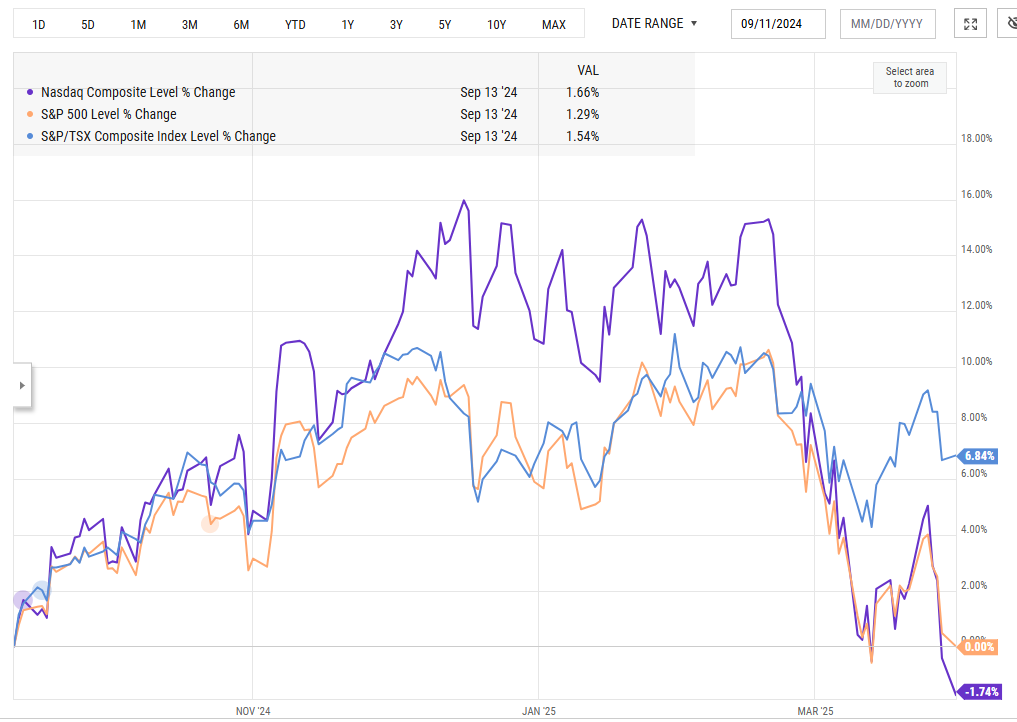
As we get closer to Trump’s “liberation day”, how much of Donald Trump’s policy agenda is well understood by investors is up for debate. According to Bloomberg, as well as some other news sources, retail investors followed a “buy the dip” mentality over March, while big institutional investors backed away. The market is not settled on what is going to happen, and while its tempting to say that little investors might take the biggest losses, there have been many instances of mistakes by large institutional investors. At the same time, there are many reasons to be cautious now. Though markets are off their all-time highs, they remain still at historic levels, and while the news has been quick to discuss “market panics” and “market crashes”, in truth we’ve only gone back to where we were in September. Investors should be on guard that markets can still go in either direction.

This leads to my final point. Investors will need to show patience in the face of the uncertainty. Followed to their natural ends, as I’ve outlined, many of his most aggressive policies don’t bode well for the future. But many of these policies may simply not come to pass. Markets may surprise people expecting the worst, and our own personal feelings about Trump and his administration’s actions may cloud our judgement about reality. What investors need to be is patient, and prepared.

Aligned Capital Partners Inc. (“ACPI”) is a full-service investment dealer and a member of the Canadian Investor Protection Fund (“CIPF”) and the Canadian Investment Regulatory Organization (“CIRO”).  Investment services are provided through Walker Wealth Management, an approved trade name of ACPI.  Only investment-related products and services are offered through ACPI/Walker Wealth Management and covered by the CIPF. Financial planning services are provided through Walker Wealth Management. Walker Wealth Management is an independent company separate and distinct from ACPI/Walker Wealth Management.

What Could a Faltering Condo Market Mean?

As summer has worn on there have been a growing number of headlines focused on Toronto’s stagnant condo market. In short, the number of units for sale continues to grow as buyers refuse to pay the elevated prices being demanded by sellers. Interestingly sale activity has been stagnant and prices haven’t really moved despite the growing inventory.

The knock on effect has been a significant slow down in new developments. This has led to growing concern that prices will rise in the future as new supply is postponed or canceled, and pressure is growing to get interest rates lowered to help stimulate buyers.

All of this sounds a touch too convenient for me. One of the reasons (not the only reason, but a significant one) we face a “cost of living crisis” is that housing has increasingly been seen as an investment, one that people have had greater faith in than other traditional assets. But housing booms aren’t new, and it seems odd to me that our chief concern about a growing glut of over-priced condos will be that condo prices will be higher in five to ten years. A more pressing concern is likely that condo investors, and the banks that have provided the mortgages, are deeply concerned that if buying doesn’t resume property prices could take a serious decline, erasing Canadian wealth and forcing Canadian banks to write down balance sheets.

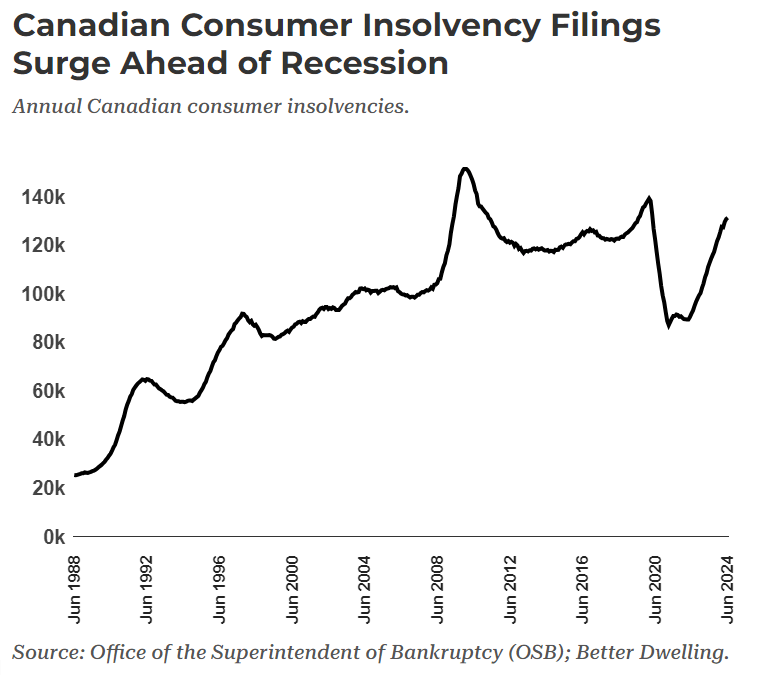
For many this would be a welcome relief, potentially opening Toronto’s property ladder and easing some of the burden of the cost of living. But property ownership has been the source of growth of Canadian wealth over the past twelve years. According to Credit Suisse, Canadian wealth rose by two thirds from 2010 to 2022, however Canadian economic growth was quite weak, with income only rising by 15% over the same period. In other words, if Canadians are richer today than they’ve been in the past, its because they owned homes, not because the economy was paying more. Independently, we might conclude that there was something unique happening with Toronto’s condo market, but this news goes hand in hand with other worrying economic trends in the country. Notably, Canadian consumer insolvencies have been steadily climbing while unemployment has also been climbing. The unsold condo inventory is the highest it’s been since 2008, while data shows that household credit growth has been decelerating. Other disturbing news includes the expansion of the public sector, which now accounts for 1 in every 4 employed Canadians while public sector growth accounted for 49% of our most recent GDP growth.

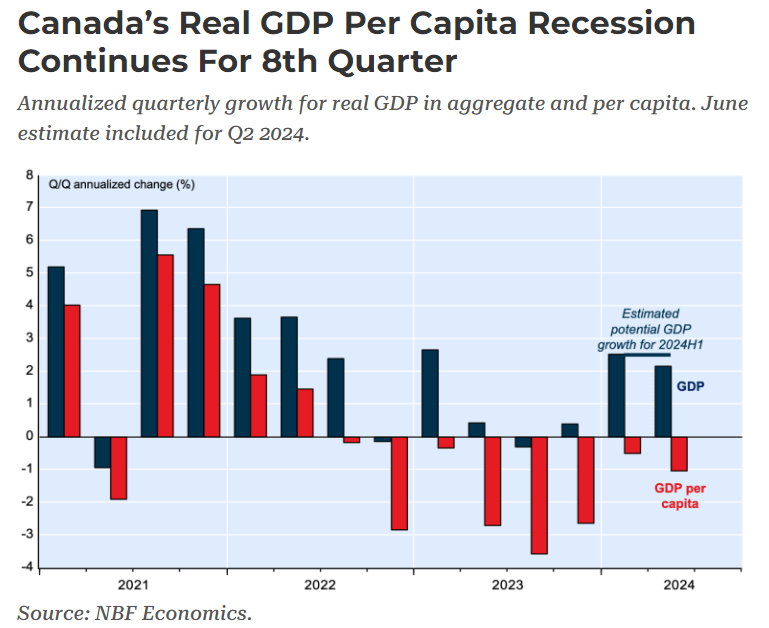
2024 has been a disappointing year for Canadian economic news. Aside from the headlines above, one of the most striking statistics is that Canada is losing economic ground per capita. Much of our GDP growth is coming from high immigration, in effect importing new economic activity but at a rate below what is needed to expand the economy on a per person basis, and it has been doing so for more than 2 years. We are, in effect, in a “per capita recession”.

Since 2022, interest rate increases have pummeled the economy, particularly real estate, which has grabbed a lot of headlines. But Canada’s real estate market has shown considerable resilience through the first few years. However, investors that over are extended and feel the building pain from higher borrowing costs are starting to exit their investments. That hasn’t been altered by the recent interest rate cut which has yet to stimulate much new buying activity. Pressure is building from sectors of the economy to see rates fall and hopefully ease or reverse the effects of higher borrowing costs, but it remains to be seen whether rate cuts can happen at a pace both responsibly and fast enough to substantially change the direction of Canada’s economy (if it can at all).

On Monday, August 5th, changes in interest rates from the Bank of Japan reportedly triggered an unwinding of a popular “carry trade”, in which large institutions borrowed money in Japan for low cost, and then invested that money in US stocks. A hike in the BoJ’s lending rate had forced up the value of the yen, forcing the sale of those same US investments to pay back the now more expensive Japanese loans. Markets have recovered quickly, but it shook investor confidence, and while the explanation may not be wholly accurate, it’s a useful reminder that debt, which offers real value when used in moderation, can make economies extremely fragile. For years Canada has had the highest level of household debt to disposable income of any G7 country, and much of that was tied up in housing. What happens next is anybody’s guess.

Aligned Capital Partners Inc. (“ACPI”) is a full-service investment dealer and a member of the Canadian Investor Protection Fund (“CIPF”) and the Canadian Investment Regulatory Organization (“CIRO”).  Investment services are provided through Walker Welath Management, an approved trade name of ACPI.  Only investment-related products and services are offered through ACPI/Walker Wealth Management and covered by the CIPF. Financial planning services are provided through Walker Wealth Management. Walker Wealth Management is an independent company seperate and distinct from ACPI/Walker Wealth Management.

Climate Change, Real Estate, & Markets – A Mid-summer Update!

Updates: Climate Change

In his book The Third Horseman: A Story of Weather, War, and the Famine That History Forgot, historian William Rosen recounts the effect of the regional climate change on Europe in the early 1300s. His recounting of the history of Europe (but mostly England) in the wake of the “Little Ice Age” is fascinating and frightening. Political upheaval, inflation and famine are all magnified by the effects of a changing climate, while the uncertainty it brings dramatically alters the European landscape and its political status quo.

The little ice age saw a general cooling across much of Europe, a shortening of the growing season, an increase in heavy rains that flooded land, rendered marginal farmland unusable, and a spiking in grain prices forcing cereals to be sourced from farther away (like the middle east) to feed the northern parts of the continent. It also saw the loss of some industries, like England’s wine producers. The reputation for terrific French and Spanish wines, and the English reputation for drinking them in great quantities is forged in the shadow of the this geographically specific climate alteration.

Until now.

According to the Financial Times Britain is seeing a surge of vineyards opening, as far south as Sussex and as far north as Scotland. In 2023 the country recorded its largest ever grape harvest, while the country’s largest winemaker, Chapel Down, is looking to sell more shares to fund further expansion of its business.

Over the last decade I’ve made the case that climate change is really about water and its predictability. It is interesting to note that in the mass of worrisome predictions, of the potential for war, for famine, and for a less secure and more fragile world, that one of the less expected outcomes might be a change in cultural identity of a whole nation; that one rainy little island may stop being rainy, and undo 700 years of a cultural identity.

Updates: Real Estate

In 2020, one of the first things I wrote in at the beginning of the lockdowns was about the Canadian real estate market, and whether lockdowns and a pandemic might unravel our condo market. Though the lockdowns were long lived, Canadian real estate survived helped in large part by the extension of emergency levels of interest rates. The cost of living crisis and the housing bubble, ever intertwined, got worse, not better.

Condo prices reached their peak in January of 2023, and fell back to a current low by late April. Since then prices have fluctuated somewhat, but have been largely range bound. Reported by the Toronto Star on June 14th, “the number of new listings for condos has increased 30% since last May” the bulk of those in the investor size, ranging between 500 to 599 square feet. Urbanation, a trade publication for real estate states “In the past year, unsold new condominium supply increased 30%, rising 124% over the past two years.” In addition “projects in pre-construction during Q1-2024 were 50% presold, down from a 61% average absorption over a year ago, and 85% two years earlier.”

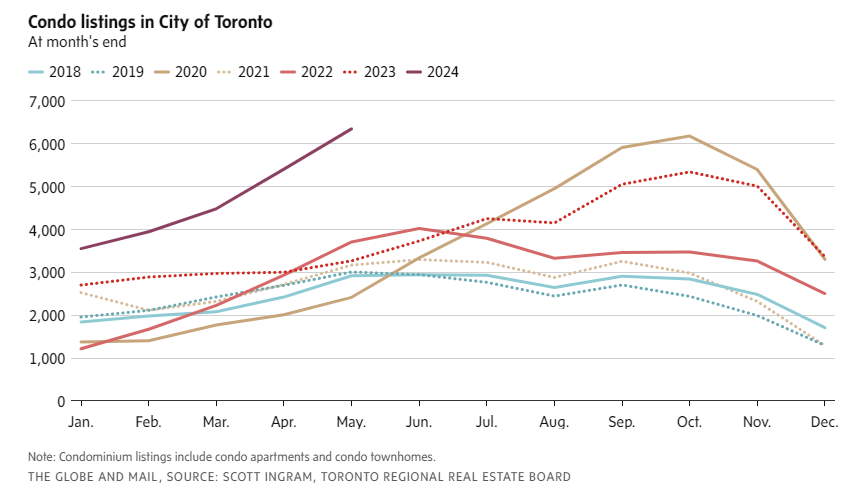
The Globe and Mail wrote on June 29th that “there were 6350 active condo listings in the city, an increase of 94% from the previous May” and that “condo inventory 70 per cent higher than the 10-year average for last month.” The deterioration in the condo market is being felt by existing owners and investors, as well as developers whose per square foot costs run roughly $500 higher than existing condo values.

All this seems to be aligning with a secondary real estate problem; office and commercial real estate. Across the United States as well as Canada office real estate is also struggling. Though not news, employees refusing to return to work and companies downsizing their real estate foot prints has had a significant impact on owners of office space. Banks are unloading office loans, REITs are trying to sell unprofitable assets, and some, like Slate Office RIET just defaulted on $158 million of debt. The story of real estate, once the most unflappable asset an investor could hold, continues to unfold in surprising and worrying ways.

Updates: Markets

With half the year behind us market performance has significantly diverged. US markets, being carried by the strong performance of NVIDIA as well as the handful of usual tech company suspects, have delivered shockingly great results. At the end of June the S&P 500 was up 14.48% so far. An impressive return, but 70% of those returns are from six companies, and 30% of the return is from just one. The S&P 500 Equal Weight return, an index that assigns each company a proportional weight, only has a return of 4.07%. That 70% difference in performance is down to Nvidia, Microsoft, Apple, Amazon, Google (Alphabet), and Facebook (Meta).

Figure 1 Performance data from Y Charts

The concentration of that performance makes the current rally fragile, though curiously other global indices, including Canada, are actually more concentrated than the US. This may account for why the TSX is only up 4.38% for the year, and had briefly dipped as low as 2.66% in June. Canadians are familiar with the feeling of having one of three industries (banking, energy, or materials) often set the tenor of a year’s returns. If the price of oil is climbing or falling, its often immediately reflected in our market index returns. In their own way the S&P 500 has taken on some of these characteristics.

Investors should know that markets continue to offer considerable upside, but those returns are coming from fewer and fewer parts of the economy.

Aligned Capital Partners Inc. (“ACPI”) is a full-service investment dealer and a member of the Canadian Investor Protection Fund (“CIPF”) and the Canadian Investment Regulatory Organization (“CIRO”).  Investment services are provided through Walker Welath Management, an approved trade name of ACPI.  Only investment-related products and services are offered through ACPI/Walker Wealth Management and covered by the CIPF. Financial planning services are provided through Walker Wealth Management. Walker Wealth Management is an independent company seperate and distinct from ACPI/Walker Wealth Management.

Looking Back on 2021

Its traditional that the end of a year should stimulate some reflection on the past and the future, and so in the spirit of tradition I thought I’d take some time to look over some of the stranger and more surprising aspects of 2021.

China

While 2021 brought the pandemic *closer* to an end through the distribution of vaccines, markets underwent some fairly dramatic reversals over the course of the year. For instance China looked to be the principal economy in January. Following its own strict enforcement of Covid restrictions and solid economic performance, China seemed to be an earlier winner by the beginning of 2021, and set to enjoy robust growth through the year.

By March the tide was shifting however. China’s leader, Xi Jinping, proved to be every bit committed to his past comments about protecting and strengthening the CCP over free market concerns. Several billionaires, notably Jack Ma the founder of Alibaba, disappeared for long periods before reemerging only to publicly announce that they would be stepping down from their roles.

However, even while China was shaking down its billionaires and upsetting foreign nations, a new economic threat appeared in the form of a housing bubble looking ready to burst. Evergrande, one of the country’s largest property developers announced that it could not finance its debt anymore and looked likely to default. This news was unwelcome for markets, but for China hawks it fit their long standing belief that China’s strength has been built on a mountain of unsustainable debt, with property one of the most vulnerable sectors of the economy.

The finer points of China’s housing market are too nuanced to get into here, but it’s enough to know that the property bubble in China is large, built on sizeable debt and could take some time to deflate (if it does) and no one is sure what the fallout might be. Combined with China’s ongoing policy of “Covid Zero” – an attempt to eradicate the virus as opposed to learning to live with and manage it, we head into 2022 with China now a major outlier in the Asian region.

Inflation

Inflation was probably the other most discussed and worrying trend of 2021. Initially inflation sceptics seemed to win the argument, as central banks rebuffed worries over rising prices and described inflation as transitory. That argument seemed to wane as we entered late Q3 and prices were indeed a great deal higher and didn’t seem to be that “transitory” anymore. Inflation hawks took a victory lap while news sites began to fill up with worrying stories about rising prices on household goods.

The inflation story remains probably the worst understood. Inflation in Canada, as in other Western nations has been going on for sometime, and its effects have been under reported due to the unique nature of the CPI. But some of the concern has also been overwrought. Much of the immediate inflation is tied to supply chains, the result of “Just-in-time” infrastructure that has left little fat for manufacturers in exchange for lower production costs. Bottlenecks in the system will not last forever and as those supply chains normalize that pressure will recede.

The other big pressure for inflation is in energy costs, but that too is likely to recede. Oil production isn’t constrained and prices, while higher than they were at the beginning of the pandemic are lower than they were in 2019. In short, many of the worries with inflation will not be indefinite, while the issues most worrying about inflation, specifically what it costs to go to the grocery store, were important but underreported issues before the pandemic. Whether they prove newsworthy into the future is yet to be seen.

*Update – at the time of writing this we were still waiting on more inflation news, and as of this morning the official inflation rate for the US over the past year was 7%. Much of this is still being chalked up to supply chains squeezed by consumer demand. An unanswered question which will have a big impact on the permanence of inflation is whether this spills into wages.

This political advertisement from the Conservatives ruffled many feathers in late November

Housing and Stocks – Two things that only go up!

If loose monetary policy didn’t make your groceries more expensive, does that mean that central bankers were right not to worry about inflation distorting the market? The answer is a categorical “No”. As we have all heard (endlessly and tediously) housing prices have skyrocketed across the country, particularly in big cities like Toronto and Vancouver, but also in other countries. The source of this rapid escalation in prices has undoubtedly been the historically low interest rates which has allowed people to borrow more and bid up prices.

In conjunction with housing, we’ve also seen a massive spike in stock prices, with even notable dips lasting only a few days to a couple of weeks. The explosion of new investors, low-cost trading apps, meme-stocks, crypto-currencies, and now NFTs has shown that when trapped at home for extended periods of time with the occasional stimulus cheque, many people once fearful of the market have become quasi “professional” day traders.

Market have been mercurial this past year. Broadly they’ve seemed to do very well, but indexes did not reveal the wide disparities in returns. Last year five stocks were responsible for half the gains in the S&P 500 since April, and for the total year’s return (24%), Apple, Microsoft, Alphabet Inc, Tesla and Nvidia Corp were responsible for about 1/3 of that total return. This means that returns have been far more varied for investors outside a tightly packed group of stocks, and also suggests markets remain far more fragile than they initially appear, while the index itself is far more concentrated due to the relative size of its largest companies.

Suspicious Investment Practices In addition to a stock market that seems bulletproof, houses so expensive entire generations worry they’ve been permanently priced out of the market, the rapid and explosive growth of more dubious financial vehicles has been a real cause for concern and will likely prompt governments to begin intervening in these still unregulated markets.

Crypto currencies remain the standout in this space. Even as Bitcoin and Etherium continue to edge their way towards being mainstream, new crypto currencies trading at fractions of the price, have gotten attention. Some have turned out to be jokes of jokes that inadvertently blew up. Others have been straight-up scams. But all have found a dedicated group of investors willing to risk substantial sums of money in the hope of striking it rich.

NFTs, or non-fungible tokens have also crept up in this space, making use of the blockchain, but instead of something interchangeable (like a bitcoin for a bitcoin, i.e. fungible) these tokens are unique and have captured tens of thousands, sometimes hundreds of thousands of dollars for unique bits of digital art. Like cryptocurrencies, much of the value is the assumed future value and high demand for a scarce resource. However, history would show that this typically ends poorly, whether its housing, baseball cards or beanie babies.  

Lastly, there has been a number of new investment vehicles, the most unusual of which is “fractional ownership”. The online broker Wealth Simple was the first to offer this in Canada and it has been targeted to younger investors. The opportunity is that if your preferred stock is too expensive, you can own fractions of it. So if you wanted to invest in Amazon or Tesla, two stocks that are trading at (roughly) $3330 and $1156 respectively at the time of writing, those stocks might be out of reach if you’re just getting started.

This is a marketing idea, not a smart idea. The danger of having all your assets tied up in one investment is uncontroversial and well understood. The premise behind mutual funds and exchange traded funds was to give people a well-diversified investment solution without the necessity of large financial position. The introduction of fractional ownership ties back to the market fragility I mentioned above, with younger investors needlessly concentrating their risk in favour of trying to capture historic returns.

The End

For most investors this year was largely a positive one, though markets went through many phases. But while the pandemic has remained the central news story, the low market volatility and decent returns has kept much of us either distracted or comfortable with the state of things. And yet I can’t help but wonder whether the risks are all the greater as a result. Many of these events, the large returns in an ever tightening group of stocks, the growth of investors chasing gains, the sudden appearance of new asset bubbles and the continued strain on the housing market and household goods add up to a worrying mix as we look ahead.

Or maybe not. Market pessimists, housing bears, and bitcoin doubters have garnered a lot of attention but have a bad track record (I should know!) Many of the most pressing issues feel as though they should come to a head soon, but history also teaches us that real problems; big problems that take years to sort out and lead to substantial changes are often much longer in the making than the patience of their critics. The test for investors is whether they can stand by their convictions and miss out on potential windfalls, or will they become converts right as the market gives way?

Next week, we’ll examine some of the potential trends of 2022.   

Recapping Last Week’s Market

A quick video looking at the sudden rise in markets last week and what conclusions we can draw from it.

Information in this commentary is for informational purposes only and not meant to be personalized investment advice. The content has been prepared by Adrian Walker from sources believed to be accurate. The opinions expressed are of the author and do not necessarily represent those of ACPI.

This House Kills the Middle Class

TheHighestBidder-14
This house sold for $1,000,000 in Vancouver. Is it houses that are in demand, or land?

In the mountains of articles written about Toronto’s exuberant housing market, one aspect of it continues to be overlooked, and surprisingly it may be the most important and devastating outcome of an unchecked housing bubble. Typically journalistic investigation into Toronto’s (or Vancouver’s) rampant real estate catalogues both the madness of the prices and the injustice of a generation that is increasingly finding itself excluded from home ownership, finally concluding with some villain that is likely driving the prices into the stratosphere. The most recent villain du-jour has been “foreign buyers”, prompting news articles for whether their should be a foreign buyer tax or not.

What frequently goes missing in these stories are the much more mundane reasons for a housing market to continue climbing. That is that in the 21st century cities, like Toronto, now command an enormous importance in a modern economy while the more rural or suburban locations have ceased to be manufacturing centres and are now commuter towns. Combined with a growing interest in the benefits of urban living and the appeal of cities like Toronto its no surprise that Toronto is the primary recipient of new immigrants and wayward Canadians looking for new opportunities.

FEA_Gold_MAY16_Map-2016_02

Toronto itself, however, has mixed feelings about it’s own growth. City planners have made their best efforts to blend both the traditional idea of Toronto; green spaces, family homes and quiet neighbourhoods, with the increasing need of a vertical city. Toronto has laid out its plans to increase density up major corridors while attempting to leave residential neighbourhoods intact. Despite that, lots of neighbourhood associations continue to fight any attempt at “density creep”. Many homeowners feel threatened by the increasing density and fear the loss of their local character and safety within their neighbourhoods, at times outlandishly so. Sometimes this comically backfires, but more often than not developers find themselves in front of the OMB (Ontario Municipal Board) fighting to get a ruling that will allow them to go ahead with some plan, much to the anger of local residents and partisan city councillors.

The result is that Toronto seems to be growing too fast and not fast enough simultaneously, and in the process it is  setting up the middle class to be the ultimate victims of its own schizophrenic behaviour.

High house prices go hand in hand with big mortgages. The bigger home prices get the more average Canadians must borrow for a house. Much of the frightening numbers about debt to income ratios for Canadians is exclusively the result of mortgage debt, while another large chunk is HELOCs (home equity lines of credit). Those two categories of debt easily dwarf credit cards or in store financing. This suits banks and the BoC not simply because houses are considered more stable, but because banks have very little at risk in the financial relationship.

To illustrate why banks have so little at risk, you only need to look at a typical mortgage arrangement. Say you buy a $1 million home with a 20% down payment, the bank would lend you $800,000 for the rest of the purchase. But assume for a second that housing prices then suddenly collapse, wiping out 20% of home values, how much have you lost? Well its a great deal more than 20%. Because the bank has the senior claim on the debt, the 20% of equity wiped out translates into a 100% loss for you, the buyer. The bank on the other hand still has an $800,000 investment in your home that must be paid back.

Bank vs you

By itself this isn’t a problem, but financial stability and comfort is built around having a set of diversified resources to fall back on. In 2008, in the United States, home owners in the poorest 20% of the population saw not just their home prices collapse, but also all of their financial resources. On average if you were part of the bottom 20% you only had $1 in other assets for every $4 in home equity. By comparison the richest 20% had $4 in other assets for every $1 in home equity. The richest Americans weren’t just better off because they had more money, but because they had a diversified pool of assets that could spread the risk around. Since the stock market bounced back so quickly while much of the housing market lagged the result was a widening of wealth inequality following 2008.

Housing impact
The impact of 2008 on household net worth by quintile. From House of Debt by Atif Mian and Amir Sufi

In Toronto the situation is a little different. Exorbitant house prices means lots of people have the bulk of their assets tied up in home equity. Funding the enormous debt of a house may preclude investing outside the home or building up retirement reserves in RRSPs and TFSAs. A change in interest rates, or a general correction in the housing market would have the effect of both wiping out savings while simultaneously raising the burden that debt places on families.

The issue of debt is one that the  government and the BoC take seriously, yet despite the potential impact of high debt levels on Canadians and the looming threat it poses to the economy the mood has remained largely indifferent. The BoC, under the governorship of Stephen Poloz, has said that it isn’t worried too much about Canada’s housing market. This isn’t because there isn’t a huge risk that it could implode, but because even if it does it is unlikely to start a run on the banks. By comparison the view of Stephen Poloz on the debt levels of Canadians is that its your problem. A curious stance given that the BoC’s position has been to try and stimulate the economy with low borrowing rates.

Screen Shot 2016-06-02 at 2.13.20 PM

There will probably never be as full throated a reason for my job than the burden the Toronto housing market places on Canadians. From experience we know that concentrating wealth inside a home contributes to economic fragility, potentially robbing home owners of longer term goals and squeezing out smart financial options. But far more important now is that city councillors and home owners come to realize that the housing market is more prison than home, shackling the city to ever more tenuous tax sources and weakening the finances of the middle class. Until then, smart financial planning alongside home ownership is still in the best interests of Canadian families.

Are Economists Incompetent or Just Unhelpful?


boc

When economists get things wrong their missteps are practically jaw dropping. Despite making themselves the presumed source of useful information about economies, interest rates and economic management, often it seems that the economists are learning with the rest of us, testing ideas under the guise of sage and knowledgable advice. Their bias is almost always positive and the choices they make can be confounding.

As an example, let us consider the case of the Bank of Canada (BoC).

If there are perennial optimists in this world they must be employed at the BoC, for no one else has ever stared more danger in the face and assumed that everything will be fine.

For those not in the know, the BoC publishes a regular document called the Financial System Review, a bi-annual breakdown of the largest threats that could undo the Canadian economy and destabilize our financial system. Because they are the biggest problems we tend to live with them over a long time and thanks to the Financial System Review we can see how these dangers are presumed to ebb and flow over time.

For instance, two years ago the four biggest dangers according to the BoC were:

  1. A sharp correction in house prices
  2. A sharp increase in long-term interest rates.
  3. Stress emanating from China and other Emerging Markets
  4. Financial stress from the euro area.

Helpfully the BoC doesn’t just list these problems but also provides the presumed severity and likelihood of them coming to pass and places them in a useful chart.

Here is what that chart looked like in June of 2014:

Screen Shot 2016-01-18 at 2.53.43 PM

The worst risk? A Canadian housing price correction. The likelihood of that happening? very low. Meanwhile stress from the Euro area and China rate higher in terms of possibility but lower in terms of impact.

By the end of 2014 the chart looked like this:

Screen Shot 2016-01-18 at 2.52.26 PM.png

Unchanged.

Interestingly the view from the BoC was that there was no perceivable difference in the risks to the Canadian market. Despite a Russian invasion of the Ukraine, the sudden collapse in the price of oil and the continued growth of Canadian debt, the primary threats to Canada’s economy remained unmoved.

So what changed by the time we got to mid 2015?

Screen Shot 2016-01-18 at 2.51.26 PM

The June 2105 FSR helpfully let Canadians know that, presumably, threats to Canada’s economy had actually decreased, at least with regards to problems from the euro area. This is curious because at that particular moment Greece was engaged in a game of brinkmanship with Germany, the IMF and the European Bank. Though Greece would go on to technically default and then get another bailout only further kicking the can down the road, the view from the BoC was that things were better.

Interestingly the price of oil had also continued to decline in that period, and the BoC had been forced to make a surprise rate cut at the beginning of the year. Debt levels were still piling up, and there was a worrying uptick in the use of non-regulated private lenders to help get mortgages.

None of that, according to the analysts at the Bank of Canada, apparently mattered. At least not enough to move the needle.

The December 2015 FSR is now out, and if we are to take a retrospective on the year we might point to a few significant events. To begin, the economy was doing so poorly in the summer that the BoC did a second rate cut, which was followed by further news that the country had technically entered a recession (but nobody cared). Europe’s migrant crisis reached a tipping point, costing money and the risking the stability of the EU. Germany’s largest auto maker is under investigation for a serious breach in ethics and falsifying test results. China’s stock market began falling in July, and the Chinese government was forced to cut interest rates 5 times in the past year. The United States did their first rate hike, a paltry 25 bps, but even that has helped spur a big jump in the value of the US dollar. Meanwhile the Canadian dollar fell by nearly 20% by the end of 2015.

And the Bank of Canada says:

Screen Shot 2016-01-18 at 2.49.58 PM

Things are better? Or not as severe?

In two years of producing these charts, despite continued worsening of the financial pictures for Canada, China, the EU and even the United States, the BoC’s view is still pretty rosy. What would it take to change any of this?

Whether they are right or not isn’t at issue. It’s the future and it is unknowable. What is at issue is how we perceive risk and how ideas about risk are communicated by the people and institutions who we trust to provide that guidance. This information is meaningless if we can’t understand its parameters and confusing if a worsening situation seems to change nothing about underlying risk.

As you read this I expect the Chinese and global markets to be performing better this morning on reassuring news about Chinese GDP. But I would ask you, has the risk dissipated or is it still there, just buried under positive news and investor relief? It’s a good question and exactly the kind that could use an honest answer from an economist.


The Difference Between Mostly Dead, and Dead

8463430_origThe first (and so far only) good day in the markets for 2016 shouldn’t go by without instilling some hope in us investors. The latter half of 2015 and the first weeks of 2016 have many convinced that the market bull is thoroughly dead, having exited stage left pursued by a bear (appropriate for January). The toll taken by worsening news out of China, falling oil, and the rising US dollar have left markets totally exhausted and despondent. But is the bull dead, or just mostly dead? Because there’s a big difference between all dead and mostly dead. In other words, is there a case to be made for a resurgence?

I am, by nature, a contrarian. I have an aversion to large groups of people sharing the same opinion. It strikes me as lazy, and inevitably many of the adherents don’t ultimately know why they hold the views that they do. They’ve just gotten swept up in the zeitgeist and now swear their intellectual loyalty to some idea because everyone else has. And when I look at the market today, I do think there is a contrarian case for a market recovery. Not yet, it’s too early, but there are reasons to be hopeful.

Letters_to_a_Young_Contrarian
This book had a big impact on me growing up.

First, let’s consider the reasons we have for driving down the value of most shares. Oil prices. The price of oil has come to seemingly dictate much of the mood. Oil’s continued weakness speaks to deflation concerns, and stands in for China. It’s price is undermining the economies of many countries, not least of which is Canada. It’s eating into the profits of some of the biggest companies around. It’s precipitous fall has lent credence to otherwise outlandish predictions about the future value. Yet this laser like focus on oil has eclipsed anything else that could turn the tide in the market. Other news no longer matters, as the oil price comes to speak for wider concerns about China and growth prospects for the rest of the world. In the price of oil people now see the fate of the world.

That’s foolish, and precisely the kind of narrow mindset that leads to indiscriminate overselling. The very definition of babies and bathwater. And negativity begets more negativity. The more investors fear the worse the sentiment gets, leading to ever greater sell-offs. Better than expected news out of China, continued employment growth from the US, and the fundamental global benefit of cheap energy are being discounted by markets today, but still represent fundamental truths about economies that will bring life to our mostly dead bull tomorrow.

Don’t mistake me, I’m not trying to downplay the fundamental challenges that markets and economies are facing. Canada has real financial issues. They are not driven by sentiment, they are tangible and measurable. But they are also fixable, and they do not and will not affect every company equally. The same is true for China, just as it is true for the various oil producers the world over. What we should be wary of is letting the negative sentiment in the markets harden into an accepted wisdom that we hold too dear.

1799e31167498fe7c3eb4c577874873f

Put another way, are the issues we are facing today as bad or worse than 2011, or even 2008? I’d argue not, and becoming too transfixed by the current market sentiment, the panicked selling and the ridiculous declarations by some market analysts only plays into bad financial management and will blind you to the opportunities the markets will present when a bottom is hit and numbers improve.

So is the bull dead? No. He is only mostly dead and there is a big difference between mostly dead and all dead. We will navigate this downturn, being mindful of both the bad news and the good news. Investors should seek appropriate financial advice from their financial advisors and remember that being too negative is just another form of complacency, a casual acceptance of the world as it currently appears, but may not actually be.

Remember, the bull is slightly alive and there’s still lots to live for.

For over 20 years we have been helping Canadians navigate difficult markets like this, by meeting in their homes and discussing their personal situations around the kitchen table. If you are looking for help, would like a complimentary review of your portfolio, or simply want to chat about your finances, please contact us today.

Go back

Your message has been sent

Warning
Warning
Warning

Warning.

Hyperbole and a Half: Terrible Financial Advice

bear market

Walking into my office this morning I was bracing for yet another day of significant losses on global markets. It’s a tricky business being a financial advisor in good or bad markets. But seeking growth, balancing risk, and managing people towards a sustainable retirement (a deadline that looms nearer now with every passing year) only grows more challenging in terrible markets like the ones we are in.

In some ways it can seem like divining, working out which thread of thought is the most crucial in understanding the problems afflicting markets and panicking investors. Is the rising US dollar enough to throw off the (somewhat) resurgent American manufacturing sector? Has China actually successfully converted its economy, and is no longer requiring infrastructure projects to drive growth? Is oil oversold, and if so should we be buying it?

Aiding me in this endeavor is the seemingly boundless supply of news media. There is never a moment in my day where I do not have some new information coming my way providing “insight” into the markets. The Economist, the world’s only monthly magazine that comes weekly, begins my day with their “Economist Espresso” email I get every morning. No wake-up period is complete for me without glancing at the Financial Times quickly. My subscription to the Globe and Mail and the National Post never go unattended. Even facebook and Reddit can sometimes provide useful information from around the planet. After that is the independent data supplied by various financial institutions, including banks, mutual fund companies and analysts.

So what should you do when the Royal Bank of Scotland (RBS) screams across the internet “Sell Everything Before Market Crash”.

Panic%20button

The answer is probably nothing, or at least pause before you hit the big red button. It’s not that they can’t be right, just that they haven’t exactly earned our trust. RBS, if you may recall, was virtually nationalized following losses in 2008, having 83% of the bank sold to the government. In 2010 despite a £1.1 billion loss, paid out nearly £1 billion in bonuses, of which nearly 100 went to senior executives worth over a £1 million each. In 2011 it was fined £28 million for anti-competitive practices. In short, RBS is a hot mess and I suppose it is in keeping with it’s erratic behavior that it should try and insight panic selling the world over with a media grabbing headline like this.

I may be unfair to RBS. I didn’t speak to the analyst personally. The analyst was reported in the Guardian, a newspaper in the UK whose views on capitalism might be best described as ‘Marxist’, and inclined to hyperbole. It’s not as though I am not equally pessimistic about the markets this year, nor am I alone in such an assessment. But it should seem strange to me that an organization whose credibility should still be highly in question, who undid the financial stability of a major bank should also be trusted when calling for mass panic and reckless selling.

The analyst responsible for this startling statement is named Andrew Roberts, and he has since followed up his argument with an article over at the Spectator (I also read that), outlining in his own words the thoughts behind his “sell everything” call, essentially spelling out much of we have said over the past few months in this blog. I find myself agreeing with much of what he has written, and yet can’t bring myself to begin large scale negation of sound financial planning in favour of apoplectic pronouncements that are designed as much to generate headlines and attention as they are to impart financial wisdom.

Panic Selling

The point is not to be dismissive of calls for safety or warnings about dire circumstances. Instead we should be mindful in how we make sense of markets, and how investors should approach shocking headlines like “sell everything”. I am not a fan of passive investing, the somewhat in-vogue idea that you can simply choose your portfolio mix, lean back and check back in once every decade for a negligible cost. I advocate, and continue to advocate for ongoing maintenance in a portfolio. That investors must be vigilante and while they should not have to know all the details of global markets, they should understand how their portfolios seek downside protection. My advice, somewhat less shrill and brimstone-esque , is call your financial advisor, discuss your concerns and be clear on what worst case scenarios might mean to your portfolios and what options are available to you. If you don’t have a financial advisor, feel free to reach out to us too.

Concerned about the markets and need a second opinion? Please drop us a line and we will be in touch…

Go back

Your message has been sent

Warning
Warning
Warning

Warning.