Ninjutsu Economics – Watch the Empty Hand

First, an apology that we have been on a break from our website. Over the last month we’ve had lots going on that has distracted us from doing our regular writing, but we’re back now for the rest of the summer!

Since 2008 there has been two great themes in investing. One, is the search for yield, or income, from safer investments. The second has been the imminent arrival of a rising interest rate environment which threatens to gobble up everyone’s money. If you aren’t too familiar with monetary policy or even how low interest rates work on the economy, don’t worry. What you need to know is this:

In really bad economic times Keynsian theory states that the government should help the economy by creating inflation through stimulus spending and keeping borrowing rates low. This is often done by printing large amounts of money. The availability of cheap money has an inflationary effect on the market, and the economy is believed to rebound more quickly than it would have if it had simply let businesses fail and people be laid off work.

The flip side is that many believe printing money can lead to serious and even extreme hyper-inflation (not entirely unfounded) that in the long term can be extremely detrimental to the financial health of people. This is the fundamental tension in modern economics that is nicely summed up in the below parody video of John Maynard Keynes vs F.A. Hayek. Should markets be steered or set free? Or put more bleakly, should economies be allowed to collapse or should they be saved in the midst of an enormous financial meltdown?

In the past few years there has been an enormous amount of money printing going on (Keynsian) but at the same time governments have been trying to reduce their debts and deficits (Hayek). But the money printing has many people worried. The printing of billions of dollars globally has many inflation hawks declaring that the end of America is nigh, that the currency will soon be worth nothing and that the older traditional economies are doomed to fail. This concern has seeped into the general consciousness to a great degree and it’s not uncommon for me to get questions about whether the United States is on the verge of some new financial collapse.

I tend towards the contrarian angle however, and encourage you to do the same. So much energy and time has been focused on the threat of inflation, few seem to be watching the encroaching danger from deflation.

What’s deflation? It’s like inflation only much worse, since no one knows how to fix it. Deflation is a self fulfilling prophecy where a decreasing supply of circulating money leads to a drop in general prices for everything (this includes labour and products). On the surface that doesn’t sound too bad, but since people tend to earn less in a deflationary environment your existing debt tends to become ever more burdensome. In the same way that the collapse of the American housing market made many homes less valuable than the mortgages on them, deflation just does it to the whole economy. Japan has been in a deflationary situation for nearly 20 years, with little sign of relief. Even last year’s introduction of the unprecedented Abenomics has yet to produce the kind of inflationary turnaround that Japan is in such desperate need of.

When I look to Canada (and more specifically Toronto) I tend to see many of the signs that deflation looms in the shadows. Borrowing rates are incredibly low, largely to encourage spending. Many small retail spaces sit empty, squeezed out by  rising lease costs. Manufacturing sectors in Ontario continue to suffer, while wages remain stagnant. Canadians are currently sitting with record amount of debt and most growth in Canadian net worth have come through housing appreciation, not through greater wealth preservation. In other words, the things that contribute to a healthy economy like rising incomes and a growing industry base are largely absent from our economy. The lesson here is that when it comes to markets, we should worry more about the issues we ignore than the ones we constantly fret over. It’s the hand you don’t watch that deals the surprising blow!

By the Numbers, What Canadian Investors Should Know About Canada

I thought I had more saved!I am regularly quite vocal about my concern over the Canadian economy. But like anyone who may be too early in their predictions, the universe continues to thwart my best efforts to make my point. If you’ve been paying attention to the market at all this year it is Canada that has been pulling ahead. The United States, and many global indices have been underwater or simply lagging compared to the apparent strength of our market.

But fundamentals matter. For instance, the current driver in the Canadian market is materials and energy (translation, oil). But it’s unclear why this is, or more specifically, why the price of oil is so high. With the growing supply of oil from the US, costly Canadian oil seems to be the last thing anyone needs, but a high oil price and a weak Canadian dollar have conspired to give life to Canadian energy company stocks.

YTD Performance of Global Indices as of April 25th, 2014

Similarly the Canadian job market has been quite weak. Many Canadian corporations have failed to hire, instead sitting on mountains of cash resulting in inaction in the jobs market. Meanwhile the weak dollar, typically a jump start to our industrial sector, has failed to do any such thing. But at the core of our woes is the disturbing trend of burdensome debt and the high cost of homeownership.

I know what you want to say. “Adrian, you are always complaining about burdensome debt and high costs of homeownership! Tell me something I don’t know!” Well, I imagine you don’t know just how burdensome that debt is. According to Maclean’s Magazine the total Canadian consumer and mortgage debt is now close to $1.7 Trillion, 1 trillion more than it was in 2003. That’s right, in a decade we have added a trillion dollars of new debt. And while there is some evidence that the net worth of Canadian families has gone up, once adjusted for inflation that increase is really the result of growing house prices and recovering pensions.

Today Canadians carry more personal credit card debt than ever before. We spend more money on luxury goods, travel and on home renovations than ever before. Our consumer spending is now 56% of GDP, and it is almost all being driven by debt.

Canadians have made a big deal about how well we faired through the economic meltdown of 2008, and were quick to wag our fingers at the free spending ways of our neighbours to the South, but the reality is we are every bit as cavalier about our financial well being as they were at the height of the economic malfeasance. While it is unlikely we will see a crash like that in the US, the Canadian market is highly interconnected, and drops in the price of oil will have a ripple effect on borrowing rates, defaults, bank profits and unemployment, all of which is be exasperated by our high debt levels.

Canada’s Economy Still Ticking Along, But Don’t be Fooled

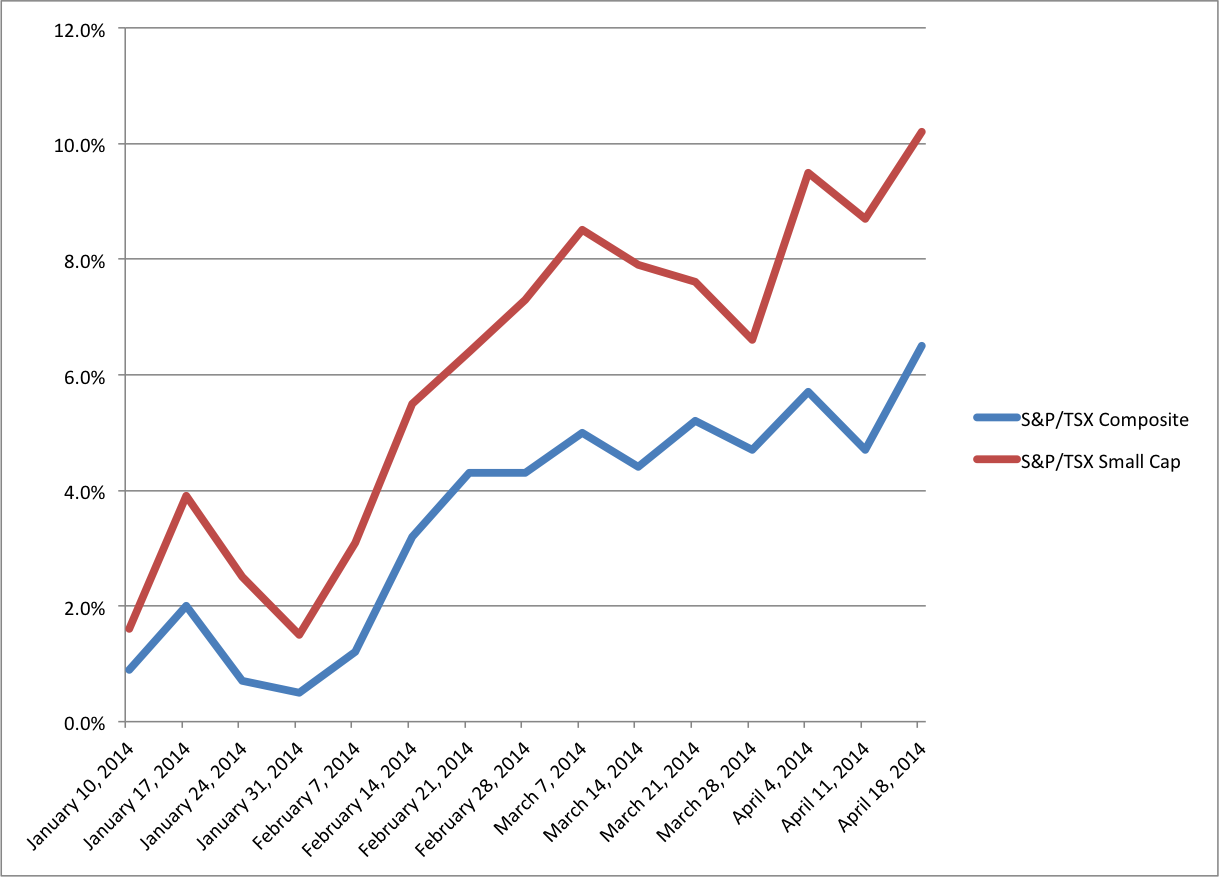
Money CanThis year the Canadian markets have been doing exceptionally well. Where as last year the S&P/TSX had been struggling to get above 2% at this time, this year the markets have soared ahead of most of their global counterparts. In fact the Canadian market triumph is only half of this story, matched equally by the disappointing performance of almost every significant global market. Concerns over China have hurt Emerging Markets. The Ukrainian crisis has hindered Europe, and a difficult winter combined with weaker economic data has put the brakes on the US as well.

YTD TSX Performance

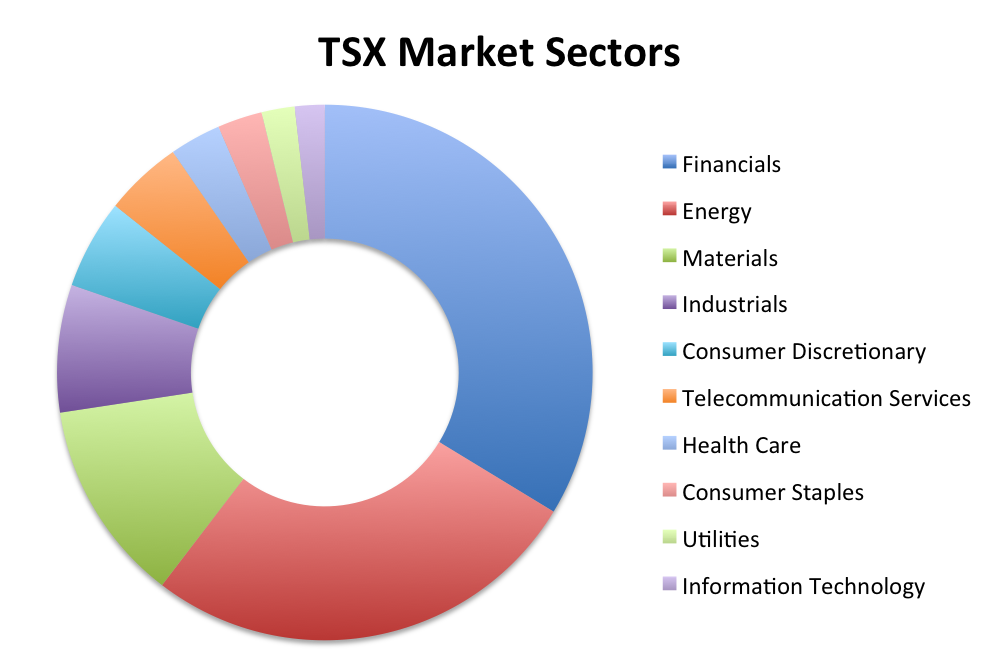
But this sudden return to form should not fool Canadians. It is a common trope of investing that people over estimate the value of their local economies, and a home bias can prove to be dangerous to a portfolio. Taking a peak under the hood of Canada’s market performance and we see it is largely from the volatile sectors of the economy. In the current year the costs of Oil, Natural Gas and Gold are all up. Utilities have also driven some of the returns, but with the Materials and Energy sector being a full third of the TSX its easy to see what’s really driving market performance. Combined with a declining dollar and improving global economy and Canada looks like an ideal place to invest.

TSX Market Sectors

But the underlying truth of the Canadian market is that it remains unhealthy. Manufacturing is down, although recovering slowly. Jobs growth exists, but its highly anemic. The core dangers to the vast number of Canadians continue to be high debt, expensive real-estate and cheap credit. In short, Canada is beginning to look more like pre-2008 United States rather than the picture of financial health we continue to project. Cheap borrowing rates are keeping the economy afloat, and it isn’t at all clear what the government can do to slow it down without upsetting the apple cart.

For Canadian investors the pull will be to increase exposure to the Canadian market, but they should be wary that even when news reports seem favourable about how well the Canadian economy might do, they are not making a comment about how healthy the economy really is. Instead they are making a prediction about what might happen if trends continue in a certain direction. There are many threats to Canada, both global and domestic, and it should weigh heavily on the minds of investors when they choose where to invest.


Economists Worry About Canadian Housing Bubble, Canada Politely Disagrees

real-estate-investingThis week the Financial Times reported that “Canada’s housing market exhibits many of the symptoms that preceded disruptive housing downturns in other developed economies, namely overbuilding, overvaluation and excessive household debt.”

These comments made by economist David Madani have been repeated and echoed by a number of other groups, all of whom cite Canada’s low interest rates and large household debt (now 163% of disposable income according to Statistics Canada) as a source of significant danger to the Canadian economy.

This is not a view shared by Robert Kavic of BMO Nesbitt Burns who believes that the Canadian housing market has long legs, saying “Cue the bubble mongers!”

Since 2008 predicting the fall of housing markets has become a popular spectator sport. Canada seems to have sidestepped most of the downturn, which has only made calls for the failing of Canada’s housing markets greater. But the reality is that our housing markets are very hot, and we do have lots of debt.

So is Canada’s housing market heading for a crash? Maybe. And even if it was its hard to know what to do. Fundamentals in Canada’s housing sector remain strong (and have improved). People also want to live in Canadian cities, with 100,000 people moving annually to Toronto alone. In other words, there is lots of demand. In addition regulations in the Canadian financial sector prevent similar scenarios that were seen in the United States, Spain and Ireland from occurring.

But housing prices can’t go up forever, and the more burdensome Canadian debt becomes the more sensitive the Canadian economy will become to interest rate changes. Meanwhile I have grown far more weary of over confident economists assuring the general public that “nothing can go wrong.” 

The big lesson here is probably that your house is a bad financial investment, but a great place to live. Unless you own your home, a house tends to be the bank’s asset and not yours. In addition your home, like your car, needs constant maintenance to retain its value. So if you wanted to buy a house to live in, good for you. If you want to buy a house as an investment my question to you is, “Is this really expensive investment the best investment in a world of financial opportunities?”