But What if He Wins?

nbc-fires-donald-trump-after-he-calls-mexicans-rapists-and-drug-runners

You may not respect him, but have you ever seen someone with more luck than Donald Trump? I put it to you that you haven’t and I would wager that neither has Hillary Clinton. Three debates and a decade old video of Donald Trump lewdly discussing how he likes to grope women seemed to have moved him from a better than outside chance of winning to a massive and decisive loss. His obituary had practically been written and pundits were getting comfortable that they were never going to have to say “President Trump” with a straight face.

snifflegrabapussThe reopening of the email investigation by the FBI has breathed second life into Trump’s campaign, reinvigorated a dejected base and rekindled the seemingly pathological hate many have for Hillary. Trump’s candidacy is still a long shot, but not as long a shot as it should be.

The question that has lurked in people’s minds since Trump actually won the nomination for the Republican nominee is “what if he wins?” Normally it would mean very little, much of America’s budget is spoken for, in the form of military, social security and domestic payments as well as interest on debts. But Trump’s promises have people scared. Beyond the impractical (build the wall) and unlikely (make Mexico pay for the wall) Trump has promised to change the economic landscape in a big way. He wants to tear up trade deals and have a trade war with China. To Wall Street and other hubs of investing this sounds insane, and people who understand these agreements know that trade deals can not simply be torn up without serious repercussions. These promises make investors heads reel with fears of economic collapse.

But asking “what happens if he wins” is really several questions stacked on top of one another. The first question is “What happens tomorrow?”, the next is “how likely is Trump to follow through on his agenda?” and lastly “What should investors do?”

The Day After Tomorrow

Predictions about the market impact of a Donald Trump win range from apocalyptic to the more mundane, but a sudden sell off wouldn’t be surprising. In fact given the time frame between the election win, the time it takes to assemble a new government and the ability to pass legislation, its unlikely the much would happen policy wise initially, and a sudden sell off would be met with growing confidence in the market as investors and market makers bought cheaply sold companies and economists saw economic health remain steady. That might amount to a phony war while real changes remain over the horizon, but the events following BREXIT might provide a useful guide: an immediate sell-off followed by a market bounce, but with a large amount of uncertainty looming.

Git’er Done!

How likely is Trump to follow through on “the greatest wall you’ve ever seen”? Probably not that likely. A lot of Trump’s plans rest on other people helping push his agenda, and while he holds the bully pulpit that role is only effective so long as he’s popular.

In Toronto, Rob Ford’s election stunned a lot of city councilors and led to some hasty changes of allegiance, but as time wore on and Ford was seemingly more unreliable, his opponents were emboldened. Trump may not even get the same grace period and early support, having won a highly contested election in which all the guardrails came off the political system, lots of people will feel better about challenging his success than making him great. But given the uncertainty of power and how craven many politicians seem to be, its likely some of his ideas will find their way into action. While he’s unlikely to actually end trade agreements, spending increases on defence and border control and new tariffs on countries like Mexico won’t be surprising.

What Should You Do?

To start with? Nothing. America’s economy looks strong and competitive. Job growth has been fairly consistent and GDP continues to rise. The standard approach for politicians is to denounce your opponents accomplishments and them claim them as your own after a certain time. I can only assume that the temptation will be for whatever president/congress to declare victory and say that not every aspect of a Trump’s agenda is needed. Whether that satiates his followers has yet to be seen, and if Trump finds political appetite in pushing his agenda, that may ultimately lead to a more insulated, poorer nation; one less appealing to invest in.

The most likely scenario?

Trump loses.

Trump loses and nothing goes back to normal.

Trump’s most damaging language may yet be his view that the election is “rigged.” Initially meant as a shorthand for media bias, it has morphed to be an accusation of actual vote rigging, and is coming dangerously close to demanding voter intimidation to “preserve democracy”. The outcome of this election may leave us much of where we were before, with Republicans comfortably in opposition to a democratic president who they feel no need to work with.

Politicians are public servants, but ones frequently given to bouts of moral cowardice. This is a result of being elected and needing to satisfy an ever more diverse group of people to hold on to power. The easiest way of holding on to power is to grab whatever tent pole groups the largest number of people together. In 2009 that tent pole was the tea party, which opened the door for a number of savvy politicians to take seats away from older and more principled people, even as the language became more extreme. For at least several decades it has also been quite popular to say that one “isn’t a politician”, a line so tired that it practically begs to be called out on live television.

These trends only exist because they resonate with enough of the public to facilitate getting elected. If Trump fails he will have still demonstrated how much more effective one can be ignoring the (now very few) niceties of politics. If you thought we had seen the last of people literally talking about penis size and advocating war crimes in an election cycle, think again. A number of junior and potential politicians will see this as a path to higher office and getting media attention, two things in short supply for any ambitious politician.

In the end, I expect more of the gridlock that has defined the past eight years, and for some reason I don’t think that will bother Wall Street one bit.

Investing in the Age of Brexit Populism

There is going to be lots of news around Brexit for the next while, and we have many other things to look at. So until more is known and more things are resolved this will be our last piece looking at the In/Out Referendum of June 23rd.


So far the best thing that I’ve read about Brexit is an essay by Glenn Greenwald, who has captured much of the essential cognitive dissonance that revolves around the populist uprisings we’ve seen this year, from Bernie Sanders to Jeremy Corbyn and from Donald Trump to UKIP. You can read the essay here, but I think he gives a poignant take down of an isolated political class and an elitist media that fails to capture what drives much of the populism intent on burning down modern institutions. In light of that criticism, what should investors think about the current situation and how does it apply to their investments?

Let’s start with the basics; that leaving the EU is a bad idea but an understandable one. The Eurozone is rife with problems, from bureaucratic nonsense to democratic unaccountability, the whole thing gets under many people’s skin, and not just in the UK. Across Europe millions of people have been displaced from good work, have lost sight of the dignity in their lives and have come to be told repeatedly that the lives they lead are small, petty and must make way for a new way of doing things. The vast project that is the EU has been to reorder societies along new globalized lines, and if you live in Greece, Spain, Portugal or Italy those lines have come with terrible burdens of austerity and high unemployment.

It’s easy to see that the outstanding issues of the 21st century are going unchecked. Wealth inequality and increasing urbanization are colliding with the problems of expensive housing markets, wage stagnation and low inflation rates. The benefits of economic growth are becoming increasingly sparse as the costs of comfortably integrating into society continue to rise.

In response to these problems the media has shown little ability to navigate an insightful course. Trump is a fascist, Bernie Sanders is clueless, “Leave” voters are bigots, and any objection to the existing status quo that could upset the prescribed “correct” system is deemed laughably impractical or simply an enemy of free society.

This is a dynamic that can plainly not exist and if there is any hope in restoring or renewing faith in the institutions that govern much of our lives. We must find ways to more tactfully discuss big issues. Trump supporters are not idiots and fascists. Bernie supporters are not ignorant millennials. Leave campaigners are not xenophobic bigots. These are real people and have come to the feeling that they are disenfranchised citizenry who see the dignity of their lives is being undercut by a relentless march of progress. Addressing that will lead to more successful solutions to our collective woes than name calling and mud slinging.

For investors this continued disruption could not happen at a worse time. In some ways it is the needs of an aging population that have set the stage of much of the discontent. As one generation heads towards retirement having benefited from a prolonged period of stability and increasing economic wealth, the generations behind it are finding little left at the table. Fighting for stability means accepting that the current situation is worth fighting for. For retirees stability is paramount as years of retirement still need to be financed, but if you are 50 or younger fighting for a better deal may be worth the chaos.

cities-history
For anyone doubts that cities are the most important part of our society and economic wealth, here is the history of cities over the past 5000 years. – From the Guardian


Investors should take note then that this is the new normal. Volatility is becoming an increasing fact of life and if wealth inequality, an unstable middle class and expensive urbanisation can not be tamed and conquered our politics will remain a hot bed of populist uprisings. So what can investors do? They need to broaden their scope of acceptable investments. The trend currently is towards more passive investments, like ETFs that mimic indices, but that only has the effect of magnifying the volatility. Investors should be speaking to their advisors about all options, including active managers, guaranteed retirement investments, products that pay income and even products with limited liquidity that don’t trade on the open market. This isn’t the time to limit your investment ideas, its the time to expand them.

Do you need new investment ideas? Give us a call to learn about all the different ways that investments can help you through volatile markets!

416-960-5995

Or contact us below!

Go back

Your message has been sent

Warning
Warning
Warning

Warning.


Notes from the Edge

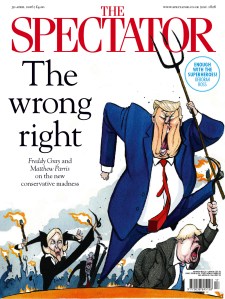
cover_180616_issue
The June 18th cover for The Spectator


With the BREXIT vote now only days away its worth taking a moment to consider the dramatic political shift that seems to be happening around the globe. Where once left/right politics dominated, or pro-capitalism vs. pro-socialist forces clashed, today the challenge is far more frightening. Today we sit on the brink of the end of the new internationalism and face the rise of old nationalism.

In Jon Ronson’s funny and insightful book THEM: Adventures with Extremists, the author describes his final meeting with a founding member of the Bilderberg Group (yes, that Bilderberg Group) Lord Healy, who explains that at the end of the Second World War a real effort was made to encourage trade and economic growth as a way of deferring future wars. The Bilderberg Group is but one of many, slightly shadowy and often undemocratic, organizations that exist to further those goals, encouraging powerful people to air out their issues and discuss ways to make that vision of the world more likely.

But for millions of people the new internationalism that has been fostered through trade agreements, globalization and corporatism has made the world more hostile to millions of “left behind” voters. It has seemingly given power to cigarette manufactures in Africa, or created unfair and uncompetitive “tax free zones” in South Pacific nations. It has fostered sweatshops in Sri Lanka, dangerous factories in Bangladesh, all at the expense of industrial workers in Western developed nations. In Europe this internationalism is blamed for feckless leadership on humanitarian, fiscal and bureaucratic issues. In America it is blamed for the rust belt through the mid-west.

The response to the growing frustration on all these issues has been a resurgence of nationalism and political “strong-men”. Putin’s Crimea grab was as much about returning pride to Russia as it was about diverting attention from his own domestic issues, reestablishing  Russia’s place as a significant regional power. Across Europe there are rumblings, both of renewed regional nationalism from within countries, as well as growing concern that a “leave vote” in Brexit could destabilize the entire EU experiment. In the United States these issues have given power to the Donald Trump populism, but have also fired the Bernie Sanders campaign.

Energy to these issues have undoubtedly been fueled as a result of 2008, a disaster so wide reaching and so disruptive to the Internationalist narrative about the skill set of the political and corporate classes that it shouldn’t be surprising that millions of people seem ready to do irreparable harm to the status quo. The subsequent inability to provide a strong and sustained economic recovery like some recessions of the past has only made matters worse. Every ill, every short coming, every poor decision and every injustice inherent within the structure that we inhabit is now expected to be resolved by setting the whole thing on fire and assuming that the problem is solved.

I am constantly surprised by how little people actually want to see changed by referendums like these. During the Scottish Referendum, the expectation was that Scotland would continue on exactly as it does, but without any association to London. The Leave campaign in Britain is quite sure that while Britain will no longer be part of the common market, a deal can be worked out that will allow free trade to continue unabated and for British people who live in places like Spain and Italy to continue to do so without visas or travel restrictions. Donald Trump is quite convinced that he can have a trade war with China without upsetting American business interests there, and the host of smaller countries like Venezuela or Turkey can slide into despotism without adverse impacts to their international reputation.

https://youtu.be/hMfx0dDRo2M

We’re at the edge, with the mob pushing for change (any change) with little real understanding of the consequences. It is little surprise that the technocrats and political establishment are so unlikable and so uninspiring in the face of the radicals and revolutionaries that want to see a sizable change that can’t be brought about until everything is torn down. And while it is true that the status quo can’t remain, it is equally unlikely that the end of the EU, or a British exit will stem the tide of migrants from Eritrea, or that tearing up NAFTA will return factories to Michigan, or that Marine Le Pen can turn the clock back on France and bring back the beret.

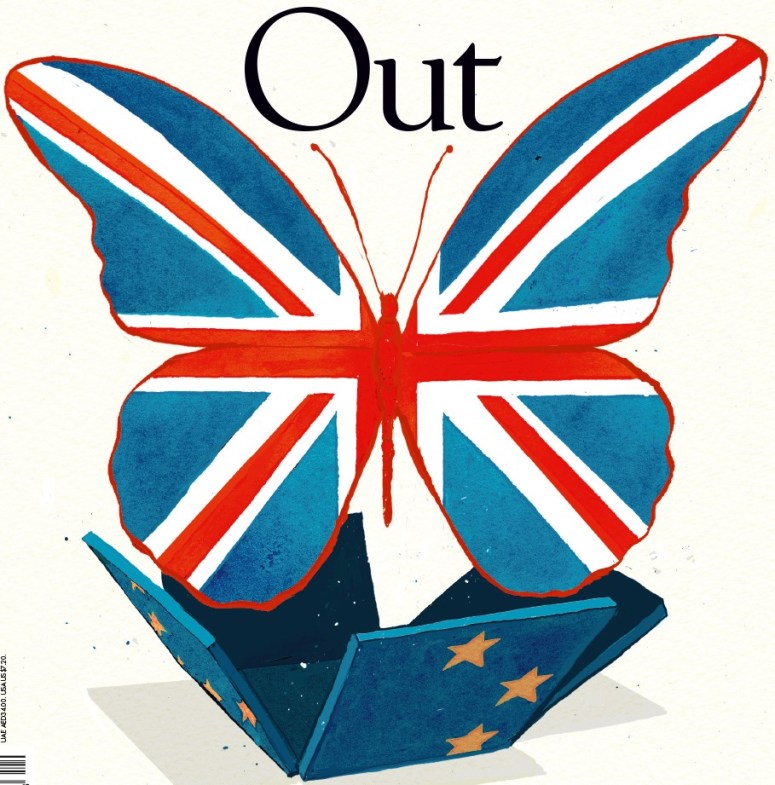
cover_300416_issue

I expect market volatility over the next while as investors and deal makers try and figure out the correct response to either a leave or remain vote. If Britain does leave, the next 100 days will be telling as pronouncements will be made to try and smooth the troubled waters. But the real work will come in the next 2 years, as negotiations will begin to do all the hard work that the referendum creates. You can’t just burn it all down, you have to build something in its place. How successful the reformers are at the latter will be the real test of the new nationalism.


Burning It All Down – The Rise of Trump’s Conservatism

tumblr_ns5yfgWfPx1rxpsuuo1_1280

Last August I wrote that Donald Trump was my pick for the Republican nominee, despite his incessant self-aggrandizing style and boorish behavior. I wrote that article because I saw something in Trump that reminded me of Rob Ford, a call back to an angry populism that favours the loud and obnoxious precisely because they are loud and obnoxious. Trump’s style of bombast is a snub to a political elite that adopt a façade of manners that suggest cordial rivalry, even while private donations and Super PACs flood the airways with crude, misleading and sometimes plain false advertising.

https://youtu.be/PDT-LN5-Edw

Despite a continued and coordinated assault on Trump by the core Republican establishment, Trump went from an outside contender to the leader of the pack. In fact the more that it seemed like the establishment was aligned against him the more support coalesced around him. And last night it seemed that enough of that support had come together to make him the presumptive nominee.

With Ted Cruz and John Kaisch now mathematically eliminated from any chance of a first round win, and the likelihood of a contested convention becoming more dubious as Trump narrows in on his needed delegates, it might be time for people to move past the look of Trump’s rhetoric and into what he’s actually saying. Because this election doesn’t bode well for anyone, but it is very much in keeping with the times.

The times, in case you’ve been hiding under a rock, are not being kind to the neoliberal world that has defined much of the 1990s and early 2000s. America’s foreign influence is waning, the middle class is shrinking, economies are floundering and the European Union is struggling to hold it all together. From a resurgent Russia to a migrant crises and angry middle class voters, this year is testing the resolve of political organizations and global partnerships to continue to do what they do; knock down borders, free up trade and move people across the planet. Citizens across much of the West now doubt many of the promises that have been made to them, notably that more free trade would make us all rich and that people from far flung lands are just like us with similar values.

That doubt about the modern world has been fueling the campaigns of both Bernie Sanders and Donald Trump, and a close look at their platforms shows some important overlap. But with Bernie Sanders also likely eliminated from any chance of the nomination the general election may come down to an establishment candidate in Hillary Clinton and the now (kind of) anti-establishment Donald Trump.

Donald Trump’s rhetoric is decidedly conservative in an old-school kind of way. His commitment to building a wall across the border with Mexico, to ignoring much of the Middle East and backing away from trade deals with China is reminiscent of a 1940s style conservativism and is a direct challenge to the current establishment view on all of these issues. I’m not convinced that Hillary Clinton, dragging her own varied and damning baggage with her, will be up to the challenge of convincing the voting public to continue to support the neoliberalism that she is so closely tied with. It seems even more unlikely that she could become the credible liberal standard bearer for an anti neoliberal platform at all.

I had initially said that Trump was my pick for nominee because the Republicans had become a tired shell of their former selves, squandering elections by ostracizing women, minorities and urban voters in favour of curmudgeonly racists, the science skeptics and the frighteningly devout. The election cycle, spent pandering to this shrinking group of largely social conservatives, was handing the democrats election after election. As I said in the summer, one party shouldn’t be electable and the other crazy. This election may indeed offer some real alternatives about the kind of world that Americans may want to live in.

Riker_gone_mad
You don’t understand Picard! Trump became president in my timeline! Mars is overrun with casinos, and not the nice ones from Vegas, the kind from Atlantic City.


So rather than wring our hands at a Trump election has the end of all things, let’s cast this election to something akin to Brexit, another insurgency by an increasingly unhappy and dissatisfied middle class that has come to suspect that their leaders no longer work for them, but for larger more self-interested groups that tend to congregate in Swiss towns and busy themselves with networking and back patting. If Trump is successful in his Whitehouse bid we may be surprised at the kind of world that is ushered in to being; one that is increasingly isolated, protectionist and introverted. If that isn’t a wakeup call to TED Talk speaker’s circuit, I don’t know what will be.


*** I’ve taken some time off of writing our articles to focus on work and family, but I’m feeling rejuvenated now and will be back with our weekly outlook on the world. Sorry if you’ve missed us!***

Donald Trump Is My Pick For Republican Nominee

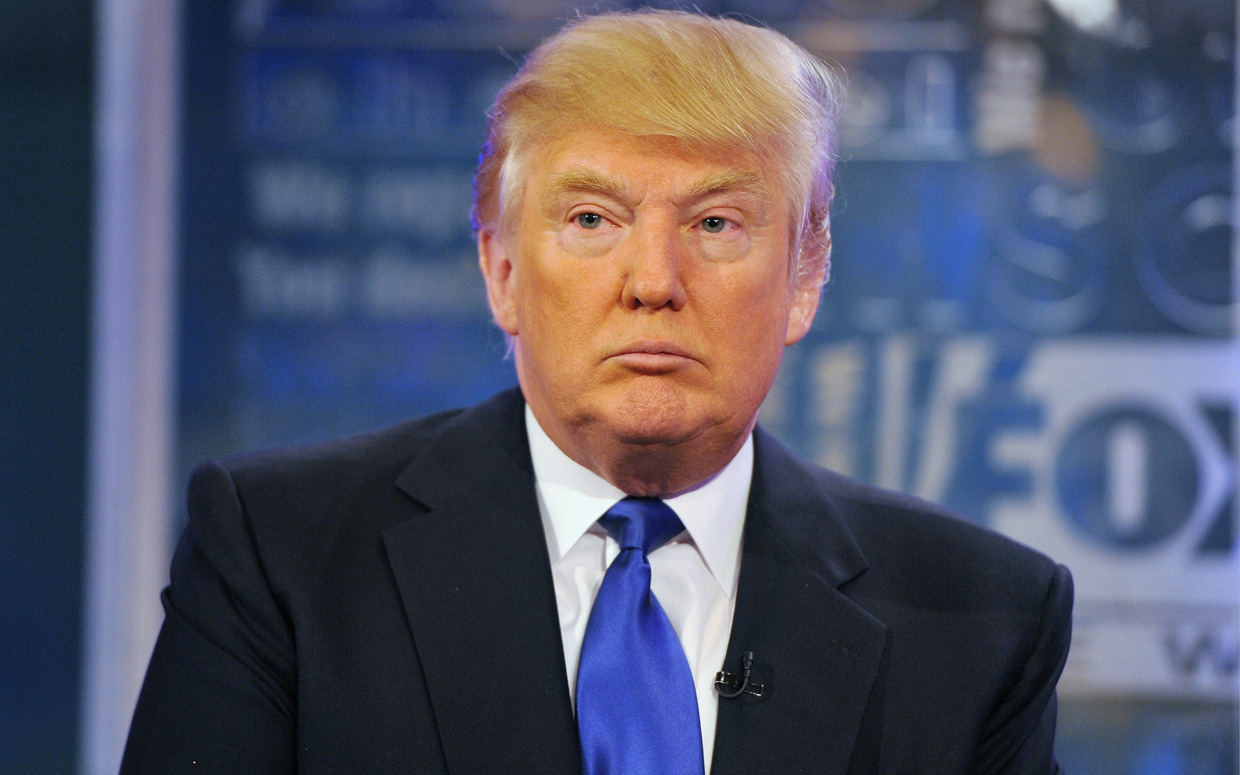
Look at this guy. What color is that? Orange? Has he got orange hair? Remember when Lloyd Robertson had orange hair? I remember when Lloyd Robertson had orange hair.

The arrival of Donald Trump to the Republican primaries has been greeted with mock and outrage by much of the media. There he is, an unapologetic billionaire blowhard with something akin to hair on top of his head, now best known for telling celebrities that they are fired. He was an immediate subject of derision, an unserious pretend candidate who says offense things regularly and calls people he doesn’t like “dummy.” To Democrats he has been a welcome addition to the Republican lineup. For Republicans he’s nothing but a headache. And if one thing is clear it’s that nobody thinks he should be the nominee. Except me. I think he will be a great nominee, and importantly I think he may be able to change some fundamentally terrible aspects of the Republican Party.

Talking heads and professional media types tend to disparage people who they don’t think look or act like a politician should. Donald Trump talks at a grade 4 level. He says impolite things and doesn’t seem to care what people say about him. He talks about himself incessantly and, again, the hair. Stubbornly “the Donald” continues to do well in the polls despite this.

But it shouldn’t have escaped anyone’s attention that the Republican Party has been in a holding pattern for the last few elections. Winning the nomination has usually meant a grueling process of ratcheting up the rhetoric around a few hot button issues, important to a dwindling number of older voters and rural Americans and out of touch with the growing urban class that is increasingly defining the voter base of general elections. By the time a winner of the primaries is declared, the candidate now looks to be stuck in an Orwellian, “Shooting an Elephant” conundrum, theoretically in charge of the mob, while totally beholden to its will.

This has been good news for Democrats, who have been happy to have the Republican nominee become an ugly caricature of cruel populism; out of touch with a modern electorate, thumping a bible and alienating moderate conservatives who don’t believe they can trust their own party to lower taxes without forcing women to carry children to term, poor people to die without medicine, and science textbooks to be re-written in ways largely defined as “stupid.” Good for Democrats, but bad for a healthy democracy. One party shouldn’t be electable, while the other crazy.

There is a museum in Kentucky where this isn't a parody.
There is a museum in Kentucky where this isn’t a parody.

But “The Donald” has the power to change that. Unlike other politicians that try and position themselves as outsiders, Trump really is an outsider. He may not have impressed anyone with his talk about Mexican illegals, but on other issues he has had the ability to surprise. On campaign finance he has denounced the system as broken, highlighting his own political contributions in exchange for favours. He’s called Jeb Bush (the presumed nominee) beholden to his donors. He may not win points from Rosie O’Donnell, but he’s broken the traditional Republican line on Planned Parenthood. Fundamentally, Donald Trump is different from other Republican candidates, in no rush to distance himself from his urban roots, unapologetic about his more liberal leanings, but credible in the eyes of many on business and economy related issues.

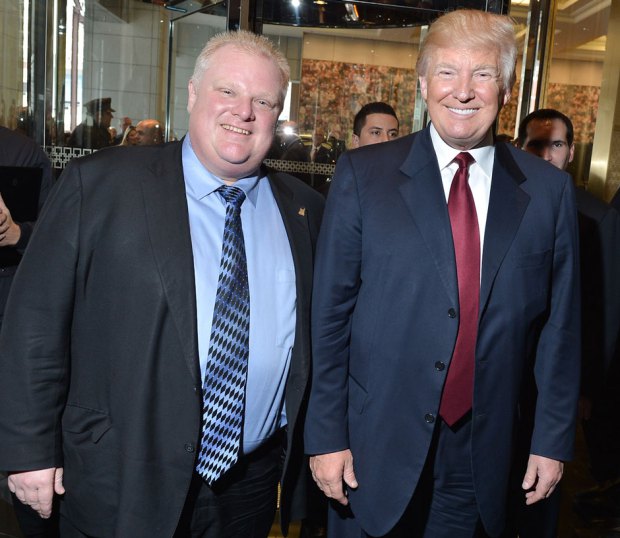
As if to make my point, these two helpfully posed for a photo together.

Trump’s current lead reminds me of Rob Ford, another unapologetic, shameless, larger than life character who seemed to exist in spite of condemnation from the media and the established political class (I found this article after I wrote this piece, but it explains my thoughts well on the two). Yet the sincerity of Rob Ford’s belief that only he would fight for tax payers won many over, even in the face of more polite, more polished and more traditional politicians. You don’t have to love people like Rob Ford or Donald Trump, but their ability to change the political terrain, to question traditional assumptions about the electorate and undo the laziness of identity politics (the ultimately abusive and anti-democratic idea that these are “my voters” and those are “your voters”) is healthy for a democracy, even when you don’t like the messenger (I think the same might be said for Bernie Sanders).

So, whether Donald Trump wins, or implodes dramatically before the July 2016 Republican nomination, he’s my pick to be the next nominee. And he’s going to be big. Big. Uuuuuuuuuge.