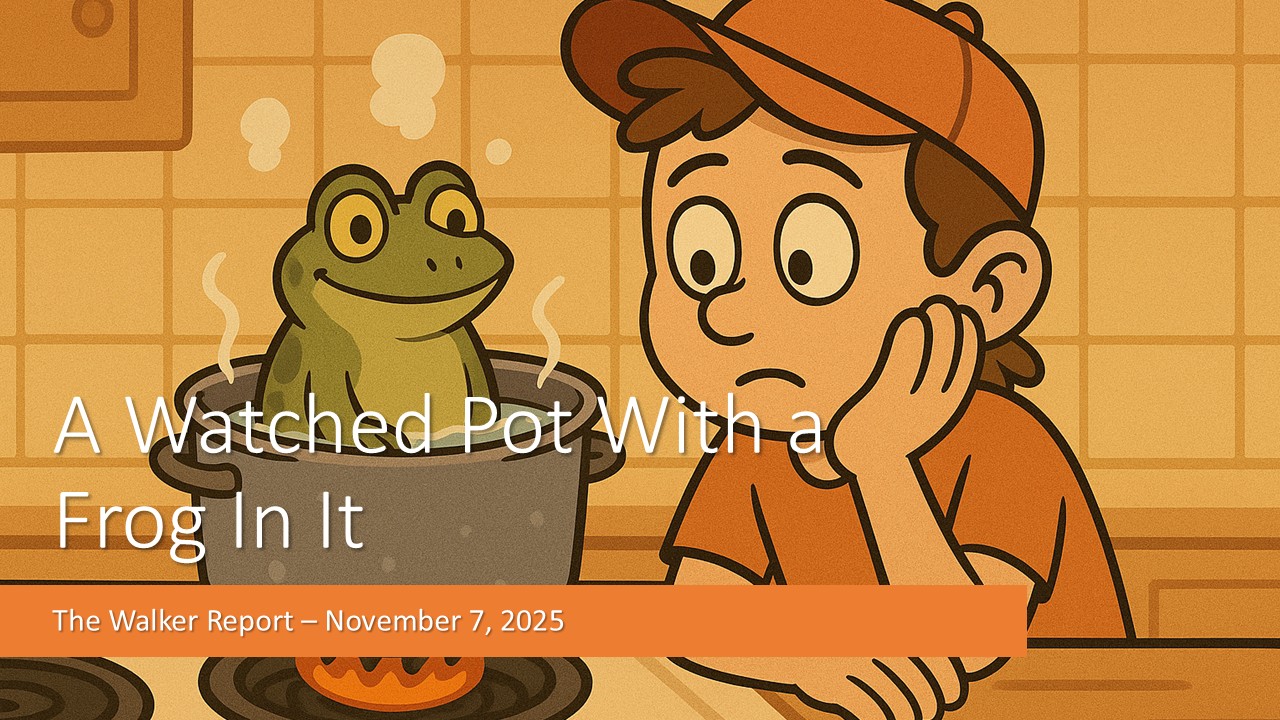
A Watched Pot With A Frog In It

Back in the spring, markets reeled after Trump announced a new round of unilateral tariffs. The April 2nd announcement triggered a week of panic selling until the administration promised a temporary 90-day pause to pursue trade negotiations. Nine months later, the U.S. now has the highest tariff levels in over a century, economic data is showing signs of weakening, and discussions of a market bubble are widespread. Why, then, is the stock market still so high?

The most immediate reason is the concentration of market leadership. The “Magnificent Seven” tech giants now account for more than 35% of the S&P 500, while the top ten companies make up nearly 40%. The gap between the S&P 500 and its equal-weighted equivalent is just shy of 10%, while the Magnificent Seven themselves have delivered a combined return of roughly 27.6% year-to-date. The comparison to the dot-com era is easy to make, but the fundamental difference is profitability: Apple, Google, Microsoft, Amazon, Meta and others continue to generate substantial earnings and hold enormous balance-sheet reserves. This profitability has helped anchor market confidence.

Figure 1 Growth of the Magnificent Seven as a part of  the S&P 500

Another factor is the lag in how economic data reflects policy changes. Despite the risks tariffs pose, the full impact has not yet shown up in backward-looking data like GDP or employment reports. Investors expecting an immediate shock instead found resilient quarterly numbers, reinforcing confidence rather than shaking it.

Figure 2 Effective tariff rates over time, from the Yale Budget Lab

There is also a deeper structural issue: the increasing concentration of economic power and spending. As wealth inequality widens, a large share of U.S. households are contributing less to measured economic activity. Recent consumer expenditure data suggests that the top 10% of households now account for roughly 50% of all consumer spending, while the bottom 60% contribute less than 20%. This means that economic stress among the majority of households may not meaningfully register in the headline data that markets rely on. Meanwhile, AI-related capital investment makes up a growing share of the remainder of measured economic activity.

Figure 3 Widening wealth disparities between households and consumer spending

This combination — delayed data effects, high concentration of consumption, and sustained AI investment — has helped keep investor sentiment resilient, even as negative signals accumulate beneath the surface. It has also masked the risks of allowing speculative dynamics to develop largely unchecked.

Figure 4 Growth of Personal Consumption as a percentage of GDP

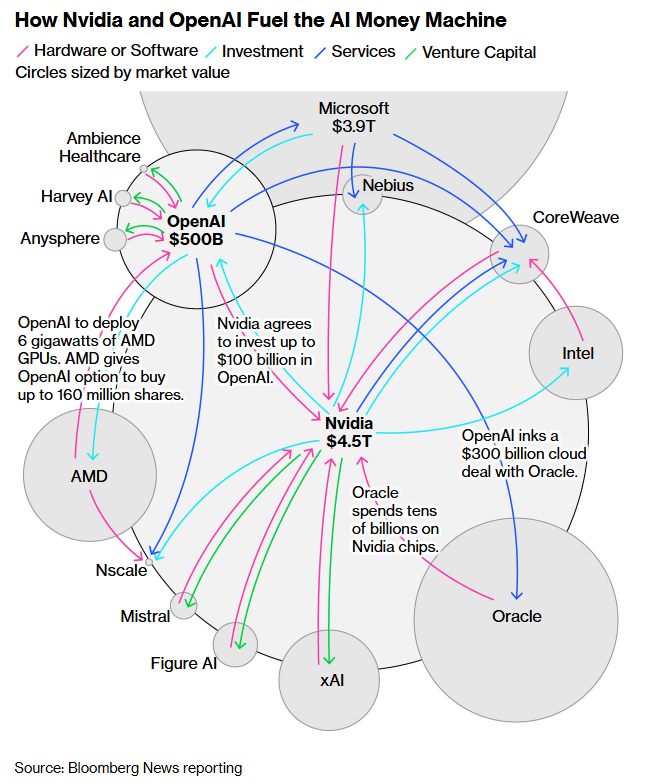
Concerns about an AI bubble are growing. Estimates of total AI investment now exceed $3 trillion when considering capital expenditures, valuations, and related infrastructure spending. Commercial use cases outside of a few sectors remain limited. Some firms have begun participating in “circular funding arrangements,” where they invest in each other’s AI initiatives to reinforce perceived valuations. Even industry leaders acknowledge the speculative environment: Sam Altman, the CEO of Open AI has said there is likely a bubble, while Jeff Bezos has called this a “good bubble” that will still produce transformative breakthroughs.
History suggests that speculative cycles are remarkably resistant to logic. They often convert skeptics into participants, including professional money managers who join in under client pressure. Market bubbles resemble the proverbial frog in a pot: the danger rises slowly enough to dull caution.

Yet they also resemble the “watched pot” that never seems to boil. As long as new capital continues to flow into AI-linked investments, momentum can persist. Predicting the end of a bubble is famously difficult — markets can remain irrational longer than investors can remain solvent.

So what should investors do? Awareness of rising risk is the starting point. We may not be able to time the end of the AI boom, but we can examine investor behavior for signs of speculative excess.

Consider Tesla. After the election, the stock surged nearly 98% in six weeks on enthusiasm linked to political alignment and narrative momentum. Since then, sales have weakened, profitability has declined, and competition has intensified — yet the stock remains 10% above its level on inauguration day and has more than doubled off its lows. Tesla’s valuation continues to reflect belief in future breakthroughs rather than current operational performance. It is a clear illustration of narrative overpowering fundamentals — a hallmark of speculative markets.
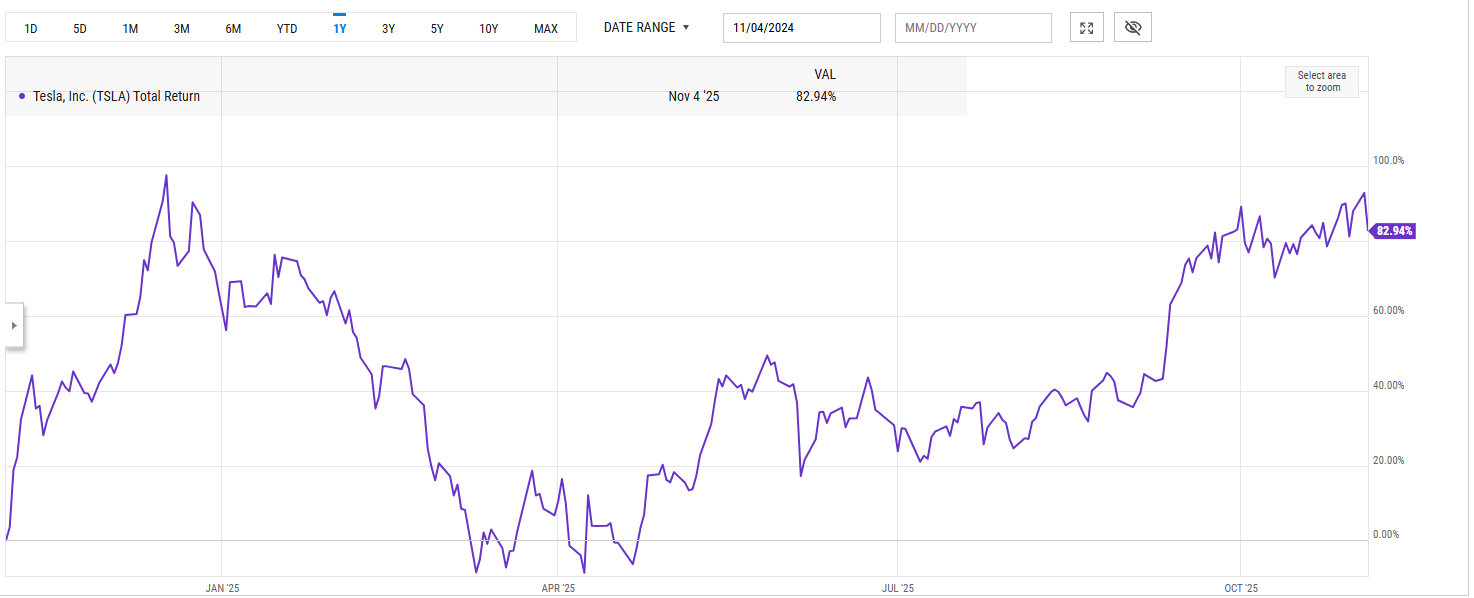
Figure 6 Tesla stock performance from November 4, 2024 to November 4, 2025

If this environment feels uncomfortable, it may be time to review portfolio risk exposure. Reducing equity risk comes with trade-offs — especially missing out on momentum-driven gains — but clarity on long-term goals can help prevent emotionally driven decision making.

Market manias are difficult to avoid and even harder to detach from when others are benefiting. The antidote is a disciplined investment plan that emphasizes long-term objectives over short-term excitement. In a world where the water may be warming around us, it is better to be a watcher than the frog.

Looking Back on 2021

Its traditional that the end of a year should stimulate some reflection on the past and the future, and so in the spirit of tradition I thought I’d take some time to look over some of the stranger and more surprising aspects of 2021.

China

While 2021 brought the pandemic *closer* to an end through the distribution of vaccines, markets underwent some fairly dramatic reversals over the course of the year. For instance China looked to be the principal economy in January. Following its own strict enforcement of Covid restrictions and solid economic performance, China seemed to be an earlier winner by the beginning of 2021, and set to enjoy robust growth through the year.

By March the tide was shifting however. China’s leader, Xi Jinping, proved to be every bit committed to his past comments about protecting and strengthening the CCP over free market concerns. Several billionaires, notably Jack Ma the founder of Alibaba, disappeared for long periods before reemerging only to publicly announce that they would be stepping down from their roles.

However, even while China was shaking down its billionaires and upsetting foreign nations, a new economic threat appeared in the form of a housing bubble looking ready to burst. Evergrande, one of the country’s largest property developers announced that it could not finance its debt anymore and looked likely to default. This news was unwelcome for markets, but for China hawks it fit their long standing belief that China’s strength has been built on a mountain of unsustainable debt, with property one of the most vulnerable sectors of the economy.

The finer points of China’s housing market are too nuanced to get into here, but it’s enough to know that the property bubble in China is large, built on sizeable debt and could take some time to deflate (if it does) and no one is sure what the fallout might be. Combined with China’s ongoing policy of “Covid Zero” – an attempt to eradicate the virus as opposed to learning to live with and manage it, we head into 2022 with China now a major outlier in the Asian region.

Inflation

Inflation was probably the other most discussed and worrying trend of 2021. Initially inflation sceptics seemed to win the argument, as central banks rebuffed worries over rising prices and described inflation as transitory. That argument seemed to wane as we entered late Q3 and prices were indeed a great deal higher and didn’t seem to be that “transitory” anymore. Inflation hawks took a victory lap while news sites began to fill up with worrying stories about rising prices on household goods.

The inflation story remains probably the worst understood. Inflation in Canada, as in other Western nations has been going on for sometime, and its effects have been under reported due to the unique nature of the CPI. But some of the concern has also been overwrought. Much of the immediate inflation is tied to supply chains, the result of “Just-in-time” infrastructure that has left little fat for manufacturers in exchange for lower production costs. Bottlenecks in the system will not last forever and as those supply chains normalize that pressure will recede.

The other big pressure for inflation is in energy costs, but that too is likely to recede. Oil production isn’t constrained and prices, while higher than they were at the beginning of the pandemic are lower than they were in 2019. In short, many of the worries with inflation will not be indefinite, while the issues most worrying about inflation, specifically what it costs to go to the grocery store, were important but underreported issues before the pandemic. Whether they prove newsworthy into the future is yet to be seen.

*Update – at the time of writing this we were still waiting on more inflation news, and as of this morning the official inflation rate for the US over the past year was 7%. Much of this is still being chalked up to supply chains squeezed by consumer demand. An unanswered question which will have a big impact on the permanence of inflation is whether this spills into wages.

This political advertisement from the Conservatives ruffled many feathers in late November

Housing and Stocks – Two things that only go up!

If loose monetary policy didn’t make your groceries more expensive, does that mean that central bankers were right not to worry about inflation distorting the market? The answer is a categorical “No”. As we have all heard (endlessly and tediously) housing prices have skyrocketed across the country, particularly in big cities like Toronto and Vancouver, but also in other countries. The source of this rapid escalation in prices has undoubtedly been the historically low interest rates which has allowed people to borrow more and bid up prices.

In conjunction with housing, we’ve also seen a massive spike in stock prices, with even notable dips lasting only a few days to a couple of weeks. The explosion of new investors, low-cost trading apps, meme-stocks, crypto-currencies, and now NFTs has shown that when trapped at home for extended periods of time with the occasional stimulus cheque, many people once fearful of the market have become quasi “professional” day traders.

Market have been mercurial this past year. Broadly they’ve seemed to do very well, but indexes did not reveal the wide disparities in returns. Last year five stocks were responsible for half the gains in the S&P 500 since April, and for the total year’s return (24%), Apple, Microsoft, Alphabet Inc, Tesla and Nvidia Corp were responsible for about 1/3 of that total return. This means that returns have been far more varied for investors outside a tightly packed group of stocks, and also suggests markets remain far more fragile than they initially appear, while the index itself is far more concentrated due to the relative size of its largest companies.

Suspicious Investment Practices In addition to a stock market that seems bulletproof, houses so expensive entire generations worry they’ve been permanently priced out of the market, the rapid and explosive growth of more dubious financial vehicles has been a real cause for concern and will likely prompt governments to begin intervening in these still unregulated markets.

Crypto currencies remain the standout in this space. Even as Bitcoin and Etherium continue to edge their way towards being mainstream, new crypto currencies trading at fractions of the price, have gotten attention. Some have turned out to be jokes of jokes that inadvertently blew up. Others have been straight-up scams. But all have found a dedicated group of investors willing to risk substantial sums of money in the hope of striking it rich.

NFTs, or non-fungible tokens have also crept up in this space, making use of the blockchain, but instead of something interchangeable (like a bitcoin for a bitcoin, i.e. fungible) these tokens are unique and have captured tens of thousands, sometimes hundreds of thousands of dollars for unique bits of digital art. Like cryptocurrencies, much of the value is the assumed future value and high demand for a scarce resource. However, history would show that this typically ends poorly, whether its housing, baseball cards or beanie babies.  

Lastly, there has been a number of new investment vehicles, the most unusual of which is “fractional ownership”. The online broker Wealth Simple was the first to offer this in Canada and it has been targeted to younger investors. The opportunity is that if your preferred stock is too expensive, you can own fractions of it. So if you wanted to invest in Amazon or Tesla, two stocks that are trading at (roughly) $3330 and $1156 respectively at the time of writing, those stocks might be out of reach if you’re just getting started.

This is a marketing idea, not a smart idea. The danger of having all your assets tied up in one investment is uncontroversial and well understood. The premise behind mutual funds and exchange traded funds was to give people a well-diversified investment solution without the necessity of large financial position. The introduction of fractional ownership ties back to the market fragility I mentioned above, with younger investors needlessly concentrating their risk in favour of trying to capture historic returns.

The End

For most investors this year was largely a positive one, though markets went through many phases. But while the pandemic has remained the central news story, the low market volatility and decent returns has kept much of us either distracted or comfortable with the state of things. And yet I can’t help but wonder whether the risks are all the greater as a result. Many of these events, the large returns in an ever tightening group of stocks, the growth of investors chasing gains, the sudden appearance of new asset bubbles and the continued strain on the housing market and household goods add up to a worrying mix as we look ahead.

Or maybe not. Market pessimists, housing bears, and bitcoin doubters have garnered a lot of attention but have a bad track record (I should know!) Many of the most pressing issues feel as though they should come to a head soon, but history also teaches us that real problems; big problems that take years to sort out and lead to substantial changes are often much longer in the making than the patience of their critics. The test for investors is whether they can stand by their convictions and miss out on potential windfalls, or will they become converts right as the market gives way?

Next week, we’ll examine some of the potential trends of 2022.   

Journal of a Plague Year – In Defense of the Lockdown

Plague Year

While curves continue to be bent and geopolitics continues to become both more silly and more frightening than anyone ever thought possible, populations of countries remain unsure and troubled about whether they have made the correct choice of trying to beat COVID-19 through lockdowns and aggressive social distancing. Predictions of economic doom run rampant, ranging from serious recessions to the potential for a depression not unlike that of the 1930s.

With nothing to do but sit at home and twiddle our thumbs, either letting our house fall into total chaos or be cleaner than ever (a battle largely determined by how tired I am and how many cookies my kids have had) making predictions and considering alternative paths to beating this virus occupy considerable mental space. How will we know whether the unprecedented steps we have taken were the correct steps to take? What dark and strange future awaits us on the other side? I’m here to put your mind at ease, both because this situation is not unprecedented, and because we may not have had any other choice.

Let’s start with precedent. In an interview with Australian talk show host John Anderson, historian Niall Ferguson mused that future historians would regard our response to the pandemic as a mistake. This is an understandable position given the continued uncertainty around much of the virus. Is it very dangerous? Does it only affect the elderly? Do we even know how many people have it? Undoubtedly the biggest threat from the virus is what we don’t know about it.

But the assumption that it is the lockdown that is hindering the economy are belied by the available evidence. For instance, Sweden has been a focus through much of this since it hasn’t locked down its economy fully. Though schools have been closed and people have been advised to socially distance, restaurants and bars have been allowed to remain open. But estimates are that business has dropped off dramatically. In fact, despite having more of their economy not under lock and key does not seem to have materially changed the country’s fate, with early economic predictions of the contractions expected to be around 7% of GDP. That’s in line with other European neighbors.

In a similar story, the state of Georgia’s efforts to open early were met with disappointing results. People, worried about a virus that has a surprising amount of variability and high level of infection simply don’t want to go axe throwing, drink in crowded bars and go bowling. With the virus still being prevalent the thing restricting economic activity is not the lockdown, it is the virus.

Much is being made of the 1918 Spanish Influenza and this is an understandable place to jump to; the last memorable global pandemic that seriously interrupted the lives of people. Economists studying that event have concluded that “cities that implemented early and extensive non pharmaceutical interventions (like physical distancing and forbidding large gatherings) suffered no adverse economic effects over the medium term. On the contrary, cities that intervened earlier and more aggressively experienced a relative increase in real economic activity after the pandemic subsided.” Other lessons drawn from the 1918 pandemic were not to give up too early on restrictions and that a multi-layered approach was what worked best.

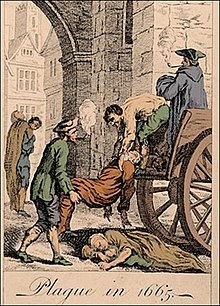
But precedent exists much farther back. In Daniel Defoe’s work “Memories of a Plague Year”, a book once thought to be a work of fiction, but now believed to be based on the diaries of Defoe’s uncle who lived through the last great plague in London of 1665, all the hallmarks of our modern response can be found in that bygone era. Wealthier people escaping to their cottages? From Defoe: “It is true, a vast many people fled, as I have observed, yet they were chiefly from the West End of the Town; and from that we call the Heart of the City, that is to say, among the wealthiest of the people.”

220px-Great_plague_of_london-1665

How about our daily obsession to see if the curve is “being bent” and watching the infection rates? In 1665 concern over the spread of the plague (called the distemper) caused people to look “towards the east end of town; and the weekly Bills showing the Increase of Burials in St. Giles’s Parish…the usual number of burials in a week, in the parishes of St Giles’s in the fields, and St. Andrew’s Holborn, were from 12 to 17 or 19 each, few more or less; but from the time that the Plague first began in St. Giles’s parish, it was observed that the ordinary burials increased in number considerably.”

What of economic activity? It has been estimated that somewhere between 25%-30% of the economy has been restricted, but in 1665 “All Master Workmen in Manufactures; especially such as belonged to Ornament, and the less necessary parts of the people’s dress, cloths, and furniture for houses; such as Riband Weavers, and other Weavers; Gold and Silverlace-makers, and…Seemstresses, Milleners, Shoemakers, Hat-makers and Glove Makers: also Upholserers, Joiners, Cabinet-Makers, Looking Glass Makers; and innumerable trades which depend upon such as these; I say the Master Workmen in such , stopped their work, dismissed their journeymen and workmen, and all their dependents.” You get the idea. The economy shut down.

source

Worried that people believe lunatic conspiracies, burning 5G towers across the world? Conspiracies depend on context, and in 1665 there were plenty of people pushing nonsense ideas, including astrologers spinning stories, and a host of charlatans that were “a worse sort of deceivers…for these petty thieves only deluded them to pick their pockets, and get their money; in which their wickedness, whatever it was, lay chiefly on the side of the deceiver’s deceiving, not upon the deceived.” Amulets, charms and potions, signs of the zodiac and any number of other bogus ways to defend the person from the plague were sold widely to a gullible public desperate for protection.

Great LevelerBut what of the predictions we keep hearing about? That life will be forever changed by the events we’re living through? While I have a great deal more to say about the nature of prognostication, I’ll keep my comments here brief. In general history shows that humans don’t tend towards radical changes following big, but temporary upheavals. Instead, crises like the one we are living through emphasize existing weaknesses within the society.
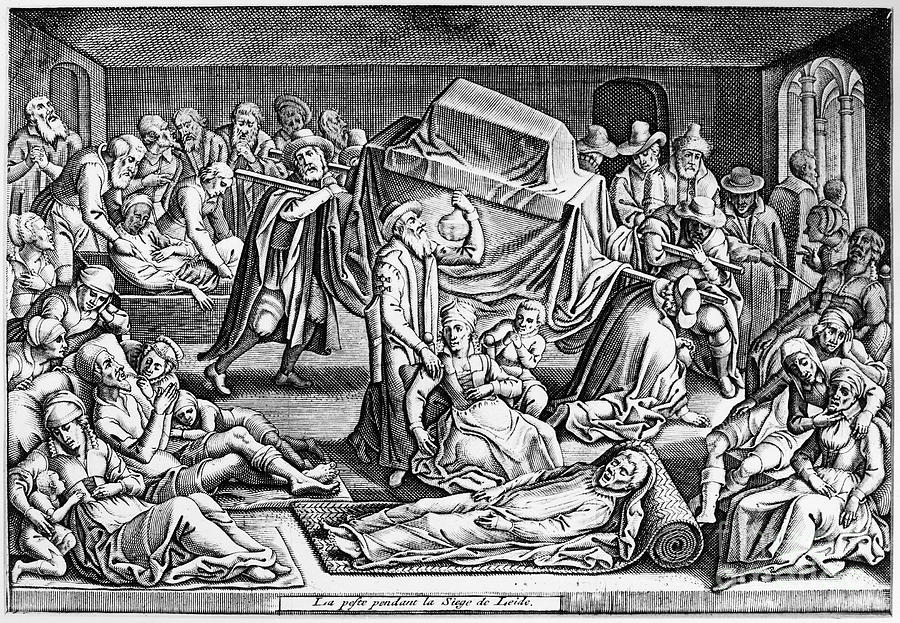
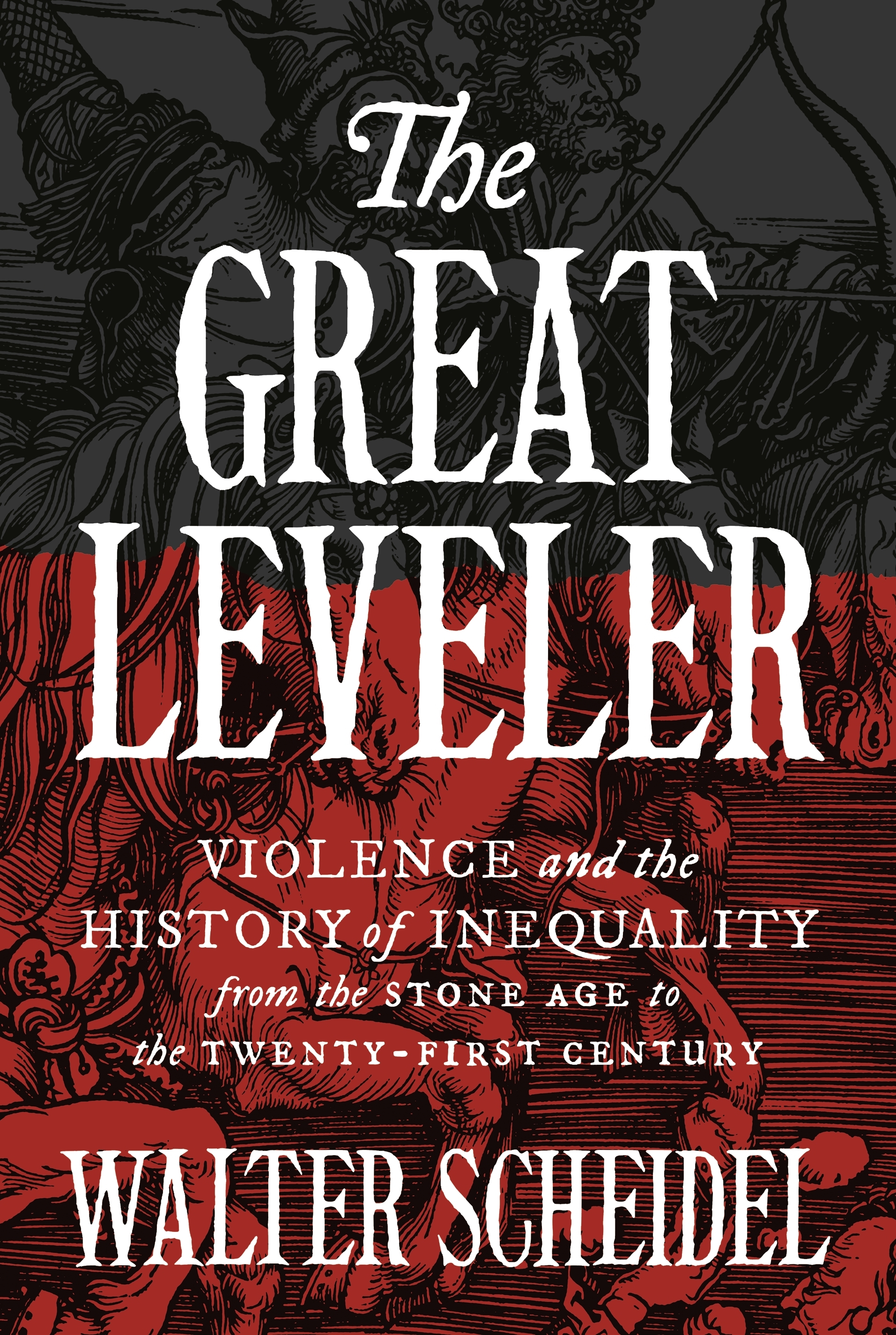
In his book “The Great Leveler: Violence and the History of Inequality from the Stone Age to the Twenty First Century”, author Walter Scheidel points out that during the first big years of the plague, which came in the 1300s, the high death rates from plague changed the existing relationship between land and labour. For a society of feudal serfs this meant that serfs could demand wages from their lords, and the lords felt compelled to pay lest their lands remain fallow. Behaviours changed too, but only in as much that hedonism and charity increased to match the scale of the devastation people were living through. In response to our own situation charity, certainly that sanctioned by the government, has been widespread. Whether we might count the volume of baking as a form of hedonism will be left to others to decide.

Wages & Covid

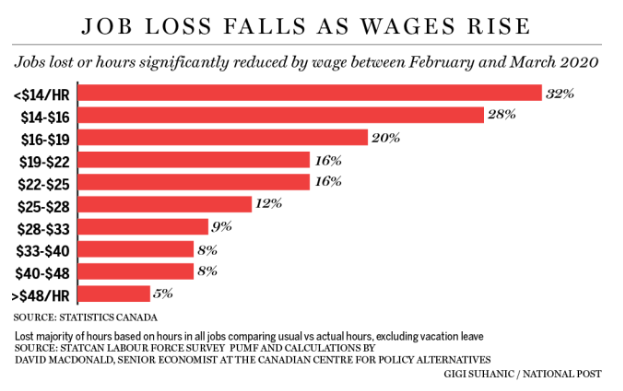
But we should largely discount predictions of an economy collapsing and a society that will not wish to do anything ever again. Cruise ships, house sales, air traffic and eating out will return as confidence returns, though there will be losses along the way. But the real damage to the economy, and the people within it, will likely remain along lines that have already been established. As fewer Canadians work in good manufacturing jobs and more work in the service sector, earning marginal wages, they will continue to take the brunt of the economic hit of the lockdown. Just as likely will be that efforts to decouple production from China will lead to greater automation in manufacturing. In other words, more of the ingredients at the heart of the widening inequality gap.

The response to the coronavirus feels novel, to us. But in the scheme of history there doesn’t seem to be many other viable options. Life will return to normal not when the lockdowns are lifted, but when the virus is gone. But if we’re going to do something with our time it would be better spent figuring out how we’re going to address a worsening crisis of inequality, or brace ourselves for the next round of populist agitation.

Black Death 1

Information in this commentary is for informational purposes only and not meant to be personalized investment advice. The content has been prepared by Adrian Walker from sources believed to be accurate. The opinions expressed are of the author and do not necessarily represent those of ACPI.


What To Do When You Need To Sell in Bad Markets?


Following up from a previous video (Why investors are told to stay invested in bad markets), we must recognize that we can’t always pick and choose when we need money from our savings. So how should we pick what investments to sell in a poorly performing market? Here’s one strategy to consider and help guide you!

As always, I’m available to talk any time and can be reached on my cell phone, through our office number or via email!

Sincerely,

Adrian Walker


Information in this commentary is for informational purposes only and not meant to be personalized investment advice. The content has been prepared by Adrian Walker from sources believed to be accurate. The opinions expressed are of the author and do not necessarily represent those of ACPI.

Recapping Last Week’s Market

A quick video looking at the sudden rise in markets last week and what conclusions we can draw from it.

Information in this commentary is for informational purposes only and not meant to be personalized investment advice. The content has been prepared by Adrian Walker from sources believed to be accurate. The opinions expressed are of the author and do not necessarily represent those of ACPI.

Why Can’t Markets Be Calmed?

A series of bad days, a moment of respite, and then more selling. This was the story of 2008, and it lasted for months. The rout lasted until finally investors felt that enough was going to be done to save the economy that people stopped selling. Massive quantitative easing, an interest rate at 0%, aggressive fund transfers, bailouts to whole industries, and the election of a president who seemed to embody the idea of “hyper competence”. That’s what it took to save the economy in 2008. Big money, an unconditional promise to save businesses and people, and the rejection of a political party that oversaw the bungled early handling of a crisis and had lost the public confidence.

I don’t think Donald Trump has never had been viewed as hyper competent. I doubt even his most ardent supporters see him as incredibly clever, but instead a thumb in the eye of “elites” who have never cared to take their concerns seriously, and to an establishment that seemed incapable of making politics work. Trump was a rejection of the status quo and a “disruptor in chief”. A TV game show host who played the role of America’s most sacrosanct character, the self made man, asked now to play the same role in politics.

There’s nothing I need to cover here you don’t already know. A history of bad business dealings, likely foreign collusion to win an election, surrounded by sycophants and yes men with little interest or understanding of the machines they have been put in charge of, and an endless supply of criminal charges. Like a dictator his closest advisors are members of his own family, and perhaps more shockingly he fawns over and publicly admires the dedications of respect other dictators get from their oppressed populations. Never has a person been so naked in their desires and shortfalls as Donald Trump.

Markets have played along with this charade because Trump seemed, if anything, largely harmless to them. Indifference to the larger operation of the government and the laser like focus on reduced regulations and tax cuts made Trump agreeable to the Wall Street set. If he could simply avoid a war and keep the economy humming, Trump was a liveable consequence of “good times”. Until the coronavirus issue, Trump had not done terribly. The economy wasn’t exactly humming. It had a bad limp due to a trade war with China. It had a chest cold because wealth inequality was continuing to worsen despite decreasing unemployment. And its general faculties were diminished as issues around health care, deficit spending, and other aspects of the society began to languish. But as far as unhealthy bodies go, the American economy still had its ever strong beating heart, the American consumer.

Whatever name you prefer; COVID-19, the coronavirus, SARS-CoV-2, or the #Chinesevirus (as Trump is now busy trying to get it renamed) has exposed the fault lines in the administration and the danger of such blinkered thinking by Wall Street. Having spent the last few weeks downplaying the severity of the outbreak and hoping China would be able to contain it, until finally, grudgingly, acknowledging its seriousness. Markets have suddenly come face to face with a problem that bluster and bravado can’t fix. Trump is a political liability for markets, and his leadership style, which is heavy on cashing in on good times with little management for rainy days, means that markets may not really have any faith that he can properly address these problems.

Other efforts to calm markets, largely through the federal reserve, have not reassured anyone. Two emergency rate cuts are not going to fix the economy but did spook investors globally (it did signal to banks that they should take loans to cover potential shortfalls). The promise of a massive set of repo loans to provide liquidity will keep markets open and lubricated, but again won’t save jobs and won’t prop up the physical economy. What will fix markets is an end to the pandemic, a problem with the very blunt solutions of “social distancing”, “self isolation” and the distant hope of a vaccine.

What investors are facing are three big problems. First, that we don’t know when the virus will be contained. Optimistically it could be a month. Realistically it could be three. Pessimistically people are talking about the rest of the year. Even under the best conditions we are also likely facing a recession in most parts of the globe, and even then stimulus spending and financial help won’t be as effective until people can leave their homes and partake in the wider market (postponing tax filings and allowing deferrals on mortgages are good policies for right now, but at some point we need to spend money on things). But the last problem is one of politics. The Trump administration is uniquely incompetent, has shown little interest in the mechanisms of government, and in a particularly vicious form of having something come back to bite you, dismantled the CDC’s pandemic response team.

The best news came last week, when it seemed a switch had been flicked and the general population suddenly grasped the urgency of the situation and people began self isolating and limiting social engagements (I am now discounting Florida from this statement). Those measures have only been strengthened by government action over the last few days. Similarly, while I write this, Trudeau has announced a comprehensive financial package to come to the aid of small businesses and Canadian families. All this is welcome news, and I expect to see more like this over the coming weeks as Western governments take a more robust and wide ranging response to the crisis. So there is just one issue still unaddressed. The political mess in Washington.

I can’t say that markets will improve if Trump is voted out of office, but its hard to imagine that they could be made worse by his exit. Markets, and the investors that drive them, are emotional and it is confidence, the belief that things will be better tomorrow, that allow people to invest. Trump promised a return to “good times”, to Make America Great Again, and it is his unique failings that have left it, if anything, poorer.

Information in this commentary is for informational purposes only and not meant to be personalized investment advice. The content has been prepared by Adrian Walker from sources believed to be accurate. The opinions expressed are of the author and do not necessarily represent those of ACPI.

Investing in the Age of Brexit Populism

There is going to be lots of news around Brexit for the next while, and we have many other things to look at. So until more is known and more things are resolved this will be our last piece looking at the In/Out Referendum of June 23rd.


So far the best thing that I’ve read about Brexit is an essay by Glenn Greenwald, who has captured much of the essential cognitive dissonance that revolves around the populist uprisings we’ve seen this year, from Bernie Sanders to Jeremy Corbyn and from Donald Trump to UKIP. You can read the essay here, but I think he gives a poignant take down of an isolated political class and an elitist media that fails to capture what drives much of the populism intent on burning down modern institutions. In light of that criticism, what should investors think about the current situation and how does it apply to their investments?

Let’s start with the basics; that leaving the EU is a bad idea but an understandable one. The Eurozone is rife with problems, from bureaucratic nonsense to democratic unaccountability, the whole thing gets under many people’s skin, and not just in the UK. Across Europe millions of people have been displaced from good work, have lost sight of the dignity in their lives and have come to be told repeatedly that the lives they lead are small, petty and must make way for a new way of doing things. The vast project that is the EU has been to reorder societies along new globalized lines, and if you live in Greece, Spain, Portugal or Italy those lines have come with terrible burdens of austerity and high unemployment.

It’s easy to see that the outstanding issues of the 21st century are going unchecked. Wealth inequality and increasing urbanization are colliding with the problems of expensive housing markets, wage stagnation and low inflation rates. The benefits of economic growth are becoming increasingly sparse as the costs of comfortably integrating into society continue to rise.

In response to these problems the media has shown little ability to navigate an insightful course. Trump is a fascist, Bernie Sanders is clueless, “Leave” voters are bigots, and any objection to the existing status quo that could upset the prescribed “correct” system is deemed laughably impractical or simply an enemy of free society.

This is a dynamic that can plainly not exist and if there is any hope in restoring or renewing faith in the institutions that govern much of our lives. We must find ways to more tactfully discuss big issues. Trump supporters are not idiots and fascists. Bernie supporters are not ignorant millennials. Leave campaigners are not xenophobic bigots. These are real people and have come to the feeling that they are disenfranchised citizenry who see the dignity of their lives is being undercut by a relentless march of progress. Addressing that will lead to more successful solutions to our collective woes than name calling and mud slinging.

For investors this continued disruption could not happen at a worse time. In some ways it is the needs of an aging population that have set the stage of much of the discontent. As one generation heads towards retirement having benefited from a prolonged period of stability and increasing economic wealth, the generations behind it are finding little left at the table. Fighting for stability means accepting that the current situation is worth fighting for. For retirees stability is paramount as years of retirement still need to be financed, but if you are 50 or younger fighting for a better deal may be worth the chaos.

cities-history
For anyone doubts that cities are the most important part of our society and economic wealth, here is the history of cities over the past 5000 years. – From the Guardian


Investors should take note then that this is the new normal. Volatility is becoming an increasing fact of life and if wealth inequality, an unstable middle class and expensive urbanisation can not be tamed and conquered our politics will remain a hot bed of populist uprisings. So what can investors do? They need to broaden their scope of acceptable investments. The trend currently is towards more passive investments, like ETFs that mimic indices, but that only has the effect of magnifying the volatility. Investors should be speaking to their advisors about all options, including active managers, guaranteed retirement investments, products that pay income and even products with limited liquidity that don’t trade on the open market. This isn’t the time to limit your investment ideas, its the time to expand them.

Do you need new investment ideas? Give us a call to learn about all the different ways that investments can help you through volatile markets!

416-960-5995

Or contact us below!

Go back

Your message has been sent

Warning
Warning
Warning

Warning.


The Robo-Advisor Cometh


roboadvisorAs proof that the robot revolution will spare no one, even our industry is feeling the intense weight of cheap human alternatives in the form of “robo-advisors”. Given some glowing press by the Globe and Mail over the last weekend, robot advisors now represent a real and growing segment of the financial services markets and are forcing many advisors, including us, to ask how they and we will live together and what our respective roles will be.

200To say that robo-advisors are a hot topic among financial advisers is to understate the collective paranoia of an industry that has come to see itself as besieged with critical and often unfair press. We haven’t been to a conference, meeting or industry event that doesn’t at some point involve financial advisors attempting to rationalize away the looming presence of cheap and impersonal financial advice. While there are some good questions that get asked at these events, there is a whiff of denial that must have given false hope to autoworkers in the 80s and 90s in these conversations.

For the uninitiated, robo-advisors are investing algorithms that provide a model portfolios based on a risk questionnaire that people can complete online. Typically using passive investment strategies (ETFs), these services charge lower fees than their human counterparts and offer little in the way of services. There isn’t anyone to talk to, no advice is dispensed and you won’t ever get a birthday card. But you can see your portfolio value literally anytime you like on your iPhone.

Looking past the idea of reducing your lifetime financial needs down to a level equivalent to a Netflix subscription, the concern around robo-advisors illustrates everything that our industry gets wrong about what services we provide that are most valuable. The pitch of automated cheap portfolio alternatives revolves entirely around the cost of the investments and has little to say about what it is that leads to bad financial self management.

E0WUums

The distinguishing feature between what we do, and what a computer algorithm can offer extends well past the price of the investment. Time and time again investors have shown themselves to be bad at investing regardless of their intentions. Financial advisors do not exist because there haven’t been cheap ways to invest money, they exist because there is an existential struggle between planning for events decades away and the fight or flight responses burned into our most reptilian brains. When times get tough investors make bad choices. Financial advisors are there to stop those decisions before they permanently define or destroy an investor’s long term plans.

That multi-decade struggle between an advisor and their client’s most primal instincts is an intangible quality and takes many forms. Genial conversations about new investing ideas, gentle reminders not to overweight stocks that are doing well, trimming earnings and investing in out of favour sectors and sometimes just being there to listen to people as they make sense of their problems and financial concerns is an ongoing roll that we, and thousands of other advisors, have been happy to fill. These qualities can be difficult to quantify, but can be best expressed in two ways. First, by the independent research which has shown that Canadians who work with a financial advisor have 2.7x the assets of investors who didn’t and second, by the number of our clients who have remained clients for the near quarter of a century of our family practice.

Fees, by comparison, are very tangible and as a rule people hate fees. And while bringing down costs is a reasonable expectation in any service, there is a snarky cockiness to proponents of robo-advisors that see the job of financial management as both straight forward and simple. Robot champions are quick to say that financial advisors must adapt to the new world that they are forging, but it is unclear just how different and liberating this world will be. Far from creating a new utopia of cheap financial management for everybody, what seems more likely is that they will have merely created a low cost financial option for low income Canadians, a profitable solution for banks and other large financial firms but not for their investors.

The proof of the pudding is in the tasting, as they say. When the markets suddenly collapsed in the beginning of the year, bottoming out in mid-February, robo-investors did not sit idly by and let their robot managers tend to their business unmolested. Robot advisory practices were swamped with phone calls and firms relied on call centres and asked employees to stay later and work more hours to deal with the sudden influx of concerned investors wondering what they should do, whether they should leave the markets and what was going to happen to their investments. As it turns out, when times are bad people just want to talk to people.

Most Canadians started saving with an adviser when they had few assets. Start saving for your future now by sending us a message!

Go back

Your message has been sent

Warning
Warning
Warning

Warning.

The Age of Breakable Things

With Brexit around the corner, the potential for a Donald Trump presidency and a host of other global problems (big problems), it’s hard not to talk about all the chaos and what it might mean to investors even when there is lots of other things to go over. For now, this will be our last article on the subject of Brexit until next week following the vote. I will take a look at some other issues later in the week.

One thing that jumps out at me about “Brexit” is how fragile much of our world is. Progress is most often thought of as making things stronger or better, but that is only true to a point. Progress also has the unfortunate downside of making things much more fragile. The more progress allows us to do, the more fragile each step makes us.

Freedom Tower
Beautiful tall buildings like this remain a testament to our progress and how profoundly fragile it all is.

Historically that fragility can frequently be seen during times of war. Britain, undoubtedly the world’s most powerful empire at the outset of the first and second world war, saw how quickly its strengths could be overcome by the weaknesses of a far flung empire. The supply lines, the distant resources and the broad reach of the war all exposed the underlying frailty of the British Empire. Two World Wars was all it took to end an empire that had been 500 years in the making.

What we hold in common with the British Empire is the causal assumption that things are the way they are naturally, that we cannot change the inherent status quo in our lives. Canada, the United States and Europe are rich nations because they are naturally rich nations, and not the result of a combination luck, science, philosophy and culture that have conspired to land us where we are today.

https://twitter.com/Walker_Report/status/727159709912825856

We live in a breakable society, one that doesn’t realize how fragile it is. In the past few years it has been tested in a multitude of ways, and this year is no exception. Brexit isn’t even the worst of how it can be. Syria has been reduced to rubble, Turkey has essentially lapsed into a dictatorship, with Russia having gone the same way. Venezuela, which I wrote about earlier, has moved from breadlines to mob violence.

https://twitter.com/Walker_Report/status/744955054520700928

Progress isn’t just uneven, it also isn’t guaranteed. Nations, empires and great civilizations have all come and gone, each of them burning brightly, however briefly, before being extinguished. The speed of a decline in Venezuela isn’t just a result of bad management, it is a reflection to just how much support our civilization needs. The rise of the new introverted nationalism doesn’t see this, and has sought an imagined self sufficiency as a way to relieve temporary difficulties. If people thought that the EU was difficult to deal with when you were a part fo it, wait until you aren’t.

Capture

Brexit is a choice that is both scary and appealing because it is scary. For an entire generation there may never be a choice like this again, a chance to permanently alter the geopolitical landscape, even with little understanding of what those changes can mean or do. Whether Britain will be poorer or richer over the next decade may ultimately hinge on the vote this Friday. Far more frightening is whether our ability to build something lasting, powerful but fragile will be permanently undone in the European sphere.