
What Your RRSP Should Have In Common With The CPP

rrsp-eggTo many Canadians the CPP is something that you simply receive when you turn 65, (or 70, or 60, depending on when you want or need it) with little consideration for how the program works or is run. That’s too bad because the CPP is successful, enlightening and puts its American counterpart, Social Security, to shame.

You’ve probably heard American politicians decrying the state of Social Security, claiming that it is broken and will one day run out of money. That’s a frightening prospect for those who will depend on it in the future. Social Security is a trust that buys US debt, and its use of US Treasuries (low risk debt issued by the US government) is crippling that program and even puts it at odds with attempts to improve government financial health (it’s more complicated than this, but it’s a useful guide). In comparison the CPP isn’t bound by the same restrictions, and operates as a sovereign wealth fund.

A sovereign wealth fund is simply a fancy way to describe a program that can buy assets, which is exactly what the CPP does. The Canada Pension Plan may be larger and more elaborate than your RRSP, but it can look very similar. The CPP has exposure to Canadian, American, European and Emerging Market equity. It invests in fixed income both domestically and abroad, and while it may also participate in private equity deals (like when the CPP bought Neiman Marcus) in essence the investments in the CPP are aiming to do exactly what your RRSP does.

CPP Breakdown

The big lesson here is really about risk though. The CPP is one of the 10 largest pension plans in the world. It’s wildly successful and is run in such a way as to be sustainable for the next 75 years. The same cannot be said for Social Security. But by taking the “safest” option Social Security is failing in its job and will run out of money by 2033. But by buying real assets and investing sensibly the CPP is far more likely to survive and continue to thrive through all of our lifetimes.

What’s also notable is what the CPP isn’t trying to do. It isn’t concentrated in Canada. It doesn’t need to get a substantial rate of return, and it doesn’t need every sector to outperform. It needs consistent returns to realize its goals, and that’s how it’s positioned. By being diversified and not trying to time the market, the CPP finds success for all Canadian investors.

I’ve said in conversation that if there was an opportunity to invest directly in the CPP I would take it. However until then the best thing investors can do is take the CPPs lessons to heart!

Canada Has Always Been a Weak Economy

real-estate-investingIt may come as a real surprise to many Canadians but we have never been a strong economy. From the standpoint of most of the world we barely even register as an economic force. Yet a combination of global events have conspired to make Canadians far more comfortable with a greater sense of complacency about the tenuous position of Canada’s economic might.

Don’t get me wrong. It’s not that Canada and Canadians aren’t wealthy. We are. But having a high standard of living is largely a result of forces that have been as much beyond our control as any particular economic decisions we’ve made.

Consider for a second the size of Canada’s economy in relation to the rest of the world. While we may be one of the G8 nations, the Canadian economy only accounts for about 2-3% of the global GDP, and has (according to the IMF) never been higher than the world’s 8th largest economy. Even with the growth in the oil fields Canada hasn’t contributed more than 2.8% to global growth between 2000 and 2010.

nortel-21
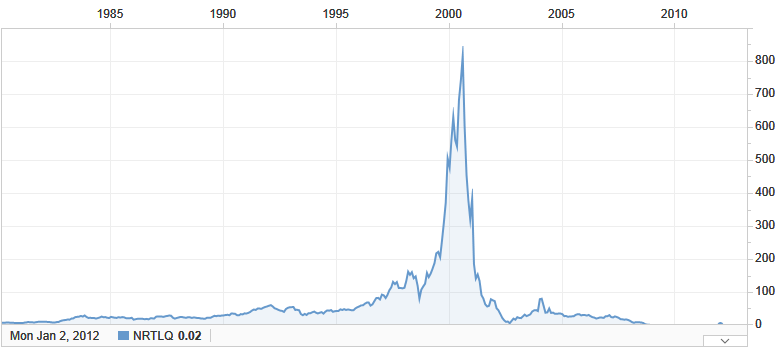
The Rise and Fall of Nortel Stock.

It’s not just that Canada isn’t a big economy, we’re also a narrow one. In the past we’ve looked at how the TSX is dominated by only a few sectors, but the investable market can play even crueler tricks than that. If you can remember the tech boom and the once great titan Nortel, you might only remember their fall from grace, wiping out 60,000 Canadian jobs and huge gains in the stock market. What you should know is that as companies get bigger in the TSX they end up accounting for an ever greater proportion of the index. At its peak Nortel accounted for 33% of the S&P/TSX, creating a dangerous weighting in the index that adversely affected everyone else and skewed performance.

Similarly much of Canada’s success through the 90s and early 2000s had as much to do with a declining dollar. While it may be the scourge of every Canadian tourist, it is an enormous benefit to Canadian industry and exports. Starting in 2007 the Canadian dollar began to gain significantly against the US dollar. This sudden gain in the dollar contributed to Canada’s relative outperformance against every global market. The dollar’s rise was also closely connected to the rise in the value of oil and the strong growth in the Alberta oil sands.

Screen Shot 2014-11-04 at 12.21.52 PM

This mix of currency fluctuations, oil revenue and narrow investable market has created an illusion for Canadian investors. It has created the appearance of a place to invest with greater strength and security than is actually provided.

Some studies have shown that the average Canadian investor will have up to 65% of their portfolio housed in Canadian equities. This is insane for all kinds of obvious reasons. Obvious except for the average Canadian. This preference for investing heavily into your local economy has been coined “home bias” and there is lots of work out there for you to read if you are interested. But while Canadians may be blind to the dangers of over contributing to their own markets, it becomes obvious if you recommend that you place 65% of your money in the Belgium or the Swedish stock market. However long Canada’s relative market strength lasts investors should remember that all things revert to the mean. That’s a danger that investors should account for.

What Investors Should Know After Europe’s Terrible, Horrible, No-Good Month

cartoon spin bull vs bearFalling inflation, terrible economic news and a general sense of dread for the future seems to have once again become the primary descriptive terms for Europe. Earlier this year things seemed to have improved dramatically for the continent. On the back of the German economic engine much of the concern about the EU had been receding. 2013 had been a good year for investors and confidence was returning to the markets. Lending rates were dropping for the “periphery nations” like Portugal, Greece and Ireland, giving them a fighting chance at borrowing at affordable rates. But first came the Ukrainian/Russia problem which caused a great deal of geo-political instability in the markets. Then came October.

I don’t know if Mario Draghi cries himself to sleep some nights, but I wouldn’t blame him. Despite the best efforts of the ECB, Europe looks closer to being in a liquidity trap then ever. Borrowing rates are not just low, they’re negative, with the ECB charging banks to now to deposit money with them. October also ushered in a string of bad news. For Germany, easily the biggest part of the Eurozone’s hopes for an economic recovery, sanctions against Russia have hurt the manufacturing sector. Germany began the month announcing a steep and unexpected decline in manufacturing of 5.7% in August, the biggest since 2009. This news was followed by criticisms of Germany’s government for not doing more infrastructure investment and being too obsessed with their strict budget discipline. Yesterday 25 banks in the Eurozone failed a stress test, a test that was meant to allay fears about the health of the financial sector.

For Europe then things look bad and even if the situation corrects itself over the next few months (sudden shifts in the economy may not always be permanent and can bounce back quickly) the concerns over Europe’s future will likely undermine any efforts by the ECB to properly stimulate the broad economy and encourage investment on a mass scale. By comparison it looks like the United States is having a party.

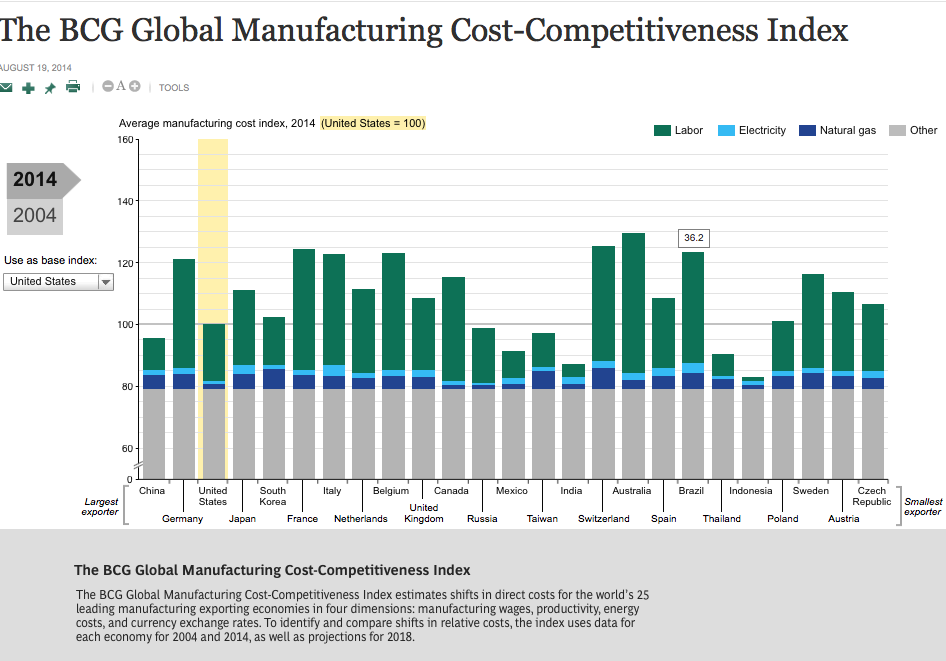
The US economy seems to be on track to grow, and as the world’s biggest economy (though there is some dispute) the country is fighting fit and especially lean. Cheap oil from shale drilling is helping the manufacturing sector, making the United States more competitive than South Korea, the UK, Germany and Canada, and the sudden drop in the price of oil is a boon to the US consumer to the tune of nearly 50 billion dollars. Consumer confidence is up, as is spending. Debt levels are down, both for companies and households. Most importantly the economy seems to be tipping over into an expansionary phase, with corporations finally starting to put some of their money to work.

Screen Shot 2014-10-28 at 12.22.48 PM

The coming months could be interesting for investors as we return to a time where once again focus is on the US as the world’s primary economy.Screen Shot 2014-10-28 at 12.32.45 PM The concerns of 2008, that the American consumer was done, the country had seen its best days and its corporations would never recover seem far fetched now. Worries over hyper-inflation are as distant as a the never arriving (but inevitable) rate hike from the Federal reserve. Worries about Great Depression levels of unemployment are problems of other nations, not the US with its now enviable 5.9%, now encroaching on full employment. Old villains seem vanquished and even Emerging Markets, long thought to be entering their own golden era, are now taking a back seat to the growing opportunities coming out of the US.

Investors should sit up and take note. It’s possible that the best is still yet to come for the US markets, and if market conditions continue to improve this bull market could prove to be a long one.

The Zombie Apocalypse and Investing

If 2008 was the financial apocalypse it is often written about, it is a zombie apocalypse for sure. It’s victims don’t die, they are merely resurrected as an infected horde threatening to infect the other survivors. And no matter how many times you think the enemy has been slain, it turns out there is always one more in a dark corner ready to jump out and bite you.

This past month has seen the return of the zombie of deflation, a menacing creature that has spread from the worst ravaged economies in Europe into the healthier economies of the Eurozone. Deflation is like the unspoken evil twin that lives in the attic. I’ve yet to meet an analyst, portfolio manager or other financial professional that wants to take the threat seriously and doesn’t insist that inflation, and with it higher interest rates are just around a corner.

The eagerness to shrug-off concerns about deflation may have more to do with the reality that few know what to do when deflation strikes. Keeping deflation away is challenging, but not impossible, and it has been the chief job of the central banks around the world for the last few years. But like any good zombie movie, eventually the defences are overrun and suddenly we are scrambling again against the zombie horde.

This. Except it’s an entire economy and it won’t go away.

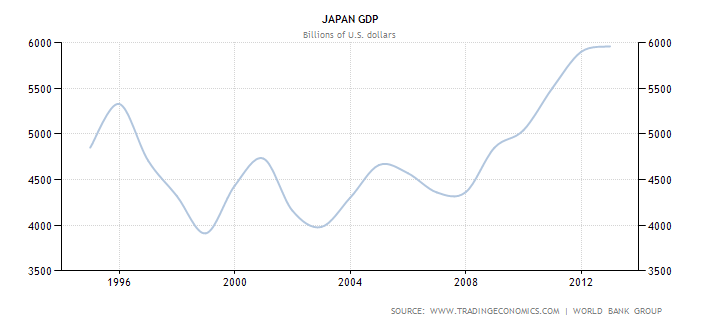
In the late 1990s, Japan was hit with deflation, and it stayed in a deflationary funk until recently. That’s nearly 20 years in which the Japanese economy didn’t grow and little could be done to change its fate. The next victim could be Europe, whose official inflation numbers showed a five year low in September of 0.3%. That’s across the Eurozone as a whole. In reality countries like Greece, Spain and Portugal all have negative inflation rates and there is little that can be done about it. Pressure is mounting on Germany to “do more”, but while the German economy has slowed over the past few months it is still a long way from a recession and there is little appetite to boost government spending in Germany to help weaker economies in the EU.

Japanese GDP from 1994-2014

Across the world we see the spectre of zombie deflation. Much has been made of China’s slowing growth numbers, but perhaps more attention should be paid to its official inflation numbers, which now sit below 2% and well below their target of 4%. The United States, the UK, the Eurozone and even Canada are all below their desired rates of inflation and things have gotten worse in this field over the summer.

What makes the parallel between this and a zombie apocalypse so much more convincing is that we have squandered some of our best options and now are left with fewer worse ones. Since 2008 the world hasn’t deleveraged. In fact governments have leveraged up to help indebted private sectors and fight off the effects of the global recession. Much of this come in the form of lower (from already low) interest rates to spur lending. But when the world last faced global deflation the cure ended up being broad based government spending that cumulated in a massive war effort. By comparison the debts of the government haven’t been transformed into lots of major public works initiatives, instead that money has sat in bank accounts and been used for share buybacks and increases in dividends.

For investors this is all very frustrating. The desire to return to normalcy (and fondly remembering the past) is both the hallmark of most zombie films and the wish of almost every person with money in the market. But as The Walking Dead has taught us, this is the new normal, and investing must take that into account. Deflation, which many have assumed just won’t happen, must be treated as a very likely possibility, and that will change the dynamics of opportunities for investment. It leads to lower costs for oil and different pressures for different economies. It will also mean different things for how people use their savings for retirement and how they will seek income in retirement. In short, the next zombie apocalypse can likely be defeated by paying attention and not keeping our fingers in our ears.

tumblr_m690z9rmAy1qhnl93
If it were only this simple….

Forget Scotland, Canada is Playing Its Own Dangerous Economic Game

house-of-cardsIn a few hours we will begin finding out the future of Scotland and the United Kingdom, and we may be witness to one of the most incredible social and economic experiments  in the history of the Western World.

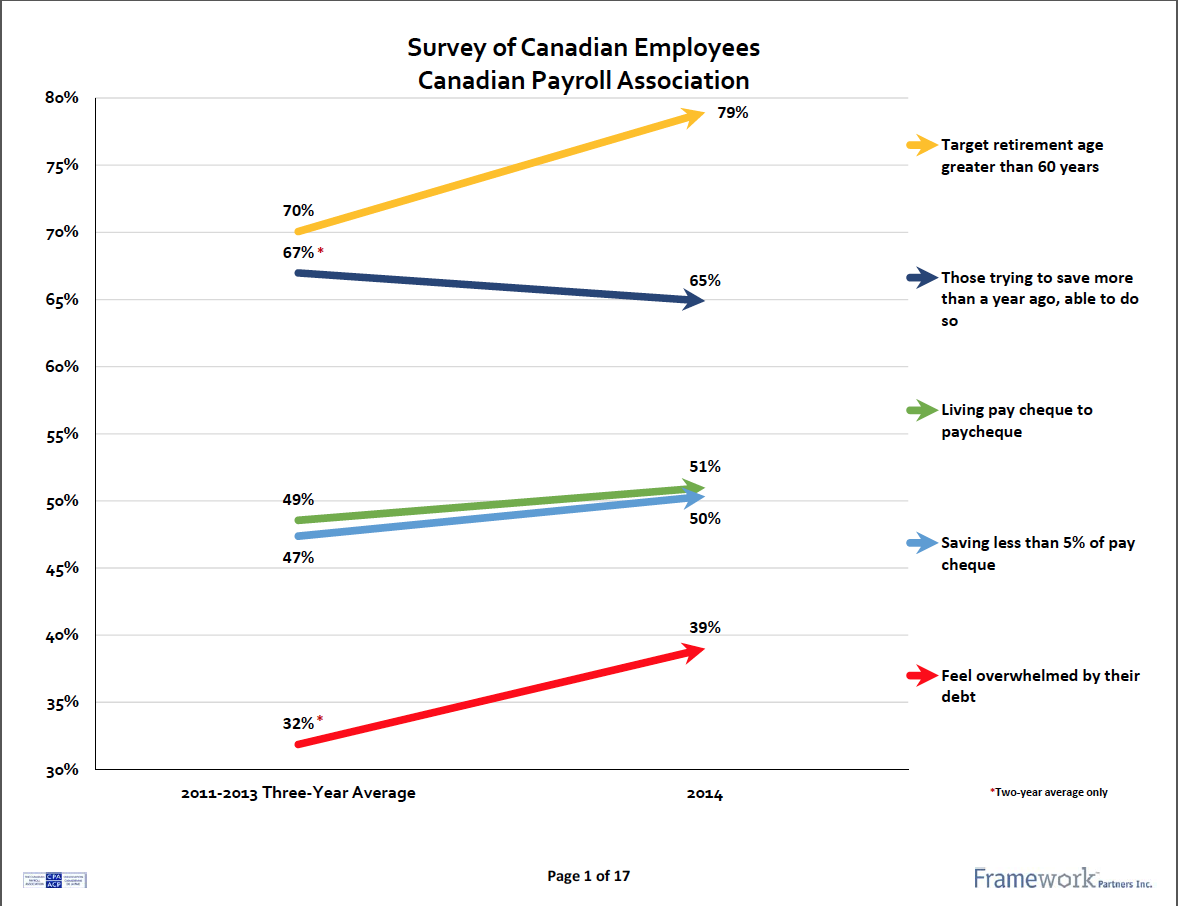
But while many suspect that a yes vote for Scottish independence may cast an uncertain economic future, it shouldn’t be forgotten that as Canadians we are also going through our own uncertain economic experiment. According to a survey conducted by Canadian Payroll Association and released this month, 25% of Canadians are living paycheque to paycheque, with nothing left in their accounts once their bills have been paid for.

Screen Shot 2014-09-18 at 4.57.44 PM

In addition, the majority of Canadians have less than $10,000 set aside for emergencies and these numbers get (unsurprisingly) worse as you look at various age groups. Young Canadians are the worst off, with 63% saying they are living paycheque to paycheque between the ages 18 to 29.

But when it comes to planning for retirement, the numbers are significantly more dire. More and more Canadians are expecting to delay their retirement, citing insufficient funds for their retirement nest egg. Even as people (correctly) assume that they will need more money to last them through retirement, 75% of those surveyed said they had put away less than a quarter of what they will need, and for those Canadians getting closer to retirement (north of 50), 47% had yet to get to even a quarter of their needed savings.

None of this is good news, and it undercuts much of the success of any economic growth that is being reported. While the survey found that people were trying to save more than they had last year it also highlights that many people felt that their debt was overwhelming, that their debt was greater than last year and that mortgages and credit cards by far accounted for the debt that was eating into potential savings.

The report has a few other important points to make and you can read the who thing HERE. But what stands out to me is how economies and markets can look superficially healthy even when the financial health of the population is being eroded. This is a subject we routinely come back to, partly because its so important, and partly because no one seems to be talking about it past the periodic news piece. Our elections focus on jobs, taxes and transit, but often fail to begin addressing the long term financial health of those voting.

← Back

Thank you for your response. ✨

From The Desk of Brian Walker: The Hardest Part of Retirement

rrsp-eggThe moment you retire you are expected never work again.

Think about that for a minute. Every dollar you’ve ever EARNED has been EARNT. Your bank accounts will never be replenished again from your toil. All of your income from here on will be the result of your Canada Pension and OAS, any private pensions you are a part of and your savings. This is your life and your future boiled down to a number.

And as most companies stopped defined benefit pensions, many Canadians have had to turn (usually out of necessity) to investing in the market to grow and fund their retirement.

I have yet to retire, although I admit to being closer to it now than I was 20 years ago when I started this business, and I have to acknowledge that I find the prospect of retiring frightening. Work has occupied most of my life, and while I enjoy travelling and have a number of hobbies I have developed over the years I wonder if they can fill my days. But the thing that always sits at the back of my mind is about the money.

Because regardless of how well you have done in life there is always the potential to lose money in the markets, but so long as you are working you can replenish some of those losses. Once you have retired however, that’s all there is. A financial loss can be permanent in retirement and its impact will last the rest of you life, defining all your future decisions.

photoFor my currently retired and retiring clients the thing that has surprised me the most is that while these concerns are very present, they sit alongside a concern that should really be receding: market growth. For all the worry about protecting their retirement nest egg from severe downturns and unforeseen financial disasters, many investors are still thinking like they are accumulating wealth and have twenty years until they retire.

When it comes to investing, retirees need to be looking at investments that fit the bill of dependability and repeatability. Dividend paying stocks, balanced income funds and certain guaranteed products offer exactly that type of solution, kicking out regular, consistent income that you can rely on regardless of the market conditions. And as more and more Canadians head towards retirement we are seeing a growing base of useful products that fit these needs beyond the limited yield of GICs and Annuities.

The downside of these products is that they are all but certain to be constrained when it comes to growth. They simply will never grow at the rates of some companies, certain investments or aggressive markets by design. That’s a good thing, but nearly a quarter of a century of investing have instilled in many Canadians a Pavlovian response to the idea that investing must equal growth. But investors will be much better served by looking past desire for an ever expanding portfolio and towards investments that secure their long term income.

I’m not suggesting that once you retire you stop participating in the market, or that having any growth in your portfolio is wrong, or that it represents some kind of fault in your retirement planning. What is at stake though is controlling and protecting your savings and lifestyle by making your investment portfolio subservient to those needs over growth focused market participation. Your retirement could last almost as long as your entire working life, and easily as long as the amount of time you saved for your retirement. There will be plenty of things to worry about in retirement, and lots of other financial needs that must be addressed; from comprehensive estate planning to out-of-pocket health care costs. Why complicate your retirement needs by worrying about whether your are participating fully in bull markets, or worse, bear markets?


If you would like to discuss how we can help your retirement needs, or how we can re-tune an account for retirement please send us a note!

← Back

Thank you for your response. ✨

Ninjutsu Economics – Watch the Empty Hand

First, an apology that we have been on a break from our website. Over the last month we’ve had lots going on that has distracted us from doing our regular writing, but we’re back now for the rest of the summer!

Since 2008 there has been two great themes in investing. One, is the search for yield, or income, from safer investments. The second has been the imminent arrival of a rising interest rate environment which threatens to gobble up everyone’s money. If you aren’t too familiar with monetary policy or even how low interest rates work on the economy, don’t worry. What you need to know is this:

In really bad economic times Keynsian theory states that the government should help the economy by creating inflation through stimulus spending and keeping borrowing rates low. This is often done by printing large amounts of money. The availability of cheap money has an inflationary effect on the market, and the economy is believed to rebound more quickly than it would have if it had simply let businesses fail and people be laid off work.

The flip side is that many believe printing money can lead to serious and even extreme hyper-inflation (not entirely unfounded) that in the long term can be extremely detrimental to the financial health of people. This is the fundamental tension in modern economics that is nicely summed up in the below parody video of John Maynard Keynes vs F.A. Hayek. Should markets be steered or set free? Or put more bleakly, should economies be allowed to collapse or should they be saved in the midst of an enormous financial meltdown?

In the past few years there has been an enormous amount of money printing going on (Keynsian) but at the same time governments have been trying to reduce their debts and deficits (Hayek). But the money printing has many people worried. The printing of billions of dollars globally has many inflation hawks declaring that the end of America is nigh, that the currency will soon be worth nothing and that the older traditional economies are doomed to fail. This concern has seeped into the general consciousness to a great degree and it’s not uncommon for me to get questions about whether the United States is on the verge of some new financial collapse.

I tend towards the contrarian angle however, and encourage you to do the same. So much energy and time has been focused on the threat of inflation, few seem to be watching the encroaching danger from deflation.

What’s deflation? It’s like inflation only much worse, since no one knows how to fix it. Deflation is a self fulfilling prophecy where a decreasing supply of circulating money leads to a drop in general prices for everything (this includes labour and products). On the surface that doesn’t sound too bad, but since people tend to earn less in a deflationary environment your existing debt tends to become ever more burdensome. In the same way that the collapse of the American housing market made many homes less valuable than the mortgages on them, deflation just does it to the whole economy. Japan has been in a deflationary situation for nearly 20 years, with little sign of relief. Even last year’s introduction of the unprecedented Abenomics has yet to produce the kind of inflationary turnaround that Japan is in such desperate need of.

When I look to Canada (and more specifically Toronto) I tend to see many of the signs that deflation looms in the shadows. Borrowing rates are incredibly low, largely to encourage spending. Many small retail spaces sit empty, squeezed out by  rising lease costs. Manufacturing sectors in Ontario continue to suffer, while wages remain stagnant. Canadians are currently sitting with record amount of debt and most growth in Canadian net worth have come through housing appreciation, not through greater wealth preservation. In other words, the things that contribute to a healthy economy like rising incomes and a growing industry base are largely absent from our economy. The lesson here is that when it comes to markets, we should worry more about the issues we ignore than the ones we constantly fret over. It’s the hand you don’t watch that deals the surprising blow!

By the Numbers, What Canadian Investors Should Know About Canada

I thought I had more saved!I am regularly quite vocal about my concern over the Canadian economy. But like anyone who may be too early in their predictions, the universe continues to thwart my best efforts to make my point. If you’ve been paying attention to the market at all this year it is Canada that has been pulling ahead. The United States, and many global indices have been underwater or simply lagging compared to the apparent strength of our market.

But fundamentals matter. For instance, the current driver in the Canadian market is materials and energy (translation, oil). But it’s unclear why this is, or more specifically, why the price of oil is so high. With the growing supply of oil from the US, costly Canadian oil seems to be the last thing anyone needs, but a high oil price and a weak Canadian dollar have conspired to give life to Canadian energy company stocks.

YTD Performance of Global Indices as of April 25th, 2014

Similarly the Canadian job market has been quite weak. Many Canadian corporations have failed to hire, instead sitting on mountains of cash resulting in inaction in the jobs market. Meanwhile the weak dollar, typically a jump start to our industrial sector, has failed to do any such thing. But at the core of our woes is the disturbing trend of burdensome debt and the high cost of homeownership.

I know what you want to say. “Adrian, you are always complaining about burdensome debt and high costs of homeownership! Tell me something I don’t know!” Well, I imagine you don’t know just how burdensome that debt is. According to Maclean’s Magazine the total Canadian consumer and mortgage debt is now close to $1.7 Trillion, 1 trillion more than it was in 2003. That’s right, in a decade we have added a trillion dollars of new debt. And while there is some evidence that the net worth of Canadian families has gone up, once adjusted for inflation that increase is really the result of growing house prices and recovering pensions.

Today Canadians carry more personal credit card debt than ever before. We spend more money on luxury goods, travel and on home renovations than ever before. Our consumer spending is now 56% of GDP, and it is almost all being driven by debt.

Canadians have made a big deal about how well we faired through the economic meltdown of 2008, and were quick to wag our fingers at the free spending ways of our neighbours to the South, but the reality is we are every bit as cavalier about our financial well being as they were at the height of the economic malfeasance. While it is unlikely we will see a crash like that in the US, the Canadian market is highly interconnected, and drops in the price of oil will have a ripple effect on borrowing rates, defaults, bank profits and unemployment, all of which is be exasperated by our high debt levels.

Why Buy an ETF?

Exchange Traded FundIt’s become an excepted fact amongst business reporters that the best investments to buy are ETFs, otherwise known as Exchange Traded Funds. What is an ETF and why are so many journalists convinced that you should buy them? Well an ETF is a fancy way to describe an investment that looks very similar too, (but isn’t quite) a stock market index. Unlike mutual funds, the ETF is bought and sold like a stock, but mirrors the performance of an index of your choosing, and by extension all the companies that make up that index. In that respect it shares the (supposedly) best aspects of both stocks and mutual funds. It is traded quickly and is quite inexpensive compared to a traditional fund, but unlike a stock is widely diversified and so should have reduced risk compared to a single company.

In the aftermath of 2008, many journalists that cover the investment portion of the news have touted ETFs as a better investment than traditional mutual funds, citing underperformance against respective benchmarks and the significant discount on trading costs for holding ETFs. ETFs represent a “passive investment”, meaning they don’t try to out perform their mirrored indexes, instead you get all of the ups, and all of the downs of the market. This message of lower fees and comparable performance has had some resonance on investors, and questions about ETFs are some of the most frequent I receive, however while I am not opposed to ETFs I am very hesitant about giving them a blanket endorsement.

That’s because I don’t know anybody who is happy with 100% risk. In the great wisdom of investing the investor should stay focused on “long term” returns and ignore short term fluctuations in the market. But investors are people, and people (this may shock you) are not cold calculating machines. They live each day as it comes and fret over negative news, get too excited about positive news and are generally greedy when they shouldn’t be. In short, people aren’t naturally good investors and being encouraged to buy an investment like an ETF exclusively on cost alone opens up all kinds of other problems for people who find that the market makes them nervous, or may be closing in on retirement. The passive nature of an ETF may be right for some people, but that decision will rarely depend solely on the cost of the product.

The hype for ETFs is therefore more comparable to buying a car exclusively on price based on the argument that all cars function the same way. But depending on your needs there may be multiple aspects you want to consider: size, safety, speed, etc. Investments are similar, with different products offering different benefits its important not to let greed set all of your investment designs. Investing is typically about retirement, not about maximizing every last dollar the market can offer. Reaching retirement is about balancing those investor needs with their wants, and frequently providing less downside at the expense of some of the performance is preferable to the full volatility of the financial markets.

Canadians Losing the Battle to Save For Retirement

Money WorriesPeople sometimes ask why I seem to be so focused on housing and its costs as a financial advisor, and I think the answer is best summed up declining rates of RRSP contributions. Currently many Canadians seem to be opting out of making a RRSP contribution this year, with both Scotiabank and BMO conducting separate and disheartening surveys about likely RRSP contribution rates. Unsurprisingly the answer most Canadians gave to why they would not be contributing this year was because they “did not have enough money.” These surveys also found that 53% of Canadians did not yet have a TFSA either for similar reasons. The expectation is that by 2018 Canadians will have over a trillion dollars of unused contribution room.

These kinds of surveys invariably lead to a kind of financial “tut-tutting” by investment gurus.

As one member of BMO’s executes put it, an “annual contribution of $2,000 to an RRSP… costs less than $6 per day.” which is true but does not really spell out a viable path to a retirement, merely the ability to make a contribution to a RRSP. While there is nothing wrong with the Gail Vaz-Oxlade’s of the world handing out financial advice and directing people to live debt free, Canadians simply do not live in some kind of financial vacuum where all choices boil down to the simple mantra of “can I afford this?” Frequently debts are incurred either because they must be (educational reasons, car troubles, etc.) or because it is not feasible to partake in an economic activity without taking on debt (like buying a house). Similarly it is not practical to assume that every decision be governed exclusively by a simple weighing of financial realities. It’s true it would cost less to live in Guelph, but many people do not wish to live in Guelph and would rather live in Toronto (Nothing personal Guelph!)

What we do have though is a precarious situation where the economy is weak (but maybe improving), which sets government policy through low interest rates. Low interest rates means borrowing for big ticket items like homes in places where supply is limited, like the GTA, or Vancouver or Calgary. This in turn keeps both house prices and debt levels high. It’s telling as well that a growing number of Canadians are beginning to look at their homes as a source of potential income in retirement. All of this seems to be happening while different financial “experts” argue whether the Canadian housing market is actually over valued, or not

This is where I get a chance to make a personal plug for the benefits of my role. While I don’t have much say in government policy, or even directing housing development in big cities, it is rewarding to know that financial advisors like me have a significant impact on the savings rates of those Canadians that work with us. A study called Value of Advice Report 2012 reported that Canadians that had a personal wealth advisor (that’s me) were twice as likely to save for retirement, and that the average net worth of households was significantly higher when they had regular financial advice from an advisor (again, me). The RRSP deadline this year is March 3, so please give me a call if you haven’t yet made your RRSP contribution. 

← Back

Thank you for your response. ✨