By the Numbers, What Canadian Investors Should Know About Canada

I thought I had more saved!I am regularly quite vocal about my concern over the Canadian economy. But like anyone who may be too early in their predictions, the universe continues to thwart my best efforts to make my point. If you’ve been paying attention to the market at all this year it is Canada that has been pulling ahead. The United States, and many global indices have been underwater or simply lagging compared to the apparent strength of our market.

But fundamentals matter. For instance, the current driver in the Canadian market is materials and energy (translation, oil). But it’s unclear why this is, or more specifically, why the price of oil is so high. With the growing supply of oil from the US, costly Canadian oil seems to be the last thing anyone needs, but a high oil price and a weak Canadian dollar have conspired to give life to Canadian energy company stocks.

YTD Performance of Global Indices as of April 25th, 2014

Similarly the Canadian job market has been quite weak. Many Canadian corporations have failed to hire, instead sitting on mountains of cash resulting in inaction in the jobs market. Meanwhile the weak dollar, typically a jump start to our industrial sector, has failed to do any such thing. But at the core of our woes is the disturbing trend of burdensome debt and the high cost of homeownership.

I know what you want to say. “Adrian, you are always complaining about burdensome debt and high costs of homeownership! Tell me something I don’t know!” Well, I imagine you don’t know just how burdensome that debt is. According to Maclean’s Magazine the total Canadian consumer and mortgage debt is now close to $1.7 Trillion, 1 trillion more than it was in 2003. That’s right, in a decade we have added a trillion dollars of new debt. And while there is some evidence that the net worth of Canadian families has gone up, once adjusted for inflation that increase is really the result of growing house prices and recovering pensions.

Today Canadians carry more personal credit card debt than ever before. We spend more money on luxury goods, travel and on home renovations than ever before. Our consumer spending is now 56% of GDP, and it is almost all being driven by debt.

Canadians have made a big deal about how well we faired through the economic meltdown of 2008, and were quick to wag our fingers at the free spending ways of our neighbours to the South, but the reality is we are every bit as cavalier about our financial well being as they were at the height of the economic malfeasance. While it is unlikely we will see a crash like that in the US, the Canadian market is highly interconnected, and drops in the price of oil will have a ripple effect on borrowing rates, defaults, bank profits and unemployment, all of which is be exasperated by our high debt levels.

Canada’s Economy Still Ticking Along, But Don’t be Fooled

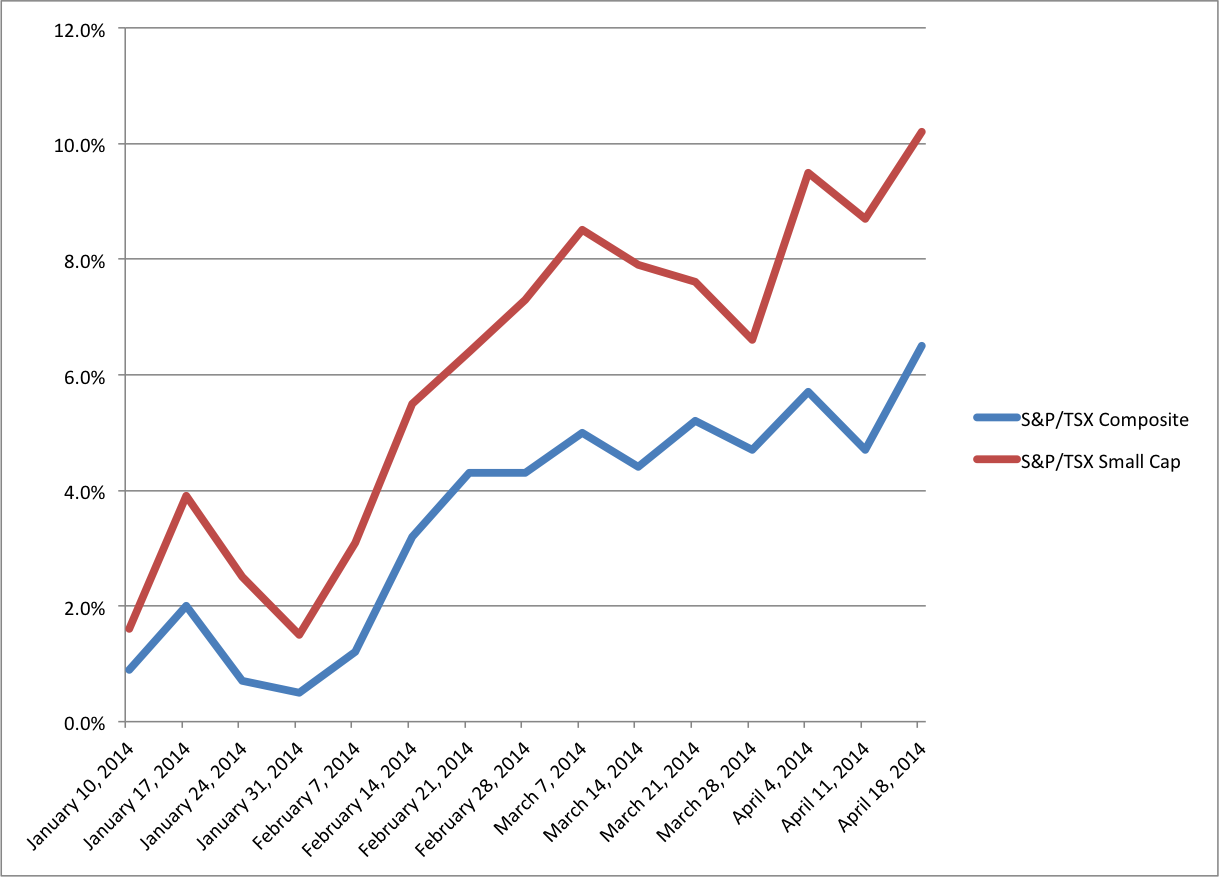
Money CanThis year the Canadian markets have been doing exceptionally well. Where as last year the S&P/TSX had been struggling to get above 2% at this time, this year the markets have soared ahead of most of their global counterparts. In fact the Canadian market triumph is only half of this story, matched equally by the disappointing performance of almost every significant global market. Concerns over China have hurt Emerging Markets. The Ukrainian crisis has hindered Europe, and a difficult winter combined with weaker economic data has put the brakes on the US as well.

YTD TSX Performance

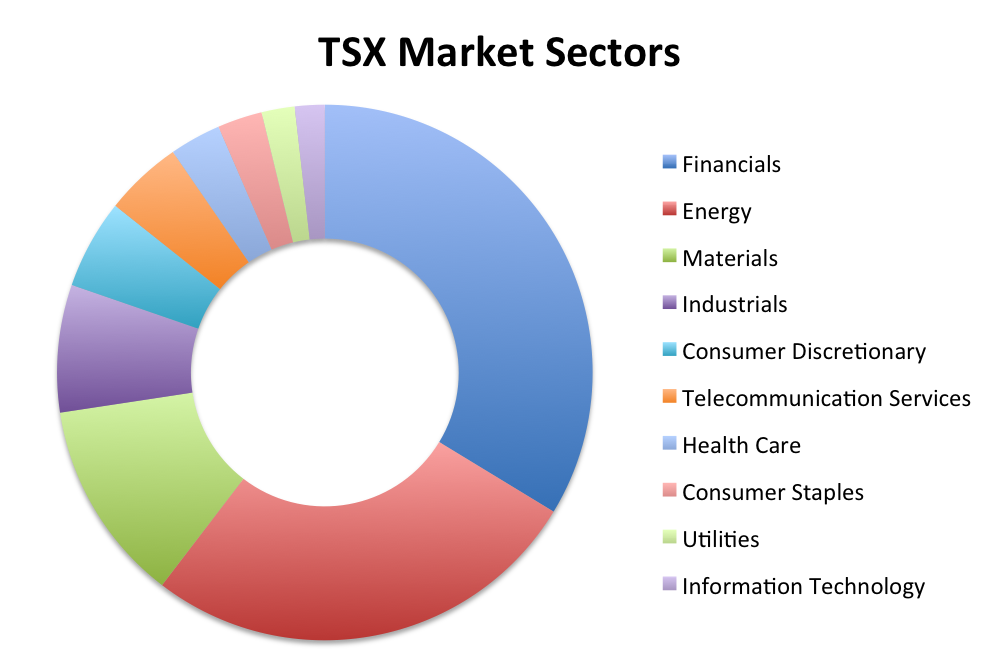
But this sudden return to form should not fool Canadians. It is a common trope of investing that people over estimate the value of their local economies, and a home bias can prove to be dangerous to a portfolio. Taking a peak under the hood of Canada’s market performance and we see it is largely from the volatile sectors of the economy. In the current year the costs of Oil, Natural Gas and Gold are all up. Utilities have also driven some of the returns, but with the Materials and Energy sector being a full third of the TSX its easy to see what’s really driving market performance. Combined with a declining dollar and improving global economy and Canada looks like an ideal place to invest.

TSX Market Sectors

But the underlying truth of the Canadian market is that it remains unhealthy. Manufacturing is down, although recovering slowly. Jobs growth exists, but its highly anemic. The core dangers to the vast number of Canadians continue to be high debt, expensive real-estate and cheap credit. In short, Canada is beginning to look more like pre-2008 United States rather than the picture of financial health we continue to project. Cheap borrowing rates are keeping the economy afloat, and it isn’t at all clear what the government can do to slow it down without upsetting the apple cart.

For Canadian investors the pull will be to increase exposure to the Canadian market, but they should be wary that even when news reports seem favourable about how well the Canadian economy might do, they are not making a comment about how healthy the economy really is. Instead they are making a prediction about what might happen if trends continue in a certain direction. There are many threats to Canada, both global and domestic, and it should weigh heavily on the minds of investors when they choose where to invest.


All Time High Doesn’t Equal Bubble

iStockphoto 046On more than one occasion I have been quizzed about the future of some stock market-or-other to the lack of satisfaction of the quizzer. Invariably the conversation goes something like: “What with all the money being printed and the new highs of the stock market, shouldn’t it all come down?” And my answer is usually, “No.”

This is frustrating for people because there is a real feeling that the stock market in the United States should not be doing as well as its doing. Some of this comes from the incongruity of negative media reports about the US economy and the ever growing stock market, some comes from the lingering shock of 2008, and some from an intellectual class that feel that our economic future is built on sand.

But a large reason for my belief in future growth is in looking past the fear of “big numbers.” When the stock market has a correction it’s often pointed out that it had just reached new highs. But this doesn’t mean that all new highs equal a market correction. The subtext is that there must be some limit to the growth in the market and that a new “all time high” must transcend this natural barrier, creating a bubble.

This is a populist understanding of market bubbles and has little to do with reality. The market should grow and reflect a burgeoning economy, and while the American economy has struggled its companies have continued to post substantial profits and many of them have either continued to grow in the slower market, or have begun to offer or expand dividends, making them more attractive. 

The simple truth is crashes happen at market highs, but not because of them. Bubbles are not simply a quickly growing market, but represent a detachment between market fundamentals and a rapidly rising price, fed by the enthusiasm for rapidly growing prices.

Economists Worry About Canadian Housing Bubble, Canada Politely Disagrees

real-estate-investingThis week the Financial Times reported that “Canada’s housing market exhibits many of the symptoms that preceded disruptive housing downturns in other developed economies, namely overbuilding, overvaluation and excessive household debt.”

These comments made by economist David Madani have been repeated and echoed by a number of other groups, all of whom cite Canada’s low interest rates and large household debt (now 163% of disposable income according to Statistics Canada) as a source of significant danger to the Canadian economy.

This is not a view shared by Robert Kavic of BMO Nesbitt Burns who believes that the Canadian housing market has long legs, saying “Cue the bubble mongers!”

Since 2008 predicting the fall of housing markets has become a popular spectator sport. Canada seems to have sidestepped most of the downturn, which has only made calls for the failing of Canada’s housing markets greater. But the reality is that our housing markets are very hot, and we do have lots of debt.

So is Canada’s housing market heading for a crash? Maybe. And even if it was its hard to know what to do. Fundamentals in Canada’s housing sector remain strong (and have improved). People also want to live in Canadian cities, with 100,000 people moving annually to Toronto alone. In other words, there is lots of demand. In addition regulations in the Canadian financial sector prevent similar scenarios that were seen in the United States, Spain and Ireland from occurring.

But housing prices can’t go up forever, and the more burdensome Canadian debt becomes the more sensitive the Canadian economy will become to interest rate changes. Meanwhile I have grown far more weary of over confident economists assuring the general public that “nothing can go wrong.” 

The big lesson here is probably that your house is a bad financial investment, but a great place to live. Unless you own your home, a house tends to be the bank’s asset and not yours. In addition your home, like your car, needs constant maintenance to retain its value. So if you wanted to buy a house to live in, good for you. If you want to buy a house as an investment my question to you is, “Is this really expensive investment the best investment in a world of financial opportunities?”