Watching the Crisis Unfold in Real Time

Housing Crisis 2

The economic fallout of the pandemic has garnered many shocking headlines, from concerns over how many restaurants may fail to the sheer number of people seeking unemployment insurance. Some of this is economic rubber necking, basking in the shocking and outlandish statistics generated by the lockdown and pandemic. The real test is still in front of us, determining what is temporary and what is permanent.

up-unemployment-claims-estimates-promo-1585760380714-superJumbo
From the New York Times

Concern that a number of restaurants may not reopen seems a reasonable fear, since lots of restaurants don’t survive normally. The impact to the airline industry will take years to work out, since you can’t just put all those planes back in the sky. It will take time to determine which routes should be brought back first, how many people want to fly and the planes themselves will need considerable maintenance before any of them roll down a runway.

But hope springs eternal. Eight weeks into the lockdown and efforts remain underway to gradually reopen the economy, and in time we will see which parts of our society (not economy, but society) need real help to get back on its feet.

I remain largely optimistic about the speed of the recovery once it’s safe to reopen, but remain cautious regarding existing problems within the Canadian economy that the pandemic will likely accelerate. Problems that were hidden just under the surface will find themselves in the cold light of day, and those problems will have repercussions, many of which will not be easy to predict.

As I wrote back in March (Will Covid-19 Make Real Estate Sick?)

“Problems rarely exist in isolation, and a problem’s ability to fester, grow and become malignant to the health of the wider body requires an interconnected set of resources to allow its most pernicious aspects to be deferred. In Canada the problem has been long known about, a high level of personal debt that has grown unabated since we missed the worst of 2008. What has allowed this problem to become wide ranging is a banking system more than happy to continue to finance home ownership, a real estate industry convinced that real estate can not fail, and a political class that has been prepared to look the other way on multiple issues including short term rental accommodation, in favour of rising property values to offset stagnant wages”

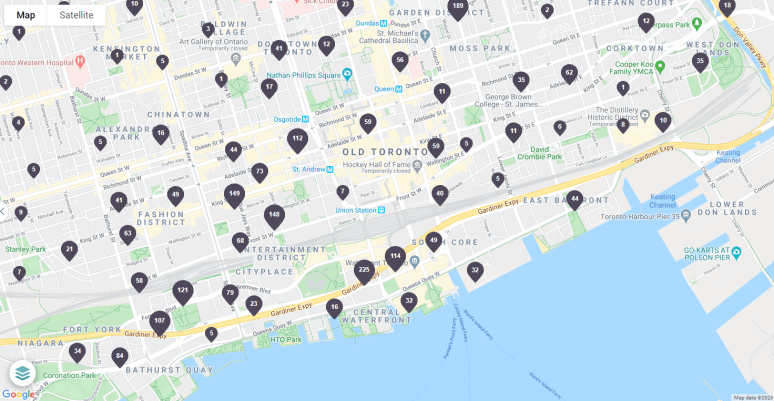
The issue of debt, real estate and short-term accommodations may be one issue undergoing a seismic shift in real time. The website MLS paints a surprisingly changed picture of the rental situation in downtown Toronto. Condominiums like the Ice Condos, located at the bottom of York Street were written about last year because so many of the units were being used for Airbnb. Today they offer hundreds of long-term rentals. The story is not limited to a few buildings either, much of the downtown condo scene, once reserved for Airbnb customers, has suddenly opened to long term accommodation.
Condo Rentals
A snapshot of available rental in May 2020 in downtown Toronto

For a city that only a few months ago was running perpetually short of rentals this change has been rapid, but its fair to assume that many of these landlords are hoping that the crisis will pass and that things will return to normal, with lucrative business in short term rentals resuming. The effect of all these new rentals is not happening in a vacuum. According to Rentals.ca in their May 2020 report, the price of condo rentals in locations like the Ice Condos have dropped by 10%.
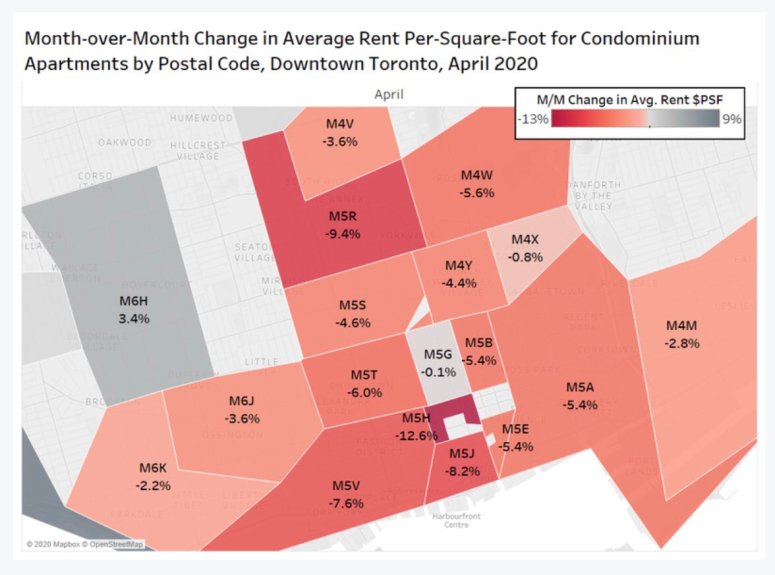
Rental Change in TO
From Rentals.ca

The flip side of the real time change has been the sudden collapse in real estate sales. Reportedly year over year housing sales have dropped in Toronto by 67%, and new listing are down 64%. The selling and buying of houses has simply come to a grinding halt, and with it much of the city’s revenue from the land transfer tax, creating a secondary crisis within cities that have depended on the land transfer tax for revenue growth. In a cruel twist on a well-intentioned effort to get government finances under control, Toronto isn’t allowed to run a deficit, a constraint that has turned into a fatal weakness under the pandemic.

It is here that we should stop and consider a reality. In a few short weeks two major sectors of the Canadian economy within the city of Toronto (and Vancouver for that matter) have been radically altered. But this is also a period where we have seen the most government support and extensive economic intervention. Long term expectations have yet to shift. Airbnb hosts wish to remain Airbnb hosts. Homeowners hope to continue to use their houses to expand their financial footprint. But we should take a page from the city of Toronto reviewing its financial books, the real crisis has yet to truly unfold.

Our future contains, but has yet to have pass, the retreat of government financial support. It has yet to put people back to work, yet to reopen universities, yet to ramp up our manufacturing base, yet to know much of anything about moving past Covid-19. Clarity about what governments should or should not do are hindered by China’s resistance to openness and transparency, while other nations that have already faced the pandemic and seemed to recover are running into second waves. There is no clarity about the future.

iStock-518182156 (1) (1)Real estate remains at the heart of the Canadian economic story for the last 20 years. Appreciating housing prices are the chief source for growth in Canadian families’ net worth. Borrowing to buy houses and borrowing against home equity remain our chief sources of debt. Our politics revolves around the tension of needing more housing in certain highly desirable areas while preserving those areas from over development. That dynamic has revolved around a status quo that seemed to have no conceivable end. The pandemic may have radically altered the Canadian real estate landscape regardless of how people feel about it or what they want. Whether we can walk back changes of this magnitude remains very much unknowable. For now we can only watch the changes our society and economy are undergoing and hope that what we are witnessing will be for the best, those changes that have happened, and those yet to come.

Information in this commentary is for informational purposes only and not meant to be personalized investment advice. The content has been prepared by Adrian Walker from sources believed to be accurate. The opinions expressed are of the author and do not necessarily represent those of ACPI.


The Financial Challenges of Being a Young Canadian

Meanwhile, at Starbucks

It is a common enough trope that people do not save enough, either for retirement or just generally in life. We are a society awash in debt, with some estimates showing Canadians carrying an astonishing $27000 of non-mortgage debt and an average of three credit cards. This financial misalignment, between how much we spend (bad) and how much we save (good) is a source of not just economic angst, but denouncements of sinfulness and failings of moral behavior.

https://youtu.be/1pQJxGIFzdo

This isn’t an exclusively Canadian problem. Pretty much everyone across the developed world has been accused of both not saving enough and carrying too much debt, and the remedy is usually the same, save more and spend less. Underneath that simplistic advice is the nuance that goes into managing money; the importance of paying down debt, of saving some of what you earn on payday (so you don’t see it) and a host of other little things that define good money habits.

bombardier-thunder-bay-plant-subway
This TTC Subway car is built in Thunder Bay. Because Toronto needs more subways, because it is a desirable, albeit expensive place to live.

But for young people trying to save and spend less they may find that the struggle is far greater than anticipated and the advice they are given can be frustrating in its obtuseness. For instance, one of the first solutions financial gurus give is “cut back on the lattes”. In one of our first articles we ever wrote was about the “Latte Effect”, (That Latte Makes You Look Poor) and how the math that underlies such advice, while not bad, isn’t going to fund a retirement.

In fact cutting costs is extremely difficult. Vox.com recently offered some advice for saving more. Pointing out that big ticket items are more useful in cost cutting than small items, the article made the improbable suggestion to “consider moving to a cheaper metropolitan area” if you are finding San Francisco or New York too expensive. Seriously. As though living in cities was a choice exclusively connected to cost, or that Minneapolis was simply New York with similar opportunities but cheaper.

In Canada this advice falls even flatter. While you can live many places, not all offer similar opportunities. Living in Windsor means (typically) making

As a financial advisor I am required to spit on the ground and curse when the subject of credit cards comes up.

cars. Thunder Bay offers both lumber production and a Bombardier plant. But if you are part of the 78% of Canadian GDP that is connected to the service sector, either through banking, finance, health services, government, retail, or high tech industries you are likely in one of four major cities, Toronto, Vancouver, Calgary or Montreal. It should be no surprise that young Canadians, facing ever increasing house prices haven’t actually abandoned major cities for “cheaper alternatives” since most of the jobs tend to be concentrated there.

full-leaf-tea-latteSo for young Canadians the challenge is quite clear. Cutting back on your expensive coffees could save you between $1000 – $2000 per year, but that won’t get you far in your retirement. Serious changes to costs of living are challenging since the biggest cost of living in cities is frequently paying for where you want to live. In between these extremes we can find some sound advice about budgeting and restraining what you spend, but it is fair to say that many young people aren’t saving because they enjoy spending their money, but because they don’t yet have enough money to cover their major costs and maintain a lifestyle that we generally aspire to.

It’s worth noting that most financial advice is pretty good and sensible, even things like watching how much you spend on coffee. Credit cards, lines of credit and overdrafts are all best avoided if possible. A solid budget that allows you to clearly see your spending habits won’t go amiss. And if you do choose to spend less on the small luxuries, it isn’t enough that the money stays in your purse or wallet. It must go somewhere so it can be both out of reach and working on your behalf or you risk spending it somewhere else.

At university and have no income? How about a credit card?

But it is financially foolish to assume that people don’t want to save. The Globe and Mail recently ran a profile on the blogger “Mr. Money Mustache” – a man who retired at 30 with his wife and claims that the solution to retiring young is to wage an endless war on wasteful spending. And he means it. Reading his blog is like reading the mind of an engineer. From how he thinks about his food budget, to what cars you own, his advice is both sound and confounding. It might be best summed up as “live like your (great) grandparents”. Sound advice? Absolutely! Confounding? You bet, since the growth in the economy and our standard of living exists precisely because we don’t want to live like our grandparents.

There is no good solution or answer here. Young Canadians face a host of challenges on top of all the regular ones that get passed down. Raising a family and buying a home are complicated by financial peer pressure and inflated house prices. Choosing sensible strategies for saving money or paying down debt (or both) often means getting conflicting advice. And young Canadians have no assurances that incomes will rise faster than their costs, nor can they simply relax about money. They must be vigilant all the time and avoid financial pitfalls that are practically encouraged by the financial industry. Finding balance amidst all this is challenging, and young Canadians should be forgiven that they find today’s world more financially difficult than the generation previous.

Canada’s Problems Are More Severe Than You Realize

house-of-cardsOn December 10th, the Bank of Canada released it’s Financial System Review for 2014. It outlined numerous problems that continue to grow and potentially undermine the Canadian economy. Globally this report attracted a great deal of attention, not something the BoC is used too, but with a rising concern that the Canadian housing market is overvalued, an official document like the FSR gets noticed.

Screen Shot 2014-12-14 at 10.56.42 AMTo understand why Canada is growing in focus among financial analysts around the world you need to turn the clock back to 2008. While major banks and some countries went bankrupt, Canada and its banking system was relatively unscathed. And while the economy has suffered due to the general economic slowdown across the planet, the relative health of our financial system made us the envy of many.

Screen Shot 2014-12-16 at 10.39.42 AMBut the problems we’d sidestepped now seem to be hounding us. Low interest rates have helped spur our housing market to new highs, while Canadians in general have continued to amass debt at record levels. Attempts to slow the growth of both house prices and improve the standard of debt for borrowers by the government have only moved loan growth into subprime territory.

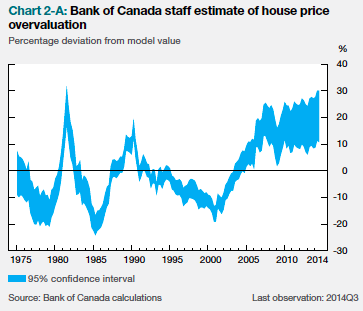
If all this sounds familiar, it’s because we’ve been talking about it for sometime, and sadly the BoC hasn’t been able to add much in the way of clarity to this story. While we all agree that house prices are overvalued, no one is sure quite how much. According to the report the range is between 10% to 30%. Just keep in mind that if you own a million dollar home and the market corrects, it would move the price from $900,000 to as low as $700,000. That can make a considerable dent to your home equity and its too big a swing to plan around.

Screen Shot 2014-12-16 at 10.39.06 AMOn top of this is the growth of the subprime sector in the market. Stiff competition between financial institutions and an already tapped out market has encouraged “certain federally regulated financial institutions” to increase “their activities in riskier segments of household lending.” This is true not just in houses but also in auto loans, where growth as been equally strong.

The Financial System Review also goes on to talk about problems growing in both cybersecurity and in ETFs (both subjects we have written about). It also talks about some of the positive outlooks for the economy, from improving economic conditions globally and support for continued economic activity. But its quite obvious that the problem Canadians are facing now is significant underlying risk in our housing and debt markets. These problems could manifest for any number of reasons (like a sudden drop in the price of oil, a significant slowdown in China, or a fresh set of problems from Europe), or they may lay dormant for months and years to come.

For Canadians the big issues should be getting over our sense of economic specialness. As I heard one economist put  it “Canadians feel that they will be sparred an economic calamity because they are Canadian.” This isn’t useful thinking for investors and as Canadians we are going to have separate our feelings about our home from the realities of the market, something that few of us are naturally good at. But long term investor success will depend on remaining diversified (I know, I link to that article a lot), and showing patience in the face of market panic.

Concerned About The Market and Recent Volatility? Contact Us!

Go back

Your message has been sent

Warning
Warning
Warning

Warning.

Why it’s so hard to see a financial correction when its staring you in the face

If you’ve been following this blog, you’ll have noticed how I am regularly concerned about the state of the Canadian economy. And while I maintain that I have good reason for this; including fears about high personal debt, an expensive housing market and weakening manufacturing numbers, the sentiment of the market isn’t with me. As of writing this article the TSX is up just over 14% YTD, spurred on by strong numbers in the small cap, energy and banking sectors.

Screen Shot 2014-08-21 at 12.36.09 PM

All this illustrates is the incredible difficulty of understanding and seeing the truth in an economy. Is an economy healthy or unhealthy? How do we know, and which data is most important? Economies produce all kinds of information and it’s frequently hard to see the forest for the trees. But even with all the secrecy around the bank’s and regulators financial misdeeds prior to 2008, the writing was on the wall that the US housing market was over inflated and that savings rates were too low and debt rates too high. And while you could be forgiven for not really understanding the fine points of bundled derivates and just how far “toxic debt” had spread, it wasn’t as though the banks had hidden the size of their balance sheets or the number of outstanding loans. It was all there for anyone to see. And people did see it and then shrugged.

One of the big fallouts of the financial meltdown was extensive criticism directed at the professional class of economist and business reporters who give regular market commentary and missed the total implosion of the financial and housing sectors. After all, how good could these “professionals” be if they can’t see the financial freight train like the one that just came through? . But I would chalk that up to overly positive market sentiment. It’s not that they didn’t see the bad news, they just assumed that other better news was more important.

Look at these two articles from yesterday’s (August 20th, 2014) Globe and Mail:

Canada losing steam in its push for an export boom

&

Bump in shipping a boon to Canada

While these two articles aren’t exactly equal, (one is talking about Canada right now, the other is talking about prolonged growth of Canadian shipping over the coming decades) it’s interesting to note that they sit side by side on the same day in the same newspaper. For investors (professional and individual alike) it is an ongoing challenge to make sense of the abundant information about the markets without resorting to our “gut feelings”. Do we tend to feel good about the market or bad? Which headline should be more important? Here is a third article from the same day: (Click the image to see the full size article).

photoIts plain to see how I feel about the state of the Canadian market (and which news I place value on), but its also possible that I’m the crazy one. Lots of Canadians disagree with me quite strongly and it is shown everyday the TSX reaches some new high. Which brings us back to investor, or market sentiment. Described as the “tone” of the market, it might be better thought as human irrationality in assessing odds and errors in estimating value. Investor sentiment plays a significant role in valuing the market over the short-term, far in excess of hard financial data. And it isn’t until that sentiment turns sour that we begin to see corrections. Coincidentally, holding an opinion contrary to the popular sentiment is quite lonely, and many portfolio managers have been criticized for their steadfast market view only to be proven right after they had acquiesced to investor complaints about poor performance.

Following a correction, once the positive market sentiment has been washed away, it seems obvious to us which information we should have been paying attention to. But that doesn’t mean being a contrarian is automatically a recipe for investment success. I may be wrong about the Canadian market space altogether (it wouldn’t be that shocking), and in time I will regret not placing more value on different financial news. What is far more valuable to investors is to have a market discipline that tempers positive (and negative) sentiment. An investing discipline will reign in enthusiasm over certain hot stocks, and keep you invested when markets are bad and the temptation is to run away. Sometimes that means being the loser in hot markets, but that may also mean better protection in down markets.

By the Numbers, What Canadian Investors Should Know About Canada

I thought I had more saved!I am regularly quite vocal about my concern over the Canadian economy. But like anyone who may be too early in their predictions, the universe continues to thwart my best efforts to make my point. If you’ve been paying attention to the market at all this year it is Canada that has been pulling ahead. The United States, and many global indices have been underwater or simply lagging compared to the apparent strength of our market.

But fundamentals matter. For instance, the current driver in the Canadian market is materials and energy (translation, oil). But it’s unclear why this is, or more specifically, why the price of oil is so high. With the growing supply of oil from the US, costly Canadian oil seems to be the last thing anyone needs, but a high oil price and a weak Canadian dollar have conspired to give life to Canadian energy company stocks.

YTD Performance of Global Indices as of April 25th, 2014

Similarly the Canadian job market has been quite weak. Many Canadian corporations have failed to hire, instead sitting on mountains of cash resulting in inaction in the jobs market. Meanwhile the weak dollar, typically a jump start to our industrial sector, has failed to do any such thing. But at the core of our woes is the disturbing trend of burdensome debt and the high cost of homeownership.

I know what you want to say. “Adrian, you are always complaining about burdensome debt and high costs of homeownership! Tell me something I don’t know!” Well, I imagine you don’t know just how burdensome that debt is. According to Maclean’s Magazine the total Canadian consumer and mortgage debt is now close to $1.7 Trillion, 1 trillion more than it was in 2003. That’s right, in a decade we have added a trillion dollars of new debt. And while there is some evidence that the net worth of Canadian families has gone up, once adjusted for inflation that increase is really the result of growing house prices and recovering pensions.

Today Canadians carry more personal credit card debt than ever before. We spend more money on luxury goods, travel and on home renovations than ever before. Our consumer spending is now 56% of GDP, and it is almost all being driven by debt.

Canadians have made a big deal about how well we faired through the economic meltdown of 2008, and were quick to wag our fingers at the free spending ways of our neighbours to the South, but the reality is we are every bit as cavalier about our financial well being as they were at the height of the economic malfeasance. While it is unlikely we will see a crash like that in the US, the Canadian market is highly interconnected, and drops in the price of oil will have a ripple effect on borrowing rates, defaults, bank profits and unemployment, all of which is be exasperated by our high debt levels.

It’s Official, Young Canadians Need Financial Help

I thought I had more saved!It must be terribly frustrating to be a twenty-something today. It’s hard to find work; you probably still live with your parents and a whole culture has developed around criticizing your generation. But beyond the superficial criticisms directed at twenty somethings, there are structural shifts going on within the economy that are making paupers of the next generation.

Some of these shifts do extend from things like a lack of good paying jobs in manufacturing and an increasingly reliance on service sector jobs. There are many university graduates that now find themselves in work that they are overqualified for and underpaid in. But some of the changes also come from an increasingly high cost of living that is making it financially untenable to move out of a parents’ home. This phenomenon has been dubbed “boomerang kids”, or “boomerang generation.”

The challenge that the Millennial generation is facing is that costs are rising as a proportion of their income. Consider the cost of a house in Toronto. In November of this year the average cost of a home sold in Toronto was $538,881, up 11.3% from November of last year. Assume you make the minimum downpayment to get a home, 5%, your downpayment would then be $26,944 (roughly).  Your monthly payment on a 25 year fixed rate mortgage would be $3,077 per month, or close to $36,924 per year. If we factor in real-estate tax and an average heating cost, that would bring annual costs to roughly $43,000 a year. That would mean that to qualify for the mortgage with a bank you would need to be earning at least $134,375 before taxes. The average income in Canada is $47,000.

We can quibble about how accurate these numbers are, but it would still amount to the same end. It costs a lot today to be like your parents. Buying a house for the first time is incredibly expensive and forces young people to make different choices about how to spend their money. For many millennials this has meant “postponing” growing up, financially as well as spiritually. But what today’s young generation actually need is a working budget that lets them get a big picture of their spending and allows them to set and reach financial goals. There are free services, like Mint.com (which I am very much in favour of), but even better is that young people should be encouraged to seek out professional financial help. People with a small amount of savings often feel discouraged about seeing a professional, but getting this guidance early on can lead to significantly better financial outcomes, comfort with the markets and wiser tax efficient planning!

Want to discuss your future planning?

Go back

Your message has been sent

Warning
Warning
Warning

Warning.

Economists Worry About Canadian Housing Bubble, Canada Politely Disagrees

real-estate-investingThis week the Financial Times reported that “Canada’s housing market exhibits many of the symptoms that preceded disruptive housing downturns in other developed economies, namely overbuilding, overvaluation and excessive household debt.”

These comments made by economist David Madani have been repeated and echoed by a number of other groups, all of whom cite Canada’s low interest rates and large household debt (now 163% of disposable income according to Statistics Canada) as a source of significant danger to the Canadian economy.

This is not a view shared by Robert Kavic of BMO Nesbitt Burns who believes that the Canadian housing market has long legs, saying “Cue the bubble mongers!”

Since 2008 predicting the fall of housing markets has become a popular spectator sport. Canada seems to have sidestepped most of the downturn, which has only made calls for the failing of Canada’s housing markets greater. But the reality is that our housing markets are very hot, and we do have lots of debt.

So is Canada’s housing market heading for a crash? Maybe. And even if it was its hard to know what to do. Fundamentals in Canada’s housing sector remain strong (and have improved). People also want to live in Canadian cities, with 100,000 people moving annually to Toronto alone. In other words, there is lots of demand. In addition regulations in the Canadian financial sector prevent similar scenarios that were seen in the United States, Spain and Ireland from occurring.

But housing prices can’t go up forever, and the more burdensome Canadian debt becomes the more sensitive the Canadian economy will become to interest rate changes. Meanwhile I have grown far more weary of over confident economists assuring the general public that “nothing can go wrong.” 

The big lesson here is probably that your house is a bad financial investment, but a great place to live. Unless you own your home, a house tends to be the bank’s asset and not yours. In addition your home, like your car, needs constant maintenance to retain its value. So if you wanted to buy a house to live in, good for you. If you want to buy a house as an investment my question to you is, “Is this really expensive investment the best investment in a world of financial opportunities?”