
A Watched Pot With A Frog In It

Back in the spring, markets reeled after Trump announced a new round of unilateral tariffs. The April 2nd announcement triggered a week of panic selling until the administration promised a temporary 90-day pause to pursue trade negotiations. Nine months later, the U.S. now has the highest tariff levels in over a century, economic data is showing signs of weakening, and discussions of a market bubble are widespread. Why, then, is the stock market still so high?

The most immediate reason is the concentration of market leadership. The “Magnificent Seven” tech giants now account for more than 35% of the S&P 500, while the top ten companies make up nearly 40%. The gap between the S&P 500 and its equal-weighted equivalent is just shy of 10%, while the Magnificent Seven themselves have delivered a combined return of roughly 27.6% year-to-date. The comparison to the dot-com era is easy to make, but the fundamental difference is profitability: Apple, Google, Microsoft, Amazon, Meta and others continue to generate substantial earnings and hold enormous balance-sheet reserves. This profitability has helped anchor market confidence.

Figure 1 Growth of the Magnificent Seven as a part of  the S&P 500

Another factor is the lag in how economic data reflects policy changes. Despite the risks tariffs pose, the full impact has not yet shown up in backward-looking data like GDP or employment reports. Investors expecting an immediate shock instead found resilient quarterly numbers, reinforcing confidence rather than shaking it.

Figure 2 Effective tariff rates over time, from the Yale Budget Lab

There is also a deeper structural issue: the increasing concentration of economic power and spending. As wealth inequality widens, a large share of U.S. households are contributing less to measured economic activity. Recent consumer expenditure data suggests that the top 10% of households now account for roughly 50% of all consumer spending, while the bottom 60% contribute less than 20%. This means that economic stress among the majority of households may not meaningfully register in the headline data that markets rely on. Meanwhile, AI-related capital investment makes up a growing share of the remainder of measured economic activity.

Figure 3 Widening wealth disparities between households and consumer spending

This combination — delayed data effects, high concentration of consumption, and sustained AI investment — has helped keep investor sentiment resilient, even as negative signals accumulate beneath the surface. It has also masked the risks of allowing speculative dynamics to develop largely unchecked.

Figure 4 Growth of Personal Consumption as a percentage of GDP

Concerns about an AI bubble are growing. Estimates of total AI investment now exceed $3 trillion when considering capital expenditures, valuations, and related infrastructure spending. Commercial use cases outside of a few sectors remain limited. Some firms have begun participating in “circular funding arrangements,” where they invest in each other’s AI initiatives to reinforce perceived valuations. Even industry leaders acknowledge the speculative environment: Sam Altman, the CEO of Open AI has said there is likely a bubble, while Jeff Bezos has called this a “good bubble” that will still produce transformative breakthroughs.
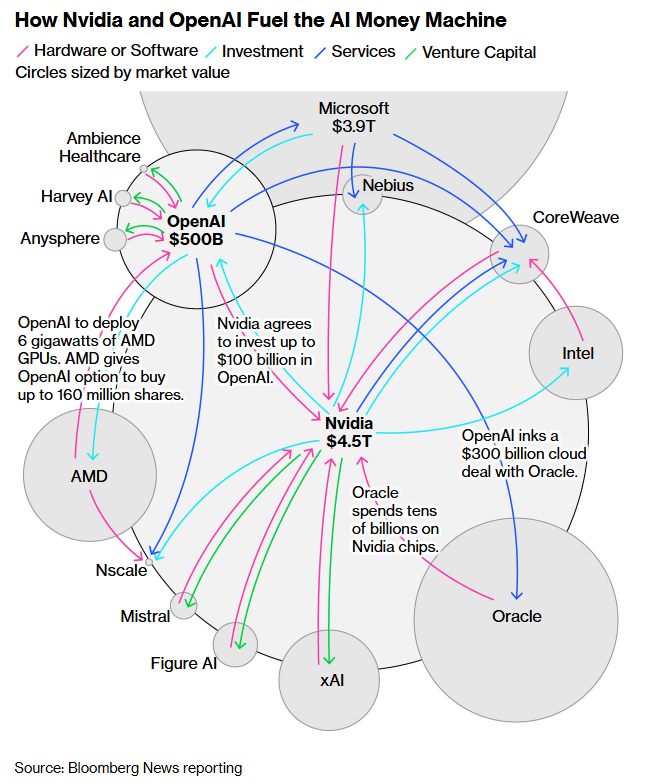
History suggests that speculative cycles are remarkably resistant to logic. They often convert skeptics into participants, including professional money managers who join in under client pressure. Market bubbles resemble the proverbial frog in a pot: the danger rises slowly enough to dull caution.

Yet they also resemble the “watched pot” that never seems to boil. As long as new capital continues to flow into AI-linked investments, momentum can persist. Predicting the end of a bubble is famously difficult — markets can remain irrational longer than investors can remain solvent.

So what should investors do? Awareness of rising risk is the starting point. We may not be able to time the end of the AI boom, but we can examine investor behavior for signs of speculative excess.

Consider Tesla. After the election, the stock surged nearly 98% in six weeks on enthusiasm linked to political alignment and narrative momentum. Since then, sales have weakened, profitability has declined, and competition has intensified — yet the stock remains 10% above its level on inauguration day and has more than doubled off its lows. Tesla’s valuation continues to reflect belief in future breakthroughs rather than current operational performance. It is a clear illustration of narrative overpowering fundamentals — a hallmark of speculative markets.
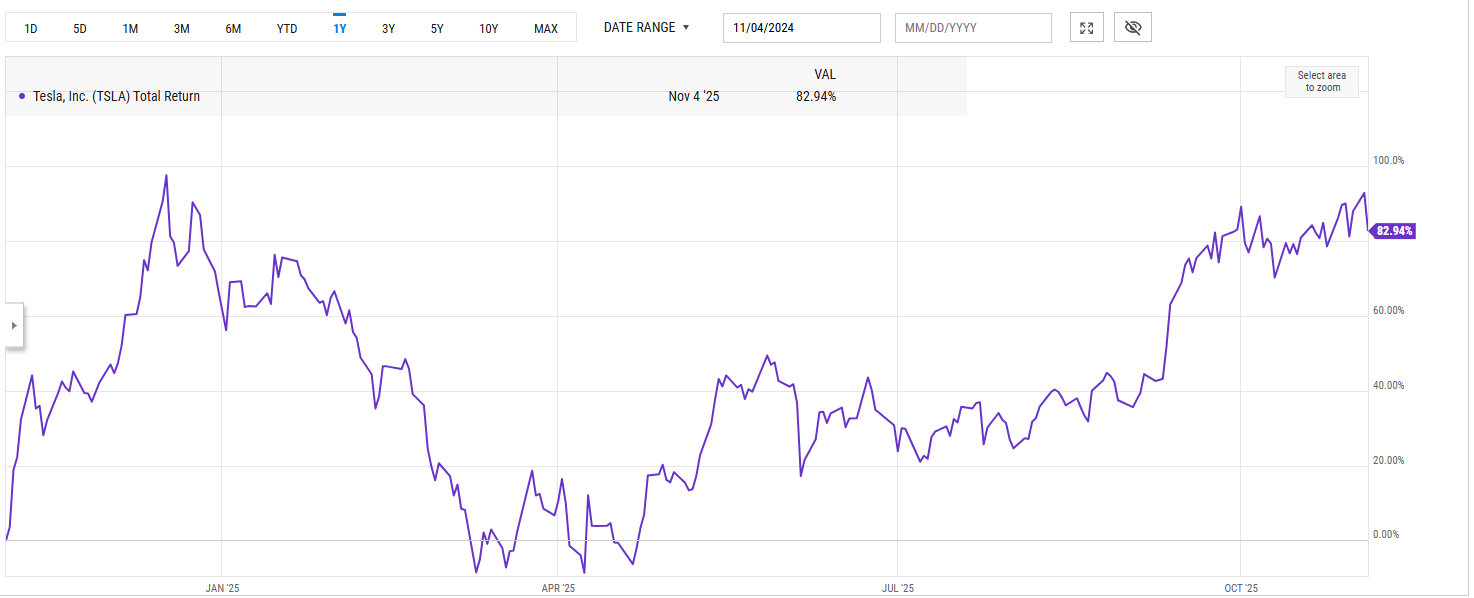
Figure 6 Tesla stock performance from November 4, 2024 to November 4, 2025

If this environment feels uncomfortable, it may be time to review portfolio risk exposure. Reducing equity risk comes with trade-offs — especially missing out on momentum-driven gains — but clarity on long-term goals can help prevent emotionally driven decision making.

Market manias are difficult to avoid and even harder to detach from when others are benefiting. The antidote is a disciplined investment plan that emphasizes long-term objectives over short-term excitement. In a world where the water may be warming around us, it is better to be a watcher than the frog.
Canada’s Economy Still Ticking Along, But Don’t be Fooled

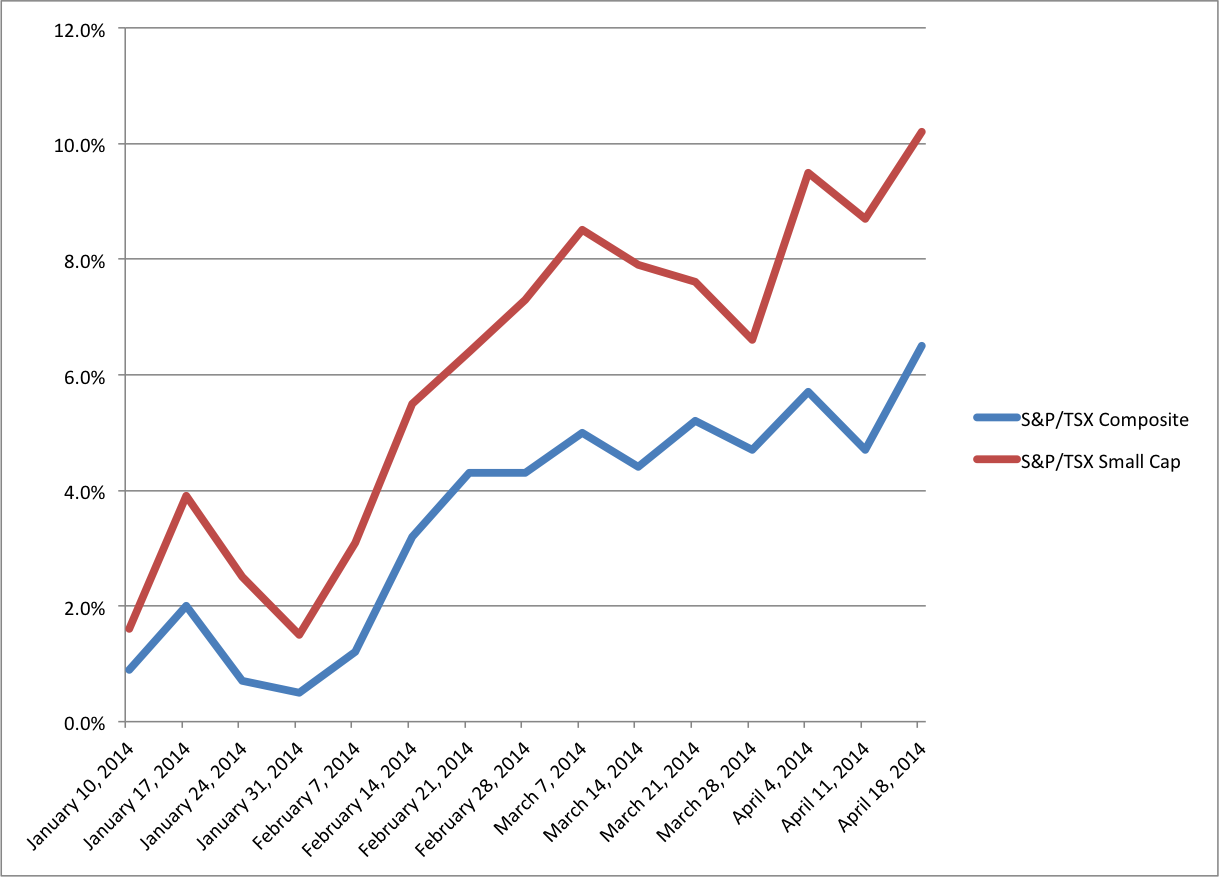
Money CanThis year the Canadian markets have been doing exceptionally well. Where as last year the S&P/TSX had been struggling to get above 2% at this time, this year the markets have soared ahead of most of their global counterparts. In fact the Canadian market triumph is only half of this story, matched equally by the disappointing performance of almost every significant global market. Concerns over China have hurt Emerging Markets. The Ukrainian crisis has hindered Europe, and a difficult winter combined with weaker economic data has put the brakes on the US as well.

YTD TSX Performance

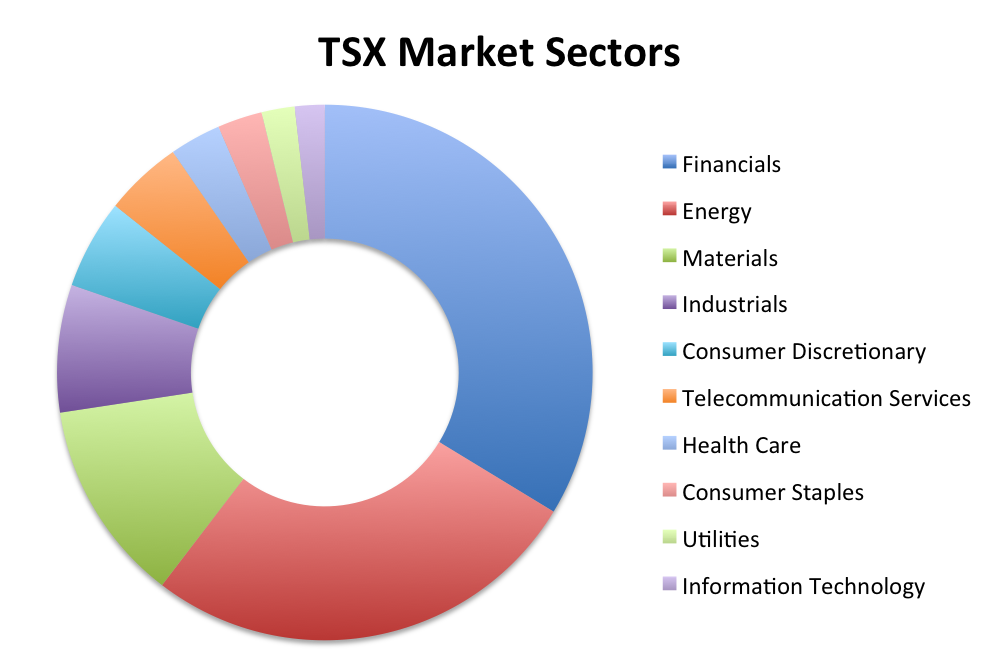
But this sudden return to form should not fool Canadians. It is a common trope of investing that people over estimate the value of their local economies, and a home bias can prove to be dangerous to a portfolio. Taking a peak under the hood of Canada’s market performance and we see it is largely from the volatile sectors of the economy. In the current year the costs of Oil, Natural Gas and Gold are all up. Utilities have also driven some of the returns, but with the Materials and Energy sector being a full third of the TSX its easy to see what’s really driving market performance. Combined with a declining dollar and improving global economy and Canada looks like an ideal place to invest.

TSX Market Sectors

But the underlying truth of the Canadian market is that it remains unhealthy. Manufacturing is down, although recovering slowly. Jobs growth exists, but its highly anemic. The core dangers to the vast number of Canadians continue to be high debt, expensive real-estate and cheap credit. In short, Canada is beginning to look more like pre-2008 United States rather than the picture of financial health we continue to project. Cheap borrowing rates are keeping the economy afloat, and it isn’t at all clear what the government can do to slow it down without upsetting the apple cart.

For Canadian investors the pull will be to increase exposure to the Canadian market, but they should be wary that even when news reports seem favourable about how well the Canadian economy might do, they are not making a comment about how healthy the economy really is. Instead they are making a prediction about what might happen if trends continue in a certain direction. There are many threats to Canada, both global and domestic, and it should weigh heavily on the minds of investors when they choose where to invest.


Don’t Forget to Like This Market Bubble on Facebook!

Say No to FacebookHow much would you pay for something that is free? This is the basic question behind trying to value the many forms of social media that have dominated the business news over the last few years. Pinterest was valued earlier in 2013 at $3.8 billion. It makes no money. In Twitter’s initial pubic offering its share’s rose to over $45, giving the company a value in excess of $30 billion. It also has yet to turn a profit. Linkedin does make money, but it’s valued like a company that makes 100x more than it actually does. Facebook, which does turn a mighty profit, generates that money not from their user base, but from companies trying to engage its user base. While Facebook does have a lot of users, many of them don’t like advertising on their profile and click rates for advertising have been reported as lower than advertising on the web in general.

What we have then is an abnormal situation where investors appear to be willing to pay big money for companies that don’t seem to be even close to making any of that investment back (some companies don’t even seem interested). In contrast companies like Apple have seen huge fluctuations in their share value on the mere speculation that they may not make quite as much money as previously thought.

To my eyes this has all the makings of a market bubble. I’ve written about the absurd way we seem to value internet businesses that don’t make any money before. One theory for these valuations is that these businesses are highly scalable. Adding more users doesn’t cost much more in terms of effort. Other theories include the idea that while many of these businesses may yet to turn a profit, the sheer number of dedicated subscribers means that the business model simply needs to be worked out.

My view on this is that there is a lot of hope attached to a lot of uncertainty. Investment excitement behind companies like Pinterest, Linkedin or Twitter, which have high valuations and little to no earnings, is driven more by a “don’t miss out” attitude. In comparison businesses that have actual earnings, products and market presence are judged far more critically and by more rigorous standards.

I think a good acid test here is what investors are being encouraged to buy compared to say, an actual tech company. In the last few months Google has acquired both robotics maker Boston Dynamic and recently Nest, the innovative thermostat and smoke detector company. Both of these companies make things. Amazing things. None of these things require you to like, share, link to or visit a page. Instead they are making tangible things that people want, or will want. The same is true for Apple computers, Samsung, GM, Toyota, Coca-Cola and Proctor & Gamble.

As investors its important not to lose focus that the ideal investment is one that provides the steak, not just the sizzle.

All Time High Doesn’t Equal Bubble

iStockphoto 046On more than one occasion I have been quizzed about the future of some stock market-or-other to the lack of satisfaction of the quizzer. Invariably the conversation goes something like: “What with all the money being printed and the new highs of the stock market, shouldn’t it all come down?” And my answer is usually, “No.”

This is frustrating for people because there is a real feeling that the stock market in the United States should not be doing as well as its doing. Some of this comes from the incongruity of negative media reports about the US economy and the ever growing stock market, some comes from the lingering shock of 2008, and some from an intellectual class that feel that our economic future is built on sand.

But a large reason for my belief in future growth is in looking past the fear of “big numbers.” When the stock market has a correction it’s often pointed out that it had just reached new highs. But this doesn’t mean that all new highs equal a market correction. The subtext is that there must be some limit to the growth in the market and that a new “all time high” must transcend this natural barrier, creating a bubble.

This is a populist understanding of market bubbles and has little to do with reality. The market should grow and reflect a burgeoning economy, and while the American economy has struggled its companies have continued to post substantial profits and many of them have either continued to grow in the slower market, or have begun to offer or expand dividends, making them more attractive. 

The simple truth is crashes happen at market highs, but not because of them. Bubbles are not simply a quickly growing market, but represent a detachment between market fundamentals and a rapidly rising price, fed by the enthusiasm for rapidly growing prices.