Separating Fact and Fiction in Investing

Is America’s economy failing? Has Trump undone the American economic empire? Do ports sit empty? Are people being laid off? Have world leaders conspired to control America’s debt?

These are just some of the headlines and subjects floating around the internet. Depending on who you are and where your political allegiances lay, the answers will be self-evident. Trump is either a an economic genius and unparalleled negotiator, or he is a clumsy and indifferent conman masquerading as successful businessman and politician.

For investors this presents a real challenge. These questions aren’t just thought experiments. Depending on the answers they may significantly impact where one chooses to invest, and the more polemical the question the farther we may get from a useful answer, regardless of politics. If our goal is to ask questions to reveal truth, we may find ourselves confused as to why markets have surged back from their lows (as of May 12th the major US indices have almost recovered from their tumble at the beginning of April) even while business reporting warns of a potential for a worsening economy.

One way to make better sense of what’s happening is to put ourselves in the shoes of Donald Trump’s administrative allies. Imagine what someone who believes in what Donald Trump is doing would say about his economic plans. Its not as though they haven’t heard economists and businesses express doubt and worry about the actions of his administration. So how would they defend them?

In my imagining I believe they would argue something like the following:

                The United States is enormously rich but wastes money on cheap goods from China, and while some of these goods don’t need to be made here, America has lost enough manufacturing jobs that its worthwhile experimenting with tariffs to bring jobs back. Over the past 45 years we’ve seen countless evidence that playing by the rules of globalization reduces the ability of governments to help their most vulnerable citizens, and money has become too fluid and too willing to cross borders at the expense of their domestic homes. Regardless of what people fear, America remains the richest country in the world, with the largest consumer base, and that combined with the existing strength of the US economy will be enough to bring industry back to the US in some capacity while tariffs on junk from other countries will help pay for renewed and permanent tax cuts. Market volatility will be temporary while the economy realigns itself, but the combination of lower taxes and existing economic strength will ultimately help lift the markets even higher.

You don’t have to believe in such a claim, or even pretend this was what Donald Trump campaigned on. What I’m putting forth is a set of ideas (picked up through numerous interviews and speeches) that I believe his administration finds largely defensible and recognizable, and would be a better frame of reference for understanding their actions. Let’s start with the recent indication that GDP is contracting. In traditional economic terms, two quarters of back-to-back GDP contractions constitute a recession. We’ve had more than a few of those over the past decade, but few people would say that we’ve had recessions. The reason for this might be best expressed by Jason Furman; an American economist, professor at Harvard, and former deputy director of the US National Economic Council, in a recent editorial in the Financial Times. Outlining the importance of “Core GDP” vs “GDP”, he points out that Core GDP (actually known as Real Final Sales to Private Domestic Purchasers) better reflects consumer spending and private investment while the traditional GDP includes net exports, inventories, and government spending, all things in flux because of Trump’s new administration. So, while the GDP contracted in Q1 of this year, the Core GDP was up in the first three months.

What about rumours of empty ports and empty shelves? Reportedly Trump was shaken following meetings with the heads of three major retailers about shelves being empty if the tariff’s remain at 145% on China. Trump seems to have vacillated a number of times about the size and implementation of the tariffs, but as of today they remain intact. Asked about higher prices and fewer options Trump seemed dismissive of concerns over the Chinese trade war declaring “maybe the children will have two dolls instead of thirty dolls, and maybe those dolls will cost a couple of bucks more.”

Is Trump being dismissive? Yes, but he’s also not worried that shelves will be empty. Though shipping and imports are down as we head into May for cargo coming from China, far from alarmist rumours that docks are sitting empty there is still plenty of ocean-going traffic coming from China.

 Does this mean that there won’t be furloughed dock workers or empty shelves? According to the Port of Los Angeles there has been a 35% drop week over week of expected cargo, and a 14% decline from the previous year. That very well may lead to reduced working hours and fewer options in stores, but the discrepancy between what’s being shared online and what is likely to actually happen is probably enough to gird the loins for Trump’s team to continue their policies.

What about layoffs? Fears about unemployment remain high, but as the most recent jobs report shows hiring remains robust and the unemployment rate, already very low, remains unchanged.

This discrepancy between a popular public impression and the on-the-ground economic reality gives room to Trump’s administration to continue ahead with ideas that remain controversial, as well as opening up investors to making mistakes in their allocations. For the time being, Trump does have a reservoir of economic and political strength to call on. He may be using that reserve up, but may also have guessed with some accuracy that the global economy will keep doing business with America regardless of whatever feathers he ruffles.

But markets may also not be calculating the longer-term direction correctly, mispricing assets and remaining too optimistic. Since Trump’s re-election markets have been shown to be placated by the promise of deferred tariffs, as though deferring them is really the prelude of getting rid of them. Trump doesn’t help this by going back and forth on their implementation, but listening to his words, and following his actions, I feel that it would be a mistake to assume that the tariffs will ultimately be rescinded.

This past week changes to the auto-tariffs were announced, reducing some of the duplication of tariffs on steel and aluminum, but also laid out reimbursements and tariff relief for parts manufacturers need to import. These changes also make clear the groundwork for a longer and more durable tariff regime. Trump himself has been quick to correct any reporting that suggests that he’s backtracking or creating exemptions for specific products, and that some products may end up with different tariff treatment, but will still be subject to tariffs.

This seems best exemplified by the announcement of the US-UK trade deal. Called “a starting point” by the British ambassador, the Trump administration has said the deal is “maxed out”, leaving in place a 10% tariff on British imports, with a reduced tariff on British cars, steel, and aluminum (the deal effectively lowers car and steel duties to the flat 10% rates, down from 27.5%).

Whether deals such as these are anything for the market to get excited about is a question that will be answered with time, like all the unanswered questions that have been introduced this year. What investors must work on is remaining clear eyed about what is happening, and resist submitting to their own partisan preferences. Trump may yet undermine the US economy, and trade deals may turn out to simply be acknowledgements of existing tariff rates, or perhaps the opposite may happen. But recognizing that reality is more mixed and that we do not yet have a clear picture about the future will promote more time tested strategies for sensible investing.

Aligned Capital Partners Inc. (“ACPI”) is a full-service investment dealer and a member of the Canadian Investor Protection Fund (“CIPF”) and the Canadian Investment Regulatory Organization (“CIRO”).  Investment services are provided through Walker Wealth Management, an approved trade name of ACPI.  Only investment-related products and services are offered through ACPI/Walker Wealth Management and covered by the CIPF. Financial planning services are provided through Walker Wealth Management. Walker Wealth Management is an independent company separate and distinct from ACPI/Walker Wealth Management.

When It Comes to Trump, Investors Must Be Patient

This piece was meant to come out last week before the most recent tariff announcement. It was delayed, but the points it makes remain relevant.

Donald Trump’s actions since taking office have failed to deliver the kind of economic and market stimulation people had been imagining. For many professionals, business owners, and financial analysts, the assumption was that Trump would be good for markets and good for the economy. His other political views, like isolationism, tariffs, and sense of personal grievance weren’t great features, but he would fundamentally be bound by market and economic performance.

That faith eroded quickly as it seemed that Trump was intent on widespread and indiscriminate tariffs, targeting first America’s closest trading partners, and then reciprocal tariffs on the European Union, Great Britain, Australia, and Taiwan. Concerns that this might damage the American economy may have bought time on when those tariffs were to be implemented (as of writing Canadian and Mexican tariffs have been deferred twice, though Steel and Aluminium tariffs have gone ahead) but April 2nd remains “liberation day” according to Trump, a day when America stops getting “ripped off”.

Trump’s administration have pivoted away from the idea that Trump will be good for the immediate economy, and that a “period of transition” is on the way. During his speech to Congress (officially not a State of the Nation) Trump also said that farmers will sell more of their food to Americans, ostensibly a populist message but one more likely grounded in further declines of American agricultural export.

Alongside Trump is Elon Musk, a man who seems possibly genuinely befuddled by the animosity his actions have garnered. Between possible nazi salutes, his outsized time on Twitter, his heading up of D.O.G.E (which he both officially and unofficially runs, for legal reasons), his direct intervention with Germany’s far right party the AFD, and the poor sales of his Tesla cars, TESLA stock has dropped considerably from its highs. Many have thought that this heralds the end of his company, and certainly would deal a blow to his personal fortune, about a third of which is in the form of TESLA stock.

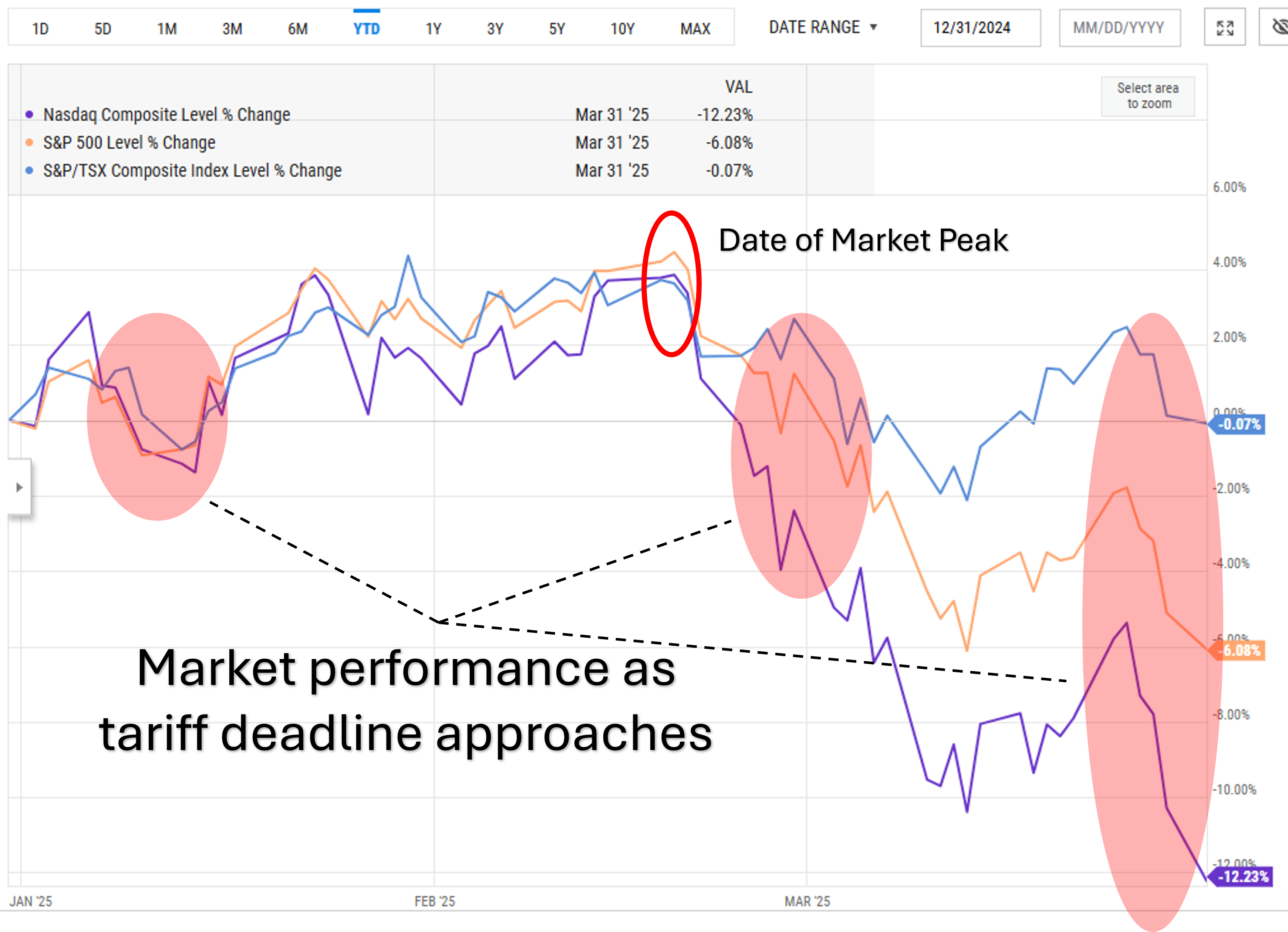
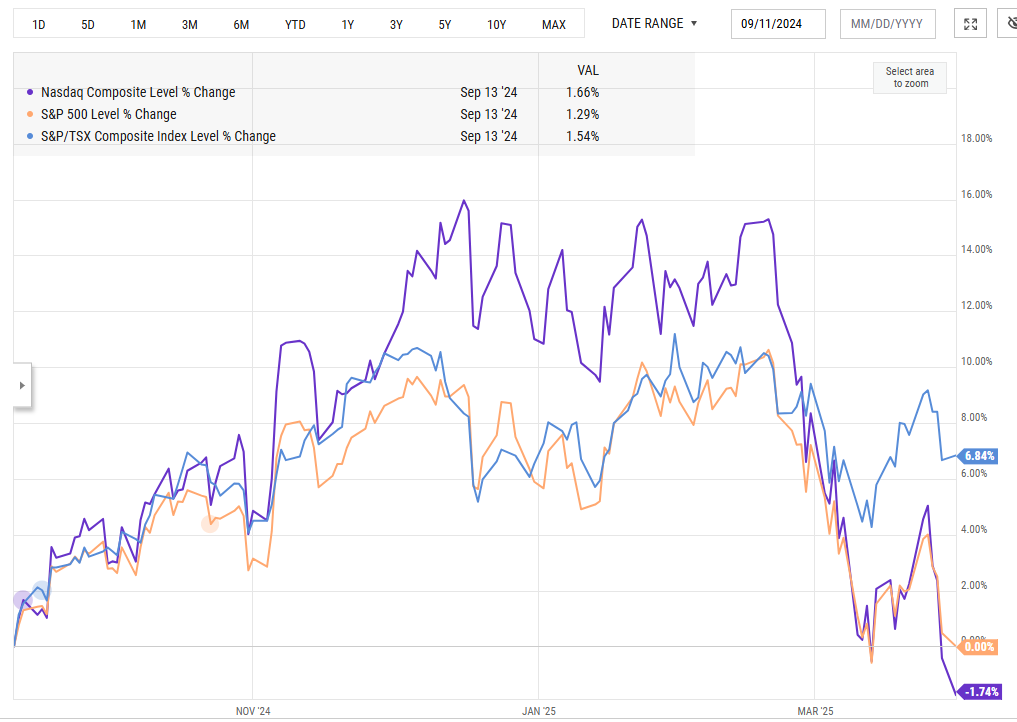
The markets peaked around February 19th, with the S&P 500 up 4.46% since January 1st. The Dow Jones had peaked a little earlier at 5.5%, and the Nasdaq Composite was up 3.86%, all respectable numbers for the first 45 days of a year, especially following a very strong 2024. Over the subsequent weeks markets began losing steam and saw a significant drop. From mid February to March 12th, a period of three weeks, the Nasdaq lost 13.05%, the S&P 500 9.31%, and the Dow 7.16%. Investors were worried, a recession seemed looming, and consumer confidence had plummeted.

Figure 1Market data provided by Y Charts. Data is until March 31, 2025

Yet only two weeks later markets seemed to have stabilised. Commentators were more confident and expected Trump’s tariffs to be more “focused”. Following some fairly significant government intervention, even Tesla’s shares regained some of their lost ground, and the bond market had retreated as investor enthusiasm seemingly returned. And then, at the end of last week the enthusiasm sputtered once again.

What’s going on?

Whether you support Trump or not, his policies if fully enacted promise to reduce the size of the US economy. His expressed understanding of tariffs, how they work, what they can do, and how easily they can rewrite the global order of trade are objectively poor. Global supply chains are complicated things, and some of the most complicated aspects of them are tied up in semi-conductor manufacturing, making tariffs an expensive tax on top of essential components of the economy. His handling of international relationships has also been poor, and the seeming unravelling of the NATO alliance under his administration threatens not just global security, but also America’s defence industries, particularly the F-35 joint strike fighter, a multi-purpose fifth gen fighter whose economics only worked if it became the standard across NATO. His stated aims of building a coalition to contain China’s global ambitions run counter to his animosity towards global trade. Australia has been slapped with steel tariffs despite having a trade deficit with the United States, all while Australia now does three times as much trade with China as it does with America. Japan and South Korea are rapidly reorienting themselves towards China and seeking better relations with them for protection. The sudden rise of a hostile border force, detaining Canadian and European’s alike, seems to be shrinking the US’s tourism by up to 15%.

But these things have not yet fully come to pass. Trump’s way of engaging with government is dictatorial with a reality show slant. Rarely does he spell out what a policy will be and frequently defaults to the phrase “we’ll see what happens.” This level of uncertainty gives Trump room to maneuver, and allows the market to engage in its most common behavior; optimism. Trump may seem to be heading towards a recession, but there remains a chance he may change his mind. The market sell-off through February and March was not an indictment of Trump’s government. It was a reset on the risk for investors and an opportunity to reevaluate what might happen next. That leaves considerable latitude for Trump’s administration to back away from damaging policies, or double down on them.

Heading into 2025 it looked like the US economy was the strongest globally, and while the early days of the new administration seemed to have changed some of that math, what it means is that there is still lots of different ways that the year could still unfold. The United States may back away from its trade war, claiming victory with whatever concessions can be finagled. Elon Musk might be kicked out of the Trump inner circle, something that would certainly change the calculus about how the government would be run. Voters, which look considerably less impressed with Trump’s early policies, might be so angry that Republican members of the house find the nerve to push back on the administration. There are lots of potential futures.

For investors the challenge is to find a path that will allow them to navigate between the pessimism of Trump’s detractors and the optimism of his own administration. After so many positive years in the markets there is real wisdom in taking some of those profits off the table, and good investment policy hasn’t changed. Given the very strong performance out of the United States for the past five years, its likely that those investments have grown, especially relative to other equity positions. This is a good time to ensure that portfolios are well diversified and that assets are not too concentrated. Lastly, safety is something that should be given real thought to. Rob Carrick of the Globe and Mail wrote a piece arguing that if you need your money in the next five years, you should pull it out now. That advice should be tempered with a conversation with your actual financial advisor, but what all investors should be looking for is a blend of the following:

  1. Enough equities to participate in good markets across the globe.
  2. Enough safety that they won’t panic if markets do worse.
  3. Enough cash to be able to take advantage of bad markets when they come up.

These three principles will look different for everyone, but should be balanced by the amount of risk you can absorb, and the ability to continue to meet your financial goals.

As we get closer to Trump’s “liberation day”, how much of Donald Trump’s policy agenda is well understood by investors is up for debate. According to Bloomberg, as well as some other news sources, retail investors followed a “buy the dip” mentality over March, while big institutional investors backed away. The market is not settled on what is going to happen, and while its tempting to say that little investors might take the biggest losses, there have been many instances of mistakes by large institutional investors. At the same time, there are many reasons to be cautious now. Though markets are off their all-time highs, they remain still at historic levels, and while the news has been quick to discuss “market panics” and “market crashes”, in truth we’ve only gone back to where we were in September. Investors should be on guard that markets can still go in either direction.

This leads to my final point. Investors will need to show patience in the face of the uncertainty. Followed to their natural ends, as I’ve outlined, many of his most aggressive policies don’t bode well for the future. But many of these policies may simply not come to pass. Markets may surprise people expecting the worst, and our own personal feelings about Trump and his administration’s actions may cloud our judgement about reality. What investors need to be is patient, and prepared.

Aligned Capital Partners Inc. (“ACPI”) is a full-service investment dealer and a member of the Canadian Investor Protection Fund (“CIPF”) and the Canadian Investment Regulatory Organization (“CIRO”).  Investment services are provided through Walker Wealth Management, an approved trade name of ACPI.  Only investment-related products and services are offered through ACPI/Walker Wealth Management and covered by the CIPF. Financial planning services are provided through Walker Wealth Management. Walker Wealth Management is an independent company separate and distinct from ACPI/Walker Wealth Management.
Seriously and Literally

In 2016, Donald Trump supporters said that you should take him seriously, but not literally. His first press secretary, Anthony Scaramucci said “don’t take him literally, take him symbolically.” This defense of Trump was meant to highlight that while he may have said incredibly controversial things, much of that was just talk, and it was his message behind the words that you should really pay attention to.

But Trump himself has contradicted this view more than once, frequently saying “I don’t kid” when challenged on policy (the exact comment came about in 2020 over coronavirus testing). In other words, Trump has let people know that you shouldn’t be surprised when he does do things that seemed initially outrageous. For the wider world this has meant that you should take Trump at his word, and that even if some of his rhetoric is just that, rhetoric, you would be foolish to ignore the substance of his messages.

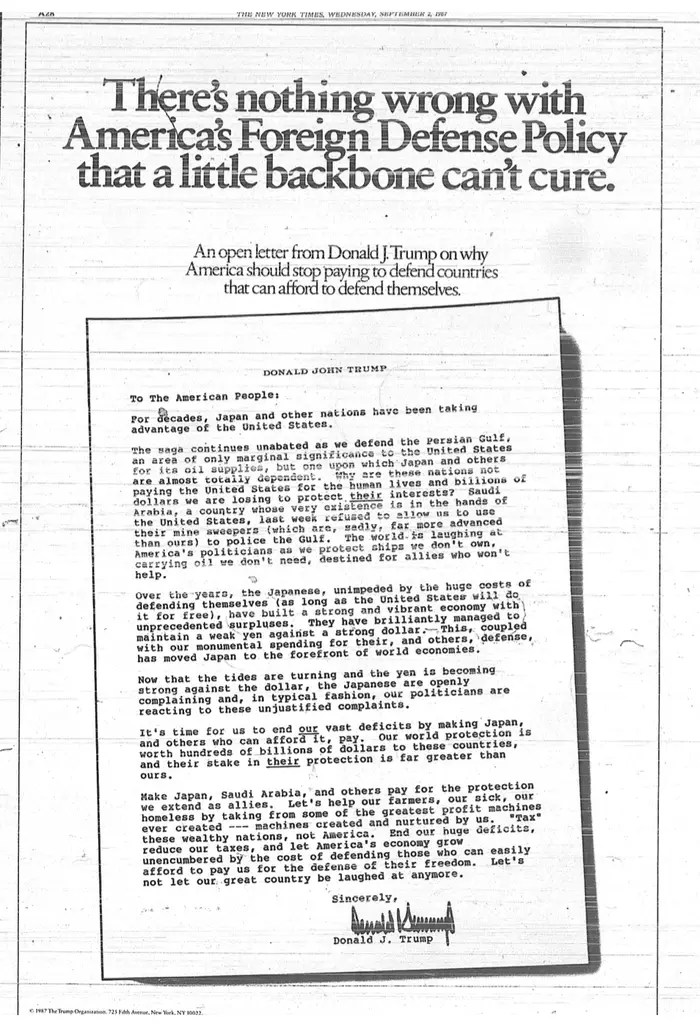
Since his re-election Trump’s focus has been squarely on tariffs, promising them on China (a further 10%), on BRIC nations (100%) and Canada and Mexico (25% each). He’s suggested that some of the tariffs can be avoided for Canada and Mexico over better border controls on drugs and illegal immigrants, but whether this is true is unknown. Political commentators like David Frum have pointed out that Trump’s views on trade have been consistent since his first considered run for the presidency in 1987, that he is hostile to trade and sees it as a zero-sum game.

A close-up of a piece of paper

Description automatically generatedIn 2025 world leaders and policy shapers believe Trump should be taken both seriously and literally. While the current political situation in Canada has been turbulent, the view of the government and provinces is almost unanimous (Quebec and Alberta remain the perennial opponents to joining the band wagon). Doug Ford took the initiative to announce that Ontario could stop energy exports to the US in the event of a trade fight, a position seconded by BC’s premier David Eby.

But in the United States the threat of aggressive and expanding tariffs have also been taken literally, notably by Jerome Powell of the Federal Reserve. On December 18th, in a move that shook markets, Jerome Powell did announce a final rate cut for 2024, but stressed that future cuts were heavily dependent on inflation, which will likely rise if Trump enacts his regime of trading tariffs. Markets were quick to react, and though 2024 will be remembered as a pretty good year for investors, the speed and size of the market sell-off was newsworthy, being the largest since August.

The next morning and markets began on a relatively positive note, continuing a trend of brief panics followed by long yawns as markets simply resume their upward momentum. Little seems to have dissuaded the bull market since 2022 and with the US economy still showing itself to be very strong there’s every chance that the brief panic on December 18th was just that, a moment of panic at the end of 2024. But Trump, like the rest of us, doesn’t live in longer and slower news cycles. Instead market panics live on in social media, and run the risk of coalescing into counter narratives that Trump might hurt the economy more than help it (its notable that the economy has been very strong under Biden, but that didn’t change the perception that Trump had been the better economic steward).

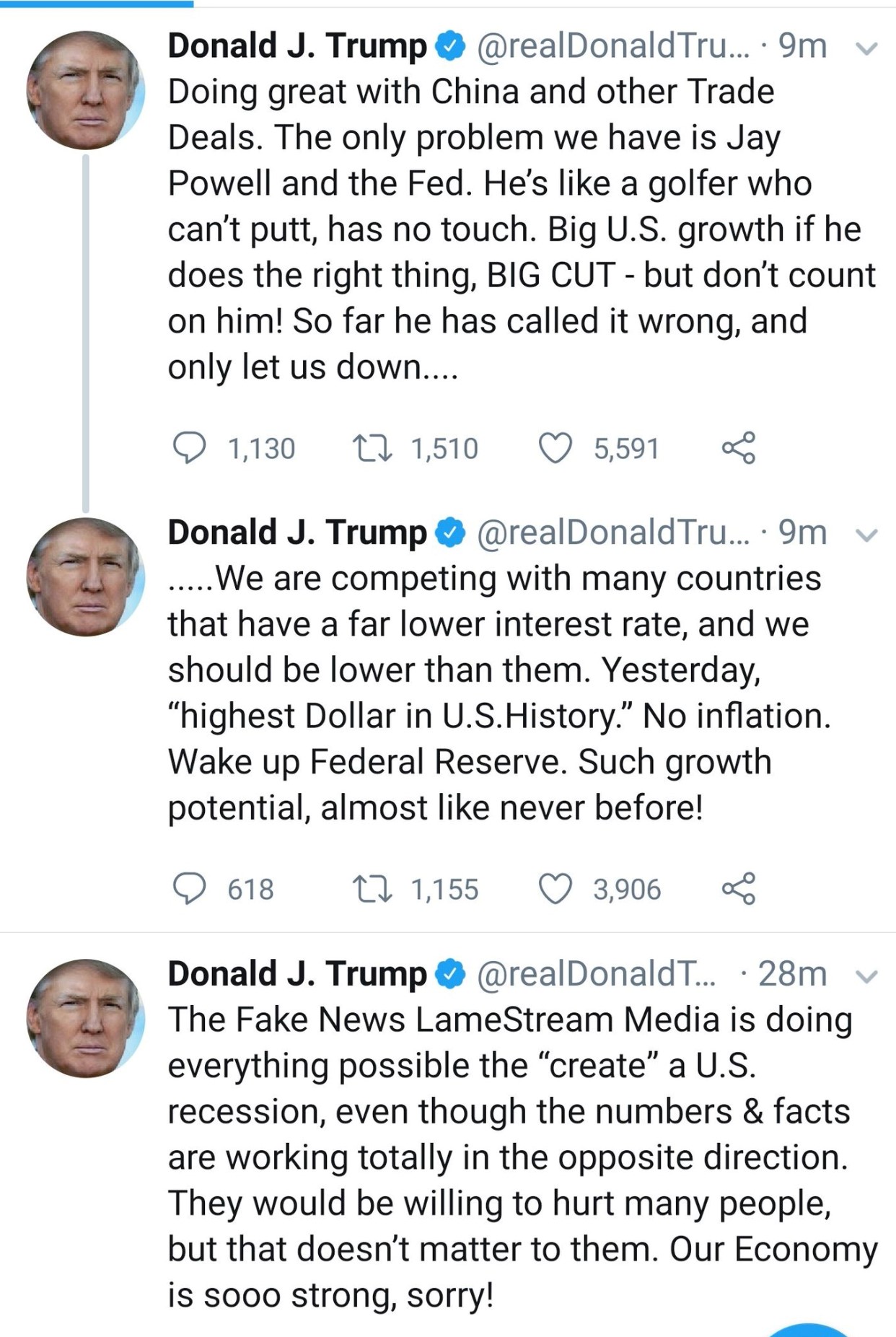
In 2018 Jerome Powell began raising rates to blunt the sharper edges of a hot economy and return interest rates to somewhere near a historic norm. Since 2008 rates had remained at emergency low levels, and there was a genuine concern that markets were becoming addicted to cheap cash. In October of that year Jerome Powell made clear that rate hikes would continue until the Fed felt they’d reached a neutral rate, news not well received by the stock market. From October to the end of the year the S&P 500 lost 18% by December 24th, before rebounding slightly by the New Year. Markets had posted decent returns to the end of September, but wiped out those gains and finished the year -6.24% . During the last months of the year Trump made repeated efforts to pressure Powell to halt or cut rates, often publicly over Twitter.

My opinion is that Trump likes the ambiguity surrounding his pronouncements. Whether he actually intends to implement all the tariffs he’s discussed, whether they are bargaining positions, or whether he can be talked out of them is a grey area that offers him a position of strength. Politicians may be particularly vulnerable to his vagaries since they often wish to protect the status quo while Trump feels free to be a disruptor. But that grey area only works as a negotiating tactic so long as people believe that deals can be reached. If nations come to believe that Trump is serious and literal about tariffs and don’t believe they can be avoided, you are only left with a trade war. Similarly if you are in charge of the Federal Reserve and believe that Trump will do what he says, then you have every reason to pursue positions that curb inflation.

Following Trump’s election Jerome Powell was asked whether he would resign as the Federal Reserve chair, and was clear in his response; he will not, he is not required to leave, and cannot be compelled to. Trump already has a difficult and publicly hostile history with Powell, and its easy to imagine that if Powell is taking Trump seriously, he will move into direct conflict with Trump because of his policies, not in spite of them. Similarly conflict may be around the corner on diplomatic issues for the exact same reason. If Mexico feels it can’t avoid a trade fight with the US, you can assume that Mexico might be less interested in working to curb migrants at the US border. In Canada the same might be true, negotiating with someone who has no intent to make a deal (or honor the one already made) is not likely to build support for concessions.

Today Trump will take office following his inauguration, and he’s expected to sign a number of executive orders kicking off his next term. He has posed as a disruptor, and has nominated a number of other unusual thinkers and people opposed to the status quo to make up his cabinet. Whether they all take those roles and can do what they say they plan too is yet to be seen, but on December 18th we may have gotten some insight into what that future might look like, a future where Donald Trump is taken at his word, both seriously and literally.  

Aligned Capital Partners Inc. (“ACPI”) is a full-service investment dealer and a member of the Canadian Investor Protection Fund (“CIPF”) and the Canadian Investment Regulatory Organization (“CIRO”).  Investment services are provided through Walker Welath Management, an approved trade name of ACPI.  Only investment-related products and services are offered through ACPI/Walker Wealth Management and covered by the CIPF. Financial planning services are provided through Walker Wealth Management. Walker Wealth Management is an independent company seperate and distinct from ACPI/Walker Wealth Management.
After Trump: The Persistent Discontent


Supporters of President Donald Trump rally at the U.S. Capitol on Wednesday, Jan. 6, 2021, in Washington. THE CANADIAN PRESS/AP, Jose Luis Magana

The shocking scenes of Trump supporters storming the capitol building on January 6th, sometimes jovially, other times with what seemed like murderous intent, may have permanently cemented Trump’s fate. He’s been impeached, again, and efforts are being made to prevent him from running for office in the future. He may also be facing multiple criminal charges and possibly even bankruptcy.

Explanations for the insurrection both over and under explain the problem. Yes, Trump is a demagogue and its true his supporters have been radicalized in a number of ways, including conspiratorial thinking and racist ideas about threats to white people and black lives matter. But as the saying goes, “the issue isn’t the issue”.

In a video about anti-vaxxers (people who promote ideas that are untrue about vaccines) the YouTube Channel WiseCrack pointed out that vaccine acceptance was highest during and just after the Second World War, a period of high confidence and trust in the government by the American citizenry. Today that confidence has ebbed to an all-time low, and that collapse in trust isn’t necessarily unwarranted. The rise of a managerial and technocratic elite has placed an unacceptable distance between citizens and their governments, while government failures seem never to lead to any improvements or accountability.

The cost of these mistakes remains high. In Europe it has led to Brexit, months of protests by “Yellow Vests” in France, the erosion of the center-left ruling party in Germany and a resurgent far right party, the decline of liberal democracies in Hungary and Poland, and a number of anti-establishment parties getting control of small countries like Greece and big countries like Italy.

Canada, forever looking reasonable and calm compared to other countries, is having its own struggles. Prior to the pandemic we had rail protests across the country, have shown a consistent inability to get large infrastructure built and continue to see the erosion of our manufacturing sector. Pandemic response itself has been a laughable mess, from overconfident and condescending pronouncements on the ineffectiveness of masks and accusations of racism about concern of the virus, to complete reversals of position. Vaccine acquisition and distribution has also been underwhelming. The federal government didn’t seem to get enough at the right time, and provincial governments have struggled to get the vaccine to those who most need it (This is nothing compared to the US, where health care workers are actually refusing the vaccine).

In this moment, China can make credible claims for being a useful alternative to the US and other Western countries in its growing sphere of influence. A competent dictatorship with substantial economic growth and a rising standard of living must seem appealing to autocrats and some global citizens alike.

There are other concerns too. The gap between Main Street and Wall Street has grown ever wider. During early months of the pandemic the collapse of jobs and business was mirrored by a resurgent stock market that began gaining steam even while the real economy was crashing. This disparity between the world of investing and the world we live in only heightens inequality concerns. Ownership of stock by Americans closely correlates with age, ethnicity, wealth, and education. For many people today, inequality continues to look like a political class consorting with a billionaire class that don’t play by the same rules that govern everyone else. In a pandemic Jeff Bezos gets rich, and you get fired.

This is obviously not universal. Different countries have different problems and the degree to which these issues are felt by individuals depends a great deal on background and government. But even if we assume that the American situation represents an extreme amongst Western nations, it should not blind us to the anger that people rightly felt when they learned of politicians and executives travelling outside of Canada while asking everyone else to cancel their Christmas dinners. Politicians of all stripes seemed to believe that they would be exempt from the restrictions they imposed on others and had a hard time fathoming that constituents would be upset.

Fixing these problems will not be easy. Technocrats, that is governing authority due to technical expertise, imbues our current leaders with a lot of confidence on issues where there may be no correct answers. They leave people blind to what they do not know and encourage authorities to rely on models and projections rather than real life.

Take for instance inflation. Governments and central banks are very concerned with inflation. Too little and the economy will not grow. Too much and the economy will stall while savings lose value. Inflation needs to be “just right” which is currently considered somewhere between 1% – 3%, with a target rate of 2%. According to Statistics Canada, the CPI since 2010 has been around 1.5%, just below the current 2% target. In other words, $100 in 2010 would buy roughly $85 of similar goods today.

But would it?

Inflation has been higher and felt more directly by lower income people. Using data collected by Statistics Canada (you can click the link below to download the spreadsheet with all these numbers and my calculations) for retail food prices between November 2010 to November 2020, we can see that many food staples have become more expensive in the last decade at rates in excess of core inflation. In that time, the price of beef has risen between 4% to 7% per year depending on the cut. Potatoes have risen in price over 10%, onions by 5.5% and carrots by 6.3% a year. Baby food rose by an average of more than 9% a year, and toothpaste by 8%. Almost none of the staple groceries tracked by Statistics Canada had price increases contained to the 1.5% official rate of inflation, instead many rose at rates double that or more.

Like real estate, another asset class that continues to defy gravity without an impact on inflation but a dramatic one on the population, a rising price of food that remains unaddressed only highlights the different reality Canadians seem to be living from our elected officials. Despite a great deal of lip service about the importance and risks facing the middle class, governments have yet to seriously tackle these issues, or make them central in elections. Instead we continue to deal with these problems in a patchwork of modest tax credits and empty rhetoric.

I, and I assume many others, would like to put the Trump era behind us and treat it as an anomaly. But to do so would assume that Trump had landed (as had Brexit and other populist movements) fully formed but alien to us, and that we had been taken by a madness that can finally be broken.

I think we know this is not true.

From the moment that Hillary Clinton called Trump supporters “Deplorables” (or half of them at least) there has not been a clearer delineation between those that control the cultural zeitgeist, and those who have come to resent it. We have a similar divide in Canada too, with Alberta constantly at odds with more “progressive” provinces over environmental issues, and Quebec (doing as it always has) putting its historic/cultural/religious identity ahead of more multi-cultural aspirations of equality. Toronto and Vancouver may sit at the centre of Canada’s cultural output, but these two economic powerhouses do not share much with the rest of the country.

Our prolonged period of peace, wealth and stability has tricked us into believing that unrest, dissatisfaction, and failure are aberrations. But the history of Canada, the United States, Great Britain, and other European powers has been one of long periods of unrest. William Jennings Bryan, before being disgraced in the Scopes Money trial, had been a tireless campaigner for agrarian populism. In Canada we too had an agrarian populist movement (interestingly enough, similarly conservative and steeped in conspiratorial anti-Semitism, prominent in Alberta and Quebec) that only really started to disappear after the mid-60s and not totally until the late 80s. Political dissatisfaction can have long legs.

Five people died as a result of the assault on the capitol on January 6th, and one was Ashley Babbitt, a Q-Anon, MAGA loving Trump supporter who had breached four lines of security in an attempt to overthrow the government on behalf of Donald Trump. But while her motives and goals were deeply misguided, her past remains a window into a dispiriting world for many Americans. A fourteen year veteran of the United States air force, Babbitt now owned a pool supply business that was struggling, forcing her into a short term loan with a 169% interest rate. Medieval Europe had better rules governing usury than California. Or consider the North Carolina woman who took to social media because she couldn’t afford the $1000 insulin prescription for her son. Insulin, among other drugs in the United States, has been reported on multiple times for its rising price. Despite that, no government or corporation has been able to act in such a way to curb the rising price of a life saving drug that been around for a century.

All this is baked into America, and represents a growing risk for the future. Though the country has a more dynamic market, holds more patents and has some of the largest corporations, the failure to consider the effects of pushing up stock valuations at the expense of everything else will likely only deliver diminishing results in the future, both for investors like you, but also for the global liberal order that provides much of the stability we rely on.

Information in this commentary is for informational purposes only and not meant to be personalized investment advice. The content has been prepared by Adrian Walker from sources believed to be accurate. The opinions expressed are of the author and do not necessarily represent those of Aligned Capital Partners Inc.

Some thoughts on the end of Donald J. Trump

President Trump, Evan Vucci AP

This was written on Friday, November 6th. Since then the election has been called for Joe Biden.

It’s Friday, November 6th, and Pennsylvania seems to be looking like it will go to Biden. With four battleground states showing narrow Biden leads, the math seems inescapable. Biden will be the 46th president of the United States.

The narrowness of this victory is unsettling. A record turnout for both Republicans and Democrats, the largest turnout since the 1960s of the electorate, the largest percentage of votes by visible minorities for a Republican candidate since Richard Nixon, only showed that American remains a polarized land. The hoped for “Blue Wave” as Americans repudiated Trump and his enablers did not materialize. The Senate will likely remain in the hands of Republicans. The House of Representatives may flip to Republicans too.

Even now, after all that has unfolded over the last four years, much of what brought Trump to power; anger at a failure of the establishment to protect jobs, uncertainty about the ethnic and cultural future of the United States, the erosion of the middle class, the simultaneous exhaustion of being THE global superpower while being blamed for being one. These issues linger, promised but unaddressed by Trump, ignored by his party and fueling alienation in the general populace.

Other, more persistent aspects of American culture have also been on display. Since Richard Hofstader first wrote his book Anti-Intellectualism in American Life in 1962 (He calls Eisenhower “conventional in mind, (and) relatively inarticulate” – cruel words for one of America’s best remembered Republican presidents) Americans continue to lament, often publicly, just how stupid they find one another. Whether it is over face masks, the environment, or conspiracies about “the deep state”, Americans remain shockingly divided, often down the middle.

But with Biden elected (presuming he survives all the legal attacks and mandated recounts) and once the final vote tallies are certified in a few weeks, a corner will have been turned. Trump, in his role as a lame duck president will likely shore up personal protections, lash out at allies that failed to defend him, denounce democratic institutions that have allowed for his failure, and presumably pardoning those in his close circle and looking to shield himself from any future prosecution. Biden will hopefully find some common ground in the Senate and House of Representatives that will allow business to proceed, but it seems safe to assume that the most ambitious parts of the Democrat’s wish list won’t make it into law. Similarly, hopes for a Trump sized stimulus package will now also be dashed by a Republican establishment always uncomfortable with Trump’s lavish spending but fearful of his wrath.

From the perspective of the investment world this seems to be a continuation of the status quo. Biden does not possess Trump’s unique skill at bullying, backed by the threat of his irate voters. Instead the hope will be that he can better negotiate with Republicans. But with the election leaving the GOP in a strong legislative position there will be little appetite for aggressive policy shifts. Instead we should expect tepid fiscal stimulus, continued strength in businesses profiting from the pandemic (like tech stocks) and a wider, more subdued recovery as we face the immediate economic uncertainty.

So often we think big things represent monumental shifts. The election of Trump was one such event, but in the end his legacy will be a great deal smaller, and I suspect better thought of, than we might guess now. His ignorance, narcissism, and sociopathy were critical flaws in a man that showed great skill in reading the American public. His few achievements, including peace between Israel and several Arab states, challenging China and striking some kind of trade deal, and boosting American military spending were not missteps. His useless forays into border walls and needless antagonism of American allies will not be missed. At the outset of his presidency he even had the foresight to surround himself with some accomplished and knowledgeable people. In the end Donald Trump’s biggest enemy was himself. Were Trump a more competent and less incurious man he could have been a formidable political force. Instead, his certainty in his own skill and inability to adapt made him an aspiring autocrat in search of a balcony.

To cultural observers, the election of Trump should be a reminder that small things that go unnoticed or ignored often prove to be bigger issues. The sudden mysterious outbreak of an unknown form of pneumonia in Wuhan at the end of 2019. The subtle shift in economic thinking by political leaders across the West. A demographic trend that sees a generation shrinking, maybe even incapable of marrying. The rapid economic growth of an often-overlooked part of the world. It may even be the surprising growth of visible minority voters for a candidate long believed to be their enemy. These quiet things, hiding in the corners, may be the issues that guide our future rather than the bombast of men like Donald Trump.

In 2015 I wrote that “You don’t have to love people like Rob Ford or Donald Trump, but their ability to change the political terrain, to question traditional assumptions about the electorate and undo the laziness of identity politics is healthy for a democracy, even when you don’t like the messenger.” Looking back on four years, I am only desiring a return to normalcy, but with so many of the issues that brought Trump to the White House still unaddressed I’m afraid that whatever normalcy Joe Biden can bring will be short lived.

Information in this commentary is for informational purposes only and not meant to be personalized investment advice. The content has been prepared by Adrian Walker from sources believed to be accurate. The opinions expressed are of the author and do not necessarily represent those of Aligned Capital Partners Inc.

The Quest to be 30% Richer

*A quick note – next week I will be discussing the recent market events, but had this written already last week and didn’t want it to go to waste. 

** Performance numbers presented here all come from Questrade’s own website. They also represent the most recent numbers available.

Money Can 

Questrade is Canada’s fastest growing online advisory service that has built its business on the back of a catchy refrain: “Retire up to 30% richer”. There ads are everywhere and the simple and straightforward message has landed with a punch. The principle behind their slogan is that, over enough time, the amount of money you can save in fees by transferring to their online platform can be worth a substantial amount when that saved money is able to compound.

https://youtube.com/watch?v=Zll_hAY58Qw%3Ffeature%3Doembed

Competing on the price of financial advice has become common place, especially as people have become increasingly comfortable doing more online. Online “robo-advisors” dispense with all that pesky one-on-one business through your bank and have focused on providing the essentials of financial planning with a comfortable interface. Champions of lowering the costs of investing have hailed the arrival of companies like Questrade and Wealth Simple, believing that they would unsure in an era of low-cost financial advice.

Such a time has yet to materialize. For one thing, traditional providers of investments, like mutual fund companies, have learned to compete heavily in price, while an abundance of comparable low-cost investment solutions have given financial advisors a wider range of investments to choose from while being mindful of cost. Meanwhile, because internet companies have a business model called “scaling” which encourages corporations to rapidly expand on the backs of investors before they become profitable, its not clear whether robo-advisors are actually all that successful. Wealthsimple, one of the earliest and most prominent such services has broadened their business to include actual advisors meeting actual people, a decidedly more retrograde approach in the digital age.

Nevertheless, efforts to win over Canadians to these low cost model continue apace, and the market leader today is Questrade. So, what should investors make out of Questrade’s signature line? Can they really retire 30% richer?

Probably not.

First we should understand the mechanics of the claim. Looking through Questrade’s website we can see through their disclaimers that for each of their own portfolios they have taken the average five year returns for categories that align with each portfolio, the average fees for those categories and added back the difference in the costs. So, for their Balanced Portfolio they refer to the “Global Neutral Balanced Category” and the five-year number associated with that group of funds (the numbers seem to be drawn from Morningstar, the independent research firm that tracks stocks, mutual funds and ETFs).

Questrade assumptions
Figure 1 https://www.questrade.com/disclosure/legal-notice-and-disclosures/2018/08/08/questwealth-portfolios-calculator

Thus, they arrive at an assumed ROR of 6.21% for five years, and then project that number into the future for the next 30 years. They also calculate the fee of 2.22% (the average for the category) and subtract that from the returns. And using those assumptions Questrade isn’t wrong. Assuming you received the average return and saved the difference in fees, over 30 years you’d be 30% richer.

Except you probably wouldn’t.

Questrade actually already has a five year performance history on their existing investments, and we can go and check to see how well they’ve actually done. Unfortunately for Questrade, their actual performance in practice is not considerably better than the average return against the categories they are comparing. For the last five years, Questrade’s 5 year annualized performance is 4.92%, less than 0.3% better than the category average of 4.66%.

But wait, there’s more!

Questrade Balanced Portfolio Performance
Figure 2 https://www.questrade.com/questwealth-portfolios/etf-portfolios#balanced

Keep in mind that Questrade’s secret sauce is not the intention to outperform markets, merely to get the average return and make up the difference in fees, but when put into practice it isn’t even 1%, let alone 2% ahead of their average competitors. In fact, we could go so far as to say the Questrade is a worse than average performer since if we assumed the same fees were to apply, Questrade’s performance would be significantly below the average return. In fact, for the purposes of their own history the above performance is shown GROSS of fees. Yes, if you read the fine print you discover that Questrade has not deducted its own management costs from these returns, meaning that the real rate of return would be 4.54%, officially below the average they are trying to beat!

Questrade Extra Disclaimer
Figure 3 https://www.questrade.com/questwealth-portfolios/etf-portfolios#balanced

Fidelity Global Neutral Comparison
Figure 4 This has been taken from Morningstar and compares the B Series Fidelity Global Balanced Portfolio performance against its category, Global Neutral Balanced. Performance for the individual fund is better than the 5 year average of Questrade’s comparable investment, and ahead of the five year average for the category of 4.66%. This should not be construed as an endorsement of Fidelity or any investment they have.

There is a temptation towards smugness and finger wagging, but I think its more important to ask the question “Why is this the case?” The argument for passive index ETFs has been made repeatedly, and its argument makes intuitive sense. Getting the market returns at a low price has shown to beat active management over some time periods. So why would Questrade underperform, particularly when markets have been relatively stable and trending up? I have my theories, but it should really be incumbent on Questrade to explain itself. What does stand out about this situation is that if you are unhappy with your performance THERE IS NOTHING YOU CAN DO ABOUT IT! Questrade’s portfolios represent their best mix, and do not allow you to make substitutions or even really get an explanation for the under-performance. The trade off in low cost alternatives is all the personalization, flexibility and face to face conversations that underpin the traditional advisor client relationship.

Given all the regulations that surround investing, I remain surprised that Questrade is able to advertise a hypothetical return completely detached from their actual returns, but that is yet another question that should be settled by people who are not me. Questrade has some benefits, not least is their low fees, but investors should be honest with themselves about how beneficial low fees are in a world when there are many options and the cost of navigating those options represents their best chance at retiring happy and secure.

As always, if you have questions, need some guidance or just a second opinion, please contact me directly at adrian@walkerwealthmgmt.com

Information in this commentary is for informational purposes only and not meant to be personalized investment advice. The content has been prepared by Adrian Walker from sources believed to be accurate. The opinions expressed are of the author and do not necessarily represent those of ACPI.

What’s Next? (And When Will It Happen)

economyis bad

Talk of recession is in the air and amongst my clients and readers of this blog the chief question is “when”?

Ever since Trump was elected, questions about when “it’s going to happen” have been floating about. Trump, an 800-pound gorilla with a twitter addiction, has left a predictable path of destruction and the promise of more chaos always seems on the horizon. It should not be surprising then that investors have been waiting with bated breath for an inevitable correction.

Those predicting imminent doom got a little taste of it last week when markets convulsed and delivered the worst day of the year so far, shedding a dramatic 800 points off the Dow Jones. Globally the news hasn’t exactly been stellar. Germany, Italy and France are all showing a weakening economic outlook, which is to say nothing of Great Britain. Despite three Prime Ministers and two deadline extensions, the nation has yet to escape its Brexit chaos and is no closer to figuring out what to do about Northern Ireland. China too is facing a myriad of problems. Trump’s tariffs may be making American’s pay more for things, but it does seem to be hurting the Chinese economy. Coupled with the persistent Hong Kong protests and its already softening market, last week the Chinese central bank opted to weaken the Yuan below the 7 to 1 threshold, a previously unthinkable option aimed at bolstering economic growth.

In all of this it is the American economy that looks to be in the best shape. Proponents of the “U.S. is strong” story point to the historic low unemployment and other economic indicators like consumer spending and year over year GDP growth. But this news comes accompanied with its own baggage, including huge subsidies for farmers hit by Chinese import bans and other trade related self-inflicted wounds. This issue is best summarized by Trump, who himself has declared that everything is great, but also now needs a huge rate cut.

Trump TweetThe temptation to assume that everything is about to go wrong is therefore not the most far-fetched possibility. Investors should be cautious because there are indeed warning signs that the economy is softening and after ten years of bull market returns, corrections and recessions are inevitable.

But if there is an idea I’ve tried to get across, it is that prognostication inevitably fails. The real question that investors should be asking is, “How much can I risk?” If markets do go south, it won’t be forever. But for retirees and those approaching retirement, now ten years older since the last major recession, the potential of a serious downturn could radically alter planned retirements. That question, more than “how much can I make?”, or “When will the next recession hit?”, should be central to your conversations with your financial advisor.

As of writing this, more chaotic news has led Trump to acknowledge that his tariff war may indeed cause a recession, but he’s undeterred. The world is unpredictable, economic cycles happen, and economists are historically bad at predicting recessions. These facts should be at the center of financial planning and they will better serve you as an investor than the constant desire to see ever more growth.

So whether Donald Trump has markets panicked, or a trade war, or really bad manufacturing numbers out of Germany, remember that you aren’t investing to do as well as the markets, or even better. You’re investing to secure a future, and ask your financial advisor (assuming it isn’t me) how much risk do you need, not how much you’ve got.

Information in this commentary is for informational purposes only and not meant to be personalized investment advice. The content has been prepared by Adrian Walker from sources believed to be accurate. The opinions expressed are of the author and do not necessarily represent those of ACPI.

Beware the Rally

*At the time that I wrote this markets had just finished several positive sessions, however by the time it was ready markets had once again changed directions!

US-STOCKS-DOW JONES-RECORD

I’m going to potentially embarrass myself and go on the record as saying we shouldn’t place too much trust in the current market rally, though the upturn is welcomed.

Rallies present opportunities for potential short-term gain, and with markets having shed roughly 10% over the month of October, there is certainly money to be made if you’re feeling sufficiently opportunistic and have a plan. For the rest of us, the rally is a welcome break the punishment the market has been delivering, and an opportunity to see portfolios stabilize and regain some ground.

S&P 500 Rally

The long-term viability of a rally, its ability to transition from opportunistic buying to sustained growth, very much depends on the fundamentals of that rally. Are markets sound, but oversold? Or are fundamentals deteriorating and represents more hopefulness than anything else?

Readers of this blog will not be surprised to find out I have no set answer to this question. As always, “it depends”. But as I look over the news that has supposedly rekindled the fire in the markets much of it seems at best temporary, perhaps even fanciful. Up against the wall of risk that investors are currently starring down, the best news currently available is that Trump had a phone call with Xi Jinping and has asked for a draft to be prepared to settle the trade disputes between the two countries.

FGIS_fig_2

I’m of the opinion that a recession isn’t imminent, but it should be obvious that recessions happen and the longer we go without one, the more likely one becomes. That seems especially true in a world that is undergoing a seminal shift when it comes to international trade and multilateral deals. To take one example, in the last year U.S. soybean exports to China have dropped by 97%, with no exports for the last quarter. This is a trade war still in its infancy. Other market data is mixed. Even as job growth exceeds expectations it will also keep the Fed raising rates. Housing starts have dropped significantly below expectations, driven in part by rising costs.

image002_0

All this is to say that market rallies like the one we’ve just seen should be treated with trepidation. Investors should be cautious that a bottom has been reached and that this is a good time to rush into the market looking for deals, and we should keep an eye on the fundamentals. Rallies falter precisely because they can be based more on hope than on reality.

So what should investors do if they want to invest but are unsure about when to get into the markets? Come talk to us! Give us a call and help get a plan together that makes sense for your needs! Check out our new website: www.walkerwealthmgmt.com or give us a call at 416-960-5995!