You Would Probably Make a Terrible Stock Picker

Mærsk_Mc-Kinney_MøllerYou would probably make a terrible stock picker. You really would. Why you ask? Because the world is big and complicated and its hard to hold on to more than a small piece of it at any one time.

Picking stocks isn’t exactly all the rage, but with the sheer volume of discount brokerages and online trading platforms there’s clearly enough interest in the DIY method of investing that it’s easy for people to either manage an entire stock portfolio or dabble in the occasional stock tip. Is this a good idea? Cost wise it’s hardly prohibitive, but from the standpoint of whether this makes for smart investing I have my doubts.

Why? Well, for one thing even the professionals get things wrong sometimes. But the investment industry is staffed with analysts that specialize in entire industries, looking to understand companies from different points of view that reveal opportunities for growth, value or misplaced market opportunities. These people spend their careers trying to understand companies and the industries they are part of.

By comparison the DIY investor tends to act on the things they think they know, and perhaps even the unknown knowns. All of this can lead to serious errors in judgement and costly mistakes in their investments. Are you right to think that Apple is on the decline because it isn’t innovative enough? Or that Microsoft has already lost because of declining computer sales. Is Tesla really worth as much as 50% of GM? Is that hot mining stock you heard about really as good a bet as you think?

In my time working at a mutual fund company I was most impressed when I spoke to portfolio managers who  talked about why they looked at companies and industries that no one else did. How much time did you think about mattress companies? How often were you reviewing currency trends between Mexico and India (yes that’s a thing)? How much do you really know about a company?

For example, have you ever heard of A.P. Moller-Maersk? It’s okay if you haven’t, but you might be surprised to learn just how big a company it is. Maersk is a Danish corporation that’s core business is global shipping. It’s so large a firm that it accounts for 20% of Denmark’s GDP. It owns and operates countless subsidiaries, including banks, energy companies and supermarkets. It’s full list of associated companies is 12 pages long (Company Overview), showing firms from Angola to Canada, the United States to  Japan, on the Middle East and through every Emerging and Developed market you can think of. Maersk commands a shipping fleet of six hundred vessels, making it the world’s largest. It’s revenues in 2011 were $60.2 billion, just shy of Microsoft’s. In 2005 it launched one of its biggest ships, called an E-class, that could carry 15,000 containers. In 2013 Maersk started using its Triple-E Class ship, so large it carries 18,000 containers.*
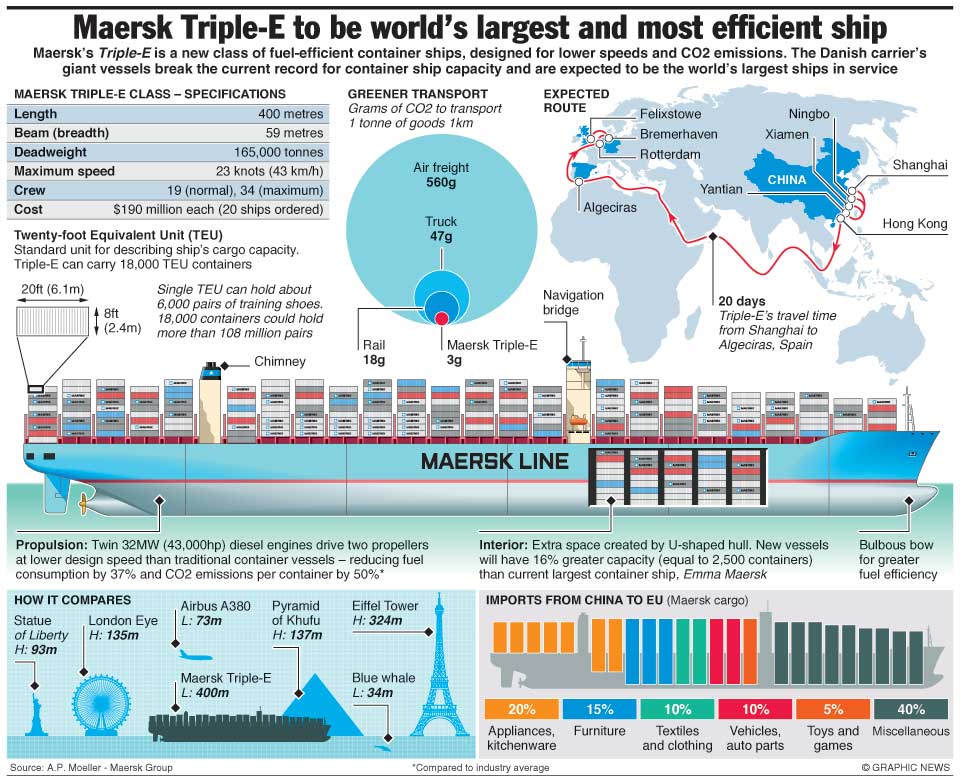
image.axd

I fully admit to knowing very little about such a large company, and it surprises me that a firm with such reach seems to fly just below the radar. But my job is to help people save for retirement and work with their individual financial situations. That’s why I trust professional analysts and portfolio managers to understand the nuances of the companies that make up the investing world. For the DIY investor all too often rumour and news reports substitute for real knowledge. The good fortune of a stock going up instills courage in stock picking prowess, while a declining market either confuses or robs an investor of their confidence and possibly their savings. Investing is a tricky business, and one where we should seek help when its offered.

*All the information regarding Maersk’s business comes either from their website or the excellent book Ninety Percent of Everything by Rose George, which I highly recommend. 

Why Buy an ETF?

Exchange Traded FundIt’s become an excepted fact amongst business reporters that the best investments to buy are ETFs, otherwise known as Exchange Traded Funds. What is an ETF and why are so many journalists convinced that you should buy them? Well an ETF is a fancy way to describe an investment that looks very similar too, (but isn’t quite) a stock market index. Unlike mutual funds, the ETF is bought and sold like a stock, but mirrors the performance of an index of your choosing, and by extension all the companies that make up that index. In that respect it shares the (supposedly) best aspects of both stocks and mutual funds. It is traded quickly and is quite inexpensive compared to a traditional fund, but unlike a stock is widely diversified and so should have reduced risk compared to a single company.

In the aftermath of 2008, many journalists that cover the investment portion of the news have touted ETFs as a better investment than traditional mutual funds, citing underperformance against respective benchmarks and the significant discount on trading costs for holding ETFs. ETFs represent a “passive investment”, meaning they don’t try to out perform their mirrored indexes, instead you get all of the ups, and all of the downs of the market. This message of lower fees and comparable performance has had some resonance on investors, and questions about ETFs are some of the most frequent I receive, however while I am not opposed to ETFs I am very hesitant about giving them a blanket endorsement.

That’s because I don’t know anybody who is happy with 100% risk. In the great wisdom of investing the investor should stay focused on “long term” returns and ignore short term fluctuations in the market. But investors are people, and people (this may shock you) are not cold calculating machines. They live each day as it comes and fret over negative news, get too excited about positive news and are generally greedy when they shouldn’t be. In short, people aren’t naturally good investors and being encouraged to buy an investment like an ETF exclusively on cost alone opens up all kinds of other problems for people who find that the market makes them nervous, or may be closing in on retirement. The passive nature of an ETF may be right for some people, but that decision will rarely depend solely on the cost of the product.

The hype for ETFs is therefore more comparable to buying a car exclusively on price based on the argument that all cars function the same way. But depending on your needs there may be multiple aspects you want to consider: size, safety, speed, etc. Investments are similar, with different products offering different benefits its important not to let greed set all of your investment designs. Investing is typically about retirement, not about maximizing every last dollar the market can offer. Reaching retirement is about balancing those investor needs with their wants, and frequently providing less downside at the expense of some of the performance is preferable to the full volatility of the financial markets.

Apple May Have Just Won the Tablet Wars

Global Tablet Sales
In 2013 global sales of tablets reached just over 195 million. Of that Apple sold over 70 million tablets, growing their year over year sales.

As of today you can download and use Microsoft Office on your iPad. This news has hit my family with a yawn, but to me this is an excellent signal for the long term financial health of both Apple and Microsoft. In fact, I’d go so far as to say that Apple may have just won the tablet wars for the foreseeable future.

In case you don’t know Microsoft has been hurting. Not financially. It’s doing great financially, but as a company where being “with it” seems important, Microsoft is decidedly not. Steve Baumer, the recently retired (and Bill Gates hand picked) CEO made several attempts to broaden and improve Microsoft’s product offerings, but many of them fell flat. The most notable has been Windows 8 and the Surface tablet, the new operating system that was meant to take Windows into the mobile era. The reception to both the Surface and Windows 8 has been so negative that the cost has been extraordinary. Microsoft has already announced Windows 9 and it is expected that it will be a return to the things that people love most about Windows.

Part of the strategy for moving into mobile computing had been to withhold Microsoft Office from the iPad. Office is still the bread and butter of the business world and it drives much of the revenue for Microsoft. The thought had been that limiting Office to a Microsoft platform would make their tablets more desirable and would steer the mobile business world towards Microsoft products. How wrong they were. Apple accounts for 73% of mobile enterprise solutions (sorry Blackberry). Even without the Microsoft Office platform people and businesses preferred to use the iPad, using different apps and numerous work arounds to integrate the Apple product into their business life.

Some will assume that the availability of Office for the iPad signals some kind of death knell for Microsoft’s future in the mobile world. I doubt that. If anything it will make them stronger. It will help solidify Microsoft Office as both the preferred software for businesses, renew interest in its personal use, and ease the pressure to choose the “right” tablet knowing that software can be shared across multiple platforms. The bigger story here is for Apple. Apple’s mobile operating system (iOS) may lag behind the sheer volume of users of Google’s Android operating system, but Apple easily sells the most tablets of any one company. In fact in 2013 Apple sold nearly double the number of iPad’s compared to its nearest competitor, Samsung.

But with the arrival of Microsoft Office it seems clear that Apple is likely to retain the profitable sector of personal and business tablets. Whether this ends up being reflected in the stock price of Apple is yet to be seen.

Las Vegas and the Shrinking Invisible Economy

dsc1511lJust over a year ago I postulated that environmental investing may not be dead. The issue that keeps arising is the invisible economy. Traditionally in economics things that are provided “free” by the natural world don’t get counted in “The Economy”, while things that people do want from the natural world do get counted. For instance, everyone agrees that there is a market for commodities like gold, oil and lumber. Extracting any of those commodities is considered part of the economic growth of the country, from the people who build the roads and equipment for accessibility to the physical harvesting of the raw materials, back to its refinement all the way down to the finished product. All of that is part of the economic system. But by-products from all this economic activity that pollute water ways, or urban expansion that paves over marsh grounds, or excessive water waste that diminishes aquifers isn’t considered an economic activity, it’s called an externality.

In other words there are a number of benefits that are provided to us through natural processes that we get “for free” and rarely get assigned a price tag for their contribution. This has been allowed to happen since much of the ecosystems have been able to absorb considerable abuse without stopping the benefits that we have been provided. Except in Las Vegas.

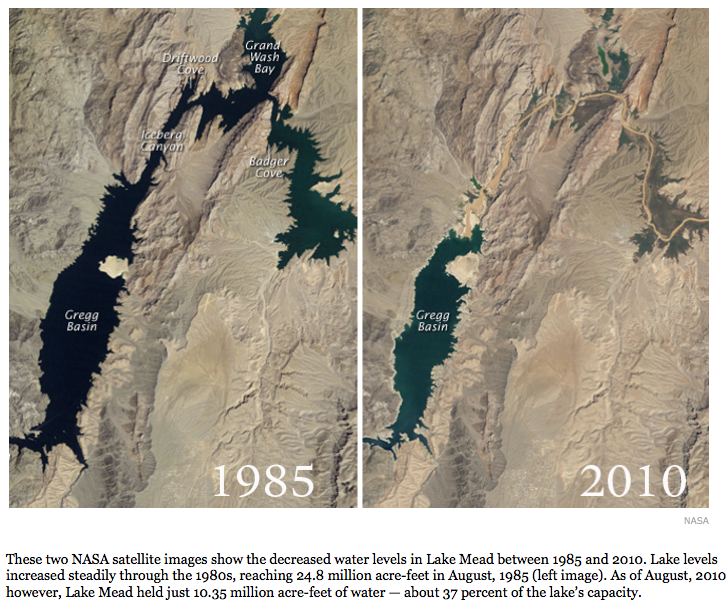
Las Vegas already doesn’t make sense. It’s a desert oasis without an oasis. A bustling city that’s situated in the middle of nowhere, with few natural resources to support it. In fact Las Vegas is so heavily dependent on water that it is literally drying up the desert that will likely lead to the ending of the Hoover Dam as a source of power. Lake Mead, the lake created by the dam is the primary source of water for the city, and the city’s needs have become so great, and the water level so low that there are now two emergency tunnelling construction projects underway to ensure that there is still water for Sin City.

How low is the water? Currently the elevation of the lake shows 1104 ft. The lake is expected to be down to 1080ft by April of 2015. Five more feet and officially there is a level 1 emergency shortage declared. If the lake drops further, to 1050 ft. the Hoover dam stops producing electricity. Under current estimates (assuming that the desert doesn’t get torrential rains for the next few years) this isn’t a question about if, but about when.

Screen shot 2010-10-21 at 11.02.31 AM-2

Las Vegas is unique for other reasons, it wastes an unbelievable amount of water, and its growth rate has been much higher than its gains in conservation. But its situation isn’t unique. It’s happening all over the world, and the result is both rising prices for water and growing infrastructure investments. These will be good opportunities for investors, but bad for local economies as disposable income will be shifted to covering increasing water costs. Las Vegas is useful because the scope of these problems is obvious. Hundreds of millions of dollars are being spent to extend the usefulness of Lake Mead to Vegas. Water rights are being purchased by the city as fast as possible, and if the Hoover Dam stops producing electricity there will be not simply lost revenue from the dam, but increasing electricity and infrastructure costs. The invisible economy of the environment may soon not be so invisible.

Lake Mead

Crimean Crisis Reminds Everybody Why Investing is a Long Game

kiev-split_2829872b
Kiev Square, before and during the protests.

You might have been forgiven if you hadn’t been paying close attention to the Ukrainian Revolution two months ago when it was a long and violent standoff between the Ukrainian government and its people. Kiev square looked like a war zone and reports, while increasingly dire, were not necessarily front page news. But since the toppling of the pro-Russian Ukrainian President Victor Yanukovych it has been impossible to not pay attention to the exploding diplomatic mess of the Crimea.

As of this morning it appears that Vladimir Putin is going to annex the Crimea, much to Ukraine’s dismay, Europe’s frustrations and America’s exhaustion. The crisis is also far from over. The Ukrainian government (now mostly pro-western Europe) is saying that that will not allow such a loss of territory, EU and US sanctions are targeting Russian oligarchs. France is promising to cancel an order of military ships to Russia if Britain punishes Russian billionaire’s living in London. Russia seems relatively unfazed by any of this and seems to know that regardless of what legal reasons may exist that could start a war, few seem interested in shedding blood for the Ukraine.

All of this is obviously upsetting markets. Over the last month the global markets, and especially European markets have taken significant hits over concerns that some kind of conflict is about to breakout.

Bloomberg's Global Index looks at European, Middle Eastern and African Markets
Bloomberg’s Global Index looks at European, Middle Eastern and African Markets
This is the UK stock market (FTSE) over the last month. Performance has clearly suffered as the Crimean situation has worsened.

This creates the kind of immediate volatility that is both temporary and is difficult to counter. It’s a reminder that investing is different from day trading. There are people who are willing to try and make profits from the day to day fluctuations of this (most recent) crisis. They will be jumping in and out of the markets, trying to grab the slight differences over each day and profiting from nervous investors. But being an investor means riding out this volatility with the knowledge that while it is uncomfortable, it is ultimately temporary and that real growth comes from long term success, not day to day jitters.

That being said, it would be nice if we didn’t accidentally end the world!

the-worlds-end-poster-header

Bitcoin looses $500M, 21st century turns out to be terrifying

Bitcoin-deal

Last week I made mention of the disappearance of Mt.Gox, the world’s largest Bitcoin Exchange. On that day it seemed that nobody knew what had happened, except that it had simply disappeared. When it did reappear it had been the apparent victim of a cyber attack that ultimately resulted in the theft of 740,000 bitcoins, worth close to $500M USD and led to the company’s bankruptcy. Since then a great deal of ink has been spilled on the story, and you can read some great reporting on it here, here, and here. But guess what? The fun is just getting started, as the CBC has reported today that another$ 600,000 USD were stolen from Flexcoin, another exchange that has been hacked.

I’m going to let other people smarter than me argue over the future of Bitcoin. The real issue of the Bitcoin thefts is how terribly exposed we all are when it comes to our online security and privacy.

Quite regularly we tend to dismiss the digital world as not being as important as the real one, but in many ways we are far more vulnerable and know a great deal less about what is happening on computers and through the internet. Criminals, governments and corporations are all equally interested in what we do online, and billions of dollars are being spent on trying to learn, understand and steal aspects about ourselves.

The rise of Bitcoin and its subsequent thefts have merely shown how easy it is to steal millions of dollars without leaving your couch. For those of us that would dismiss this as the concern of enthusiastic tech heads, I would point to the growing body of news and statistics that show that we all have a web presence that is constantly being monitored and mined for information. For instance:

Don’t get me wrong, I don’t want you living in fear. However the reality is that our highly interconnected world has commoditized you. We willingly provide mountains of data about ourselves for free because we assume it isn’t valuable to anyone else. But it turns out that where you live, where you eat, what products you buy, how often you visit certain locations and your general personal details all have a dollar value. But we don’t talk or act like they do. It doesn’t help that when companies or governments get caught snooping through what we have assumed are the decidedly unimportant bits of our lives that they tell us that it’s no big deal.

This would all be different if we understood that our information had a price. You could choose to sell it, or choose to improve your privacy. Legislators could pass laws to make privacy statements clearer and give control back to citizens about what companies and governments seek to know. You could receive fair value for information about yourself, and you could pay for additional privacy features that protected you from hackers as well as other private interests.

The genie is out of the bottle, and I predict that in the future the market for online privacy will grow as we become increasingly exposed to electronic risk. Until then I think I can recommend a new smart phone:

Canadians Losing the Battle to Save For Retirement

Money WorriesPeople sometimes ask why I seem to be so focused on housing and its costs as a financial advisor, and I think the answer is best summed up declining rates of RRSP contributions. Currently many Canadians seem to be opting out of making a RRSP contribution this year, with both Scotiabank and BMO conducting separate and disheartening surveys about likely RRSP contribution rates. Unsurprisingly the answer most Canadians gave to why they would not be contributing this year was because they “did not have enough money.” These surveys also found that 53% of Canadians did not yet have a TFSA either for similar reasons. The expectation is that by 2018 Canadians will have over a trillion dollars of unused contribution room.

These kinds of surveys invariably lead to a kind of financial “tut-tutting” by investment gurus.

http://youtu.be/1pQJxGIFzdo

As one member of BMO’s executes put it, an “annual contribution of $2,000 to an RRSP… costs less than $6 per day.” which is true but does not really spell out a viable path to a retirement, merely the ability to make a contribution to a RRSP. While there is nothing wrong with the Gail Vaz-Oxlade’s of the world handing out financial advice and directing people to live debt free, Canadians simply do not live in some kind of financial vacuum where all choices boil down to the simple mantra of “can I afford this?” Frequently debts are incurred either because they must be (educational reasons, car troubles, etc.) or because it is not feasible to partake in an economic activity without taking on debt (like buying a house). Similarly it is not practical to assume that every decision be governed exclusively by a simple weighing of financial realities. It’s true it would cost less to live in Guelph, but many people do not wish to live in Guelph and would rather live in Toronto (Nothing personal Guelph!)

What we do have though is a precarious situation where the economy is weak (but maybe improving), which sets government policy through low interest rates. Low interest rates means borrowing for big ticket items like homes in places where supply is limited, like the GTA, or Vancouver or Calgary. This in turn keeps both house prices and debt levels high. It’s telling as well that a growing number of Canadians are beginning to look at their homes as a source of potential income in retirement. All of this seems to be happening while different financial “experts” argue whether the Canadian housing market is actually over valued, or not

This is where I get a chance to make a personal plug for the benefits of my role. While I don’t have much say in government policy, or even directing housing development in big cities, it is rewarding to know that financial advisors like me have a significant impact on the savings rates of those Canadians that work with us. A study called Value of Advice Report 2012 reported that Canadians that had a personal wealth advisor (that’s me) were twice as likely to save for retirement, and that the average net worth of households was significantly higher when they had regular financial advice from an advisor (again, me). The RRSP deadline this year is March 3, so please give me a call if you haven’t yet made your RRSP contribution. 

Go back

Your message has been sent

Warning
Warning
Warning

Warning.

The Debt Ceiling Is Pointless

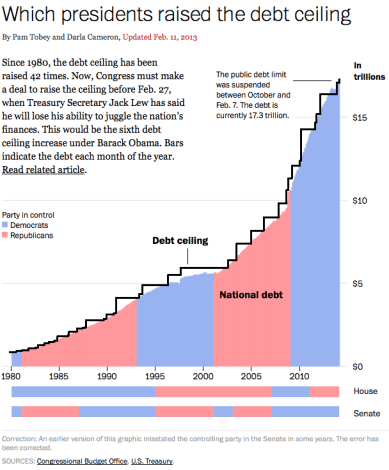
From the Washington Post, Tuesday February 11, 2014

It would seem that the Republicans in the United States have been largely de-fanged when it comes to using the debt ceiling as a political lever. Yesterday Republicans agreed to a ‘clean’ debt ceiling vote, meaning that there were no poison pills for Democrats to swallow, and that political fighting and decisions would have to happen without the threat of a total global economic meltdown.

But the debt ceiling need not exist at all. As you may know, there aren’t any other major economies that have “debt ceilings” – instead the debt ceiling was a by-product of America’s involvement in the First World War, when Congress (the group authorized to allow for debt) needed to give the treasury room to borrow. The solution was the Debt Ceiling that we know today.

But the debt ceiling isn’t helpful and doesn’t do any of the things that people intend it to do. For instance, as a way of stopping or limiting borrowing it doesn’t work. Most of what the treasury is paying goes out automatically, like paycheques and benefits. Stopping borrowing doesn’t eliminate the debt obligation, it just puts you in default.

As a method to improve the financial health of the United States its hard to see how breaching the debt ceiling would improve the American economy. Far more likely it would tank the US and much of the global markets.

As a tool to fight for social change it is dangerous and undemocratic. The financial responsibilities of the United States sit on both party’s shoulders, not just one.

Lastly, the debt ceiling has prevented more useful conversations about how to help the American economy where both parties had something to offer. Have a look at this video by historian Niall Ferguson from 2011. The economy has improved since then and the economic outlook is better than before, but it is telling that the debt ceiling offers us little and distracts people from more useful political solutions.

It’s time to get rid of the debt ceiling.

Don’t Forget to Like This Market Bubble on Facebook!

Say No to FacebookHow much would you pay for something that is free? This is the basic question behind trying to value the many forms of social media that have dominated the business news over the last few years. Pinterest was valued earlier in 2013 at $3.8 billion. It makes no money. In Twitter’s initial pubic offering its share’s rose to over $45, giving the company a value in excess of $30 billion. It also has yet to turn a profit. Linkedin does make money, but it’s valued like a company that makes 100x more than it actually does. Facebook, which does turn a mighty profit, generates that money not from their user base, but from companies trying to engage its user base. While Facebook does have a lot of users, many of them don’t like advertising on their profile and click rates for advertising have been reported as lower than advertising on the web in general.

What we have then is an abnormal situation where investors appear to be willing to pay big money for companies that don’t seem to be even close to making any of that investment back (some companies don’t even seem interested). In contrast companies like Apple have seen huge fluctuations in their share value on the mere speculation that they may not make quite as much money as previously thought.

To my eyes this has all the makings of a market bubble. I’ve written about the absurd way we seem to value internet businesses that don’t make any money before. One theory for these valuations is that these businesses are highly scalable. Adding more users doesn’t cost much more in terms of effort. Other theories include the idea that while many of these businesses may yet to turn a profit, the sheer number of dedicated subscribers means that the business model simply needs to be worked out.

My view on this is that there is a lot of hope attached to a lot of uncertainty. Investment excitement behind companies like Pinterest, Linkedin or Twitter, which have high valuations and little to no earnings, is driven more by a “don’t miss out” attitude. In comparison businesses that have actual earnings, products and market presence are judged far more critically and by more rigorous standards.

I think a good acid test here is what investors are being encouraged to buy compared to say, an actual tech company. In the last few months Google has acquired both robotics maker Boston Dynamic and recently Nest, the innovative thermostat and smoke detector company. Both of these companies make things. Amazing things. None of these things require you to like, share, link to or visit a page. Instead they are making tangible things that people want, or will want. The same is true for Apple computers, Samsung, GM, Toyota, Coca-Cola and Proctor & Gamble.

As investors its important not to lose focus that the ideal investment is one that provides the steak, not just the sizzle.