Canada’s Bad Week (Or The Best Recession Ever)

boc

Perennial pessimists like myself have been waiting for something to go wrong with the Canadian economy for some time. But years have passed and the economy continues to defy logic. Despite abundant consumer debt and a housing bubble of record proportions, and an economy dependent on volatile material and natural resource markets, disaster has forever loomed but never struck. And while the TSX hasn’t always been the strongest performer, the Canadian stock market has proven to be quite resilient over the past few years.
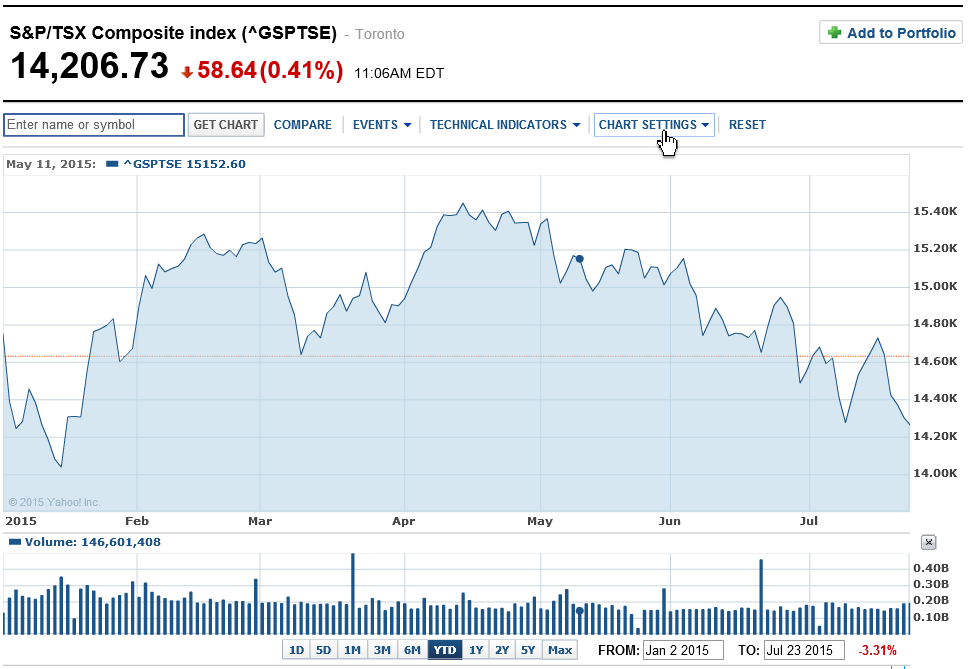
TSX performance YTD, July 24, 2015. Yahoo Finance

That may be coming to an end however. The TSX has had five negative days in a row, following a sudden cut in Canada’s key interest rate. This is the second unexpected cut this year, dropping the lending rate from 1% to 0.5%. Energy prices remain quite low, off 50% from their high last year, and severely stunting Alberta’s economic engine. The Bank of Canada (BoC) was reportedly taken by surprise by the negative GDP numbers for April, marking four consecutive months of GDP contraction and edging us closer to an “official” recession of two consecutive negative quarters. Just this week the BoC predicted a $1 Billion deficit, challenging the Federal Government’s expectation that they would have a $1.4 Billion surplus.

Joe Oliver flees reports after refusing to take questions
The price of West Texas Crude, over the past 18 months. From NASDAQ

The optimism that surrounds Canada’s economic future is an unspoken assumption that a reviving US economy floats all boats, just maybe not this time. As the United States economy continues to improve, the Federal Reserve continues to remain optimistic about raising the lending rate, a sign of burgeoning economic strength. Canada is going the other direction, and for now it seems, the two economies are diverging.

Things could still turn around; the Canadian economy has shown surprising resilience so far, and our falling dollar could very well help super charge the Ontario manufacturing engine, or the price of oil could begin a steep rise (it has in the past) and restart the Alberta economy. But the challenges faced are fairly enormous. 

But if I’m concerned about one thing, it seems to be the general Canadian obliviousness to the problems we are facing. The National Post called this the “Best Recession Ever”, because of how little has changed despite the worsening GDP. The BoC’s June Financial Service Review highlighted that the biggest threats to the Canadian market would be “some event” that would make it difficult for Canadians to service their ballooning debt, but that such an event was “very unlikely”. That was despite the collapsing oil price and the sudden need for two interest rate cuts.

 Optimism can easily become denial as “experts” twist themselves into knots attempting to explain how risks are really benefits, danger is really safety and hurricanes are only storms in teacups. And while business news thrives off of both controversy and hyperbole, there is also a vested interest in making things seem like they are under control. The news should be exciting, but never give the impression that the experts don’t know what is going on. Thus, everything is explainable and only in hindsight do we acknowledge just how out of control it seemed to be. Whether this is the case for Canada right now is hard to say. But the risks associated with Canada have been large for some time, and they have been ignored, dismissed or marginalized regularly by experts within the media. Being a smart investor means facing those risks honestly and acting accordingly.

Danger Creeps: Housing Bubbles and Crying Wolf

I can not find a better metaphor for Canada's housing market than this image from the movie UP! (Which is a film I highly recommend)
I can not find a better metaphor for Canada’s housing market than this image from the movie UP! (Which is a film I highly recommend)

If you’re looking for some good reading Google “Canadian Housing Bubble” and you could fill a library with the amount of material available. There isn’t a week that goes by without some new article somewhere screaming with alarm about Canada’s precarious and overvalued housing market. I’ve written many myself, but in conversation almost everyone admits that regardless of the danger nothing seems to abate the growth in home values.

From the Globe and Mail, published May 13, 2015
The history of the average five year mortgage in Canada going back to the mid 1960s. It’s hard to believe that Canadians once paid interest rates in excess of 20% to buy a home. Today rates are at an all time low and unlikely to rise anytime soon. From the Globe and Mail, published May 13, 2015

This defying of financial gravity gives ammunition to those that doubt there is any real risk at all. The combination of low interest rates, willing banks, rising prices and an aggressive housing market has given a veneer of stability to an otherwise risky situation. Combined with the “sky is falling” talk about the house prices and it is easy to understand why many simply accept, or outright dismiss, the growing chorus of concerns about house prices.

26621859Nissam Taleb’s book “The Black Swan” highlighted that negative Black Swan events tended to be fast, like 2008, while positive Black Swan events tended to be slow moving, like the progressive improvement in standards of living since the end of the Second World War. But it would be fair to say that creating a negative event requires a prolonged period of danger creep, a period where a known danger continues to grow but remains benign, fooling many to believe that there isn’t any real danger at all.

I would argue we are living in such a period now. The housing market is continuing to grow more precarious and many Canadians are finding that their own financial well being is connected to their home’s appreciating value. Between large mortgages and HELOCs, Canadians are deeply indebted and need their home prices to continue to inflate to offset the absurd level of borrowing that is going on.

As an example of how the “danger creeps” have a look at this article from last week’s Globe and Mail which highlights a young couple living in Mississauga with a burdensome debt and an unexpected pregnancy. They are classified as some of the “most indebted” of Canadians; house rich and cash poor. By their own estimates they are over budget every month and 100% of one of their incomes goes exclusively to pay the mortgage, stressful as that is they aren’t worried. It may seem irresponsible on their part to buy such a home, but they couldn’t do it if there weren’t many others complicit in making such a bad financial arrangement. Between lax rules from the government, a willing lending officer and well intentioned families that help out, it turns out that creating a financially fragile family takes a village.

A nation of debtors is a vulnerable one indeed. I’ve often said that financial strength comes through being able to withstand financial shocks, and this is exactly where Canadians are falling short. It’s the high debt load and minimal savings (and that these two issues are self-reinforcing) that make Canadians vulnerable. A change in the economic fortunes would force many Canadians to deleverage and in the process would inflict further damage to the economy and likely many homes onto the market.

Such an event is strictly in the “uncharted seas” sector of the economy. No one has a clear idea what it would take to shift the housing sector loose, or what would happen once it did. And that’s just the unknown stuff. With interest rates at an all time low it would also only take a small increase in the interest rate (say 2%) to bump up many people out of their once affordable mortgage and into unaffordable territory.

That’s the problem with slow growing danger, it has a glacial pace but when it arrives it is already too large to be dealt with easily. In one of my favorite movies, the Usual Suspects, Kevin Spacey utters the line “The greatest trick the devil ever pulled was convincing the world he didn’t exist”. That’s something we should all be wary of, the longer the housing market stays aloft the more convinced we become that not only is it not dangerous, but that there was never any danger at all.

https://youtu.be/DN_sRhaehw4

Canada’s Housing Bubble Will Burst & We’re Not Ready

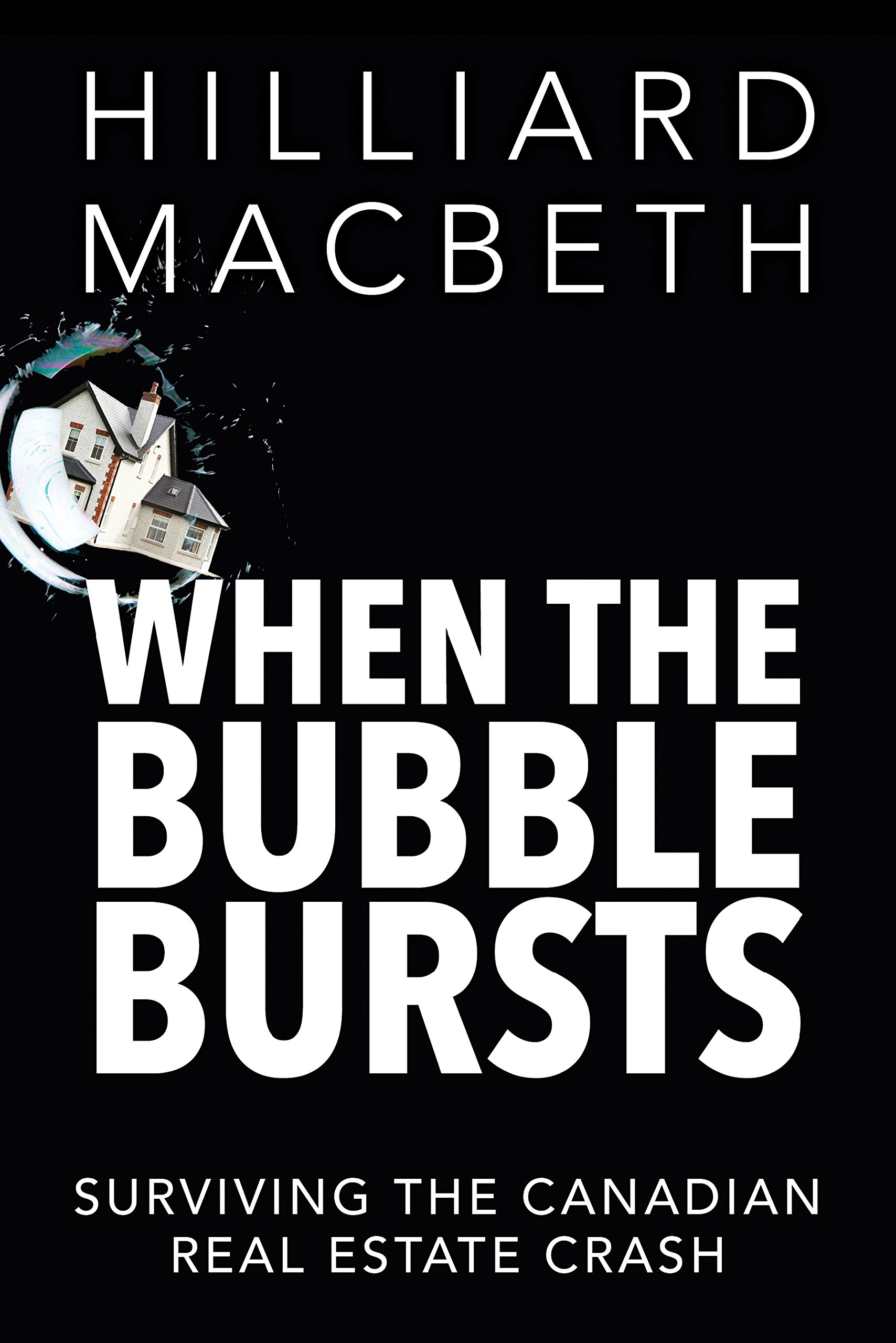
On Saturday a small book was released nation wide that made a big claim, Canadian housing prices are poised to drop between 40% to 50%. Written by a financial advisor in Edmonton, Hilliard MacBeth, When the Bubble Bursts is a grim and insightful polemic about both our obsession with housing and the danger such high valuations pose to our economy. I’ve been negative about Canada for a long time, particularly about Canada’s improbable and endless real estate boom, but what the author has done in his book is attach some actual numbers around how serious our housing problem is.

81lYobbkTmLI picked the book up on Saturday and it is terrifying. His insights are troubling and his points are all backed with reputable sources. Like all serious financial problems it is the interconnectedness of the our financial lives that magnifies the impact of any bubble. Hilliard’s chief accomplishment is to show just how interconnected these issues are. The real estate bubble eats into the middle class need of disposable income, encourages people to view their home as the primary source of savings while banks profit off the increasingly indebted backs of hard working Canadians. Government insurance on mortgages (which protects banks, not you) also ties the public coffers to the inevitable need of bank bailouts, while governments themselves worsen the situation by helping boost the homeowners’ market.

In Hilliard’s view we have sold ourselves on a dream, that our homes can increase in value forever (above the non-existent rate of inflation), that we can use our home equity lines of credit to fuel our lifestyles and that as Canadians we are somehow immune from the normal problems that affect other economies. We aren’t and we aren’t ready for the financial collapse that is coming. I’m sympathetic to this view.

HMcB
Click on the picture to see the article and interview

But since I live in Toronto, and our author lives in Edmonton I think it is important to note some financial nuances that should be considered. For instance, not every market is built equally. Bubbles are as much a product of oversupply as they are speculation (which fuels the supply). But in the last 30 years we have become an increasingly urban society. When it comes to value in homes it is frequently the land that we find valuable, not the building (the building is a depreciating asset, like your car). Desirable land is in short supply, and that explains why our urban world is more often than not a suburban world. Look at this expected growth in population around the GTA from now until 2031.

First printed in the Toronto Star, Friday Feb 27, 2015 http://www.thestar.com/news/insight/2015/02/27/ontario-farmland-under-threat-as-demand-for-housing-grows.html

Notice that there isn’t expected to be substantial growth within the core city of Toronto. But as we look to the suburbs, where land is cheaper and desirability for homes will be lower but more affordable we find our source for significant speculation. In short the insurance against significant losses on your home has everything to do with desirability of the land.

This held true particularly in the United States in their own housing bubble. Cities like Phoenix and their accompanying suburbs proved to be the most susceptible to the market downturn. New York on the other hand was far less severely impacted, and I would imagine even less so if we had numbers for Manhattan.

CaseShillerCitiesJuly2013
The above chart shows three numbers regarding several American cities using the year 2000 as a baseline; from the peak of the housing market, the lowest point in that market, and where they stood five years later (2013). In Phoenix, house prices had jumped 127% from where they had been in 2000. They then dropped back to their 2000 values in the correction, and had recovered by 37% by 2013. In New York however, prices had risen 116% from their values in 2000, but only lost 40% of those gains in 2008 and were valued at 67% above their 2000 price five years after the correction. Dallas and Denver were both above their bubble highs by 2013, while Los Vegas was still off 110% of their previous market high.

This should seem obvious. The old line on real estate is “location, location, location”, and it is location that locks in value. There is no hidden land to be developed in Leaside, no undiscovered country in Rosedale or Lawrence Park. On the other hand Vaughan, Pickering, Ajax and Mississauga are all areas to be concerned about, both because they attract younger buyers with lower savings and it is where we see the most growth in new homes. It’s logical to assume that the worst impacts of a correction will be felt there.

https://twitter.com/Walker_Report/status/580048068688678912

But the truth is, when the Canadian housing market corrects it will cause us all a problem. It will magnify the effects of a recession, put pressure on the federal budget and worsen our prospects internationally for investment. That some neighborhoods will be less affected than others is of small consequence. It will affect those with no savings far worse, disproportionately affect the younger (and more financially vulnerable) while hitting those baby boomers depending on their home sale for retirement very hard.

https://twitter.com/Walker_Report/status/580036170056269824

Since no one knows when this will happen the best thing for prospective home owners to do is have a conversation about the choices they are making now, to save more, reduce debt and rethink whether big home purchases or significant renovations are the best use of our money. Corrections are inevitable. Bubbles burst. Whether we are prepared or not can determine your financial future.

Nervous? Don’t be! Set up a meeting to talk about your financial future instead:

Go back

Your message has been sent

Warning
Warning
Warning

Warning.

Further Readings About the Housing Market:

Canada’s Problems Are More Severe Than You Realize (December 16, 2014)

Forget Scotland, Canada is Playing It’s Own Dangerous Economic Game (September 18, 2014)

Ninjutsu Economics – Watch The Empty Hand (June 20, 2014)

By The Numbers, What Canadian Investors Should Know About Canada (May 1, 2014)

Canada’s Economy Still Ticking Along, But Don’t Be Fooled (April 24, 2014)

Toronto Has A Real Estate Problem (April 11, 2014)

Canadians Losing Battle to Save For Retirement (February 19, 2014)

It’s Official, Young Canadians Need Financial Help (December 4, 2013)

Economists Worry About Canadian Housing Bubble, Canada Politely Disagrees (November 12, 2013)