
Why It Matters If The Fed Raises Rates

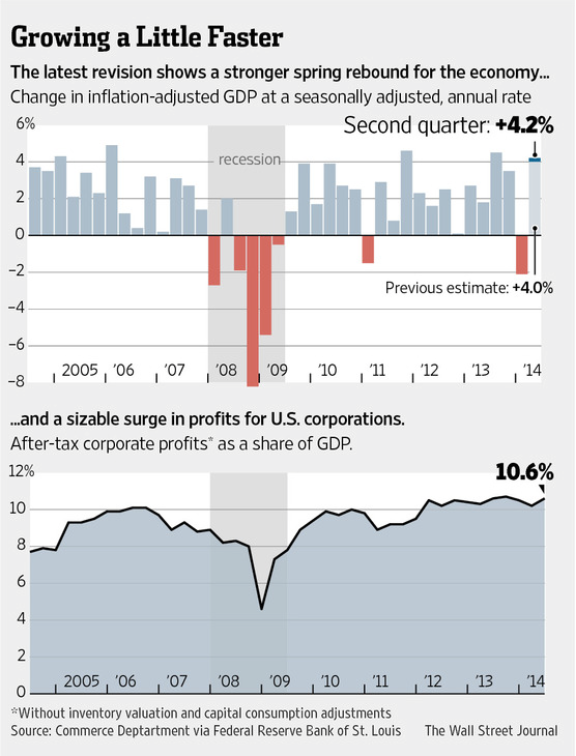
628x471This summer might prove to be quite rocky for the American and global economies. The smart money is on the Federal Reserve raising its borrowing rate from a paltry 0.25% to something…marginally less paltry. But in a world where borrowing rates are already incredibly low even a modest increase has some investors shaking in their boots.

Why is this? And why do interest rates matter so much? And why should a small increase in the government borrowing rate matter so greatly? The answer has everything to do with that financial black hole 2008.

I asked NASA to use the Hubble telescope to take a photo of the 2008 financial crash. This is what it looks like from space.

No matter how much time passes we still seem to orbit that particular mess. In this instance it is America’s relative success in returning economic strength that is the source of the woes. Following the crash their was a great deal of “slack” in the economy. Essentially factories that didn’t run, houses that sat empty and office space that was unused. The problem in a recession is convincing 1. Banks to lend to people to start or expand businesses, and 2. to convince people to borrow. During the great depression the double hit of banks raising lending rates and people being unable to borrow created a protracted problem, and it was the mission of the Federal Reserve in 2008 to not let that happen again.
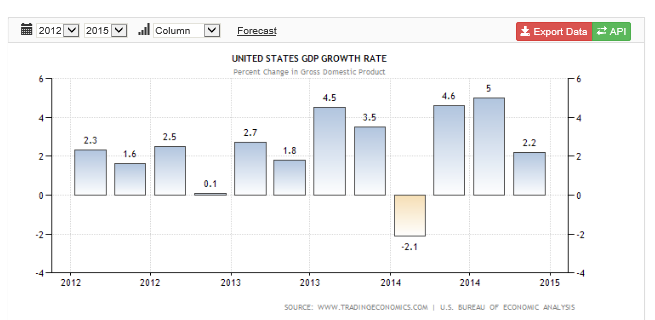
US GDP Growth 2012-2015 source: tradingeconomics.com

To do that the American government stepped in, first with bailouts to pick up the bad debt (cleaning the slate so to speak) and then with a two pronged attack, by lowering the overnight lending rate (the rate that banks can borrow at) and then promising to buy bonds indefinitely, (called Quantitative Easing). The effect is to print mountains of money, but in ways that should hopefully stimulate banks and corporations to lend and spend on new projects. But such a program can’t go on for ever. Backing this enormous expansions of the treasury requires borrowing from other people (primarily China) and the very reasonable fear is that if this goes on too long either a new financial bubble will be created, or the dollar will become worthless (or both!).

Today the Fed is trying to determine whether that time has come. And yet that answer seems far from clear. Investors are wary that the economy can survive without the crutch of cheap credit. Analysts and economists are nervous that raising rates will push the US dollar higher, making it less competitive globally. Meanwhile other countries are dropping interest rates. Germany issued a negative bond. Canada’s own key lending rates was cut earlier this year. People are rightly worried that a move to tighten lending is going in the exact opposite direction of global trends of deflation. If anything, some argue the US needs more credit.

The question of raising rates reveals just how little we really know about the financial seas that we are sailing. I often like to point to Japan, whose own economic problems are both vast and mysterious. Lots of research has gone into trying to both account for Japan’s economic malaise; it’s high debt, non-existent inflation, and how to resolve it. Currently the Japanese government is making a serious and prolonged attempt to change the country’s twenty year funk, but it is meeting both high resistance and has no guarantee of success.

Similarly we have some guesses about what might happen if the Fed raises its rates in the summer or fall. Most of the predictions are temporary instability, but generally the trend is good, raising rates usually correlates to a stronger and more profitable market.

But that’s the key word. Usually. Usually European countries aren’t issuing negative interest rates on their debt. Usually we aren’t in quite a pronounced deflationary cycle. Usually we aren’t buying billions of dollars of bonds every month. Usually.

The answer isn’t to ignore the bad predictions, or obsess over them. The best idea is to review your portfolio and make sure it’s anti-fragile. That means incorporating traditional investment techniques and keeping a steadfast watch over the markets through what are often considered the quiet months of the year.

Only Time Gives Clarity to Investors

The reality of the 21st century is that finding clarity in world events for investors is almost impossible. Take the recent price drop in oil, which has been hailed as both a good and bad thing. And as the new lower price of energy slowly becomes the norm, everyday news reports come in about its respective benefits and unintended negative consequences.

https://twitter.com/Walker_Report/status/540161044786589698

Those seeking to know what those events mean and what guidance headlines should give will only be frustrated by the almost endless supply of information that seeks to empower decisions but leaves many scratching their heads in wonder about the future.

Screen Shot 2014-12-03 at 8.36.05 PM

A big reason for this is the sheer volume of information that we can now rely on. Since the advent of computers and the more recent rise of high-speed communication and networking we have found that the core truth of an event still isn’t apparent until after something has happened. In other words it’s almost impossible to predict corrections before they happen despite an almost inconceivable amount of data and endless ability to process it.

This is true no matter where we look in the world of investing. Consider Black Friday, the end all and be all day in shopping in the United States. This year Black Friday seemed to fizzle. Sales were down 11% year-over-year and that got people nervous. Yet Cyber Monday, the electronic version of Black Friday, sales were up 17% and topped $2 billion for the first time. Combined with the longer sales period leading up to the weekend, many suspect that total sales were actually higher.

All of this data conflicts with each other, which for investors means sometimes you will be wrong. Small things sometimes prove to be big things, and what initially appears simple turns out to be surprisingly complex, and much of it you simply won’t predict. This points investors back to some dull but surprising truths about investing.

1. Not much has changed when it comes to determining what makes a company worthwhile to invest in. Corporate health, sound governance and healthy cash flow still tell us more than loud hype about potential new markets, new products and new trends.

2. Time is a better arbiter than you about investing. The old line is time in the market, not timing the market, and that still appears true. Many Canadians are likely wringing their hands about the sudden drop of oil and the impact it is having on their portfolios. But the best course of action maybe not to abandon their investments, but make sure they are still sensibly invested and well diversified. The market still tends to correct in the long run and immediate volatility (both up and down) are smoothed out over time.

Screen Shot 2014-12-04 at 2.48.01 AM
The S&P 500 over the last 50 years. From Yahoo Finance

Not every sensible investment will work out, but a portfolio of sensible investments over time will. For investors now wondering about the future and their investments in Canada, the best thing to do is understand the logic behind their investments before choosing a course of action.


How To Invest In Energy When You Hate Volatility

***This post will refer to both a mutual fund company and a particular fund. This post should not be construed as endorsing that fund. We always make sure that we cite our sources and in this instance our source is a fund company, and we are not suggesting in any way that you should invest in or purchase this fund. If you are interested in any fund, please consult with your financial advisor first for suitability, especially if that financial advisor is us!*** 

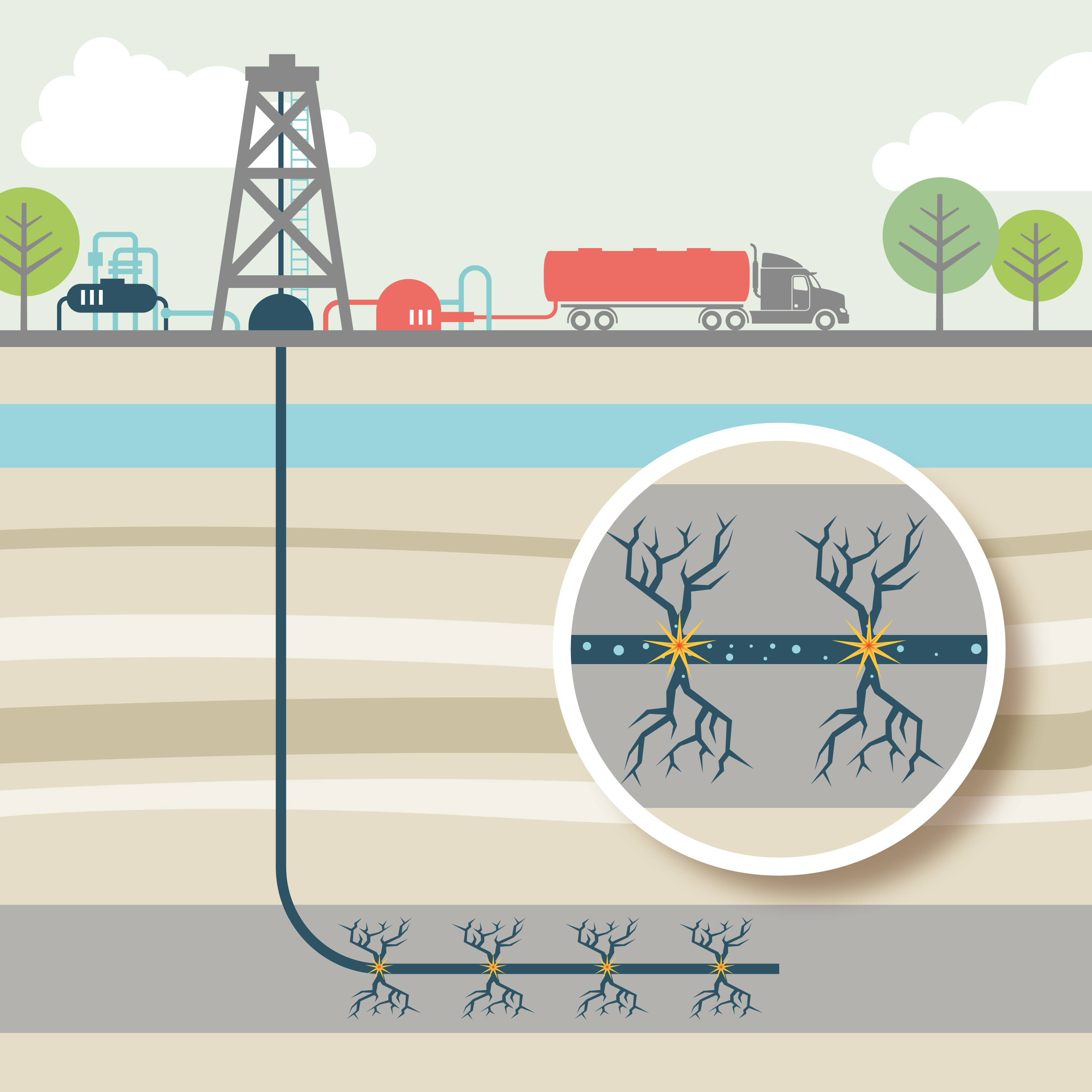
frackingSince the price of oil dropped there have been lots of reasons to be excited. First the price of gas at the pumps is so low that I don’t hate going there anymore. Second, investments in energy have suffered since oil lost close to $30 in value.

WTI price over the last 6 months. From NASDAQ.com

And while energy stocks have recovered somewhat from their low points, they are still way off where they were earlier in the year. I’m not going to get into the finer points about the nuances of energy producers and the various types of oil and  costs of production. It’s a worthwhile article, but will take up too much time here. Instead I wanted to focus on a different way that Canadians can participate in the energy sector.

Commodities can be volatile but also a valuable element of a portfolio. So how can Canadians play the energy sector while being mindful of the risks associated with it?

The answer may be by investing in what is called “Midstream MLPs”. Midstream MLPs (Master Limited Partnerships) are American operators that transport energy from the producers to the consumers. It’s a capital intensive business that is federally regulated but traded on the stock market. It therefore provides consistent cash flow while offering liquidity to investors. But Canadians already have opportunities for energy infrastructure, so why should they care about this in the United States?Midstream2The answer has everything to do with the rising levels of oil production in the United States combined with what federal regulators are willing to do to encourage new growth.
That brings us to the growth of the shale revolution in the United States. Newly discovered reserves (of significant size), improved technology and a dropping costs of production have set the US on a course to be the largest global energy provider in the coming years. This combination of efficiencies means that the United States is going to continue to increase its oil production over the next decade, while dropping the cost of extraction for each additional barrel. But each barrel produced has to go somewhere.

Projected Oil Growth in the United States

In the United States, Midstream MLPs are responsible for moving that oil. But it’s a sector that also must grow. Infrastructure to move oil efficiently from shale producers doesn’t exist yet, and regulators are eager to get MPLs in place with new development. New infrastructure is costly, and while the business model for an MLP doesn’t require a high price for energy to be profitable, it does need assurances about the consistency of the volume of oil to be moved. To encourage that growth regulators are allowing the price that MLPs charge to rise at a rate faster than inflation. Why are they doing that? Much of the shale oil is having to be shipped via rail to get to its right home. This causes price disparities that reduces producer margins and rankles federal governments.

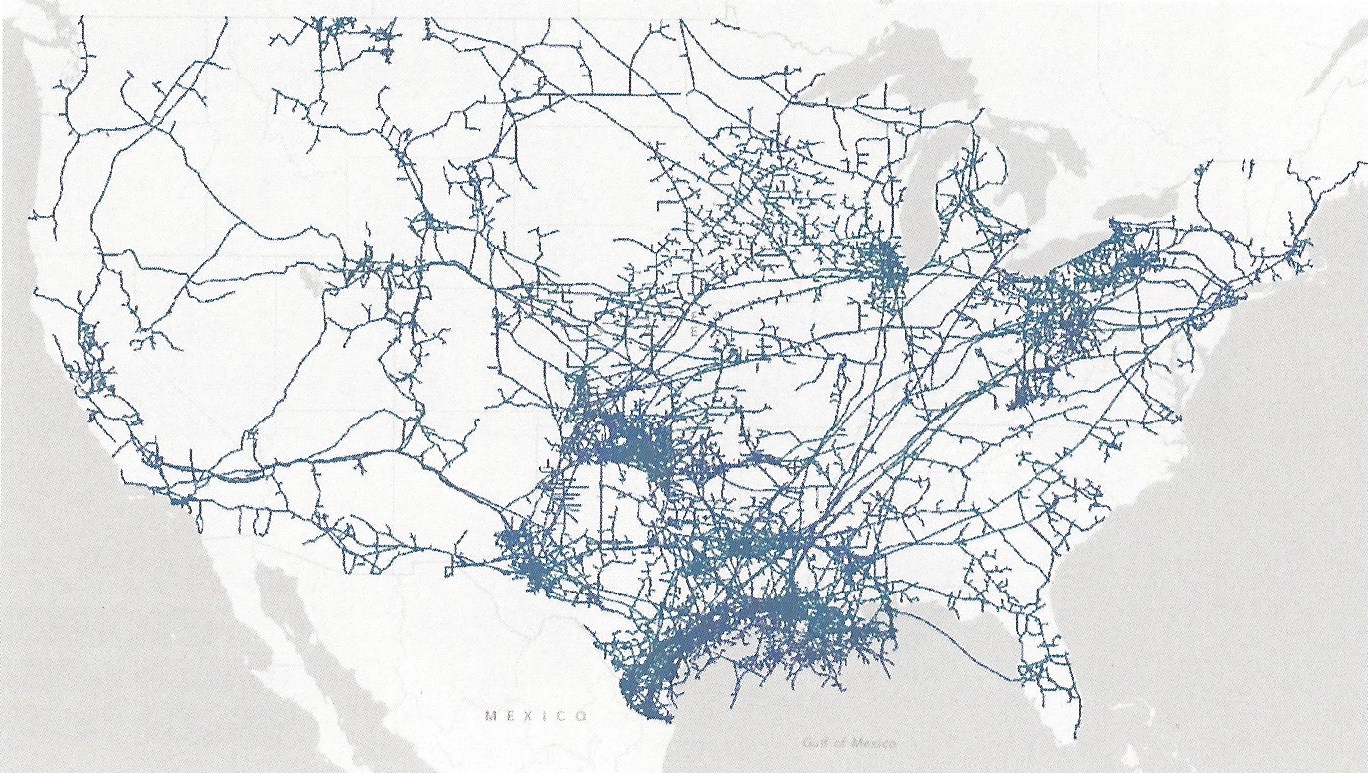
 Pipelines in the US. Most of the pipelines direct energy to Texas, which isn't set up to handle the ultra light crude from shale projects. that energy, coming out of North Dakota, needs to get to New Jersey. The lack of pipelines means it is being shipped by rail to Chicago and then via pipeline.

Pipelines in the US. Most of the pipelines direct energy to Texas, which isn’t set up to handle the ultra light crude from shale projects. that energy, coming out of North Dakota, needs to get to New Jersey. The lack of pipelines means it is being shipped by rail to Chicago and then via pipeline.
The various prices of oil. Oil from Canada is sold at a discount while Brent crude is sold at a premium to WTI. Improving infrastructure would rectify this problem and equalize prices. (The WTI price is listed from the summer). Click on the image to see it larger.


Currently there is only one fund option in Canada that we are aware of for investing in MLPs. We had an opportunity earlier this week to meet the managers of this fund and were greatly impressed by what they had to show us. I am already a big believer in the growing Shale Revolution, and am particularly pleased by the arrival of new opportunities for investment. Growth in the Canadian and American energy sectors is good news for not just investors, but also citizens. Russia, Saudi Arabia, Venezuela and a host of other despotic and semi-despotic regimes have been able to get by on the high price of oil. Now they are feeling the pinch of a decreasing price that has the benefit of bringing jobs back to North America while weakening their influence. In all, this is a good story for everyone.

Want to talk oil? Send us a message!

Go back

Your message has been sent

Warning
Warning
Warning

Warning.


What Your RRSP Should Have In Common With The CPP

rrsp-eggTo many Canadians the CPP is something that you simply receive when you turn 65, (or 70, or 60, depending on when you want or need it) with little consideration for how the program works or is run. That’s too bad because the CPP is successful, enlightening and puts its American counterpart, Social Security, to shame.

You’ve probably heard American politicians decrying the state of Social Security, claiming that it is broken and will one day run out of money. That’s a frightening prospect for those who will depend on it in the future. Social Security is a trust that buys US debt, and its use of US Treasuries (low risk debt issued by the US government) is crippling that program and even puts it at odds with attempts to improve government financial health (it’s more complicated than this, but it’s a useful guide). In comparison the CPP isn’t bound by the same restrictions, and operates as a sovereign wealth fund.

A sovereign wealth fund is simply a fancy way to describe a program that can buy assets, which is exactly what the CPP does. The Canada Pension Plan may be larger and more elaborate than your RRSP, but it can look very similar. The CPP has exposure to Canadian, American, European and Emerging Market equity. It invests in fixed income both domestically and abroad, and while it may also participate in private equity deals (like when the CPP bought Neiman Marcus) in essence the investments in the CPP are aiming to do exactly what your RRSP does.

CPP Breakdown

The big lesson here is really about risk though. The CPP is one of the 10 largest pension plans in the world. It’s wildly successful and is run in such a way as to be sustainable for the next 75 years. The same cannot be said for Social Security. But by taking the “safest” option Social Security is failing in its job and will run out of money by 2033. But by buying real assets and investing sensibly the CPP is far more likely to survive and continue to thrive through all of our lifetimes.

What’s also notable is what the CPP isn’t trying to do. It isn’t concentrated in Canada. It doesn’t need to get a substantial rate of return, and it doesn’t need every sector to outperform. It needs consistent returns to realize its goals, and that’s how it’s positioned. By being diversified and not trying to time the market, the CPP finds success for all Canadian investors.

I’ve said in conversation that if there was an opportunity to invest directly in the CPP I would take it. However until then the best thing investors can do is take the CPPs lessons to heart!

4 Reason Why Planning for Retirement is Getting Harder

How expensive is this Big Mac? More expensive than you might think...
How expensive is this Big Mac? More expensive than you might think…

For the enormous wave of Canadians that are on course to retire over the coming few decades, retiring and planning for retirement is getting harder.

Here are the four big reasons why!

1. Inflation

Inflation is the scary monster under the bed when it comes to one’s retirement. People living off of fixed pensions can be crippled by runaway costs of living, and naturally retirees dread the thought that their savings won’t keep pace with the cost of their groceries. But while historic inflation rates have been around 3.2% over the last hundred years, and have been around 2% (and less) over the past few years, inflation has been much higher in all the things that matter. Since the inflation rate is an aggregate number made up of a basket of goods that include big things like computers, fridges and televisions that have been dropping in price over time, those drops offset the rising price of gas, food and home costs. Since you buy food all the time and fridges almost never, the rate of inflation is skewed lower than your pocket book reflects.

You can show this in a simple way by comparing the price of a McDonald’s Big Mac over time. When the Big Mac was first introduced to Canada the price was .45¢, today that price is $5.25. Inflation has fluctuated a great deal since then, but let’s assume the historic rate of 3.2% was an accurate benchmark. If you apply that rate the price of a  Big Mac today would be $1.91, in reality the inflation rate on a Big Mac has been  much closer to 5.5%.

Canadian Inflation Rate from 2008 - 2014
Canadian Inflation Rate from 2008 – 2014

2. Interest Rates

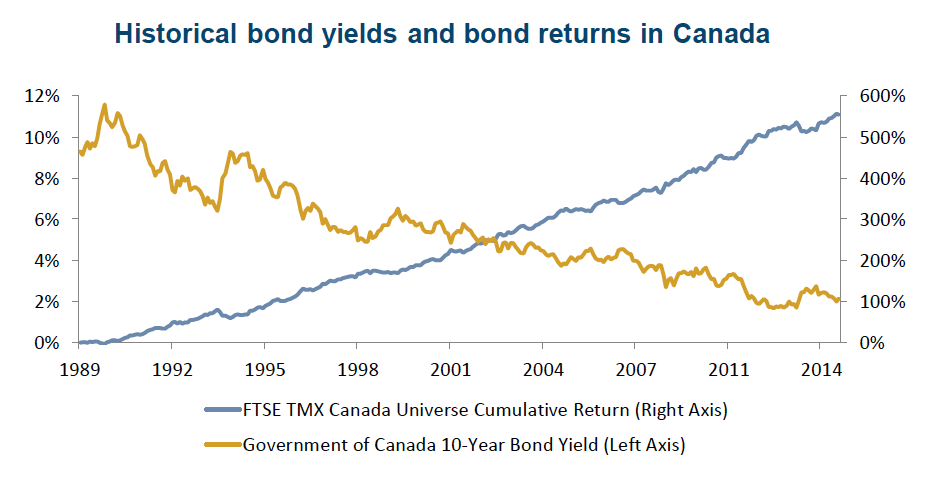
The business of central bankers has gained greater attention since 2008, but for many making the connection between interest rates, the broader economy and their retirement is tenuous at best. The short story is that weak economies means low interest rates to spur borrowing. Borrowing, or fixed income products, have been the typical go-to engine for creating sustainable income in retirement, and low borrowing costs means low fixed income rates. The drying up of low risk investments that pay livable, regular income streams have left many retirees scratching their heads and wondering how they can keep market volatility at bay while still drawing an income. But as rates have stayed low, and will likely do into the future, bonds, GICs and annuities won’t be enough to cover most living costs, forcing retirees into higher risk sectors of the market.

Source: Bloomberg and FTSE TMX Global Debt Capital Markets, monthly data from July 31, 1989 to September 30, 2014, Courtesy of NEI Investments

3. Living Cost Creep

Guess what, the cost of living is going up, not just in real dollars, but because what we consider to be a “normal” number of things in our life keep expanding. Don’t believe me? When your parents retired they probably had a tv and an antenna for it. The cost of their tv was whatever they paid for it, and whatever it might be to replace it if it broke. By comparison most people today have moved into the realm of digital television, PVRs, and digital cable subscriptions. It’s almost unheard of today to not have a smartphone with a data plan and our homes are now filled with a wide assortment of goods and products that would have been inconceivable to a previous generation. The same is true for cars. While cars themselves cost less, prices are kept high by the growing feature creep that have slowly moved into the realm of necessity.

4. You Aren’t Dying Fast Enough

This appointment is wayyyy out in the future...
This appointment is wayyyy out in the future…

Don’t get me wrong, I’m not in a rush or anything; but the reality is that you are going to live a long time, and in good health. Where as retirement was once a brief respite before the angel of death swooped in to grab you maybe a year or two later, living into your 90s is going to be increasingly common, putting a beneficial, but very real strain on retirement plans.

In short, retirement is getting harder and harder to plan. You’re living longer, with higher costs and fewer low risk options to generate a steady income.

What Should You Do?

Currently the market itself has been responding to the low interest rate environment. A host of useful  products have been launched in the past few years that are addressing things like consistent and predictable income for those currently transitioning into retirement. Some of these products are able to reduce risk, while others explore non-traditional investments to generate income. But before you get hung up on what product you should have you should ensure that your retirement plan is meeting your needs and addressing the future. There is no product that can substitute for a comprehensive retirement and savings plan, so call your financial advisor today if you have questions (and yes, that includes us!)

Want to discuss your retirement? Send us an email and we’ll be in touch right away!

Go back

Your message has been sent

Warning
Warning
Warning

Warning.

Why I Just Bought A BlackBerry

passport_desk

In the hunt for returns in the jungle of investing we rarely talk about “quality of life”, but it should be remembered that the whole reason for investing is precisely that; to preserve and improve one’s quality of life, either through retirement savings, covering and planning for education or making purchasing a house feasible. That’s what this is all for.

So it’s easy then to get lost in the mechanics of investing. At the charts (see #MarketGlance) the news and the conferences:

https://twitter.com/Walker_Report/status/515164444604006400

This tends to create a disconnect between how we experience the world and how we want our investments to work. For instance I am a big believer in Apple products. (AAPL). I like their phones and computers, I’m in their ecosystem, and as an investor I am impressed at their success as a company. But as a user of an iPhone I’ve started to wonder just how much time I waste under the pretence  of having a highly capable phone.

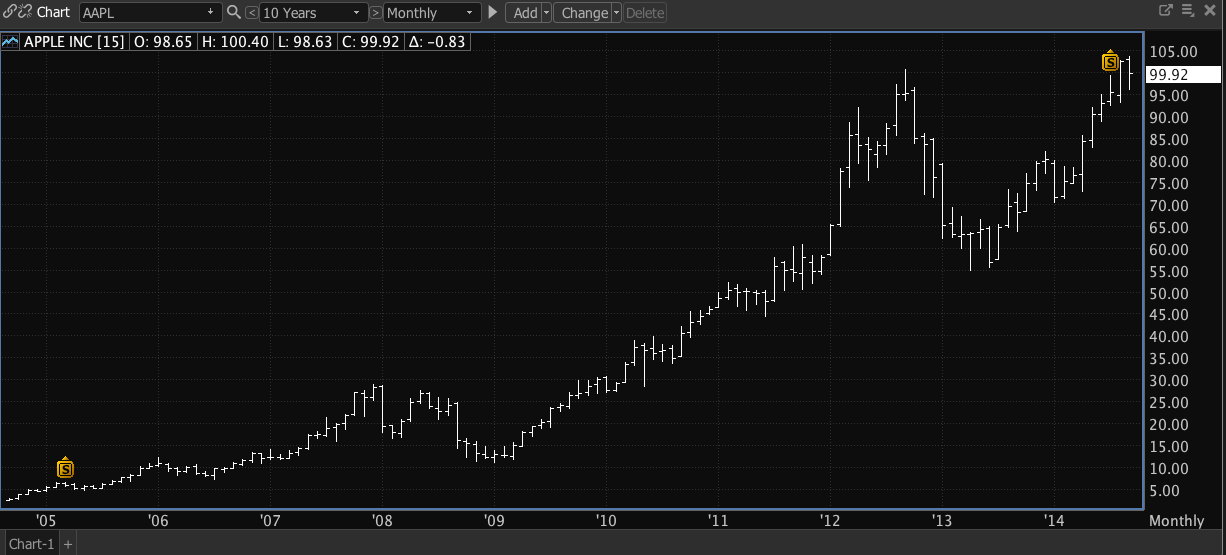
Apple Stock over the last ten years

When the iPhone first came to Canada I was struck by the idea that I could look up directions easily, check the internet quickly for information and have access to my emails. When first introduced the iPhone was a tool of productivity. Since then the smart phone market has been flooded and “feature creep” is definitely a term I would use to describe what many of these phones can now do. Meanwhile productivity has taken a backseat to a host of other competing and primarily entertaining functions. In short, I was tired of wasting time on my phone doing nothing.

And along came Blackberry offering, in some ways, a phone that promises to do less fun stuff, and do more work stuff. And while I had shunned Blackberry for years, based largely on my own terrible experience with the older models and their tiny screens, the new Passport seemed to offer me not simply a useful phone for doing work, but also terrible one to watch Netflix on. Because why am I watching Netflix on my phone in the first place?

Are angry birds really the best use of your time on a $1000 phone?

We live in an age of giant flat TVs with instant movie watching capabilities, but for reasons beyond me I’ve taken to watching stuff on my phone. So while I love Apple, and believe that they have a great company, I’m hoping that I can improve my quality of life by degrading my phone experience somewhat.

Maybe there is hope for Blackberry yet.

Recommended Read: The End of Absence: What We’ve Lost in a World of Connection by Michael Harris

51BrEAxPAHL

Don’t Be Surprised That No One Knows Why The Market Is Down

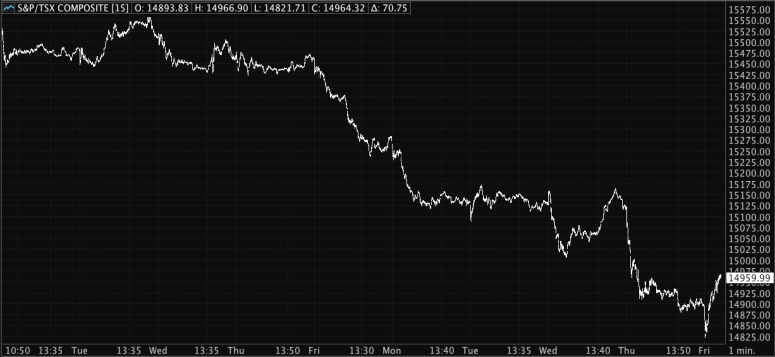
Money CanLast Friday I watched the TSX start to take a precipitous fall. The one stock market that seemed immune to any bad news and had easily outperformed almost every other index this year had suddenly shed 200 points in a day.

Big sell-offs are common in investing. They happen periodically and can be triggered by anything, or nothing. A large company can release some disappointing news and it makes investors nervous about similar companies that they hold, and suddenly we have a cascade effect as “tourist” investors begin fleeing their investments in droves.

This past week has seen a broad sell-off across all sectors of the market in Canada, with Financials (Read: Banks), Materials (Read: Mining) and Energy (Read: Oil) all down several percentage points. In the course of 5 days the TSX lost 5% of its YTD growth. That’s considerable movement, but if you were looking to find out why the TSX had dropped so much so quickly you would be hard pressed to find any useful information. What had changed about the Canadian banks that RBC (RY) was down 2% in September? Or that TD Bank (TD) was down nearly 5% in a month? Oil and gas were similarly effected, many energy stocks and pipeline providers found themselves looking at steep drops over the last month. Enbridge (ENB) saw significant losses in their stock value, as did other energy companies, big and small, like Crew Energy (CR).

Screen Shot 2014-09-26 at 11.08.02 AM
The S&P TSX over the last five days

All this begs the question, what changed? The answer is nothing. Markets can be distorted by momentum investors looking to pile on to the next hot stock or industry, and we can quibble about whether or not we think the TSX is over valued by some measure. But if you were looking for some specific reason that would suggest that there was something fundamentally flawed about these companies you aren’t going to have any luck finding it. Sometimes markets are down because investors are nervous, and that’s all there is to it.

Market panic can be good for investors if you stick to a strong investment discipline, namely keeping your wits about you. Down markets means buying opportunities and only temporary losses. It help separates the real investors from the tourists, and can be a useful reminder about market risk.

Screen Shot 2014-09-26 at 11.19.50 AM

So was last Friday the start of a big correction for Canada? My gut says no. The global recovery, while slow and subject to international turmoil, is real. Markets are going to continue to recover, and we’ve yet to see a big expansion in the economy as companies deploy the enormous cash reserves they have been hoarding since 2009. In addition, the general trend in financial news in the United States is still very positive, and much of that news has yet to be reflected in the market. There have even been tentative signs of easing tensions between Russia and the Ukraine, which bodes well for Europe. In fact, as I write this the TSX is up just over 100 points, and while that may not mean a return to its previous highs for the year I wouldn’t be surprised if we see substantial recoveries from the high quality companies whose growth is dependent on global markets.

Super Cool New Device Won’t Fix the Economy

Apple just unveiled its new watch (called the Apple Watch no less) and briefly I watched the stock price climb quickly as the promise of Apple’s great new thing came to life. But before Apple had its big webcast yesterday, I was actually having a look at this nifty thing called NAVDY.

NAVDY seems like a great idea and its one of many many great things that is regularly and constantly being developed by an increasingly connected world that funds great ideas through websites like kickstarter.com. But like many new great things that I see, most of them won’t dramatically change the economy in any significant way. Specifically, none of these new businesses will create a great number of new jobs.

This may seem like a small point to quibble over, however when we look through the prominent industries that tend to occupy the business sections of newspapers, like Apple Computers, you begin to realize that very few of these businesses do much in the way of employment. Improvements in productivity, automation and robotics continue to eat away at an industrial base that forces young people into retail sectors, and an older generation into early retirement.

More people are employed in Canada year-over-year, however it has involved net losses in high employment sectors combined with net gains in high-education sectors.
More people are employed in Canada year-over-year, however it has involved net losses in high employment sectors combined with net gains in high-education sectors. Many of the jobs that employ lots of Canadians present opportunities for automation. Click on the image to view a larger version.
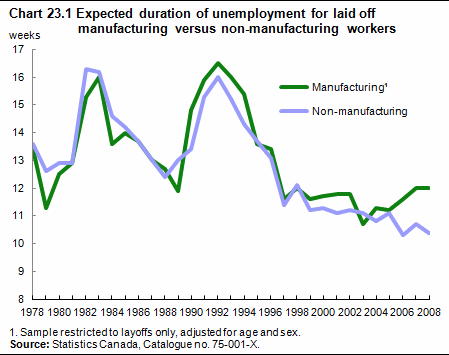
From Stats-Can - the widening gap in unemployment spells. Being employed in manufacturing meant you could be out of work longer in Canada than in non-manufacturing based jobs.
From Stats-Can – the widening gap in unemployment spells. Being employed in manufacturing meant you could be out of work longer in Canada than in non-manufacturing based jobs.

Where there were once middle class factory jobs for thousands of Canadians they are now increasingly rare, and often exist through substantial subsidization from the provincial or federal government.

This story isn’t new. In fact it’s so old now that the first real impact of it dates back to the 1980s. But as time marches on and we are increasingly numb to this reality it may have escaped our attention just how great a challenge this is posing to our society.

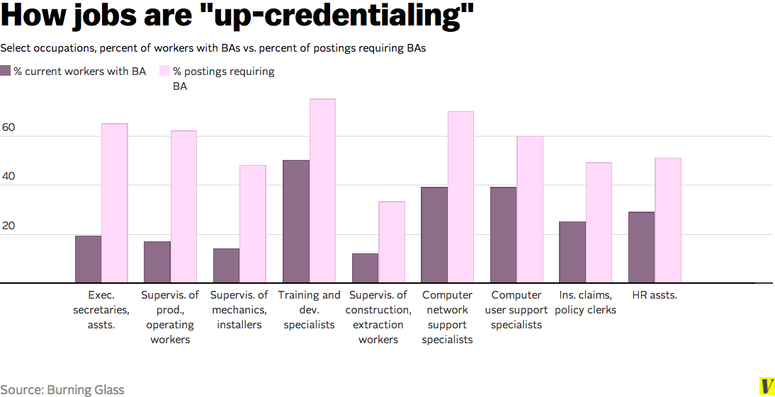
For instance, today, Vox.com posted an article about “Why you need a bachelor’s degree to be a secretary“, focusing on how many jobs are “up-credentialing”.

Screen_Shot_2014-09-09_at_11.31.55_AM.0

Industrial decline also plays an indirect role in rising housing markets in cities. It’s easy to see that falling employment in traditionally well paying blue-collar sectors may contribute to higher crime rates and stagnant wages, but it also tells us where it makes the most sense to live. Young Canadians finishing university are unlikely to move back to Windsor when the best jobs are now in Toronto, fuelling a condo boom while raising housing prices across the city to the point of being unaffordable to new families.

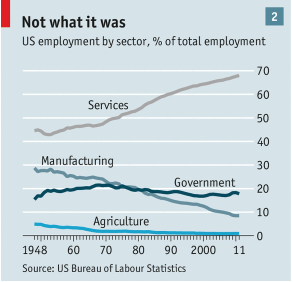
From the Economist, January 18, 2014: Briefing: The Future of Jobs - Retail services continue to grow as other market sectors decline.
From the Economist, January 18, 2014: Briefing: The Future of Jobs – Retail services continue to grow as other market sectors decline.

All of this speaks to a larger and more looming issue for Canadians, which is that continued improvements in automation place long term pressure on things like infrastructure and wealth distribution and raise other questions about middle class viability. In other words, we seem eager to introduce new technologies into our lives, but each of these technologies doesn’t just reduce jobs, they reduce jobs that employ lots of people. The January 18th, 2014 Economist ran a frightening story about this kind of automation and that up to 47% of existing jobs could come under pressure by new forms of cost effective robotics and computers.

It’s often hard to see changes that are incrementally slow, but changes are occurring, and over the coming years and decades these changes will likely shake out in ways that we aren’t expecting. But for Canadians looking to save and retire in the future, many of these trends are coming together in worrying ways. In the form of higher educational costs, more limited job opportunities, higher costs of living and potential unemployability, and sadly the new industries and businesses we are quick to promote won’t likely be enough to stave off a society that is undergoing a significant shift in how it employs people.

All of this is a lot to explain in a single article. But if you’d like a simple video that does a good job of scaring you, please watch this video by Youtuber CPG Grey, whose excellent video from a few weeks ago got widely picked up and shared on the web. Otherwise, if you’d like to talk about getting set-up with a savings plan, either for yourselves and kids please give me a call!

Go back

Your message has been sent

Warning
Warning
Warning

Warning.

Russia Invades Ukraine, Needs Potatoes

This Russian paratrooper crossed the Ukrainian border “by accident”

Last week it looked as though Russia was escalating its engagement in Ukraine, sending supplies directly into Ukrainian territory and potentially starting a full blown war. But things have remained opaque since then, with increasing reports that Russian troops were crossing the border and Russia steadfastly denying it. But after days of reports from the Ukraine that Russia had started a low level invasion to assist with Pro-Russian forces, CNN reports this morning that Russia is now using tanks and armoured personal carriers and is fighting on two fronts within the Ukraine.

Screen Shot 2014-08-28 at 8.19.38 AM

Whether this proves to be a false start, or if Russia is going to become more open in its military involvement it’s hard to say. What is clear is that this war in Ukraine is far from over.

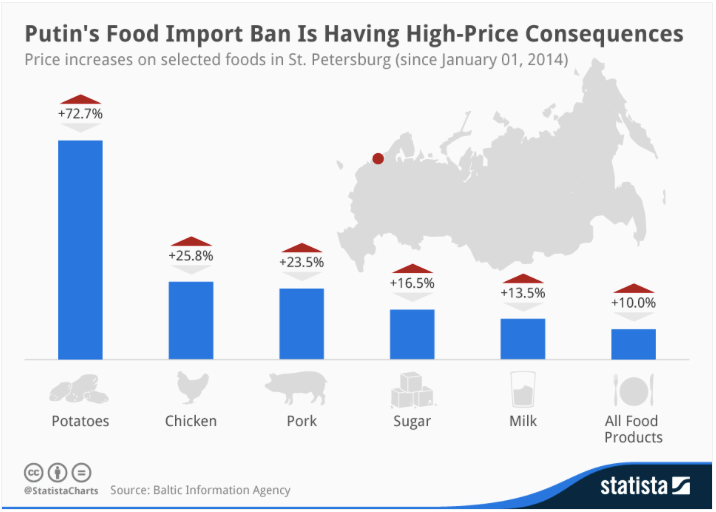
Meanwhile this week also saw some evidence about the rising cost of food in Russia as a result of the retaliatory trade restrictions directed at nations like the United States, Canada and most of Europe. Reported in Slate and Vox.com, this graph of rising food costs is actually quite surprising. Potato prices have risen by 73%!

Screen Shot 2014-08-28 at 8.26.29 AM

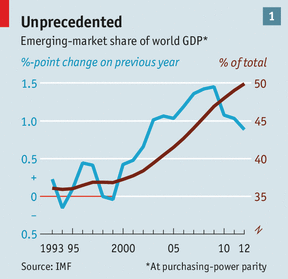
I’m reluctant to say too much about this situation and what it means from an investor standpoint, lest people think I am taking the suffering of people in a war zone too lightly.  I will say that as emerging market countries become richer and begin to flex their national muscles, jostling over everything from important natural resources, long disputed borders, and sometimes even national approval, its likely that international events could increasingly be outside of our control. Since much of our manufacturing is now outside of our borders, and often even energy supplies come from nations openly hostile to us, we find ourselves in an economic trap of our own making. How can you act with a free hand against a nation that holds so many of your own economic interests?

Screen Shot 2014-08-28 at 11.39.19 AM
From “The Economist” July 27th, 2013 “When Giants Slow Down”

I sincerely doubt that our sanctions against Russia or high potato prices will bring Putin to his knees, (although his people may get fed up with higher food costs) but in the past it was much clearer how to deal with this kind of brinkmanship. Today we live a world where many of our economic interests are heavily tangled with nations who do not share our same strategic goals. It is said that nations do not have friends, only interests, and as Emerging Markets look increasingly attractive to foreign investors we may have to remind ourselves that Emerging Markets are not simply opportunities for growth, but nations with their own set of interests and goals separate from our own.

Russia’s Trade War Shows Europe to be The Better Economy

Putin-SmirkSince I first wrote about the Ukraine much has happened. Russia has been unmasked as a bizarre cartoon villain seemingly hellbent on destabilizing the Ukrainian government, assisting “rebels” and being indirectly responsible for the murder of a plane full of people. All of which came to a head last week when it appeared that Russia might have just started a war with the Ukraine (still somewhat indeterminate).

Russia’s moves with the Ukraine may have more to do with challenging the West, and some of the other recent militaristic actions show that may be its real intent. Russia announced in July that it would be reopening both an arctic naval base and a listening post in Cuba built back in the 1960s. Combined with many heavy handed tactics at home including essentially banning homosexuality, Putin is making a brazen attempt to assert its regional dominance and stem the growth of Europe’s influence in the most aggressive way it can. To some extent this seems to be working with his own population, but it isn’t making him popular globally.

Europe’s response to Russia has been to hurt it with economic sanctions, which since the Ukrainian situation first began have been escalating in severity. Two weeks ago Russia responded in kind. How? By banning food imports from sanctioning nations.

If you don’t know much about the Russian or European economies this may seem like potent response from one of the BRIC countries and major global economies. But Europe is a big economy, and agricultural exports don’t make up a significant part of GDP, with the same being true for the United States. And while sanctions targeted at farms can be politically dangerous (farmers are typically a well organized and vocal lobby) the most interesting thing about these sanctions is what it tells us about the Russian and European economies respectively.

First, Russia imports a great deal of food, mostly from Denmark, Germany, the United States and Canada. So sanctions imposed by Russia are really going to hurt the Russians as food prices begin to rise and new food suppliers (expected to be from Latin America) have to ship food farther. But more interesting is the sanctions Russia chose not to impose. Europe is heavily dependant on oil & gas for its energy needs. So why not really make Europe feel the pinch and create an energy crisis? Because Russia needs oil revenue.

16% of Russia’s GDP is made up from the oil and gas sector. Beyond that oil and gas make up more than half of Russia’s tax revenues and 70% of it’s exports. In other words Russia can’t stop selling its oil without creating an economic crisis at home every bit as severe as in Europe. Banning imports of food and raising the cost of living may not be the ideal outcome from sanctions you impose, but it is mild in comparison to creating a full on catastrophe.

By comparison Europe starts to look very good, and it’s a reason that investors shouldn’t be quick to write off Europe and all its recent economic troubles. It’s a large and dynamic economy, filled with multi-national companies that do business the world over. It is backed by stable democracies and a relatively prosperous citizenry. By comparison Russia is a very narrow economy, dependent on one sector for its economic strength run by a (in all but name) dictator with an incredibly poor populace. A few years ago it was quite trendy in the business news to write off Europe as a top heavy financial mess, and while I wouldn’t want to dismiss Europe’s problems (some of which are quite serious) it’s important to have some perspective about how economies can rebound and which ones have the flexibility to recover.