What Investors Should Know After Europe’s Terrible, Horrible, No-Good Month

cartoon spin bull vs bearFalling inflation, terrible economic news and a general sense of dread for the future seems to have once again become the primary descriptive terms for Europe. Earlier this year things seemed to have improved dramatically for the continent. On the back of the German economic engine much of the concern about the EU had been receding. 2013 had been a good year for investors and confidence was returning to the markets. Lending rates were dropping for the “periphery nations” like Portugal, Greece and Ireland, giving them a fighting chance at borrowing at affordable rates. But first came the Ukrainian/Russia problem which caused a great deal of geo-political instability in the markets. Then came October.

I don’t know if Mario Draghi cries himself to sleep some nights, but I wouldn’t blame him. Despite the best efforts of the ECB, Europe looks closer to being in a liquidity trap then ever. Borrowing rates are not just low, they’re negative, with the ECB charging banks to now to deposit money with them. October also ushered in a string of bad news. For Germany, easily the biggest part of the Eurozone’s hopes for an economic recovery, sanctions against Russia have hurt the manufacturing sector. Germany began the month announcing a steep and unexpected decline in manufacturing of 5.7% in August, the biggest since 2009. This news was followed by criticisms of Germany’s government for not doing more infrastructure investment and being too obsessed with their strict budget discipline. Yesterday 25 banks in the Eurozone failed a stress test, a test that was meant to allay fears about the health of the financial sector.

For Europe then things look bad and even if the situation corrects itself over the next few months (sudden shifts in the economy may not always be permanent and can bounce back quickly) the concerns over Europe’s future will likely undermine any efforts by the ECB to properly stimulate the broad economy and encourage investment on a mass scale. By comparison it looks like the United States is having a party.

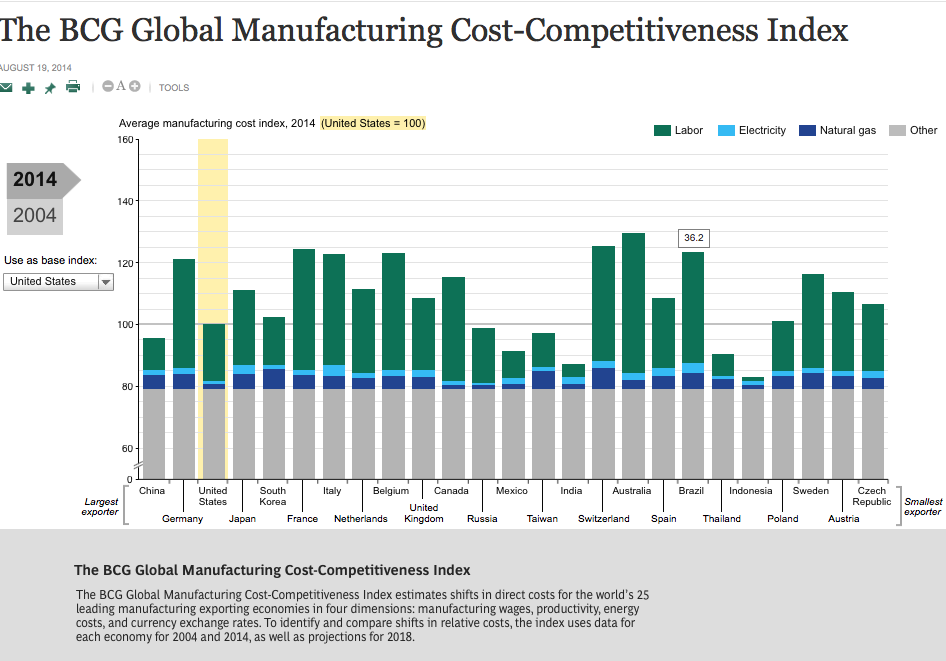
The US economy seems to be on track to grow, and as the world’s biggest economy (though there is some dispute) the country is fighting fit and especially lean. Cheap oil from shale drilling is helping the manufacturing sector, making the United States more competitive than South Korea, the UK, Germany and Canada, and the sudden drop in the price of oil is a boon to the US consumer to the tune of nearly 50 billion dollars. Consumer confidence is up, as is spending. Debt levels are down, both for companies and households. Most importantly the economy seems to be tipping over into an expansionary phase, with corporations finally starting to put some of their money to work.
Screen Shot 2014-10-28 at 12.22.48 PM

The coming months could be interesting for investors as we return to a time where once again focus is on the US as the world’s primary economy.Screen Shot 2014-10-28 at 12.32.45 PM The concerns of 2008, that the American consumer was done, the country had seen its best days and its corporations would never recover seem far fetched now. Worries over hyper-inflation are as distant as a the never arriving (but inevitable) rate hike from the Federal reserve. Worries about Great Depression levels of unemployment are problems of other nations, not the US with its now enviable 5.9%, now encroaching on full employment. Old villains seem vanquished and even Emerging Markets, long thought to be entering their own golden era, are now taking a back seat to the growing opportunities coming out of the US.

Investors should sit up and take note. It’s possible that the best is still yet to come for the US markets, and if market conditions continue to improve this bull market could prove to be a long one.

http://youtu.be/y6AY27MaQGU

Super Cool New Device Won’t Fix the Economy

Apple just unveiled its new watch (called the Apple Watch no less) and briefly I watched the stock price climb quickly as the promise of Apple’s great new thing came to life. But before Apple had its big webcast yesterday, I was actually having a look at this nifty thing called NAVDY.

NAVDY seems like a great idea and its one of many many great things that is regularly and constantly being developed by an increasingly connected world that funds great ideas through websites like kickstarter.com. But like many new great things that I see, most of them won’t dramatically change the economy in any significant way. Specifically, none of these new businesses will create a great number of new jobs.

This may seem like a small point to quibble over, however when we look through the prominent industries that tend to occupy the business sections of newspapers, like Apple Computers, you begin to realize that very few of these businesses do much in the way of employment. Improvements in productivity, automation and robotics continue to eat away at an industrial base that forces young people into retail sectors, and an older generation into early retirement.

More people are employed in Canada year-over-year, however it has involved net losses in high employment sectors combined with net gains in high-education sectors.
More people are employed in Canada year-over-year, however it has involved net losses in high employment sectors combined with net gains in high-education sectors. Many of the jobs that employ lots of Canadians present opportunities for automation. Click on the image to view a larger version.
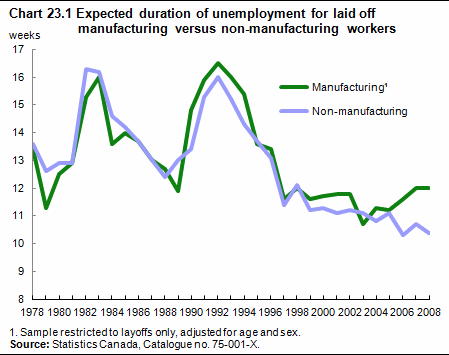
From Stats-Can - the widening gap in unemployment spells. Being employed in manufacturing meant you could be out of work longer in Canada than in non-manufacturing based jobs.
From Stats-Can – the widening gap in unemployment spells. Being employed in manufacturing meant you could be out of work longer in Canada than in non-manufacturing based jobs.

Where there were once middle class factory jobs for thousands of Canadians they are now increasingly rare, and often exist through substantial subsidization from the provincial or federal government.

This story isn’t new. In fact it’s so old now that the first real impact of it dates back to the 1980s. But as time marches on and we are increasingly numb to this reality it may have escaped our attention just how great a challenge this is posing to our society.

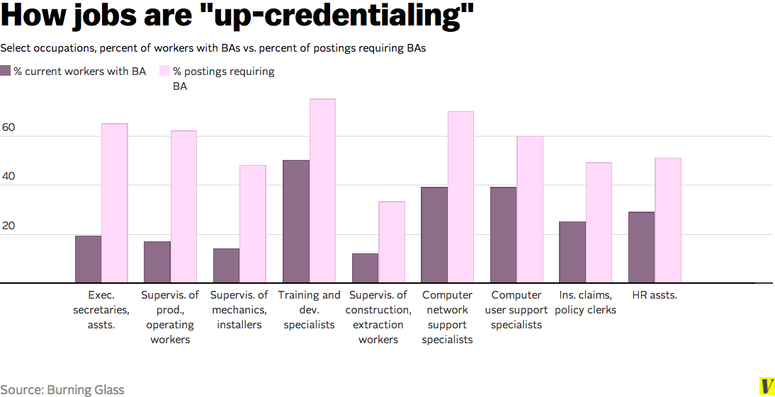
For instance, today, Vox.com posted an article about “Why you need a bachelor’s degree to be a secretary“, focusing on how many jobs are “up-credentialing”.

Screen_Shot_2014-09-09_at_11.31.55_AM.0

Industrial decline also plays an indirect role in rising housing markets in cities. It’s easy to see that falling employment in traditionally well paying blue-collar sectors may contribute to higher crime rates and stagnant wages, but it also tells us where it makes the most sense to live. Young Canadians finishing university are unlikely to move back to Windsor when the best jobs are now in Toronto, fuelling a condo boom while raising housing prices across the city to the point of being unaffordable to new families.

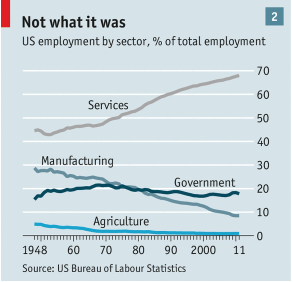
From the Economist, January 18, 2014: Briefing: The Future of Jobs - Retail services continue to grow as other market sectors decline.
From the Economist, January 18, 2014: Briefing: The Future of Jobs – Retail services continue to grow as other market sectors decline.

All of this speaks to a larger and more looming issue for Canadians, which is that continued improvements in automation place long term pressure on things like infrastructure and wealth distribution and raise other questions about middle class viability. In other words, we seem eager to introduce new technologies into our lives, but each of these technologies doesn’t just reduce jobs, they reduce jobs that employ lots of people. The January 18th, 2014 Economist ran a frightening story about this kind of automation and that up to 47% of existing jobs could come under pressure by new forms of cost effective robotics and computers.

It’s often hard to see changes that are incrementally slow, but changes are occurring, and over the coming years and decades these changes will likely shake out in ways that we aren’t expecting. But for Canadians looking to save and retire in the future, many of these trends are coming together in worrying ways. In the form of higher educational costs, more limited job opportunities, higher costs of living and potential unemployability, and sadly the new industries and businesses we are quick to promote won’t likely be enough to stave off a society that is undergoing a significant shift in how it employs people.

All of this is a lot to explain in a single article. But if you’d like a simple video that does a good job of scaring you, please watch this video by Youtuber CPG Grey, whose excellent video from a few weeks ago got widely picked up and shared on the web. Otherwise, if you’d like to talk about getting set-up with a savings plan, either for yourselves and kids please give me a call!

Go back

Your message has been sent

Warning
Warning
Warning

Warning.

My Car Runs on Geopolitics – Why “Fracking” is an Important Investment for Your Portfolio

frackingI’m an environmentalist. But as a Financial Advisor I consider that some of the best opportunities I can provide to my clients is exposure to the burgeoning US and Canadian energy markets. That’s right I’m a big proponent for one of the most ecologically damaging and publicly derided forms of energy extraction.

However, next time you put gas in your tank consider this: 7000 fighters are currently making a mockery of whatever pretense Iraq was making at being a legitimate country. ISIS, the Islamic faction currently pushing into northern Iraq from Syria with aims to establish an Islamic Caliphate in the region has been routing Iraqi government forces. An army a quarter of a million strong, equipped with the latest in weapons, tanks and aircraft are losing regularly to a rag tag group of extremists equipped only with machine guns.

Meanwhile in the Ukraine we have fresh assurances that Russia will abide by a new ceasefire between Ukrainian government forces and rebels loyal to the Russian government. While Russia may have undone its own objectives of building a rival economic group, they have successfully reminded everyone why Russia, no matter how weakened it may be, is a powerful force that controls a great deal of energy needed for global consumption.

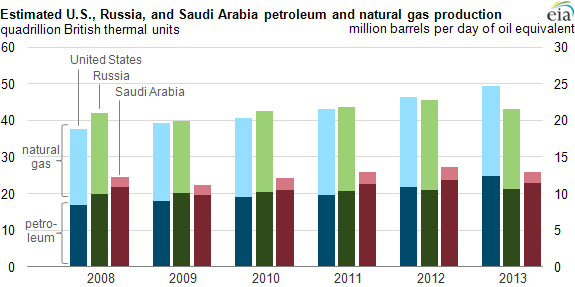
Across many of the nations that produce some form of energy (oil, natural gas, coal, etc.) there are very few that can claim to be a democratic, civil society not embroiled in some kind of sectarian civil war. But as of this year the United States has become the world’s largest producer of energy, outpacing Russia and Saudi Arabia, and that promises to change the way we think about economies and economic opportunities going forward.

production

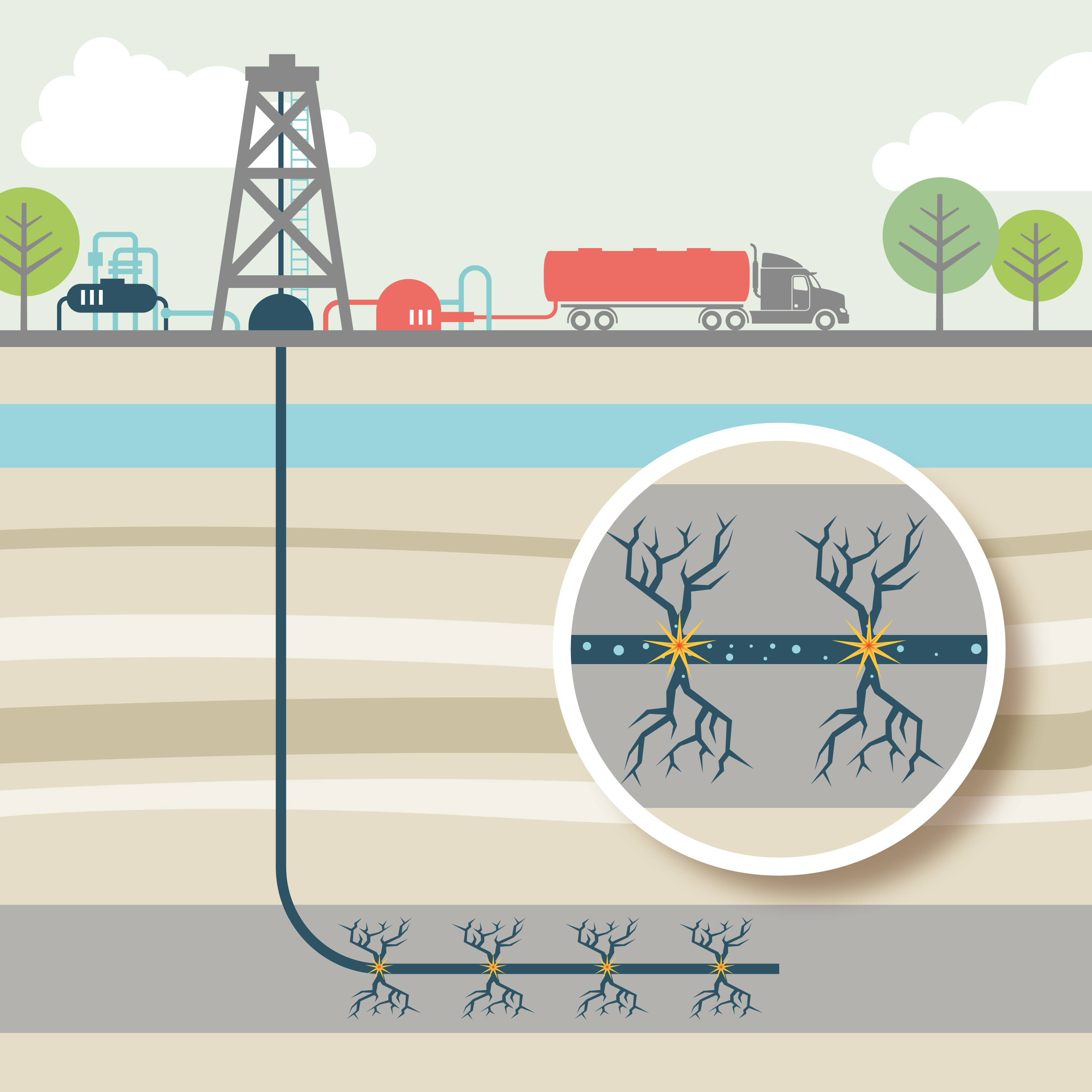
In many developed countries there is a great deal of hand-ringing about the sudden rise of hydraulic fracturing – a relatively recent method of energy extraction that is reducing the cost of production and breathing new life into American manufacturing. “Fracking” comes with a number of environmental downsides, some of which are both scary and quite dramatic.

But energy is the life blood of civilisations and a steady supply of affordable energy is what gives us the ability to grow our economies and invest in new technologies. Sometimes this means making hard choices about how we allocate resources, and what the long term impacts of certain industries to our environment might be. But affordable energy, in the form of both oil and natural gas, provided from countries like Canada and the United States doesn’t just help bring back domestic manufacturing. It also economically weakens dictators and states that ignore human rights and puts power back in the hands of liberal democracies to enforce sanctions.

In other words there are numerous political and economic benefits that come along with cheaper Western energy. While this doesn’t address our environmental problems it’s important to love your monsters. The tools that give us our wealth and prosperity shouldn’t be abandoned just because they pose challenges, rather it invites us to both reap profits and seek new ways to conquer those problems we face. That is at least until either Google or Tesla solve all our driving problems.