Russia Invades Ukraine, Needs Potatoes

This Russian paratrooper crossed the Ukrainian border “by accident”

Last week it looked as though Russia was escalating its engagement in Ukraine, sending supplies directly into Ukrainian territory and potentially starting a full blown war. But things have remained opaque since then, with increasing reports that Russian troops were crossing the border and Russia steadfastly denying it. But after days of reports from the Ukraine that Russia had started a low level invasion to assist with Pro-Russian forces, CNN reports this morning that Russia is now using tanks and armoured personal carriers and is fighting on two fronts within the Ukraine.

Screen Shot 2014-08-28 at 8.19.38 AM

Whether this proves to be a false start, or if Russia is going to become more open in its military involvement it’s hard to say. What is clear is that this war in Ukraine is far from over.

Meanwhile this week also saw some evidence about the rising cost of food in Russia as a result of the retaliatory trade restrictions directed at nations like the United States, Canada and most of Europe. Reported in Slate and Vox.com, this graph of rising food costs is actually quite surprising. Potato prices have risen by 73%!
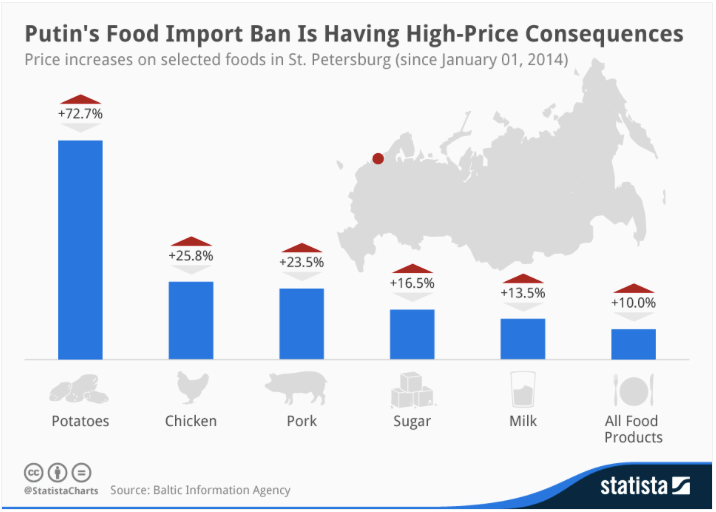
Screen Shot 2014-08-28 at 8.26.29 AM

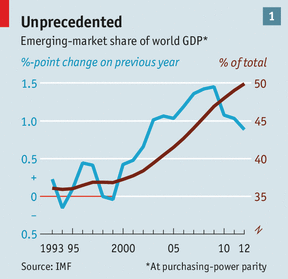
I’m reluctant to say too much about this situation and what it means from an investor standpoint, lest people think I am taking the suffering of people in a war zone too lightly.  I will say that as emerging market countries become richer and begin to flex their national muscles, jostling over everything from important natural resources, long disputed borders, and sometimes even national approval, its likely that international events could increasingly be outside of our control. Since much of our manufacturing is now outside of our borders, and often even energy supplies come from nations openly hostile to us, we find ourselves in an economic trap of our own making. How can you act with a free hand against a nation that holds so many of your own economic interests?
Screen Shot 2014-08-28 at 11.39.19 AM
From “The Economist” July 27th, 2013 “When Giants Slow Down”

I sincerely doubt that our sanctions against Russia or high potato prices will bring Putin to his knees, (although his people may get fed up with higher food costs) but in the past it was much clearer how to deal with this kind of brinkmanship. Today we live a world where many of our economic interests are heavily tangled with nations who do not share our same strategic goals. It is said that nations do not have friends, only interests, and as Emerging Markets look increasingly attractive to foreign investors we may have to remind ourselves that Emerging Markets are not simply opportunities for growth, but nations with their own set of interests and goals separate from our own.

The Real Reason Why Tim Hortons and Burger King are Merging

While I rarely get the chance to watch late night TV anymore, I’m sure there will be a few segments on The Daily Show and Colbert Report about “inversion” – the process by which American companies buy another foreign firm and relocate their head-office there to avoid paying taxes, over the next couple of days.


Screen Shot 2014-08-26 at 4.15.26 PM
Click on this picture to see John Stewart make fun of “tax inversion”

The arrival yesterday of the Burger King/Tim Horton’s deal has a number of lawmakers and journalists screaming about lack of loyalty, tax dodging and  America’s uncompetitive corporate tax rate. But being quick to anger isn’t the smartest way to understand why one company might wish to purchase another and pull up stakes.

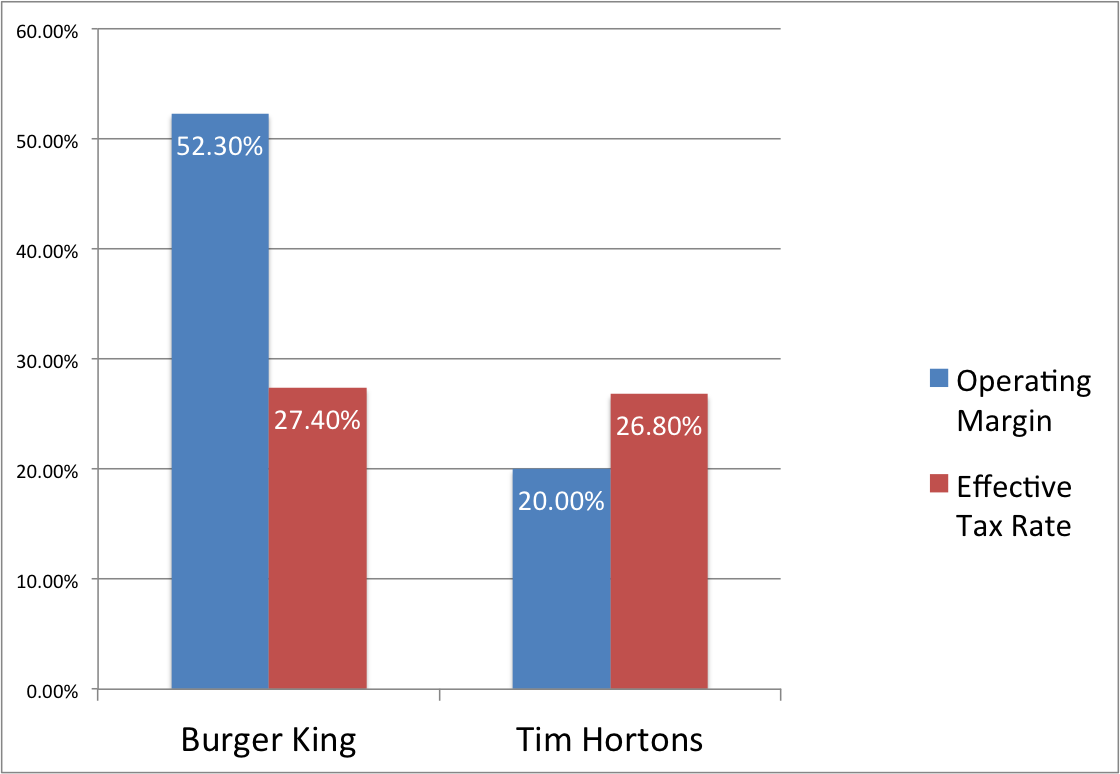
For instance, despite claims that Burger King intends to avoid substantial taxes in the United States in favour of Canada’s more moderate tax rate isn’t actually that true. As reported this morning by the Financial Times, the two companies both pay a very similar effective tax rate, literally only points apart from each other. So relocating a company like Burger King may indeed yield some benefits in taxation, but likely so small as to not make the deal worth while.

So why do it? It may have more to do with the Burger King itself and how it was acquired in 2010. According to the Financial Times, Burger King was purchased in a leveraged buyout, meaning that those doing the buying borrowed a great deal of money to do so. But interest expense is tax deductible. Since 2010, Burger King has been restructured and deleveraged, and since it went public in 2012 has had an 85% return in stock value. In other words, the people who own Burger King have done well. But buying Tim Hortons means that the consortium will once again have to borrow substantially to do the buying, creating further tax right-offs for the newly merged company.

Burger King's share price since it went public in 2012
Burger King’s share price since it went public in 2012

There are other reasons for this merger that actually make sense. Burger King is struggling to gain market share and is under pressure from the growing business of “fast-casual” restaurants like Chipotle. But despite that it has a strong operating margin, 52%, which shows that the restructuring has been effective at making the business profitable. Meanwhile Tim Hortons has an operating margin of only 20%, an opportunity for improvement in the eyes of Burger King. Together they will form the third largest fast food business in the world and open a new front into the coveted and notoriously difficult breakfast market.

Operating Margin and Effective Tax Rate for Burger King and Tim Hortons. Courtesy of the Financial Times

There may be other synergies and reasons for this merger and subsequent inversion, and the tax benefits that come from borrowing could do with some scrutiny, but it would seem from the outset that avoiding taxes is hardly the exclusive driving force behind this deal.

California could be at a tipping point…

I’ve been quite vocal about how one day we will have to accept that things we get for free may not be free forever. Water is of particular concern for everyone not simply because it’s a necessity, but because almost none of us live with water scarcity anymore its often hard to connect the dots when it comes to facing real water shortages.

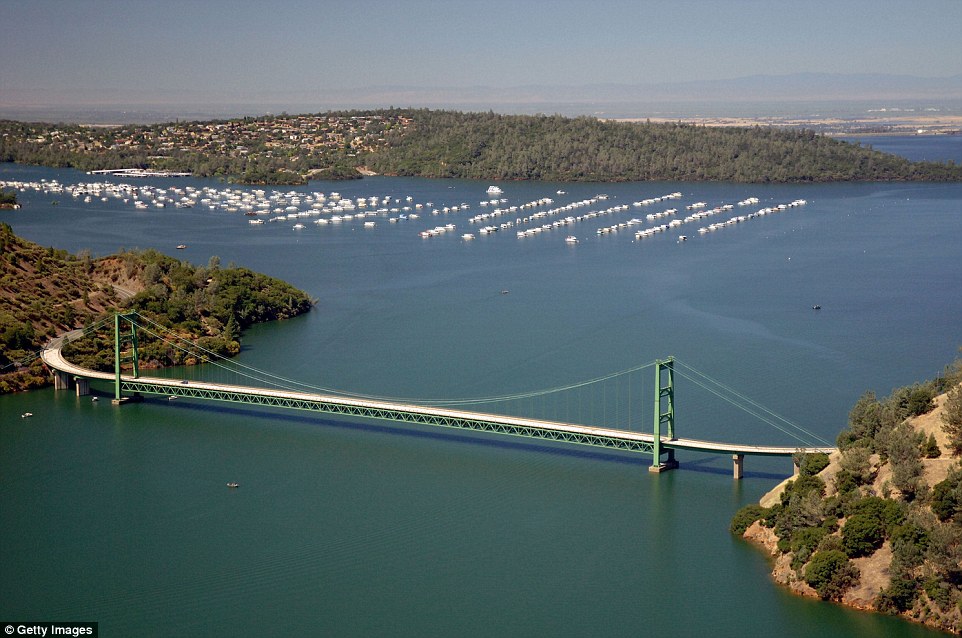
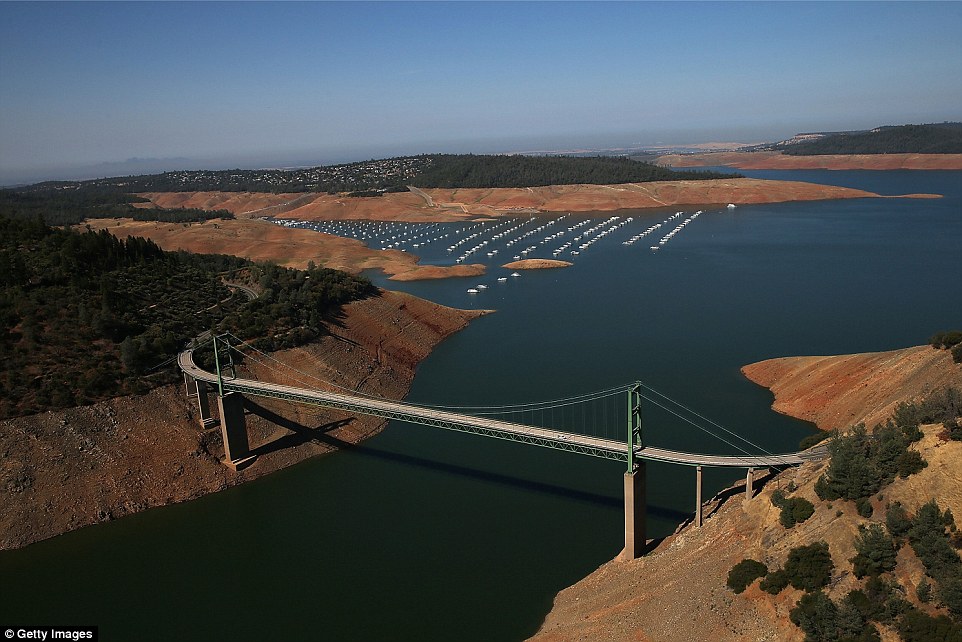
Take for instance California, whose three year drought has reached new and frightening proportions. There are some excellent articles about what impact the drought is having here and here, but take a look at these images of water reserves from 2011 and then the same locations from 2014. Running out of water is a frightening prospect, but 30 million people don’t just pack up and move because water has gotten a little scarce. What happens instead is you begin paying more for water while getting less back in economic benefits.

MO7iuWD

m1pB5Xm

qIVWJ2E

yuaG7l5

8pHrTnw

6RJnDpD

I highly recommend Elizabeth Renzetti’s excellent piece in the Globe and Mail today, and I suggest everyone have a read of it. Its an excellent reminder that the biggest issue we face in managing serious economic and environmental problems is not a lack of skill, knowledge, or imagination, but a simple willingness to face the problem. The outcome of which is usually higher costs for everybody immediately, and possibly disastrous results in the future.

Why it’s so hard to see a financial correction when its staring you in the face

If you’ve been following this blog, you’ll have noticed how I am regularly concerned about the state of the Canadian economy. And while I maintain that I have good reason for this; including fears about high personal debt, an expensive housing market and weakening manufacturing numbers, the sentiment of the market isn’t with me. As of writing this article the TSX is up just over 14% YTD, spurred on by strong numbers in the small cap, energy and banking sectors.

Screen Shot 2014-08-21 at 12.36.09 PM

All this illustrates is the incredible difficulty of understanding and seeing the truth in an economy. Is an economy healthy or unhealthy? How do we know, and which data is most important? Economies produce all kinds of information and it’s frequently hard to see the forest for the trees. But even with all the secrecy around the bank’s and regulators financial misdeeds prior to 2008, the writing was on the wall that the US housing market was over inflated and that savings rates were too low and debt rates too high. And while you could be forgiven for not really understanding the fine points of bundled derivates and just how far “toxic debt” had spread, it wasn’t as though the banks had hidden the size of their balance sheets or the number of outstanding loans. It was all there for anyone to see. And people did see it and then shrugged.

One of the big fallouts of the financial meltdown was extensive criticism directed at the professional class of economist and business reporters who give regular market commentary and missed the total implosion of the financial and housing sectors. After all, how good could these “professionals” be if they can’t see the financial freight train like the one that just came through? . But I would chalk that up to overly positive market sentiment. It’s not that they didn’t see the bad news, they just assumed that other better news was more important.

Look at these two articles from yesterday’s (August 20th, 2014) Globe and Mail:

Canada losing steam in its push for an export boom

&

Bump in shipping a boon to Canada

While these two articles aren’t exactly equal, (one is talking about Canada right now, the other is talking about prolonged growth of Canadian shipping over the coming decades) it’s interesting to note that they sit side by side on the same day in the same newspaper. For investors (professional and individual alike) it is an ongoing challenge to make sense of the abundant information about the markets without resorting to our “gut feelings”. Do we tend to feel good about the market or bad? Which headline should be more important? Here is a third article from the same day: (Click the image to see the full size article).

photoIts plain to see how I feel about the state of the Canadian market (and which news I place value on), but its also possible that I’m the crazy one. Lots of Canadians disagree with me quite strongly and it is shown everyday the TSX reaches some new high. Which brings us back to investor, or market sentiment. Described as the “tone” of the market, it might be better thought as human irrationality in assessing odds and errors in estimating value. Investor sentiment plays a significant role in valuing the market over the short-term, far in excess of hard financial data. And it isn’t until that sentiment turns sour that we begin to see corrections. Coincidentally, holding an opinion contrary to the popular sentiment is quite lonely, and many portfolio managers have been criticized for their steadfast market view only to be proven right after they had acquiesced to investor complaints about poor performance.

Following a correction, once the positive market sentiment has been washed away, it seems obvious to us which information we should have been paying attention to. But that doesn’t mean being a contrarian is automatically a recipe for investment success. I may be wrong about the Canadian market space altogether (it wouldn’t be that shocking), and in time I will regret not placing more value on different financial news. What is far more valuable to investors is to have a market discipline that tempers positive (and negative) sentiment. An investing discipline will reign in enthusiasm over certain hot stocks, and keep you invested when markets are bad and the temptation is to run away. Sometimes that means being the loser in hot markets, but that may also mean better protection in down markets.

Russia’s Trade War Shows Europe to be The Better Economy

Putin-SmirkSince I first wrote about the Ukraine much has happened. Russia has been unmasked as a bizarre cartoon villain seemingly hellbent on destabilizing the Ukrainian government, assisting “rebels” and being indirectly responsible for the murder of a plane full of people. All of which came to a head last week when it appeared that Russia might have just started a war with the Ukraine (still somewhat indeterminate).

Russia’s moves with the Ukraine may have more to do with challenging the West, and some of the other recent militaristic actions show that may be its real intent. Russia announced in July that it would be reopening both an arctic naval base and a listening post in Cuba built back in the 1960s. Combined with many heavy handed tactics at home including essentially banning homosexuality, Putin is making a brazen attempt to assert its regional dominance and stem the growth of Europe’s influence in the most aggressive way it can. To some extent this seems to be working with his own population, but it isn’t making him popular globally.

Europe’s response to Russia has been to hurt it with economic sanctions, which since the Ukrainian situation first began have been escalating in severity. Two weeks ago Russia responded in kind. How? By banning food imports from sanctioning nations.

If you don’t know much about the Russian or European economies this may seem like potent response from one of the BRIC countries and major global economies. But Europe is a big economy, and agricultural exports don’t make up a significant part of GDP, with the same being true for the United States. And while sanctions targeted at farms can be politically dangerous (farmers are typically a well organized and vocal lobby) the most interesting thing about these sanctions is what it tells us about the Russian and European economies respectively.

First, Russia imports a great deal of food, mostly from Denmark, Germany, the United States and Canada. So sanctions imposed by Russia are really going to hurt the Russians as food prices begin to rise and new food suppliers (expected to be from Latin America) have to ship food farther. But more interesting is the sanctions Russia chose not to impose. Europe is heavily dependant on oil & gas for its energy needs. So why not really make Europe feel the pinch and create an energy crisis? Because Russia needs oil revenue.

16% of Russia’s GDP is made up from the oil and gas sector. Beyond that oil and gas make up more than half of Russia’s tax revenues and 70% of it’s exports. In other words Russia can’t stop selling its oil without creating an economic crisis at home every bit as severe as in Europe. Banning imports of food and raising the cost of living may not be the ideal outcome from sanctions you impose, but it is mild in comparison to creating a full on catastrophe.

By comparison Europe starts to look very good, and it’s a reason that investors shouldn’t be quick to write off Europe and all its recent economic troubles. It’s a large and dynamic economy, filled with multi-national companies that do business the world over. It is backed by stable democracies and a relatively prosperous citizenry. By comparison Russia is a very narrow economy, dependent on one sector for its economic strength run by a (in all but name) dictator with an incredibly poor populace. A few years ago it was quite trendy in the business news to write off Europe as a top heavy financial mess, and while I wouldn’t want to dismiss Europe’s problems (some of which are quite serious) it’s important to have some perspective about how economies can rebound and which ones have the flexibility to recover.

Why Malcolm Gladwell and TED Talks are a Terrible Way to Understand the Economy

The last few years have seen a slew of books that explore ideas about how nature governs far more of our lives than we might care to admit. Books like Stumbling On Happiness by Dan Gilbert and The Righteous Mind by Jonathon Haidt both explore the way that the subconscious mind governs many aspects of our lives. Meanwhile a number of other books like Malcom Gladwell’s Blink and Steven Levvitt and Stehpen Dubner’s book Freakonomics are working to explain the secret rules of economics in our lives. Book’s like this tend to distill highly complicated ideas down to bite sized stories, simplifying complex data into snippets of wit and good storytelling and removing the scientific uncertainty that may accompany many of the findings the books claim to show.

What’s far more interesting is how useless much of this data is. Take for instance this video from Vox.com about the statistical benefits of being good looking.

While much of the data seems interesting it isn’t exactly helpful, especially when we consider that this is in aggregate and doesn’t likely reflect your reality.

In fact many of these theories don’t reflect reality the way they hope. Freakonomics co-author and economist Steven D. Levitt found this out when they attempted to bribe students to improve their grades. While they did get some positive results, the reality was it was far from a resounding success. Even with an opportunity to earn $200 a week if the children continued to improve their grades many simply didn’t take the opportunity.

You may have never heard of Hernando DeSoto, but the Peruvian economist is sought after around the world for his insights about poverty and property rights. His book (which I love) outlines some of the most convincing connections between lack of property and the ability to improve one’s standard of living. His argument was that if squatters were given ownership over their home they would have collateral to borrow against and could start or improve their businesses. However, when in 2004 the World Bank carried out a program in Peru to test DeSoto’s theory that land titles would lead to more lending by banks. In actuality it failed in its entirety, with bankers unwilling to lend against the only asset of an impoverished family.

An actual simple truth is that life is unbelievably complicated and its hard to understand and know what governs many of the elements of our lives. Whether the question is nature of nurture, economics or social sciences in the end we seem to know very little about what drives some of the biggest events in our lives. In spite of the number of times these theories prove to be wrong, our media has come to speak more and more in absolutes. It is getting to be so that you can’t get on television or in government unless you claim to know all the answers without doubt.

Meanwhile there seems to be an actual deficit in useful information that the media ignores. For instance, a more intriguing statistic is that in a recent poll by Gallup, less than 25% of Americans were able to correctly identify what has been the most successful type of investment (You can do the quiz here). Over a third of Americans haven’t taken any steps towards planning their retirement and I’m sure that number is similar for Canadians. There is a knowledge gap opening up, where knowledgable investors will be able to save on average 25% more than less prepared and less knowledgable people, a reality that could be addressed by the news, but is being perpetuated through bad journalism.


Correlation: Or How I Learned to Stop Worrying About the Market and Love Diversification

140617strangelove
The look of a nervous investor who needs more diversification

This year has seen further gains in the stock market both in Canada and the United States. But after five straight years of gains (the US is having its third longest period without a 10% drop) many are calling for an end to the party.

Calling for a correction in the markets isn’t unheard of, especially after such a long run of good performance. The question is what should investors do about it? Most financial advisors and responsible journalists will tell you to hold tight until it 1. happens, and 2. passes. But for investors, especially post 2008, such advice seems difficult to follow. Most Canadians with any significant savings aren’t just five years closer to retiring than they were in 2008, they are also likely considering retirement within the next 10 years. Another significant correction in the market could drastically change their retirement plans.

Complicating matters is that the investing world has yet to return to “normal”. Interest rates are at all time lows, reducing the returns from holding fixed income and creating a long term threat to bond values. The economy is still quite sluggish, and while labour numbers are still slack, labour participation will likely never return to previous highs as more and more people start retiring. Meanwhile corporations are still sitting on mountains of cash and haven’t really done much in the way of revenue growth, but share prices continue to rise making market watchers nervous about unsustainable valuations.

In short, it’s a confusing mess.

My answer to this is to stay true to principles of diversification. Diversification has to be the most boring and un-fun elements of being invested and it runs counter to our natural instincts to maximize our returns by holding investments that may not perform consistently. Diversification is like driving in a race with your brakes on. And yet it’s still the single most effective way to minimize the impacts of a market correction. It’s the insurance of the investing world.

This is not you, please do not use him as your investing inspiration.

The challenge for Canadians when it comes to diversifying is to understand the difference between problems that are systemic and those that are unique. The idea is explained well by Joseph Heath in his book Filthy Lucre. Using hunters trying to avoid starvation he notes that “10 hunters agree to share with one another, so that those who were lucky had a good day give some of their catch to those who were unlucky and had a bad day…the result will be a decrease in variance.” This type of risk pooling is premised off the idea “that one hunter’s chances of coming home empty handed must be unrelated to any other hunter’s chances of coming home empty handed.”  Systemic risk is when “something happens that simultaneously reduces everyone’s chances of catching some game.” This is why it is unhelpful to have more than one Canadian equity mutual fund in a portfolio, and to be cognizant of high correlation between funds.

The question investors should be asking is about the correlation between their investments. That information isn’t usually available except to people (like myself) who pay for services to provide that kind of data. But a financial advisor should be able to give you insight into not just the historic volatility of your investments, but also how closely they correlate with the rest of the portfolio.

Sadly I have no insights as to whether the market might have a correction this year, nor what the magnitude of such a correction could be. For my portfolio, and all the portfolios I manage the goal will be to continue to seek returns from the markets while at the same time finding protection through a diversified set of holdings.


Why Apple is a Good Lesson on Investing

Over the last few years some elements of the stock market have seemed fairly crazy. Tech stocks, often belonging to social networking sites like Twitter, have had an unbelievable run. Meanwhile Apple Computers (a favourite of mine) have frequently been heavily criticized for declining revenue growth and slowing sales numbers. Business commentators like to point to the growth in Google’s Android phone platform and its large share of the mobile phone market as proof that Apple’s days as a global leader are past.

However with Apple’s most recent earnings report out there are some important things to take note of. The chief reason that we invest in companies is because they make money, and Apple is currently one of the most profitable companies around. How profitable? Take these statistics published today in Slate.com.

If Apple’s iPhone was it’s own company it would be larger than 474 companies on the S&P 500 index and would have revenues in excess of Amazon, Coca-Cola, McDonalds, Google and E-bay. iphone.png.CROP.promovar-mediumlargeThat’s just its phone division. The iPad, whose sales numbers are definitely plateauing if not declining is still a valuable business netting $5.9 billion in revenues, greater than Facebook, Twitter, Yahoo, Groupon, and Tesla combined. ipad_1.png.CROP.promovar-mediumlargeMac Computers, which earned less than the iPad division, still garnered an impressive $5.5 billion. Even the iPod, now almost totally forgotten in the midst of smartphones and iPads still earned an impressive $442 million, 77% than Twitter’s $250 million in quarterly revenues.

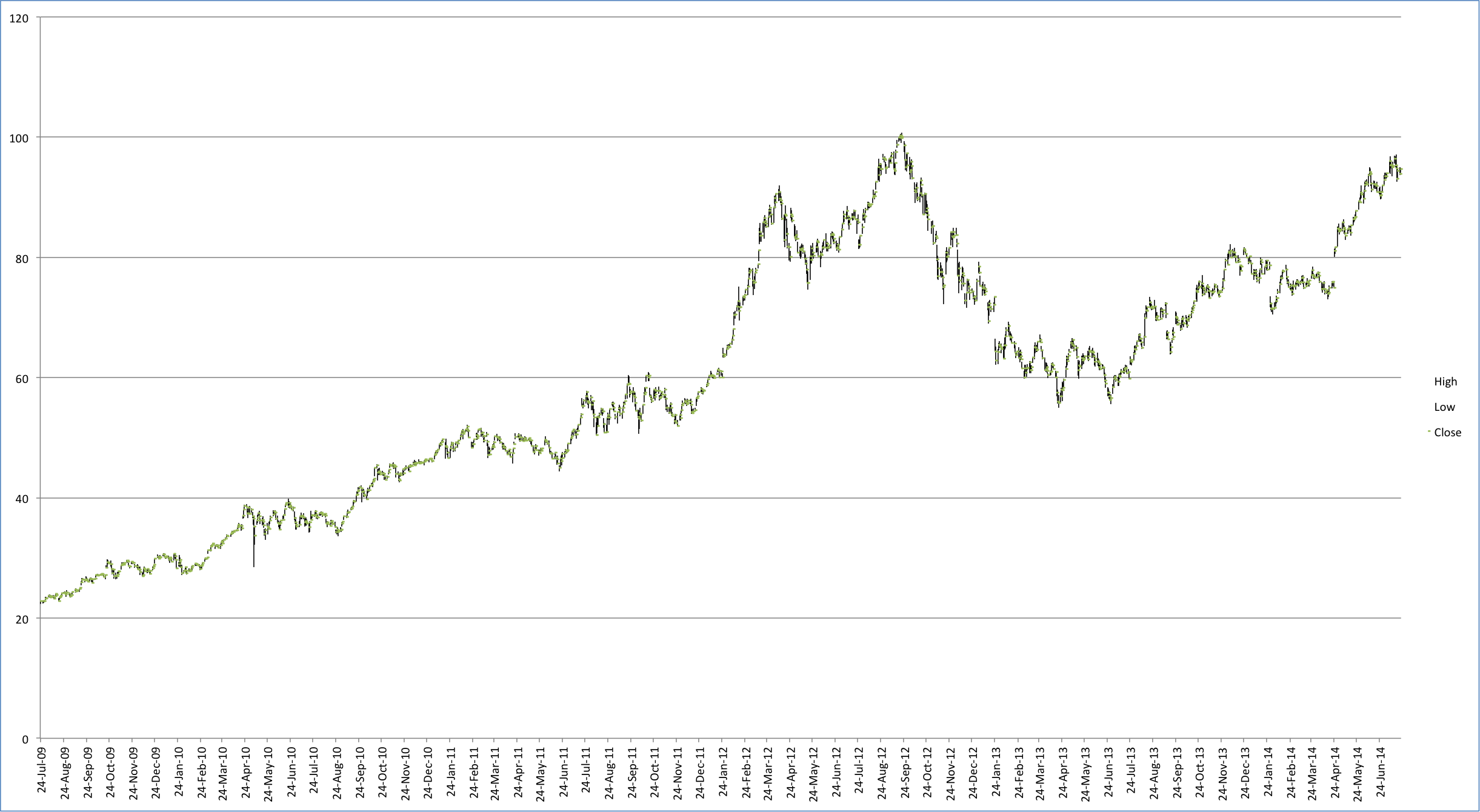
Apple’s stock has periodically taken a licking, but has been beating its way back to its previous high (partly due to a recent stock split and dividends periodically being paid), but its story is an important cautionary tale.

Apple Stock Price
Apple Share Price History

Good investing comes from choosing companies that produce revenue and retain growth potential, in other words focusing on the fundamentals of investing. Despite naysayers, that’s exactly the kind of company Apple has been. So why does Apple get so much negative attention? Because predicting the fall of a Goliath is exactly the kind of thing that makes news. Whether it’s true or not is irrelevant in the news cycle, but it is a source of bad investor advice, and should serve as a cautionary tale to investors considering taking financial advice from business news.

Market Inefficiencies are Making You Fat (But Maybe Also Wealthy)

If you wish to prove that the world is more prosperous today than ever before, you merely need to look at the statistics of global obesity. With close to 400 million people world wide affected by Type-2 Diabetes and costs to global health care nearing $470B (USD) obesity is the unfortunate side effect of rising standards of living.

Canadians and Americans spend around $130B (USD) on fast food annually. That’s a lot of money, and you can imagine that much of it happens at lunch. Across many major cities, workers flee their office towers and head towards food courts to satisfy their hunger. Something else that both Canadians and Americans spend a lot of money on is weight loss, to the tune of $44B a year. So to recap, Canadians are spending lots of money on fast food, and lots of money on trying to lose weight.

Obesity is easily one of the major social issues that occupies our conscious. Perhaps because so many of us are now overweight, because the costs are so high, because the science is so confusing, or because we have such a warped image of beauty,

It's time to end the unreal expectations of beauty for men, most of us just won't have claws.
It’s time to end the unreal expectations of beauty for men, most of us just won’t have claws.

Canadians are eating too much and regretting it later to the tune of billions. Whatever the reasons it is now common to say that obesity is at epidemic levels.

One of the more popular reasons cited for this epidemic is that not only are our eating habits so poor, but that we aren’t really clear about what is in our food. Most recently this has been the focus of the Katie Couric documentary FED UP, which took aim at the sugar industry and how much sugar has been added to our foods without our knowledge. And there is some strong evidence that sugar may be one of the chief culprits behind obesity, type-2 diabetes, and a host of other illnesses now largely associated with prosperous societies.

We might expect that our “efficient markets ” would respond to the incredible demand for healthy foods by providing more nutritious fast foods, like Freshii. Freshii is a highly successful fast food chain that specializes in salads, wraps and other healthy food options. At lunch time in most food courts the lineup for Freshii is easily one of the longest, and yet the number of fast food places that imitate their business model, or compete directly is shockingly low. The theory that markets naturally respond to the needs and wants of the consumer seems to fall flat here.

One explanation is that the markets are responding to the desires of the consumer, and consumers don’t really want healthy food, but prefer hamburgers and french fries. Another theory is that if there aren’t any healthy food options around, people will choose only what they have available to them (hamburgers and french fries). I choose to assume another explanation. That is that businesses are incredibly conservative and typically don’t like to disrupt a known and profitable business model in favour of one that is largely untested. Entrepreneurs tend towards being “disagreeable” (to borrow a term from Malcolm Gladwell) and don’t mind risking failure to try something new.

This lag between successful companies and upstart firms like Freshii has been demonstrated by other companies (and most recently challenged in the New York Times) like Apple, and even Ford Motors. Henry Ford famously said that if he had asked what his customers wanted, “they would have asked for a faster horse.” Markets may ultimately be responsive to consumer needs, but not efficiently so. And within market inefficiencies we often find opportunities that are being ignored. While that can be good for the watchful investor, it seems to be bad for our waistlines.

My Car Runs on Geopolitics – Why “Fracking” is an Important Investment for Your Portfolio

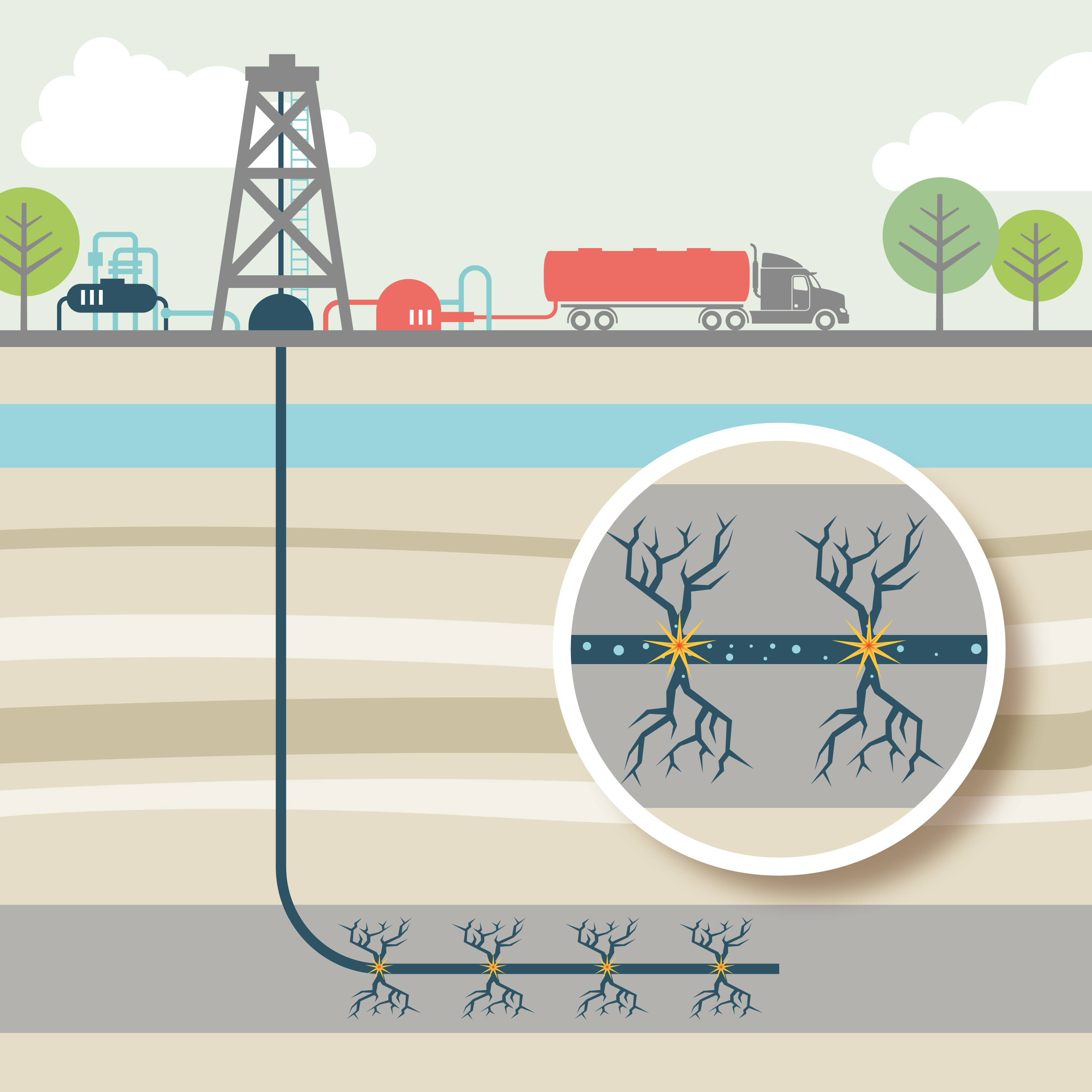
frackingI’m an environmentalist. But as a Financial Advisor I consider that some of the best opportunities I can provide to my clients is exposure to the burgeoning US and Canadian energy markets. That’s right I’m a big proponent for one of the most ecologically damaging and publicly derided forms of energy extraction.

However, next time you put gas in your tank consider this: 7000 fighters are currently making a mockery of whatever pretense Iraq was making at being a legitimate country. ISIS, the Islamic faction currently pushing into northern Iraq from Syria with aims to establish an Islamic Caliphate in the region has been routing Iraqi government forces. An army a quarter of a million strong, equipped with the latest in weapons, tanks and aircraft are losing regularly to a rag tag group of extremists equipped only with machine guns.

Meanwhile in the Ukraine we have fresh assurances that Russia will abide by a new ceasefire between Ukrainian government forces and rebels loyal to the Russian government. While Russia may have undone its own objectives of building a rival economic group, they have successfully reminded everyone why Russia, no matter how weakened it may be, is a powerful force that controls a great deal of energy needed for global consumption.

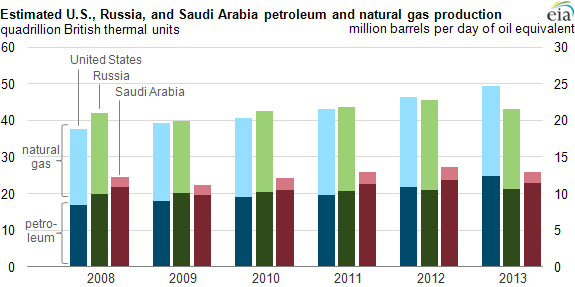
Across many of the nations that produce some form of energy (oil, natural gas, coal, etc.) there are very few that can claim to be a democratic, civil society not embroiled in some kind of sectarian civil war. But as of this year the United States has become the world’s largest producer of energy, outpacing Russia and Saudi Arabia, and that promises to change the way we think about economies and economic opportunities going forward.

production

In many developed countries there is a great deal of hand-ringing about the sudden rise of hydraulic fracturing – a relatively recent method of energy extraction that is reducing the cost of production and breathing new life into American manufacturing. “Fracking” comes with a number of environmental downsides, some of which are both scary and quite dramatic.

But energy is the life blood of civilisations and a steady supply of affordable energy is what gives us the ability to grow our economies and invest in new technologies. Sometimes this means making hard choices about how we allocate resources, and what the long term impacts of certain industries to our environment might be. But affordable energy, in the form of both oil and natural gas, provided from countries like Canada and the United States doesn’t just help bring back domestic manufacturing. It also economically weakens dictators and states that ignore human rights and puts power back in the hands of liberal democracies to enforce sanctions.

In other words there are numerous political and economic benefits that come along with cheaper Western energy. While this doesn’t address our environmental problems it’s important to love your monsters. The tools that give us our wealth and prosperity shouldn’t be abandoned just because they pose challenges, rather it invites us to both reap profits and seek new ways to conquer those problems we face. That is at least until either Google or Tesla solve all our driving problems.