The Mystery of Market Volatility

GTY 460643338 A FIN MAX USA NY

This past week markets had a sudden and sustained sell off that lasted for two days, and though they bounced back a little on Friday, US markets had several negative sessions. The selloff in US markets, which began on Wednesday and extended into Thursday, roiled global markets as well, with extensive selling through Asia and Europe on Wednesday evening/Thursday morning. At the end of the week Asian, European and Emerging markets looked worse than they already were for the year, and US markets had been badly rattled. This week has seen an extension of that volatility.

Explanations for sudden downturns bloom like flowers in the sun. Investors and business journalists are quick to latch onto an explanation that grounds the unexpected and shocking in rational sensibility. In this instance blame was handed to the Federal Reserve, where members had been quoted recently talking about higher than expected inflation forcing up lending rates at an accelerated pace. This account was so widely accepted that Donald Trump was quoted as saying that “The Fed has gone crazy”, a less than surprising outburst.
TSX YTD
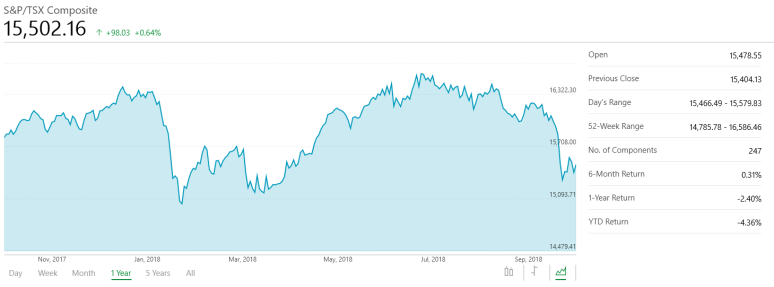
TSX year to date performance is currently just over -4.3%

I tend to discount such explanations about market volatility. For one, it seeks to neuter the truth of markets as large complex institutions that are subject to multiple forces of which many are simply invisible. Second, by pretending that the risk in markets is far more understandable than it really is, investors are encouraged to take up riskier positions and strategies than they rightly should and ignore advice that has proven effective in managing risk. Finally, I have a personal dislike for the façade of “all-knowingness” that comes along after the fact by people who have parlayed luck into “expertise”. Markets are risky and complex, and it would be better if we treated them like a vicious animal that’s only partially domesticated.

Dow YTD
The Dow Jones performance has been quite good this year, but in the past week lost just over 5%, bringing year to date returns to 2.94%

In fact, as markets continue to grow with technology and various new products, complexity continues to expand. At any given time markets are subject to small investors, professional brokers, pension funds, algorithm driven trading programs, mutual fund managers, exchange traded funds and even governments, all of whom are trying to derive profits.

So what does that tell us about markets, and what should we take from the recent spike in volatility? One way to think about markets is that they operate on two levels, a tangible level based on real data and expectations set by analysts, and another that trades on sentiment. On the first level we tend to find people who advocate for “bottom up investing”, or the idea that corporate fundamentals should be the sole governor of stock’s price. If you’ve ever heard someone discuss a stock that’s “under-performing,” “undervalued,” “out of favor,” or that they are investing on the “principles of value” this is what they are referring to. People who invest like this believe that the market will eventually come around to realizing that a company hasn’t been priced correctly and tend to set valuations that tell them when to buy and sell.
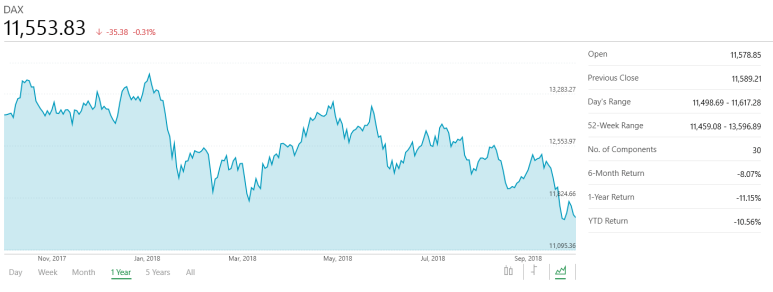
DAX YTD
Germany, the strongest economy in EUrope has already struggled this year under the burden of the EU fight with Italy’s populist government and ongoing BREXIT negotiations. YTD performance is -10.56%

The second level of investing is based on sentiment, informed by the daily influx of headlines, rumour and conspiracy that clogs our news, email inboxes and youtube videos. This is where most investors tend to hang their hat because its where the world they know meets their investments. Most people aren’t analyzing a specific bank, but they may be worried a housing bubble in Canada, or the state of car loans, or the benefits of a recent tax cut or trade war. The sentiment might be best thought of as the fight between good and bad news informing optimism and pessimism. If a bottom up investor cares about a company they may ignore general worry that might overwhelm a sector. So if there is a change in in the price of oil, a value investor may continue to own a stock while the universe of sentiment sees a widespread selling of oil futures, oil companies, refining firms and downstream products.
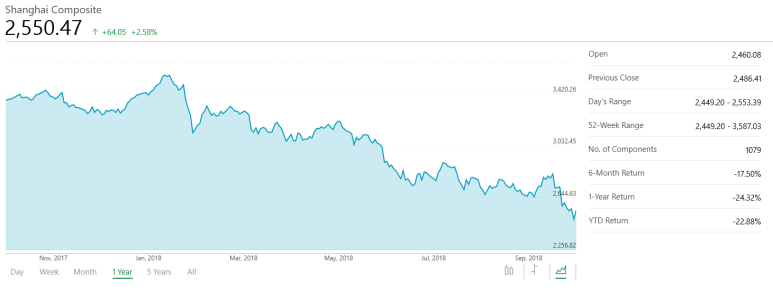
Shanghai Comp YTD
China is the world’s second largest economy and the biggest market among the emerging markets. Having struggled with Trump’s tariffs, YTD performance is a whopping -22.8%

As you are reading this you may believe you’ve heard it before. Indeed you have, as our advice has remained consistent over the years. Diversification protects investors and retirement nest eggs better than advice that seeks to “beat the market” or chases returns. However, it seems to me that the market sentiment is undoubtedly a stronger force now than its ever been before. As more investors come to participate in the market and passive investments have grown faster than other more value focused products, sentiment easily trumps valuations. Since we’re always sitting atop a mountain of conflicting information, some good and some bad, whichever news happens to dominate quickly sets the sentiment of the markets.

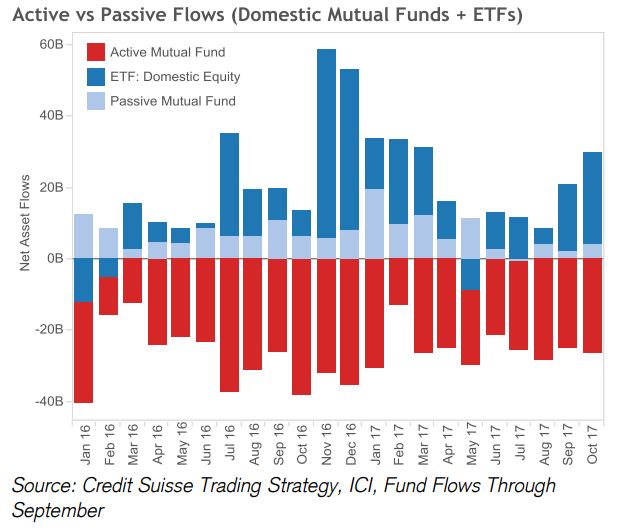
You don’t have to take my word for it either. There is some very interesting data to back this up. Value investing, arguably the earliest form of standardized profit seeking from the market, has remained out of favor for more than a decade. Meanwhile the growth of ETFs has continued to pump money into the fastest growing parts of the market, boosting their returns and attracting more ETF dollars. When the market suddenly changed direction on Wednesday, the largest ETF very quickly went from taking in new dollars to a mass exodus of money, pushing down its value and the value of the underlying assets. At the same time some of the worst performing companies went to being some of the best performing in a day.
MW-FZ971_CSetff_20171211161201_NS
This chart shows that actively managed mutual funds have hemorrhaged money oer the past few years, while passive ETFs have been the chief beneficiaries, radically altering the investment landscape.

So what’s been going on? The markets have turned negative and become much more volatile because there is a lot of negative news at play, not because interest rates are set to go up too quickly. Sentiment, that had been positive on tech stocks like Amazon and Google gave way to concern about valuations, and with it opened the flood gates to all the other negative news that was being suppressed. Brexit, the Italian election, the rise of populism, currency problems in Turkey, a trade war with China and rising costs everywhere came to define that sentiment. As investors begin to feel that no where was safe, markets reflected that view.

Our advice remains steadfast. Smart investing is less about picking the best winner than it is about having the smartest diversification. A range of solutions across different sectors and styles will weather a storm better, and investors should be wary of simplistic answers to market volatility. Markets always have the potential to be volatile, and investors should always be prepared.

The Deceptive Nature of Indices

Index

An essential part of the business of investing involves figuring out how well you are doing. In some respects, the best benchmark for how well you are doing should be personalized to you. How conservative are you? What kind of income needs do you have? How old are you? While the case remains strong for everyone to have a personal benchmark to compare against their investment portfolios, in practice many people simply default to market indexes.

I’ve talked a little about market indexes before. They are poorly understood products, designed to give an impression about the overall health and direction of the economy and can serve as a guide to investment decisions. Large benchmarks, like the S&P 500, the TSX, or the FTSE 100, can tell us a great deal about the sentiment of investors (large and small) and what the expected direction of an economy may be.

But because these tools are usually poorly understood, they can contribute to as much confusion as they do clarity. For instance, the Dow Jones uses a highly confusing set of maths to determine performance. Last year General Electric lost about 50% of its market capitalization, while at the same time Boeing increased its market capitalization by 50%, but their impact on the Dow Jones was dramatically different. Boeing had an outsized positive contribution while General Electric had a much smaller negative impact.

The S&P 500 currently is one of the best preforming markets in 2018. Compared to most global indexes, the S&P 500 is ahead of Germany’s DAX, Britain’s FTSE 100 and FTSE 250, Japan’s Nikkei and Canada’s TSX. Yet if you are looking at your US focused investments, you might be surprised to see your own mutual funds lagging the index this year. If you were to ask an ETF provider or discount financial advisor why that is they would likely default to the answer “fees”, but they’d be wrong.

YTD FTSE S&P500 TSX
While the S&P 500 isn’t exactly “running away” it is doing considerably better than the TSX and the UK’s FTSE 100

This year is an excellent example of the old joke about Bill Gates walking into a bar and making each patron, on average, a millionaire. While the overall index has been performing quite well, the deeper story is about how a handful of companies are actually driving those returns, while the broader market has begun to languish. Of the 11 sectors in the S&P 500, only two are up, technology and consumer discretionary, while a further 6 were down for the year. In fact the companies driving most of the gains are: Facebook, Amazon, Apple, Alphabet (Google), Netflix and Microsoft. The 80 stocks in the consumer discretionary space not in that list have done almost nothing at all.

What does this portend for the future? There is a lot to be concerned about. The narrowing of market returns is not a good sign (although there have been some good results in terms of earnings), and it tends to warp investment goals. Investors demand that mutual fund returns keep up with their index, often forcing portfolio managers to buy more of a stock that they may not wish to have. In the world of Exchange Traded Funds (or ETFs), they participate in a positive feedback loop, pulling in money and buying more of the same stocks that are already driving the performance.

In all, indexes remain a useful tool to gage relative performance, but like with all things a little knowledge can be deceptive. The S&P 500 remains a strong performing index this year, but its health isn’t good. Healthy markets need broad based growth, and investors would be wise to know the details behind the stories of market growth before they excitedly commit money to superficially good performance.  

Did that make you worried? Don’t be scared, call us to set up a review of your portfolio to better understand the risks!

Do Banks Misrepresent GIC Rates?

I thought I had more saved!To say that Canadians aren’t financially literate may seem a touch unfair, but everywhere you look we find testaments to this unavoidable fact. Credit cards, car loans, mortgage rates and even how returns are calculated are a confusing mess for most people. The math that governs these relationships is often opaque and can feel misleading, and its complexity assures that even if some do understand it, the details will only be retained by a tiny minority.

Even relatively straightforward investments can be terrifically misleading. Take for instance a well-known credit union offering a (limited) 90-day rate of 2.5% on a GIC. This advertised rate is not simply featured in the windows of its various locations but is promoted online and on the radio.

Banks and credit unions frequently offer improved GIC rates for a limited time to drive deposits. But how those rates are advertised can be misleading. The aforementioned “2.5% 90 Day GIC rate” has its own website where it contrasts its deposit rate against other major financial institutions, all of them paltry compared to the prominently displayed 2.5%.

90 Day
This seems shockingly dishonest. Also the importance of that footnote seems understated.

At the very bottom of the website there does exist a footnote however. That 90-day GIC rate? It’s an annualized number, meaning that the interest you will earn at the end of that 90 days is 0.62% not 2.5%. The most egregious part perhaps is that it compares its misleading return to the far more understandable 90 day return of other GIC providers.


Linked GIC
Sounds good right? Don’t forget to click on the “More Details” button.


Other innovations in obfuscation abound. Exploring their website and we find a “linked GIC” which offers to protect your principle while giving you market returns linked to a custom index. The marketing material promises to “give you exposure to the Canadian stock market” and offers you a chance to see it performance results. But if you click to learn more of the details you find out that returns on the 3 year product are capped with cumulative returns of 15%. Not bad until you remember that traditionally returns are annualized in Canada. The maximum returns the product will offer is 4.77% regardless of what the market does in that time. Better than a 3 year GIC perhaps, but potentially far worse than what the market may deliver.

As always, the details are available for those interested. They’re just a scroll farther down, an additional click, or perhaps another page over. So, if there exists full disclosure, what am I complaining about?


Important disclaimer
This sentence feels like it should be in the yellow, and not a different webpage towards the bottom.


The answer is best illustrated in every search you do on Google. At the top of the page are the websites that have sought to be promoted. 67% of clicks are on the top five results on a google search. 95% of clicks are exclusively for the first page only. Things on the next page barely warrant looking at. It’s just not of interest. Disclosure details may only be a click away, but from the point of view of an average person looking over the details, they may never get around to reading them.

GICs are considered the safest investments for Canadians looking for security, but their function is to provide banks with low cost loans to help finance their own business activities. Every investment made in a GIC may help bring someone comfort at night, but they’ve really entered a business relationship with a bank. Framed as such it seems that better and clearer disclosure should be the primary order, but because our thinking is that GICs are a form of product they are treated as such.

Importantly, I must stress that these banks, credit unions, and other financial institutions are not lying. They are doing what they are allowed to do under the various laws that govern financial institutions. That such rules fall short is precisely why its always smart to talk to an independent financial advisor like myself. Providing context, clarity and advice free from the conflict of corporate proprietary products is how we help people every day, and its what makes us unique.

If you have questions about this article, or wish to discuss an important financial matter please call or email us!


Go back

Your message has been sent

Warning
Warning
Warning

Warning.


Making Economics Meaningful – How Official Inflation Figures Obscure Reality

Since 2008 (that evergreen financial milestone) central banks have tried to stimulate economies by keeping borrowing rates extremely low. The idea was that people and corporations would be encouraged to borrow and spend money since the cost of that borrowing would be so cheap. This would eventually stimulate the economy through growth, help people get back to work and ultimately lead to inflation as shortages of workers began to demand more salary and there was less “slack” in the economy.

Capture
Following the financial crisis lending rates dropped from historic norms of around 5% to historic lows and remained there for most of the next decade.

Such a policy only makes sense so long as you know when to turn it off, the sign of which has been an elusive 2% inflation target. Despite historically low borrowing rates inflation has remained subdued. Even with falling unemployment numbers and solid economic growth inflation has remained finicky. The reasons for this vary. In some instances statistics like low unemployment don’t capture people who have dropped out of the employment market, but decide to return after a prolonged absence. In other instances wage inflation has stayed low, with well-paying manufacturing jobs being replaced by full-time retail jobs. The economy grows, and people are employed, but earnings remain below their previous highs.

Recently this seems to have started to change. In 2017 the Federal Reserve in the United States (the Fed) and the Bank of Canada (BoC) both raised rates. And while at the beginning of this year the Fed didn’t raise rates, expectations are that a rate hike is still in the works. In fact the recent (and historic) market drops were prompted by fears that inflation numbers were rising faster than anticipated and that interest rates might have to rise much more quickly than previously thought. Raising rates is thought to slow the amount of money coursing through the economy and thus slow economic growth and subsequently inflation. But what is inflation? How is it measured?

One key metric for inflation is the CPI, or Consumer Price Index. That index tracks changes in the price or around 80,000 goods in a “basket”. The goods represent 180 categories and fall into 8 major groupings. CPI is complicated by Core CPI, which is like the CPI but excludes things like mortgage rates, food and gas prices. This is because those categories are subject to more short-term price fluctuation and can make the entire statistic seem more volatile than it really is.

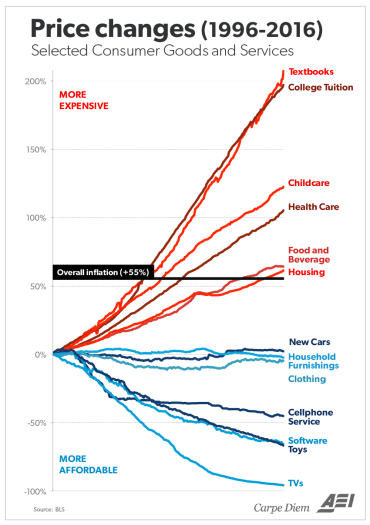
CollegeInflationArmed with that info you might feel like the whole project makes sense. In reality, there are lots of questions about inflation that should concern every Canadian. Consider the associated chart from the American Enterprise Institute. Between 1996 – 2016 prices on things like TVs, Cellphones and household furniture all dropped in price. By comparison education, childcare, food, and housing all rose in price. In the case of education, the price was dramatic.
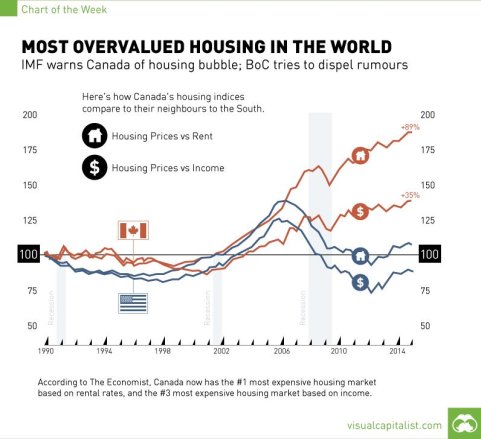
Canada’s much discussed but seemingly impervious housing bubble shows a similar story. The price of housing vs income and compared to rent has ballooned in Canada dramatically between 1990 to 2015, while the 2008 crash radically readjusted the US market in that space.

The chart below, from Scotiabank Economics, shows the rising cost of childcare and housekeeping services in just the past few years, with Ontario outpacing the rest of the country in terms of year over year change when it comes to such costs.

DWudiGFWkAUkBHp

My desktop is littered with charts such as these, charts that tell more precise stories about the nature of the broader statistics that we hear about. Overall one story repeatedly stands out, and that is that inflation rate may be low, but in all the ways you would count it, it continues to rise.

DIe6Fh2UMAEDmaIIn Ontario the price of food is more expensive, gas is more expensive and houses (and now rents) are also fantastically more expensive. To say that inflation has been low is to miss a larger point about the direction of prices that matter in our daily lives. The essentials have gotten a lot more expensive. TVs, refrigerators and vacuum cleaners are all cheaper. This represents a misalignment between how the economy functions and how we live. 
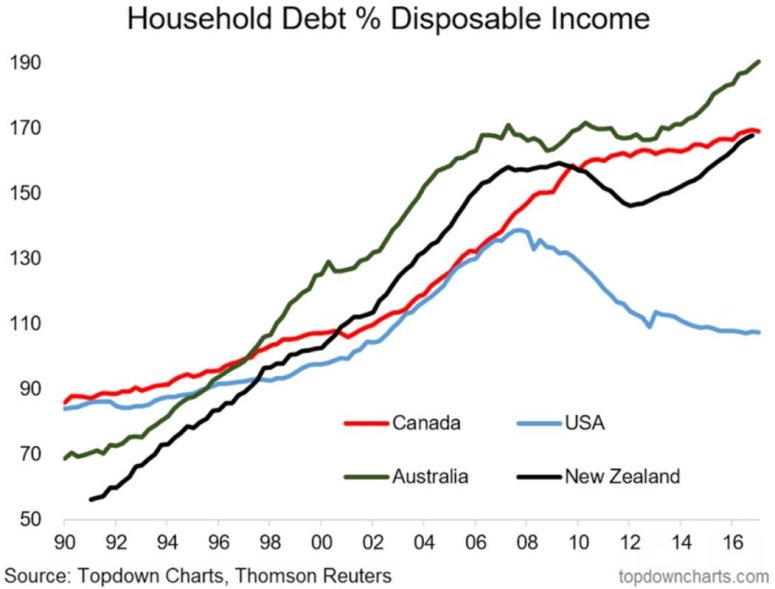
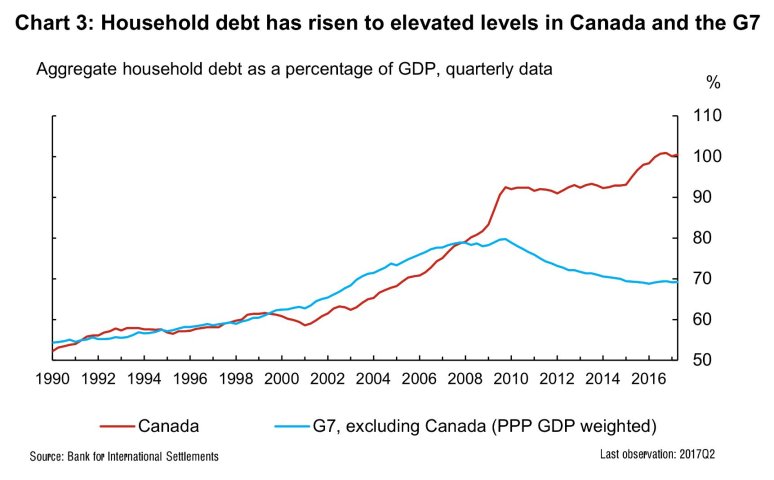
DJs5AdwXoAANcDTEconomic data should be meaningful if it is to be counted as useful. A survey done by BMO Global Asset Management found that more and more Canadians were dipping into their RRSPs. The number one reason was for home buying at 27%, but 64% of respondents had used their RRSPs to pay for emergencies, for living expenses or to pay off debt. These numbers dovetail nicely with the growth in household debt, primarily revolving around mortgages and HELOCs, that make Canadians some of the most indebted people on the planet.
DWS3VJkX4AAXXaT

In the past few years, we have repeatedly looked at several stories whose glacial pace can sometimes obscure the reality of the situation. But people seem to know that costs are rising precisely in ways that make life harder in ways that we define as meaningful. When we look at healthcare, education, retirement, and housing it’s perhaps time that central banks and governments adopt a different lens when it comes understanding the economy.

The Ballooning Cost of Growing Old

Senior Couple Enjoying Beach Holiday Running Down Dune
The reality about retirement is that this bit can be fleetingly short compared with the scope of being elderly. 

Getting old is something that comes to us all and is rightly considered a blessing of our modern world. Free from most wars, crime and disease the average age of Canadians continues to rise, with current life expectancy just over 82 years.

But being old is no fun. From your late 70s onward quality of life begins to decline in a multitude of ways. From a media perspective we tend to focus on outliers, like the oldest marathon runner, or the oldest male model, men and women who seem to exemplify youth well past their physical. In truth though the aging process is simply a battle that we have gotten good at slowing down.

20696006In his excellent book Being Mortal, author and practicing surgeon Atul Gawande goes through the effects of aging, the limits of science to combat it and how we could be using medicine better to improve quality of life for the elderly. It’s a great and sometimes upsetting read that I recommend for everyone.

One of the great challenges that looms on the horizon is the cost of an aging population. The dependency ratio for the elderly (the metric of people over 65 against those between the working ages of 20-64) is rising, putting higher living costs on a smaller working base. In Canada the dependency ratio is expected to climb to 25% by 2050, and is currently at 23.77% as of 2015. That may not seem like much, but in 1980 (the year I was born) the ratio was 13.84%.

ch1_graph3.0-eng

Since old age is also the point where you consume the most in terms of health care costs we should be aware that Canada’s population isn’t just aging, but that our retiring seniors are poised to become the biggest and most expensive demographic; financially dependent on a shrinking workforce and more economically fragile than they realize. That’s a problem that nations like Japan have been struggling with, where old age benefits are extensive, but the workforce has dwindled.

In other articles we’ve touched on the various aspects of the rising costs of old age. I’ve written about: the importance of wills, the impact of an aging population on our public health care, how demographics shift both investing patterns and warp our economic senses, why seniors may be getting too much of a break economically, how poor land management has made cities too expensive and that’s hurting retirement, and how certain trends are making retirement more expensive. Often these are written as issues in a distant (or not too distant) future. But increasingly they won’t be.

This past week eight long term care facilities have said they will be leaving Toronto. As part of a bigger project, long term care spaces are being rebuilt to meet new guidelines. A new facility is larger, more spacious and designed to maximize medical care. However land costs within Toronto are proving to be too high to be considered for the updated facilities. Why is that? The government pays $150 a day per bed in a facility like the ones leaving. From that subsidy costs for maintenance, nurses, janitors, medicine and food as well as the profit of the business must all be extracted. Margins are thin and building costs in the city are huge. Six more facilities are also considering leaving the GTA for cheaper land.


Toronto's City Hall, Nathan Phillips Square. (Shutterstock)
Toronto is a wonderful city, but we’ve done a bad job of making sure that we can still afford to live here. 


Eric Hoskins, health minister for the province, is arguing that the subsidy the government provides is enough, but he is already embroiled in other fights with the medical community. In 2015 the ministry cut doctors fees and began clawing back previously earned money as well. Currently lots of people in Ontario struggle to see their family doctor, and there are 28,000 elderly waiting to get access to long term care facilities, and only 79,000 beds. Coincidentally this is also the year that the Ontario Liberals balanced the books. Something about that should give us pause.

This is the reality of getting old in 2017. Costs are rising and are expected to continue growing. Some of this you can’t avoid, and many of us will end up in private retirement homes, assisted living situations, dependent on the government or even family. But there are steps that can be taken to protect assets and insulate against protracted medical or legal disputes.

Here’s a list of eight things that can help you with retirement and your estate:

  1. Keep an updated will and a named executor young enough to handle your affairs. I know it goes without saying, but its extremely important and many of us don’t do it.
  2. Ensure that you’ve got a Power of Attorney (POA) established and that it is current.
  3. Make sure you have a living will and discuss with your family your expectations about how you want your life to end.
  4. Look into your funeral arrangements while you can. It seems macabre, but funerals can be wildly expensive and burdensome to thrust onto grieving family.
  5. Create a space where all important documents can be found by your next of kin and with a detailed contact sheet so people can help settle your estate.
  6. Look into assisted living options early and consider what you might be able to afford. Have your financial plan reflect some of these income needs.
  7. Consider passing along family heirlooms early. Is there a broach, or a clock that you would like to see in someone’s hands? These conversations are easier to handle when you are well than when you aren’t, and downsizing frequently involves saying goodbye to long loved possessions.
  8. Big assets like houses and cottages should be discussed with family, especially if there is a large family and the assets might need to be shared. A lot of family strife comes from poor communication between generations and among siblings.

There will be much more to say about getting old, about protecting quality of life and managing the rising costs of living on fixed incomes. We gain little from sticking our heads in the sand and hoping that we will be healthy and strong to the day we die. In reality our retirement plans should better reflect not our most hopeful ideas of retirement but instead our greatest concerns and seek ways to preserve our quality of life.

Vexed by the VIX

This past week a number of articles spilled forth regarding the VIX index being at record lows. If you aren’t familiar with the VIX, that’s quite okay; the VIX is an index that tracks the nervousness of investors. The lower the VIX is the more confident investors are. The higher the VIX, the greater the concern.

At first glance the VIX seems to clearly tell us…something. At least it seems like it should. The index is really a measure of volatility using an aggregate of prices of options traded on the S&P 500, estimating how volatile those options will be between the current date and when they mature. The mechanics aren’t so important for our purposes, just that this index has become the benchmark for the assumed fear or comfort investors have with the market.

So what does it mean when the VIX is supposedly at its lowest point in nearly a quarter of a century?

Historic VIX
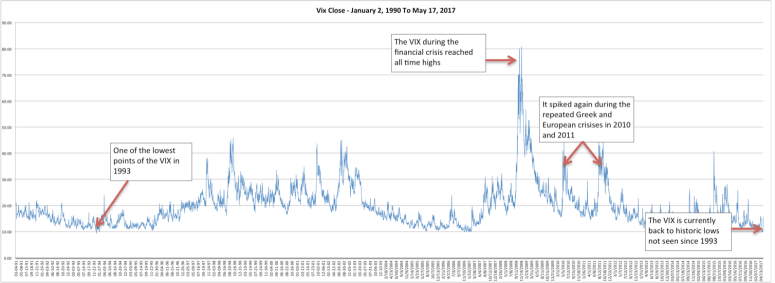
This is the historic performance of the VIX. Data provided by CBOE.

Because we live in the 21st century, and not some other more primitive time, we have the best technology and research to look to when it comes to discerning the meaning of such emotionally driven statistics. Its here that the the area of study of behavioural economics and investing supposedly cross paths and that we might be able to yield some useful insight from the VIX.

Motorola RAZR V3_1
What is this, 2007? Might as well be the stone age!

Or not.

The holy grail of investing would presumably be something that allowed you to accurately predict changes in the market based on investor sentiment. Though over time stock markets are meant to be an accurate reflection of the health and wealth of an economy, in the short term the market more closely tracks a series of more micro events. Investor sentiment, political news, potential scandals as well as outside influences like high frequency trading and professional traders pushing stocks up and down all make up daily activity.

The VIX seems like an ideally suited index to then tell us something about the market, and yet it probably isn’t. The problem with research into behavioural economics (and its other partner, big data) is that it is great at telling us about things that have already happened. The goal, that we could use this information to change or alter human behaviour, is still a long way off (if it exists at all). Similarly the VIX is basically great at telling us stuff that we already know. When markets are bad the VIX is high. When markets are good its generally low.

Skiing in pants
Bad forecasting can lead to terrible outcomes.

Thus, the VIX represents a terrible forecasting device but an excellent reminder about investor complacency. When markets are “good” (read: going up) there is a tendency for investors to ask for more exposure to those markets to maximize returns. If you feel uncertain about the future, investors and financial advisors are less likely to “drift” in terms of their investing style, but if people feel very good about the future their far more likely to take their foot off the breaks.

Screen Shot 2017-05-18 at 2.00.19 PM
Yesterday’s selloff followed news that Trump’s Russia problem wasn’t going to go away, but remain a permanent feature of his administration.

Real market panics and crashes tend to be triggered by actual structural problems. 2008 wasn’t the result of too much confidence about the future from investors, but because the market itself was sitting on a bubble. That the VIX was low only tells us what we already knew, that we weren’t expecting a financial crisis.

Trump-Jail
We can hope.

With markets down sharply yesterday its tempting to see that this level of investor complacency/confidence harbingered the most recent sell off. But that’s not the case. Trump is, and remains, a kind of nuclear bomb of unpredictability that must be factored into anyone’s expectations about the markets. But what we should do is consider the VIX a mirror to judge our willingness and preparedness to deal with unexpected events and market downturns. If you’ve started to assume that you can afford growing concentration in your portfolio of high performing equity or that you don’t need as many conservative positions, you should take a long hard look at why you feel that way. Maybe its just because you feel a little too confident.

Like everyone else.


The Sentry Scandal & Unethical Sales Practices

For the past week I’ve been tinkering with a piece around the allegations that TD’s high pressure sales tactics had driven some staff to disregard the needs of their clients and encourage financial advisers in their employ to push for unsuitable products, and in some instances drove employees to break the law.

Screen Shot 2017-04-07 at 2.35.55 PM
The drop in the value of TD shares following the allegations reported by CBC (from Google Finance)

My general point was that the financial advising industry depends on trust to function, and runs into problems when those that we employ for those jobs serve more than one master. The sales goals of the big banks are only in line with the individual investor needs so long as investor needs serve the banks. In other words, clients of the banks frequently find that their interests run second to the profit and management goals of Canada’s big five.

Yet I was having a hard time getting the article together. Something about the message was too easy; too obvious. No one who read the reports from the CBC was in any doubt about the ethical dubiousness of TD’s position, and forgetting the accusations of illegality, I doubt most people were surprised to find out that banks put their corporate needs ahead of their average Canadian clients.

But then yesterday something truly shocking happened. One of Canada’s larger independent mutual fund companies had to pay a $1.5 million settlement to the OSC for “non-compliant sales practices” (you can read the actual ruling by the OSC HERE). Effectively the OSC was reprimanding a company for giving excessively large non-monetary gifts to financial advisers, rewarding them for being “top producers”.

For the uninitiated, Canada’s mutual fund industry can seem a little confusing, so let me see if I can both explain why a mutual fund company would do what it did, and how you can avoid it.

First, there are several different kinds of mutual fund companies:

  1. There are companies like those of the banks, that provide both the service of financial advice and the mutual funds to invest in. This includes the five big banks and advice received within a branch.
  2. There are also independent mutual fund companies that also own a separate investing arm that operate independently. Companies like CI Investments own the financial firm Assante, IA Clarington owns FundEx, and the banks all have an independent brokerage (for example TD has Waterhouse, RBC owns Dominion Securities and BMO owns Nesbitt Burns).
  3. Lastly, there are a series of completely independent mutual fund companies with no investment wing. Companies like Franklin Templeton, Fidelity Investments, AGF Investments and Sentry Investments all fall into that category.

The real landscape is more complicated than this. There are lots of companies, and many are owned by yet other companies, so it can get muddy quickly. But for practical purposes, this is a fair picture for the Canadian market.

In theory, any independent financial adviser (either with a bank-owned brokerage, or an independent brokerage, like Aligned Capital) can buy any and all of these investments for our clients. And so, the pressure is on for mutual fund companies to get financial advisers to pay attention to them. If you are CI Investments, in addition to trying to win over other advisers, you also have your own financial adviser team that you can develop. But if you are a company like Sentry, you have no guarantee that anyone will pay attention to you. So how do you get business?

Sentry is a relatively new company. Firms like Fidelity and Franklin Templeton have been around for more than half a century. Banks have deep reserves to tap into if they want to create (out of nothing) a new mutual fund company. By comparison, Sentry has been around for just 20 years, and has had to survive through two serious financial downturns, first in 2000 and then 2008, as an independent firm. By all accounts, they’ve actually been quite successful, especially post 2009. You may have even seen some of their advertisements around.


600_319143892
Over the past few years independent mutual fund companies have increasingly turned to public advertising to try and encourage individual investors to bug their advisers about their funds.


But while Sentry has had some fairly good performance in some important sectors (from a business standpoint, it is more important to have a strong core of conservative equity products than high flying emerging market or commodity investments) it has also had some practices that have made me uncomfortable.

For a long time, Sentry Investments paid financial advisers more than most other mutual fund companies. For every dollar paid to an adviser normally, Sentry would pay an additional $0.25. That may not sound like much, but across enough assets thats a noticeable chunk of money. And while there is nothing illegal about this, it is precisely the kind of activity that makes regulators suspicious about the motives of financial advisers and the relationships they have with investment providers. Its no surprise that about a year ago Sentry scaled back their trailer to advisers to be more like the rest of the industry.

The fact is, though, that Sentry is in trouble because of their success. No matter how much Sentry was willing to pay advisers, no-one has a business without solid performance, and Sentry had that. The company grew quickly following 2008 and has been one of the few Canadian mutual fund companies that attracted new assets consistently following the financial meltdown. When times are good, it’s easy for companies to look past their own bottom line and share their wealth. That Sentry chose to have a Due Diligence conference in Beverly Hills and shower gifts on their attending advisers was a reflection of their success more than anything else.

And yet, from an ethical standpoint, it is deeply troubling. I have always been wary of companies that offer to pay more than the going market rate for fear that the motives of my decision could be questioned or maligned. Being seen to be ethical is frequently about not simply following the law, but doing everything in your power to avoid conflicts of interest (Donald Trump: take notice). The financial advisers attending the due diligence (who would have paid for their own air travel and hotel accommodation) probably had no reason to believe that the gifts they were receiving exceeded the annual contribution limit. But now those gifts cast them too in the shadow of dubious behaviour.

10-donald-trump-debate-w750-h560-2x
This is a man who has a hard time creating the impression that he is above ethical conflicts.

So how can you protect yourself from worries that your adviser is acting unethically, or being swayed to make decisions not in your interest? First, insist that your adviser at least offers the option of a fee for service arrangement. While the difference between an embedded trail and a transparent fee may be nominal, a fee-for-service agreement means that you have complete transparency in costs and full disclosure about where your advisers interests lie.

Second, if an embedded trail is still the best option, ask your adviser what the rationale was behind the selection of each of the funds in your portfolio, and what the trail commission was for each of those investments. This is information that you are entitled to, and you shouldn’t be shy about asking for.

Lastly, ask what mutual funds have given your adviser, but be open to the answer. Gifts to advisers are meant to fall into the category of “trinkets and trash”, mostly disposable items that are visibly branded by the company providing them, though gifts can be moderately more expensive. The difference between receiving cufflinks from Tiffany’s and cufflinks that bare the logo of a mutual fund firm is the difference between ethically dubious and openly transparent.

Regulators in Canada are pushing the industry towards a Fiduciary Responsibility for financial advisers. While that may clarify some of the grey areas, it will certainly create its own series of problems. Until then though, investors should not hesitate to question the investments they have, and why they have them. It may be unfair to expect the average Canadian to remember all the details about the types of investments that they have, but you should absolutely expect your financial adviser to be able to transparently and comprehensively explain the rationale and selection method behind the investments that you own.

If you would like an independent review of your current portfolio, please don’t hesitate to give us a call. 416-960-5995.


Down With Universities, Up With Education!

Article_postsecondary

Let’s say I had an investment that cost around $100,000 to be a part of, and after a fixed period you would be left with debt in the area of 25% of your initial purchase. Also there is less than 50% shot at having any ROI at all. If that sounds like a bad deal that’s essentially the proposition of going to university; an expensive 4 year party that leaves many young Canadians in debt with little chance of landing a job that even requires a degree in the first place, let alone one in the chosen field of study.

In some ways universities have it tough. They have become an outlet for millions of Canadians expecting a good future; the final stop for middle class social mobility. They carry with them all of the unexamined concerns we have about class and status in our lives. They are the primary gateway to white collar high paying jobs. They hold the simultaneously contrarian positions of bastions of independent thought and radicalism while also being expected to turn out thousand of grads ready to work “in the real world.” The demand for this type of schooling is so great and has become so expected that parents begin saving from the minute their kids are born, sometimes at the expense of much needed retirement planning.

Universities don’t always help their cause either. While the number of Canadians (and Americans, Brits, Australians, or anybody for that matter) struggle to both pay off their student debt and can’t seem to find gainful employment, some of the major schools themselves have become sources of ridicule as they deal with less serious, or trumped up issues. Students have had their way at college campuses, objecting, protesting and winning arguments that seem pointless, silly or ridiculous. Halloween costumes were deemed to “triggering” at Yale, and statues of Canadian Prime Ministers were called too offensive at Wilfred Laurier.

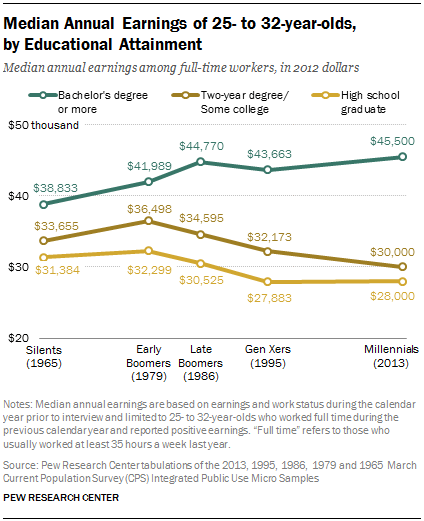
But if we look past silly controversies and focus on university attendance as an investment, we can see that returns really are low, and its hard to imagine any other investment we would make that carries with it so much speculative risk. Being smart about secondary education requires a similar mindset akin to being smart about investing. Where can my investment yield me the best return? And while universities can show that simply having a degree does improve earnings compared to those with only a high school diploma, it doesn’t make up for the fact that costs remain high and students are still saddled with too much debt after they leave school.

pew-income-levels

Saving for education is but one part in an ongoing series of financial life goals. The purpose of that education is to help set the stage for a productive economic life (so to speak), where an education provide options for meritocratic growth and allow for economic milestones like home buying and raising families. As the education system becomes both too expensive and largely pointless, the knock on effect has been young people deferring other stages of their lives.

For now there is no quick fix for the question of higher education. Since before I was in university, students have complained about the rising costs of tuition and the weakening job market. But the absence of top-down solutions doesn’t mean that parents and students are without options. Education is an investment and it should be treated like one. Parents who take the time to open RESPs, collect the Canadian Education Savings Grant dutifully and invest wisely should not consider their due diligence over once their children begin going to school.

Entering higher education is an ideal opportunity to begin expanding children’s entry into the world of finance, and is an excellent way to reframe the education conversation from one about “passion” to understanding that school is an investment akin to a home. A bad investment will end up yielding a negative return, will cost large sums of money and leave the owner feeling helpless. A good investment is one that will provide both comfort and security, allowing for future ambitions to be fulfilled.

Is your financial advisor at your table, or are you at theirs? We’ve been helping families for nearly a quarter of a century one kitchen table conversation at a time, and we’d love to help yours. Plan for your children’s education, and have us join them and you to discuss their educational options. Give us a call or send us a message today!

Go back

Your message has been sent

Warning
Warning
Warning

Warning.


Investing in the Age of Brexit Populism

There is going to be lots of news around Brexit for the next while, and we have many other things to look at. So until more is known and more things are resolved this will be our last piece looking at the In/Out Referendum of June 23rd.


So far the best thing that I’ve read about Brexit is an essay by Glenn Greenwald, who has captured much of the essential cognitive dissonance that revolves around the populist uprisings we’ve seen this year, from Bernie Sanders to Jeremy Corbyn and from Donald Trump to UKIP. You can read the essay here, but I think he gives a poignant take down of an isolated political class and an elitist media that fails to capture what drives much of the populism intent on burning down modern institutions. In light of that criticism, what should investors think about the current situation and how does it apply to their investments?

Let’s start with the basics; that leaving the EU is a bad idea but an understandable one. The Eurozone is rife with problems, from bureaucratic nonsense to democratic unaccountability, the whole thing gets under many people’s skin, and not just in the UK. Across Europe millions of people have been displaced from good work, have lost sight of the dignity in their lives and have come to be told repeatedly that the lives they lead are small, petty and must make way for a new way of doing things. The vast project that is the EU has been to reorder societies along new globalized lines, and if you live in Greece, Spain, Portugal or Italy those lines have come with terrible burdens of austerity and high unemployment.

It’s easy to see that the outstanding issues of the 21st century are going unchecked. Wealth inequality and increasing urbanization are colliding with the problems of expensive housing markets, wage stagnation and low inflation rates. The benefits of economic growth are becoming increasingly sparse as the costs of comfortably integrating into society continue to rise.

In response to these problems the media has shown little ability to navigate an insightful course. Trump is a fascist, Bernie Sanders is clueless, “Leave” voters are bigots, and any objection to the existing status quo that could upset the prescribed “correct” system is deemed laughably impractical or simply an enemy of free society.

This is a dynamic that can plainly not exist and if there is any hope in restoring or renewing faith in the institutions that govern much of our lives. We must find ways to more tactfully discuss big issues. Trump supporters are not idiots and fascists. Bernie supporters are not ignorant millennials. Leave campaigners are not xenophobic bigots. These are real people and have come to the feeling that they are disenfranchised citizenry who see the dignity of their lives is being undercut by a relentless march of progress. Addressing that will lead to more successful solutions to our collective woes than name calling and mud slinging.

For investors this continued disruption could not happen at a worse time. In some ways it is the needs of an aging population that have set the stage of much of the discontent. As one generation heads towards retirement having benefited from a prolonged period of stability and increasing economic wealth, the generations behind it are finding little left at the table. Fighting for stability means accepting that the current situation is worth fighting for. For retirees stability is paramount as years of retirement still need to be financed, but if you are 50 or younger fighting for a better deal may be worth the chaos.

cities-history
For anyone doubts that cities are the most important part of our society and economic wealth, here is the history of cities over the past 5000 years. – From the Guardian


Investors should take note then that this is the new normal. Volatility is becoming an increasing fact of life and if wealth inequality, an unstable middle class and expensive urbanisation can not be tamed and conquered our politics will remain a hot bed of populist uprisings. So what can investors do? They need to broaden their scope of acceptable investments. The trend currently is towards more passive investments, like ETFs that mimic indices, but that only has the effect of magnifying the volatility. Investors should be speaking to their advisors about all options, including active managers, guaranteed retirement investments, products that pay income and even products with limited liquidity that don’t trade on the open market. This isn’t the time to limit your investment ideas, its the time to expand them.

Do you need new investment ideas? Give us a call to learn about all the different ways that investments can help you through volatile markets!

416-960-5995

Or contact us below!

Go back

Your message has been sent

Warning
Warning
Warning

Warning.


Let’s Undo Brexit! (Here’s How)

Brexit-2If there was ever going to be a moment to gain some clarity about what the Brexit would truly and ultimately mean, Friday was the day. Following the win by the leave camp, markets were sent reeling on the uncertainty stirred up by the referendum, and by the day’s end Britain had gone from being the 5th largest economy to the 6th, $2 trillion in value had been wiped from the markets, Scotland wants another referendum as Northern Ireland is proposing a unified Ireland, and embarrassingly the top google result in the UK following the referendum was “What is the EU?”

giphy-2

The buyers remorse now swirling around the UK seems to have ignited a renewed “Remain” campaign. Already there is a petition to have another referendum, citing the quite reasonable objections that a 52-48 split does not indicate the kind of definitive turnout to, in good conscience, topple the British economy and break up the UK. In other corners some of the bloom has quickly come off the rose.

Screen Shot 2016-06-24 at 11.30.56 PM

Nigel Farage, the UKIP leader who has been championing the leave vote while Boris Johnson (BoJo for short) has parading across the country with a bus emblazoned with the phrase “we give the EU £350 million a week, let’s fund the NHS instead” has said that was a poor choice of campaign phrase. In other words the NHS will not be getting an additional £350 million per week. JoJo on the other hand has said that there is no urgency in triggering Article 50 of the Lisbon treaty, and instead there should be preliminary discussions before actually starting the leaving process.

stream_img
Liars! Lying Liars!

In Cornwall, the picturesque seaside county with a crumbling and weak economy, it has suddenly dawned on the residents that they are hugely dependent on cash transfers from Brussels, an idea that had apparently not occurred to them when they overwhelmingly voted in favour of leaving.

It is worth taking some time to consider some underlying facts. The referendum is non-binding, merely advisory to the government. As the impact of a leave vote starts to set in and people begin to reject the emotional tenor of the campaign in favour of some hard truths, the next government will have time to try and potentially weasel out of the deal. The current front-runner for the next Prime Minister is BoJo himself, a man who had said that he sided with Leave (and became its very public face) because he didn’t think Brussels would really negotiate with the UK unless they knew the Britain might seriously leave.

So I’m going to go out on a limb here and say that Brexit will not happen, at least not like the worst case scenarios have made it out to be. David Cameron has said triggering Article 50 will fall to the next Prime Minister, which is months away. The chief proponents of Brexit don’t seem eager to start the clock on an official leave at all. Despite calls from within the EU to get the ball rolling on leaving, the real appetite to lock down a time table for a permanent withdrawal from the eurozone isn’t there. Instead it seems the winners are happier to let everyone know that they’ve got the gun, and that it’s loaded.

There are months to still screw this up, but the leave camp has had its outburst and now its time to look in the mirror and see the outburst for what it is; and ugly distortion of what the future could be. Nigel Farage and UKIP have had their moment, letting everyone know they are a serious force that needs to be addressed. But the stakes are far higher than I think many believed or thought could come to pass. The GBP fell dramatically, markets convulsed, Scotland and Northern Ireland might leave and starting Monday many financial jobs will start being cut in London. Now is the time to calm markets not with more interest rate cuts but with some measured language that could open the door to another referendum, or at least avoid the worst outcomes of an isolated and petulant Britain.

* this article had initially incorrectly identified Boris Johnson’s nickname as JoJo