At the end of December we pointed out the themes of 2015 were unlikely to disappear into 2016. It’s just that in 2016 we would be more likely to think of those themes as established rather than new. And while that’s certainly the case I didn’t expect 2016 to so openly embraced that principle.
So what to do? Eternal optimist might be excited by the prospect of discounted markets, but given the nature and severity of the problems that we currently face, it is difficult to endorse the idea of simply jumping into last year’s losers. Consider China as an example. There have been expectations that China would face serious economic consequences for its boundless growth for a long time. Optimists that predicted that China’s top-down economy was more clever and more sound than our own have clearly now been proven wrong. With so much to unravel does it make sense to invest in China right now? The answer is possibly, but not without taking on considerable risk.
The same can be said for Canada. Over the last six months the TSX has returned in excess of -12%. Are things cheaper than they were before? Certainly. Is the Canadian economy so healthy and discounted that it presents an irresistible opportunity to invest? Even the optimist would have to concede that’s unlikely. Falling oil, weakening banks, and declining manufacturing all speak for longer term problems that are yet to be resolved.
In a past life when I worked for a mutual fund company I heard some smart advice about these types of situations. It involved corporate mergers, but is useful here. A particular fund would buy into companies that were merging but only after the merger was announced. Mergers are preceded by rumours which pump up share prices, and those gains can be huge. But it’s not until a merger has been announced and the plan outlined that the likelihood of the deal can be understood. The big jump in share prices represent opportunity but all the risk. They’d have missed the big money, but rather than gamble with money on the rumour of a merger that could be successful, they instead chose to bank the guaranteed gain between the time of the deal was announced and when it closed.

There’s a lot of sadness underlying this photo…
This advice is good for investors generally as well, and is useful guidance when looking at distressed markets like we see today. Lots of markets have had significant sell offs. From the emerging markets to Europe and Canada returns over the past year have all been negative. But as people approach retirement it would make sense to not be to anticipatory of recoveries, and ensure that when we see market recoveries they are built on solid ground, that economic growth has secular reasons for occurring before running in and investing in discounted markets. It will not hurt investors to miss some of a gain in favour of a more certain perspective.
Let’s not squander this new year’s pessimism! Resist the temptation to chase last year’s losers, and be content to be a little pessimistic as our year takes shape.
Well not really, but they have joined my cause on the problems we face with regards to urbanism and increasing urban density. It’s not everyday that you can say that the economist endorses your position (even if they don’t know it) but in early April my constant nagging about the insane price of housing became a feature for the weekly.
Canada’s housing market is therefore a confusing and expensive mess. The risk is high but the need for housing is great and this fuels a great deal of arguments over how great the problem in Canadian housing really is.
But the problem goes beyond merely being frustrated by increasing realty costs. Housing is a significant aspect to any economy. Building homes makes a lot of jobs, but affordable housing encourages a growing economy. As home prices eat up income there is simply less money to go around. It hurts domestic growth, slows trade and reduces standards of living.
The culprit is not a big bogeyman like the banks (though they are benefiting from this situation) but ourselves. In an effort to improve aesthetic standards of living by restricting changes to our surroundings we have unwittingly hurt our economic standard of living. Almost every city today is burdened with development guidelines and urban bylaws that restrict density and height. These rules run into the hundreds of pages and fill volumes in most city halls around the globe. It’s made cities like Bombay one of the most expensive in the world in a country that is one of the poorest. It restricts taxes and hinders economic and city improvements.
And cities need taxes. We tend to be critical of enormous budgetary outlays for cities, but whether it’s a new subway line in Toronto or a super-sewage pipe in Mexico City, cities depend on the taxes that are generated primarily through dense urbanization. This week the free newspaper Metro published an article showing which wards in the city of Toronto contribute the greatest amount in taxes. Unsurprisingly the “downtown” wards contributed the bulk of city revenue. Wards out in Scarborough had some of the lowest, a difference in the hundreds of millions of dollars for city revenue. Some are quick to point out that the “lie” about spoiled downtowners, but the reality is that density improves economic performance and reduces the burden of taxes while improving its efficiency.
The Economist argues that we waste space in cities, and that comes with a high cost. According to their article the US economy is 13.4% smaller than it could have been in 2009, a total of $2 trillion. Because cities that offer high incomes (like San Francisco) become too expensive people endup working in lower productivity sectors, while making it difficult to live for those that choose to reside in those cities. In the case of Canada this potentially fueling an enormous and dangerous housing bubble while undermining our economic growth. But this is a problem of our own doing. Through our own efforts we have masterminded a situation that threatens our own economic well being. The question that remains is whether we can be clever enough to undo it before it hurts us all.
As for The Economist I will assume they should be calling me anytime to start writing for them regularly….
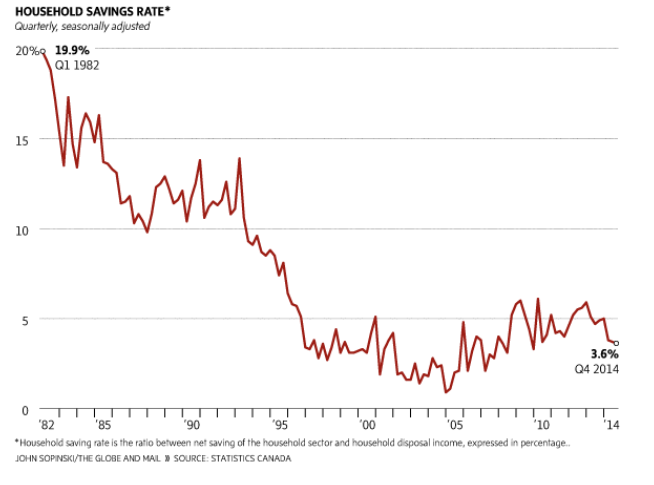
It is a common enough trope that people do not save enough, either for retirement or just generally in life. We are a society awash in debt, with some estimates showing Canadians carrying an astonishing $27000 of non-mortgage debt and an average of three credit cards. This financial misalignment, between how much we spend (bad) and how much we save (good) is a source of not just economic angst, but denouncements of sinfulness and failings of moral behavior.
This isn’t an exclusively Canadian problem. Pretty much everyone across the developed world has been accused of both not saving enough and carrying too much debt, and the remedy is usually the same, save more and spend less. Underneath that simplistic advice is the nuance that goes into managing money; the importance of paying down debt, of saving some of what you earn on payday (so you don’t see it) and a host of other little things that define good money habits.
This TTC Subway car is built in Thunder Bay. Because Toronto needs more subways, because it is a desirable, albeit expensive place to live.
But for young people trying to save and spend less they may find that the struggle is far greater than anticipated and the advice they are given can be frustrating in its obtuseness. For instance, one of the first solutions financial gurus give is “cut back on the lattes”. In one of our first articles we ever wrote was about the “Latte Effect”, (That Latte Makes You Look Poor) and how the math that underlies such advice, while not bad, isn’t going to fund a retirement.
In fact cutting costs is extremely difficult. Vox.com recently offered some advice for saving more. Pointing out that big ticket items are more useful in cost cutting than small items, the article made the improbable suggestion to “consider moving to a cheaper metropolitan area” if you are finding San Francisco or New York too expensive. Seriously. As though living in cities was a choice exclusively connected to cost, or that Minneapolis was simply New York with similar opportunities but cheaper.
In Canada this advice falls even flatter. While you can live many places, not all offer similar opportunities. Living in Windsor means (typically) making
As a financial advisor I am required to spit on the ground and curse when the subject of credit cards comes up.
cars. Thunder Bay offers both lumber production and a Bombardier plant. But if you are part of the 78% of Canadian GDP that is connected to the service sector, either through banking, finance, health services, government, retail, or high tech industries you are likely in one of four major cities, Toronto, Vancouver, Calgary or Montreal. It should be no surprise that young Canadians, facing ever increasing house prices haven’t actually abandoned major cities for “cheaper alternatives” since most of the jobs tend to be concentrated there.
So for young Canadians the challenge is quite clear. Cutting back on your expensive coffees could save you between $1000 – $2000 per year, but that won’t get you far in your retirement. Serious changes to costs of living are challenging since the biggest cost of living in cities is frequently paying for where you want to live. In between these extremes we can find some sound advice about budgeting and restraining what you spend, but it is fair to say that many young people aren’t saving because they enjoy spending their money, but because they don’t yet have enough money to cover their major costs and maintain a lifestyle that we generally aspire to.
It’s worth noting that most financial advice is pretty good and sensible, even things like watching how much you spend on coffee. Credit cards, lines of credit and overdrafts are all best avoided if possible. A solid budget that allows you to clearly see your spending habits won’t go amiss. And if you do choose to spend less on the small luxuries, it isn’t enough that the money stays in your purse or wallet. It must go somewhere so it can be both out of reach and working on your behalf or you risk spending it somewhere else.
At university and have no income? How about a credit card?
But it is financially foolish to assume that people don’t want to save. The Globe and Mail recently ran a profile on the blogger “Mr. Money Mustache” – a man who retired at 30 with his wife and claims that the solution to retiring young is to wage an endless war on wasteful spending. And he means it. Reading his blog is like reading the mind of an engineer. From how he thinks about his food budget, to what cars you own, his advice is both sound and confounding. It might be best summed up as “live like your (great) grandparents”. Sound advice? Absolutely! Confounding? You bet, since the growth in the economy and our standard of living exists precisely because we don’t want to live like our grandparents.
There is no good solution or answer here. Young Canadians face a host of challenges on top of all the regular ones that get passed down. Raising a family and buying a home are complicated by financial peer pressure and inflated house prices. Choosing sensible strategies for saving money or paying down debt (or both) often means getting conflicting advice. And young Canadians have no assurances that incomes will rise faster than their costs, nor can they simply relax about money. They must be vigilant all the time and avoid financial pitfalls that are practically encouraged by the financial industry. Finding balance amidst all this is challenging, and young Canadians should be forgiven that they find today’s world more financially difficult than the generation previous.
Last week I published a piece on the dangers of the housing bubble in Canada. It caused a stir with a number of clients and followed many articles over the past two years about our concerns with the Canadian economy.
But on Wednesday I was at an industry lunch with another group of advisors talking about the Canadian housing market and was met with a curious objection over whether there was any real danger at all. Another advisor happily pointed out to me that while the indebtedness of Canadians may be high, it is still affordable, and we should be mindful of the famous investors you have been hoisted by their own doom saying petards.
While it’s true that many doom saying predictions don’t come to pass and we should be careful before signing on to one particular points of view, arguing that lots of debt is affordable and therefore no threat is similar to a drug addict arguing everything is under control because they still hold down a job. The job is irrelevant to the problem, although it’s absence is likely to make matters worse.
This is why it is somewhat irrelevant to worry about the Canadian housing market. Whether you believe there will be a soft landing, a hard landing or no landing at all, what Canadians have is a debt problem. Only it’s not a problem because it’s affordable. Also it’s a problem.
If that last sentence is confusing, don’t worry. It sounds worse coming from the Bank of Canada, who in their December Financial Systems Review pointed out that debt levels continue to climb but the relative affordability of the debt remains consistent. And while an economic shock to the system could make much of that debt unserviceable, for now that seems unlikely. They concluded this section of the report identifying the risk to Canadians as “elevated”.
How to best handle this problem will have to be left to others. There is no simple solution that will not trigger the bomb, and the goal of any government is to slowly reduce the average debt burden without hurting the economy or deflating the bubble. For my part I tend to advise people to pay their debts down, shy away from things they cannot afford and encourage saving rather than debt spending to limit risk. When it comes to saving for the future there is no reason to make many people’s problems your problems.
Possibly the most significant news in the last 24 hours was that Barack Obama had used his veto for the first time in five years to end the Keystone XL Pipeline. The pipeline, delayed by 6 years carried with it the hopes of the Canada’s Conservative party and oil executives in Alberta. The pipeline had been opposed, studied and debated, being bounced back and forth through the US government. It had been primarily opposed by environmentalists who object to the environmental impact of Alberta Tar Sand oil and hoped that by killing the pipeline less of it would be extracted, alternative fuels would fill some of the gaps and the world would be a healthier place as a result. It’s subsequent (and rather final) cancelation is being heralded as a victory by many environmental activists.
As we’ve already written, this was not case. While the pipeline hadn’t been built it hadn’t slowed the development of the oil sands, or impeded its movement to refineries. Instead it had simply been supplanted by rail cars. Although more expensive, the roughly $9 a barrel premium was well worth it when oil was above $100 a barrel.
The current price of oil helps explain why there was little real political risk to anybody in the veto of the pipeline. While oil was expensive there was real incentive to get Canadian oil to US markets. It helps offset oil from more troubling parts of the world and makes the economy run a little smoother. But the rise of US shale, the falling price of oil, the use of train cars, an improving economy and rising dollar has wrecked the economics of building the pipeline. By the time the Obama had vetoed the bill there was very little at stake politically except to satisfy his environmental base of voters. The pipeline may yet be still resurrected, but six years on and a new economic reality will likely mean little will get done soon.
The death of the pipeline is troubling most of all for Canada. Shipping oil by train is more expensive, and considerably more dangerous. It also reflects the new found reality that the government cannot rely on oil prices to bolster the economy. But most of all it reflects the continuing declining fortunes of Alberta and returns focus to Ontario, the once and future king of the broad economy.
On December 10th, the Bank of Canada released it’s Financial System Review for 2014. It outlined numerous problems that continue to grow and potentially undermine the Canadian economy. Globally this report attracted a great deal of attention, not something the BoC is used too, but with a rising concern that the Canadian housing market is overvalued, an official document like the FSR gets noticed.
To understand why Canada is growing in focus among financial analysts around the world you need to turn the clock back to 2008. While major banks and some countries went bankrupt, Canada and its banking system was relatively unscathed. And while the economy has suffered due to the general economic slowdown across the planet, the relative health of our financial system made us the envy of many.
But the problems we’d sidestepped now seem to be hounding us. Low interest rates have helped spur our housing market to new highs, while Canadians in general have continued to amass debt at record levels. Attempts to slow the growth of both house prices and improve the standard of debt for borrowers by the government have only moved loan growth into subprime territory.
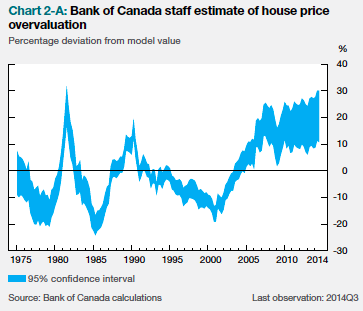
If all this sounds familiar, it’s because we’ve been talking about it for sometime, and sadly the BoC hasn’t been able to add much in the way of clarity to this story. While we all agree that house prices are overvalued, no one is sure quite how much. According to the report the range is between 10% to 30%. Just keep in mind that if you own a million dollar home and the market corrects, it would move the price from $900,000 to as low as $700,000. That can make a considerable dent to your home equity and its too big a swing to plan around.
On top of this is the growth of the subprime sector in the market. Stiff competition between financial institutions and an already tapped out market has encouraged “certain federally regulated financial institutions” to increase “their activities in riskier segments of household lending.” This is true not just in houses but also in auto loans, where growth as been equally strong.
The Financial System Review also goes on to talk about problems growing in both cybersecurity and in ETFs (both subjects we have written about). It also talks about some of the positive outlooks for the economy, from improving economic conditions globally and support for continued economic activity. But its quite obvious that the problem Canadians are facing now is significant underlying risk in our housing and debt markets. These problems could manifest for any number of reasons (like a sudden drop in the price of oil, a significant slowdown in China, or a fresh set of problems from Europe), or they may lay dormant for months and years to come.
For Canadians the big issues should be getting over our sense of economic specialness. As I heard one economist put it “Canadians feel that they will be sparred an economic calamity because they are Canadian.” This isn’t useful thinking for investors and as Canadians we are going to have separate our feelings about our home from the realities of the market, something that few of us are naturally good at. But long term investor success will depend on remaining diversified (I know, I link to that article a lot), and showing patience in the face of market panic.
Concerned About The Market and Recent Volatility? Contact Us!
It may come as a real surprise to many Canadians but we have never been a strong economy. From the standpoint of most of the world we barely even register as an economic force. Yet a combination of global events have conspired to make Canadians far more comfortable with a greater sense of complacency about the tenuous position of Canada’s economic might.
Don’t get me wrong. It’s not that Canada and Canadians aren’t wealthy. We are. But having a high standard of living is largely a result of forces that have been as much beyond our control as any particular economic decisions we’ve made.
Consider for a second the size of Canada’s economy in relation to the rest of the world. While we may be one of the G8 nations, the Canadian economy only accounts for about 2-3% of the global GDP, and has (according to the IMF) never been higher than the world’s 8th largest economy. Even with the growth in the oil fields Canada hasn’t contributed more than 2.8% to global growth between 2000 and 2010.
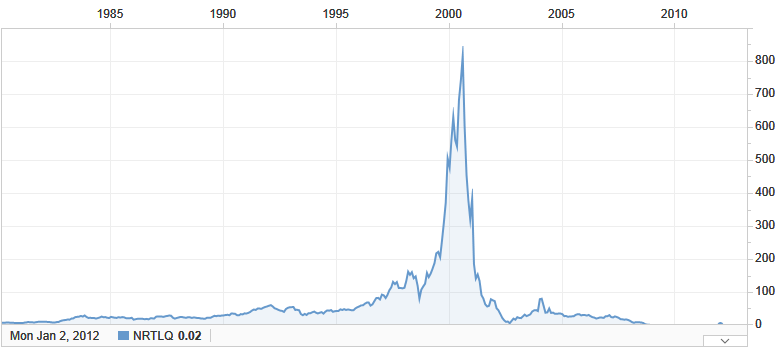
The Rise and Fall of Nortel Stock.
It’s not just that Canada isn’t a big economy, we’re also a narrow one. In the past we’ve looked at how the TSX is dominated by only a few sectors, but the investable market can play even crueler tricks than that. If you can remember the tech boom and the once great titan Nortel, you might only remember their fall from grace, wiping out 60,000 Canadian jobs and huge gains in the stock market. What you should know is that as companies get bigger in the TSX they end up accounting for an ever greater proportion of the index. At its peak Nortel accounted for 33% of the S&P/TSX, creating a dangerous weighting in the index that adversely affected everyone else and skewed performance.
Similarly much of Canada’s success through the 90s and early 2000s had as much to do with a declining dollar. While it may be the scourge of every Canadian tourist, it is an enormous benefit to Canadian industry and exports. Starting in 2007 the Canadian dollar began to gain significantly against the US dollar. This sudden gain in the dollar contributed to Canada’s relative outperformance against every global market. The dollar’s rise was also closely connected to the rise in the value of oil and the strong growth in the Alberta oil sands.
This mix of currency fluctuations, oil revenue and narrow investable market has created an illusion for Canadian investors. It has created the appearance of a place to invest with greater strength and security than is actually provided.
Some studies have shown that the average Canadian investor will have up to 65% of their portfolio housed in Canadian equities. This is insane for all kinds of obvious reasons. Obvious except for the average Canadian. This preference for investing heavily into your local economy has been coined “home bias” and there is lots of work out there for you to read if you are interested. But while Canadians may be blind to the dangers of over contributing to their own markets, it becomes obvious if you recommend that you place 65% of your money in the Belgium or the Swedish stock market. However long Canada’s relative market strength lasts investors should remember that all things revert to the mean. That’s a danger that investors should account for.
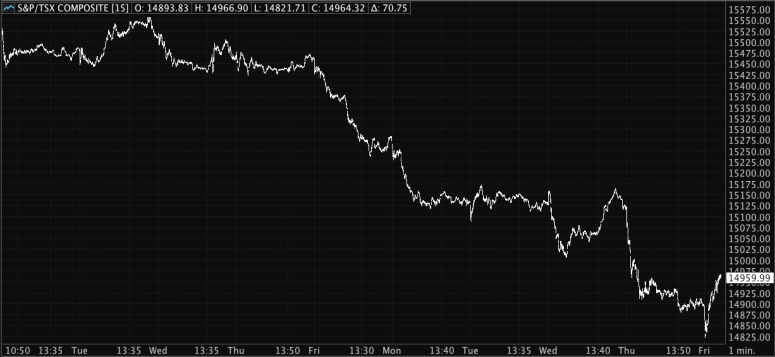
Last Friday I watched the TSX start to take a precipitous fall. The one stock market that seemed immune to any bad news and had easily outperformed almost every other index this year had suddenly shed 200 points in a day.
Big sell-offs are common in investing. They happen periodically and can be triggered by anything, or nothing. A large company can release some disappointing news and it makes investors nervous about similar companies that they hold, and suddenly we have a cascade effect as “tourist” investors begin fleeing their investments in droves.
This past week has seen a broad sell-off across all sectors of the market in Canada, with Financials (Read: Banks), Materials (Read: Mining) and Energy (Read: Oil) all down several percentage points. In the course of 5 days the TSX lost 5% of its YTD growth. That’s considerable movement, but if you were looking to find out why the TSX had dropped so much so quickly you would be hard pressed to find any useful information. What had changed about the Canadian banks that RBC (RY) was down 2% in September? Or that TD Bank (TD) was down nearly 5% in a month? Oil and gas were similarly effected, many energy stocks and pipeline providers found themselves looking at steep drops over the last month. Enbridge (ENB) saw significant losses in their stock value, as did other energy companies, big and small, like Crew Energy (CR).
The S&P TSX over the last five days
All this begs the question, what changed? The answer is nothing. Markets can be distorted by momentum investors looking to pile on to the next hot stock or industry, and we can quibble about whether or not we think the TSX is over valued by some measure. But if you were looking for some specific reason that would suggest that there was something fundamentally flawed about these companies you aren’t going to have any luck finding it. Sometimes markets are down because investors are nervous, and that’s all there is to it.
Market panic can be good for investors if you stick to a strong investment discipline, namely keeping your wits about you. Down markets means buying opportunities and only temporary losses. It help separates the real investors from the tourists, and can be a useful reminder about market risk.
So was last Friday the start of a big correction for Canada? My gut says no. The global recovery, while slow and subject to international turmoil, is real. Markets are going to continue to recover, and we’ve yet to see a big expansion in the economy as companies deploy the enormous cash reserves they have been hoarding since 2009. In addition, the general trend in financial news in the United States is still very positive, and much of that news has yet to be reflected in the market. There have even been tentative signs of easing tensions between Russia and the Ukraine, which bodes well for Europe. In fact, as I write this the TSX is up just over 100 points, and while that may not mean a return to its previous highs for the year I wouldn’t be surprised if we see substantial recoveries from the high quality companies whose growth is dependent on global markets.
In a few hours we will begin finding out the future of Scotland and the United Kingdom, and we may be witness to one of the most incredible social and economic experiments in the history of the Western World.
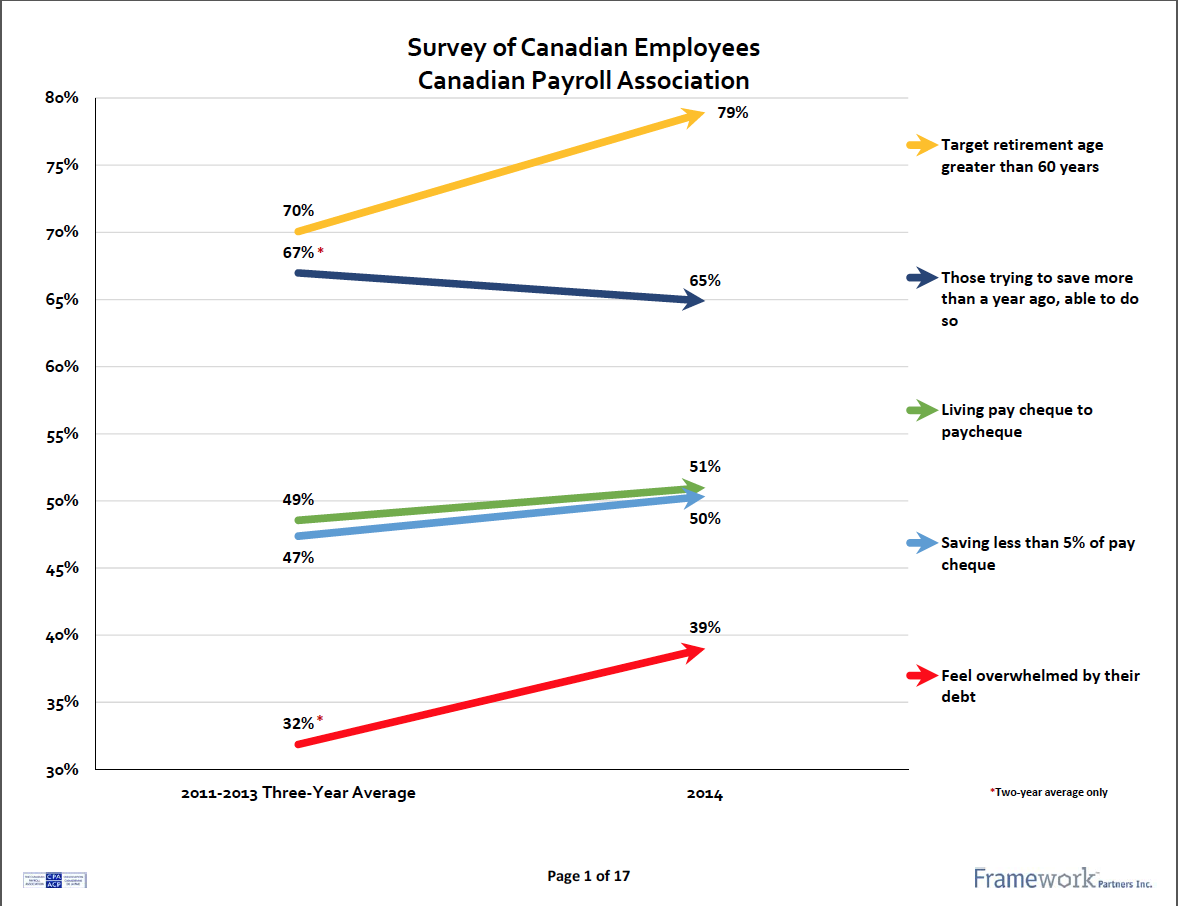
But while many suspect that a yes vote for Scottish independence may cast an uncertain economic future, it shouldn’t be forgotten that as Canadians we are also going through our own uncertain economic experiment. According to a survey conducted by Canadian Payroll Association and released this month, 25% of Canadians are living paycheque to paycheque, with nothing left in their accounts once their bills have been paid for.
In addition, the majority of Canadians have less than $10,000 set aside for emergencies and these numbers get (unsurprisingly) worse as you look at various age groups. Young Canadians are the worst off, with 63% saying they are living paycheque to paycheque between the ages 18 to 29.
But when it comes to planning for retirement, the numbers are significantly more dire. More and more Canadians are expecting to delay their retirement, citing insufficient funds for their retirement nest egg. Even as people (correctly) assume that they will need more money to last them through retirement, 75% of those surveyed said they had put away less than a quarter of what they will need, and for those Canadians getting closer to retirement (north of 50), 47% had yet to get to even a quarter of their needed savings.
None of this is good news, and it undercuts much of the success of any economic growth that is being reported. While the survey found that people were trying to save more than they had last year it also highlights that many people felt that their debt was overwhelming, that their debt was greater than last year and that mortgages and credit cards by far accounted for the debt that was eating into potential savings.
The report has a few other important points to make and you can read the who thing HERE. But what stands out to me is how economies and markets can look superficially healthy even when the financial health of the population is being eroded. This is a subject we routinely come back to, partly because its so important, and partly because no one seems to be talking about it past the periodic news piece. Our elections focus on jobs, taxes and transit, but often fail to begin addressing the long term financial health of those voting.
If you’ve been following this blog, you’ll have noticed how I am regularly concernedabout the state of the Canadian economy. And while I maintain that I have good reason for this; including fears about high personal debt, an expensive housing market and weakening manufacturing numbers, the sentiment of the market isn’t with me. As of writing this article the TSX is up just over 14% YTD, spurred on by strong numbers in the small cap, energy and banking sectors.
All this illustrates is the incredible difficulty of understanding and seeing the truth in an economy. Is an economy healthy or unhealthy? How do we know, and which data is most important? Economies produce all kinds of information and it’s frequently hard to see the forest for the trees. But even with all the secrecy around the bank’s and regulators financial misdeeds prior to 2008, the writing was on the wall that the US housing market was over inflated and that savings rates were too low and debt rates too high. And while you could be forgiven for not really understanding the fine points of bundled derivates and just how far “toxic debt” had spread, it wasn’t as though the banks had hidden the size of their balance sheets or the number of outstanding loans. It was all there for anyone to see. And people did see it and then shrugged.
One of the big fallouts of the financial meltdown was extensive criticism directed at the professional class of economist and business reporters who give regular market commentary and missed the total implosion of the financial and housing sectors. After all, how good could these “professionals” be if they can’t see the financial freight train like the one that just came through? . But I would chalk that up to overly positive market sentiment. It’s not that they didn’t see the bad news, they just assumed that other better news was more important.
Look at these two articles from yesterday’s (August 20th, 2014) Globe and Mail:
While these two articles aren’t exactly equal, (one is talking about Canada right now, the other is talking about prolonged growth of Canadian shipping over the coming decades) it’s interesting to note that they sit side by side on the same day in the same newspaper. For investors (professional and individual alike) it is an ongoing challenge to make sense of the abundant information about the markets without resorting to our “gut feelings”. Do we tend to feel good about the market or bad? Which headline should be more important? Here is a third article from the same day: (Click the image to see the full size article).
Its plain to see how I feel about the state of the Canadian market (and which news I place value on), but its also possible that I’m the crazy one. Lots of Canadians disagree with me quite strongly and it is shown everyday the TSX reaches some new high. Which brings us back to investor, or market sentiment. Described as the “tone” of the market, it might be better thought as human irrationality in assessing odds and errors in estimating value. Investor sentiment plays a significant role in valuing the market over the short-term, far in excess of hard financial data. And it isn’t until that sentiment turns sour that we begin to see corrections. Coincidentally, holding an opinion contrary to the popular sentiment is quite lonely, and many portfolio managers have been criticized for their steadfast market view only to be proven right after they had acquiesced to investor complaints about poor performance.
Following a correction, once the positive market sentiment has been washed away, it seems obvious to us which information we should have been paying attention to. But that doesn’t mean being a contrarian is automatically a recipe for investment success. I may be wrong about the Canadian market space altogether (it wouldn’t be that shocking), and in time I will regret not placing more value on different financial news. What is far more valuable to investors is to have a market discipline that tempers positive (and negative) sentiment. An investing discipline will reign in enthusiasm over certain hot stocks, and keep you invested when markets are bad and the temptation is to run away. Sometimes that means being the loser in hot markets, but that may also mean better protection in down markets.