Crimean Crisis Reminds Everybody Why Investing is a Long Game

kiev-split_2829872b
Kiev Square, before and during the protests.

You might have been forgiven if you hadn’t been paying close attention to the Ukrainian Revolution two months ago when it was a long and violent standoff between the Ukrainian government and its people. Kiev square looked like a war zone and reports, while increasingly dire, were not necessarily front page news. But since the toppling of the pro-Russian Ukrainian President Victor Yanukovych it has been impossible to not pay attention to the exploding diplomatic mess of the Crimea.

As of this morning it appears that Vladimir Putin is going to annex the Crimea, much to Ukraine’s dismay, Europe’s frustrations and America’s exhaustion. The crisis is also far from over. The Ukrainian government (now mostly pro-western Europe) is saying that that will not allow such a loss of territory, EU and US sanctions are targeting Russian oligarchs. France is promising to cancel an order of military ships to Russia if Britain punishes Russian billionaire’s living in London. Russia seems relatively unfazed by any of this and seems to know that regardless of what legal reasons may exist that could start a war, few seem interested in shedding blood for the Ukraine.

All of this is obviously upsetting markets. Over the last month the global markets, and especially European markets have taken significant hits over concerns that some kind of conflict is about to breakout.

Bloomberg's Global Index looks at European, Middle Eastern and African Markets
Bloomberg’s Global Index looks at European, Middle Eastern and African Markets
This is the UK stock market (FTSE) over the last month. Performance has clearly suffered as the Crimean situation has worsened.

This creates the kind of immediate volatility that is both temporary and is difficult to counter. It’s a reminder that investing is different from day trading. There are people who are willing to try and make profits from the day to day fluctuations of this (most recent) crisis. They will be jumping in and out of the markets, trying to grab the slight differences over each day and profiting from nervous investors. But being an investor means riding out this volatility with the knowledge that while it is uncomfortable, it is ultimately temporary and that real growth comes from long term success, not day to day jitters.

That being said, it would be nice if we didn’t accidentally end the world!

the-worlds-end-poster-header

Looking for Dark Clouds Amidst Silver Linings

628x471This year got off to a rocky start. As of writing this post, the S&P 500 is down over -2% year-to-date (YTD), while other global markets have been similarly affected. The MSCI Global Index is down nearly -1%, the MSCI Emerging Markets index is also down -4.5%, as is the FTSE 100 (UK, -1.3%) and last year’s super-performer, Japan (-12.1%). This sudden “frothiness” has brought out the fear mongers and market doom-sayers. So regularly has the drum been beaten that 2014 should see a significant slide in market value that it has become a regular question in every meeting. (note: I did not update these numbers for the current week, however many of these returns have improved. In some cases quite dramatically)

The only problem is that any internet search will easily reveal market calls for a correction EACH and EVERY YEAR! This doesn’t mean that a correction won’t happen, in fact if there is one thing that we know about the markets its that corrections do, and must happen. We also know that the longer you go without a correction the closer you must be to having one. The problem is that we place value on people who claim to be able to predict a market downturn, even when we can’t actually predict when a downturn will actually occur. So the media keeps trotting out people willing to make outlandish market predictions knowing that it will grab headlines and eventually be right.

Except….

Except that there are lots of reasons to be cautious in the current market conditions. Not that we can predict when we might actually see a downturn, but there a lot of reasons why it makes sense to have defensive positions in your portfolio. For instance, we are currently at an all time high for IPOs, the most since 1997. There is some evidence that as IPOs peak its not uncommon to see a market correction, as less valuable companies try to cash in on market exuberance and professional investors try and sell their positions in less viable companies to bullish markets.

Other market metrics also seem to favour being on the defensive. Currently there are 84 companies on the S&P 500 with shares that are valued above 10x earnings. This means that investors are incredibly bullish about the future prospects when it comes to income growth. Many of these companies are in hi-tech sectors, like social media firms such as Twitter. For the record that is the most number of companies above this valuation since prior to the tech bubble in 1999.

Share buy backs also play a role here. If you aren’t familiar, with borrowing rates still very low many companies have taken the opportunity to borrow large sums of money and buy their outstanding shares back. Why? As the number of outstanding shares in the market declines the Earnings Per-Share goes up. This means that even if a company isn’t seeing actual growth in sales, it does mean that the the remaining shares receive a greater portion on the earnings, artificially increasing their value. In of itself this isn’t a problem, but it serves to increase the stock market while not seeing much in the way of actual economic growth.

Lastly we have also seen that the flow of money into ETF funds (passive investments that mimic indices) is also adding volatility to the markets. As investors remain concerned over negative surprises in the news, the high liquidity of ETFs causes even greater short term fluctuations in the markets as investors pull back. This is especially true in the Emerging Markets, and has had the unusual side effect of showing that actively managed funds have outperformed comparable ETFs.

In summary then there are four good reasons to believe that the markets may get more turbulent going forward. The lesson however is not to commit to a wholly negative or positive view of the markets, but rather continue to hold a diversified group of assets to deal with all market surprises, both good and bad!


Canadians Losing the Battle to Save For Retirement

Money WorriesPeople sometimes ask why I seem to be so focused on housing and its costs as a financial advisor, and I think the answer is best summed up declining rates of RRSP contributions. Currently many Canadians seem to be opting out of making a RRSP contribution this year, with both Scotiabank and BMO conducting separate and disheartening surveys about likely RRSP contribution rates. Unsurprisingly the answer most Canadians gave to why they would not be contributing this year was because they “did not have enough money.” These surveys also found that 53% of Canadians did not yet have a TFSA either for similar reasons. The expectation is that by 2018 Canadians will have over a trillion dollars of unused contribution room.

These kinds of surveys invariably lead to a kind of financial “tut-tutting” by investment gurus.

As one member of BMO’s executes put it, an “annual contribution of $2,000 to an RRSP… costs less than $6 per day.” which is true but does not really spell out a viable path to a retirement, merely the ability to make a contribution to a RRSP. While there is nothing wrong with the Gail Vaz-Oxlade’s of the world handing out financial advice and directing people to live debt free, Canadians simply do not live in some kind of financial vacuum where all choices boil down to the simple mantra of “can I afford this?” Frequently debts are incurred either because they must be (educational reasons, car troubles, etc.) or because it is not feasible to partake in an economic activity without taking on debt (like buying a house). Similarly it is not practical to assume that every decision be governed exclusively by a simple weighing of financial realities. It’s true it would cost less to live in Guelph, but many people do not wish to live in Guelph and would rather live in Toronto (Nothing personal Guelph!)

What we do have though is a precarious situation where the economy is weak (but maybe improving), which sets government policy through low interest rates. Low interest rates means borrowing for big ticket items like homes in places where supply is limited, like the GTA, or Vancouver or Calgary. This in turn keeps both house prices and debt levels high. It’s telling as well that a growing number of Canadians are beginning to look at their homes as a source of potential income in retirement. All of this seems to be happening while different financial “experts” argue whether the Canadian housing market is actually over valued, or not

This is where I get a chance to make a personal plug for the benefits of my role. While I don’t have much say in government policy, or even directing housing development in big cities, it is rewarding to know that financial advisors like me have a significant impact on the savings rates of those Canadians that work with us. A study called Value of Advice Report 2012 reported that Canadians that had a personal wealth advisor (that’s me) were twice as likely to save for retirement, and that the average net worth of households was significantly higher when they had regular financial advice from an advisor (again, me). The RRSP deadline this year is March 3, so please give me a call if you haven’t yet made your RRSP contribution. 

← Back

Thank you for your response. ✨

Jack Sparrow and the Pirate Stock Exchange

In case you missed it 2013 seemed to mark the end of Somali piracy. If you can cast your mind back to 2011, piracy off the coast of Africa seemed to be the next big problem. In fact 2011 marked the peak of Somali piracy with 237 separate attacks. In contrast 2013 saw only 15 Somali pirate attacks, an incredible reduction. Piracy is still out there, around countries like Indonesia and off the coast of some West African nations, but the threat of Somali piracy has largely disappeared.

That’s good for those on the high seas, but it means that we miss an opportunity to see how natural and beneficial capital markets are in distributing wealth and helping economies. And yes you read that sentence right.

In this photo taken Sunday, Sept. 23, 2012, masked Somali pirate Hassan stands near a Taiwanese fishing vessel that washed up on shore after the pirates were paid a ransom and released the crew, in the once-bustling pirate den of Hobyo, Somalia. The empty whisky bottles and overturned, sand-filled skiffs that litter this shoreline are signs that the heyday of Somali piracy may be over - most of the prostitutes are gone, the luxury cars repossessed, and pirates talk more about catching lobsters than seizing cargo ships. (AP Photo/Farah Abdi Warsameh)
In this photo taken Sunday, Sept. 23, 2012, masked Somali pirate Hassan stands near a Taiwanese fishing vessel that washed up on shore after the pirates were paid a ransom and released the crew, in the once-bustling pirate den of Hobyo, Somalia. The empty whisky bottles and overturned, sand-filled skiffs that litter this shoreline are signs that the heyday of Somali piracy may be over – most of the prostitutes are gone, the luxury cars repossessed, and pirates talk more about catching lobsters than seizing cargo ships. (AP Photo/Farah Abdi Warsameh)

The core problem for Somalians is that amongst their many, many problems, there is not enough money in the country. This makes sense for a number of reasons. It is a dangerous place, and people who do have money and live there are unlikely to put money into local businesses or trust a bank. Corruption is rampant and the best way to describe Somalia currently is as a failed state. All this makes it very difficult for the citizens of Somalia to attract foreign investors. As an alternative to traditional business practices, many Somalians took up the cause of high seas piracy and ransomed boats and ships back to their host countries in exchange for money. Whether you realize it or not, in this way Somalia was actually improving their economy (albeit illegally) by providing fresh inflows of foreign capital. But how did the money find its way into the local economy? Through the pirate stock market of course!

That’s right, in 2009 a stock market was set up in the small fishing community of Harardheere with about 70 different…pirate entities(?) that locals could invest in. Giving money to one of these entities helped fund piracy on the high seas and successful raids would be paid out to the investors. There is more information about it in this 2011 article in the Wall Street Journal and I encourage you to have a read of this fascinating account of a naturally occurring stock market, but I think this quote from the article sums up the rather banal and natural benefits that markets provide to economies:

As local security officer Mohamed Adam put it to Reuters, “Piracy-related business has become the main profitable economic activity in our area and as locals we depend on their output.” Mr. Adam claims that the district government gets a cut of every dollar collected by pirates and uses it—naturally—for schools, hospitals and other public infrastructure.

jack-sparrow-running

Since then however the international response to Somalian piracy has been swift and decisive. And while the horn of Africa might be safer for international shipping the reasons behind Somalian piracy remain unresolved. But it is insightful to see that this brief chapter of piracy (outside of the Johnny Depp variety) was actually more nuanced and lends an odd credibility to the needs and benefits of markets for investors and companies, regardless of who they are or what business they are in.

The Debt Ceiling Is Pointless

From the Washington Post, Tuesday February 11, 2014

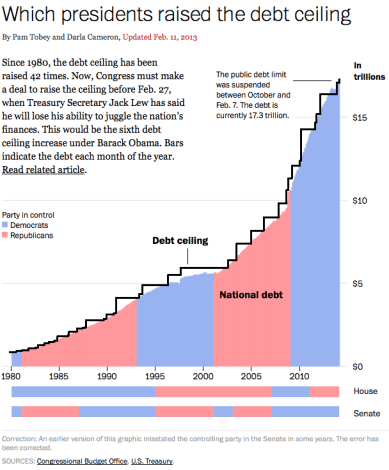
It would seem that the Republicans in the United States have been largely de-fanged when it comes to using the debt ceiling as a political lever. Yesterday Republicans agreed to a ‘clean’ debt ceiling vote, meaning that there were no poison pills for Democrats to swallow, and that political fighting and decisions would have to happen without the threat of a total global economic meltdown.

But the debt ceiling need not exist at all. As you may know, there aren’t any other major economies that have “debt ceilings” – instead the debt ceiling was a by-product of America’s involvement in the First World War, when Congress (the group authorized to allow for debt) needed to give the treasury room to borrow. The solution was the Debt Ceiling that we know today.

But the debt ceiling isn’t helpful and doesn’t do any of the things that people intend it to do. For instance, as a way of stopping or limiting borrowing it doesn’t work. Most of what the treasury is paying goes out automatically, like paycheques and benefits. Stopping borrowing doesn’t eliminate the debt obligation, it just puts you in default.

As a method to improve the financial health of the United States its hard to see how breaching the debt ceiling would improve the American economy. Far more likely it would tank the US and much of the global markets.

As a tool to fight for social change it is dangerous and undemocratic. The financial responsibilities of the United States sit on both party’s shoulders, not just one.

Lastly, the debt ceiling has prevented more useful conversations about how to help the American economy where both parties had something to offer. Have a look at this video by historian Niall Ferguson from 2011. The economy has improved since then and the economic outlook is better than before, but it is telling that the debt ceiling offers us little and distracts people from more useful political solutions.

It’s time to get rid of the debt ceiling.

Don’t Forget to Like This Market Bubble on Facebook!

Say No to FacebookHow much would you pay for something that is free? This is the basic question behind trying to value the many forms of social media that have dominated the business news over the last few years. Pinterest was valued earlier in 2013 at $3.8 billion. It makes no money. In Twitter’s initial pubic offering its share’s rose to over $45, giving the company a value in excess of $30 billion. It also has yet to turn a profit. Linkedin does make money, but it’s valued like a company that makes 100x more than it actually does. Facebook, which does turn a mighty profit, generates that money not from their user base, but from companies trying to engage its user base. While Facebook does have a lot of users, many of them don’t like advertising on their profile and click rates for advertising have been reported as lower than advertising on the web in general.

What we have then is an abnormal situation where investors appear to be willing to pay big money for companies that don’t seem to be even close to making any of that investment back (some companies don’t even seem interested). In contrast companies like Apple have seen huge fluctuations in their share value on the mere speculation that they may not make quite as much money as previously thought.

To my eyes this has all the makings of a market bubble. I’ve written about the absurd way we seem to value internet businesses that don’t make any money before. One theory for these valuations is that these businesses are highly scalable. Adding more users doesn’t cost much more in terms of effort. Other theories include the idea that while many of these businesses may yet to turn a profit, the sheer number of dedicated subscribers means that the business model simply needs to be worked out.

My view on this is that there is a lot of hope attached to a lot of uncertainty. Investment excitement behind companies like Pinterest, Linkedin or Twitter, which have high valuations and little to no earnings, is driven more by a “don’t miss out” attitude. In comparison businesses that have actual earnings, products and market presence are judged far more critically and by more rigorous standards.

I think a good acid test here is what investors are being encouraged to buy compared to say, an actual tech company. In the last few months Google has acquired both robotics maker Boston Dynamic and recently Nest, the innovative thermostat and smoke detector company. Both of these companies make things. Amazing things. None of these things require you to like, share, link to or visit a page. Instead they are making tangible things that people want, or will want. The same is true for Apple computers, Samsung, GM, Toyota, Coca-Cola and Proctor & Gamble.

As investors its important not to lose focus that the ideal investment is one that provides the steak, not just the sizzle.

Be the Most Interesting Person at Christmas Dinner

Merry Christmas and Happy Holidays! We’ve been busy over here for the last couple of weeks and unfortunately I haven’t been able to update our blog as often as I would like. However lots of interesting and important things have been happening over the past two weeks and they are worth mentioning. Check them out below!

Bitcoin is maybe not going to survive. Maybe: There is an ongoing fight about whether Bitcoin, the digital currency, is in fact a real currency. Bitcoin has been criticized for being a tool of the criminal underworld, and praised for its inventiveness. But like all fiat currencies there is a lot of speculation about whether it is worth anything. After all, who is backing Bitcoin? There is no government that will guarantee it and not every government is happy with it, and its value fluctuates wildly. And yet Bitcoin persists, at least until today. China has just banned Bitcoin and its largest exchange will not accept any more deposits, sending the value of Bitcoin tumbling.

What’s good for the investor maybe bad for the economy: There is a demographic shift going on in the Western Developed nations. People are getting older. Not just older, but retirement older, and as a result the economy is feeling pressured to respond to needs arising out of this aging baby boomer trend. One of those shifts is towards dividends. Dividends are traditionally issued by companies to their shareholders when the companies have extra money lying around and can’t use it productively. However many companies, especially large ones that generate more cash flow than they can reasonably use issue regular dividends, such as banks and many utilities. This is useful to investors that are looking to retire or are retired already. Regular dividends help provide retirees with regular and predictable income. However dividends may be bad for the economy. CEOs are often rewarded for market performance, and markets tend to like companies that increase their dividends (Microsoft increased its dividend in September). But companies can be far more useful to the economy generally when they invest in growth rather than give money back to shareholders. That would mean hiring new people, building new factories and generally moving money through the economy. But as much of the population ages and looks for dividends this might undermine the both growth in economic terms and affect choices that CEOs make about the future of their companies.

Canadians are at record debt levels, again: This may not come as much of a surprise, but Canadians have record debt levels and nothing seems to be correcting it! This story began regularly occurring in 20102011, 2012, and of course 2013. What is more important about how high the debt of Canadians continues to rise, but what’s driving it. Not surprisingly it’s mortgages. The high cost of Canadian housing has worried the federal government, and many global organizations. But far worse would be a deflationary cycle on Canadian homes, driving down the price while saddling home owners with debts far in excess the value of their houses. Despite a number of efforts to limit the amounts that Canadians are borrowing, the very low interest rate set by the Bank of Canada is keeping Canadian’s interested in buying ever more expensive homes. The reality is that no one is really sure what is to be done, or what the potential fallout might be. What is clear is that this can’t continue forever.

We’re going to be taking next week off, but will be back in January!

It’s Official, Young Canadians Need Financial Help

I thought I had more saved!It must be terribly frustrating to be a twenty-something today. It’s hard to find work; you probably still live with your parents and a whole culture has developed around criticizing your generation. But beyond the superficial criticisms directed at twenty somethings, there are structural shifts going on within the economy that are making paupers of the next generation.

Some of these shifts do extend from things like a lack of good paying jobs in manufacturing and an increasingly reliance on service sector jobs. There are many university graduates that now find themselves in work that they are overqualified for and underpaid in. But some of the changes also come from an increasingly high cost of living that is making it financially untenable to move out of a parents’ home. This phenomenon has been dubbed “boomerang kids”, or “boomerang generation.”

The challenge that the Millennial generation is facing is that costs are rising as a proportion of their income. Consider the cost of a house in Toronto. In November of this year the average cost of a home sold in Toronto was $538,881, up 11.3% from November of last year. Assume you make the minimum downpayment to get a home, 5%, your downpayment would then be $26,944 (roughly).  Your monthly payment on a 25 year fixed rate mortgage would be $3,077 per month, or close to $36,924 per year. If we factor in real-estate tax and an average heating cost, that would bring annual costs to roughly $43,000 a year. That would mean that to qualify for the mortgage with a bank you would need to be earning at least $134,375 before taxes. The average income in Canada is $47,000.

We can quibble about how accurate these numbers are, but it would still amount to the same end. It costs a lot today to be like your parents. Buying a house for the first time is incredibly expensive and forces young people to make different choices about how to spend their money. For many millennials this has meant “postponing” growing up, financially as well as spiritually. But what today’s young generation actually need is a working budget that lets them get a big picture of their spending and allows them to set and reach financial goals. There are free services, like Mint.com (which I am very much in favour of), but even better is that young people should be encouraged to seek out professional financial help. People with a small amount of savings often feel discouraged about seeing a professional, but getting this guidance early on can lead to significantly better financial outcomes, comfort with the markets and wiser tax efficient planning!

Want to discuss your future planning?

← Back

Thank you for your response. ✨

Successful Cities Don’t Always Feel Successful

Toronto Boom Town

In the ongoing tedious and sad affair that is Rob Ford, I came across an interesting article from Edward Keenan written just before Mayor Ford won his election. The pertinent part of the article I feel is where the Ford campaign’s genius was to define the election around the idea that Toronto is a city in decline. This idea, which caught on as the election narrative suited the Ford camp well, and by pointing to traffic, city projects and basically the realities of a city that is rapidly growing made it appear that Toronto really was broken.

But Toronto isn’t broken, and many of the problems that we face are actually the problems of a city that is incredibly successful and growing rapidly. It’s ironic that the outward signs of our success are some of the things that aggravate us the most, but its a reminder that strong economies don’t look like lazy towns on a Sunday afternoon but instead are chaotic, busy, hot and frustrating. It’s also interesting that many of the problems that successful cities face (and things that define a successful city) don’t ever change, regardless of the age. Noise, construction, overcrowding, congested traffic and suburban resentment are the hallmarks of prosperous cities.

Since I am a great believer that cities are our economic future I think its worth pointing out that the problems we face today we faced in the past, and will continue to face in the future. Cities that are actually in decline have a totally different set of problems. So its better to worry about constant traffic congestion and debate how best to expand our public transit than to wonder whether we should have public transit at all. If you’d like to see Toronto dealing with this in the past, may I recommend Toronto Boom Town by Leslie McFarlaneNational Film Board of Canada, a ten minute long video from 1951, looking at Toronto, a booming city of tomorrow!

Great Further Reading: The Unwanted Sound of Everything We Want by Garret Keizer, Triumph of the City by Edward Glaeser, Some Great Idea by Edward Keenan