Canada’s Housing Bubble Will Burst & We’re Not Ready

On Saturday a small book was released nation wide that made a big claim, Canadian housing prices are poised to drop between 40% to 50%. Written by a financial advisor in Edmonton, Hilliard MacBeth, When the Bubble Bursts is a grim and insightful polemic about both our obsession with housing and the danger such high valuations pose to our economy. I’ve been negative about Canada for a long time, particularly about Canada’s improbable and endless real estate boom, but what the author has done in his book is attach some actual numbers around how serious our housing problem is.
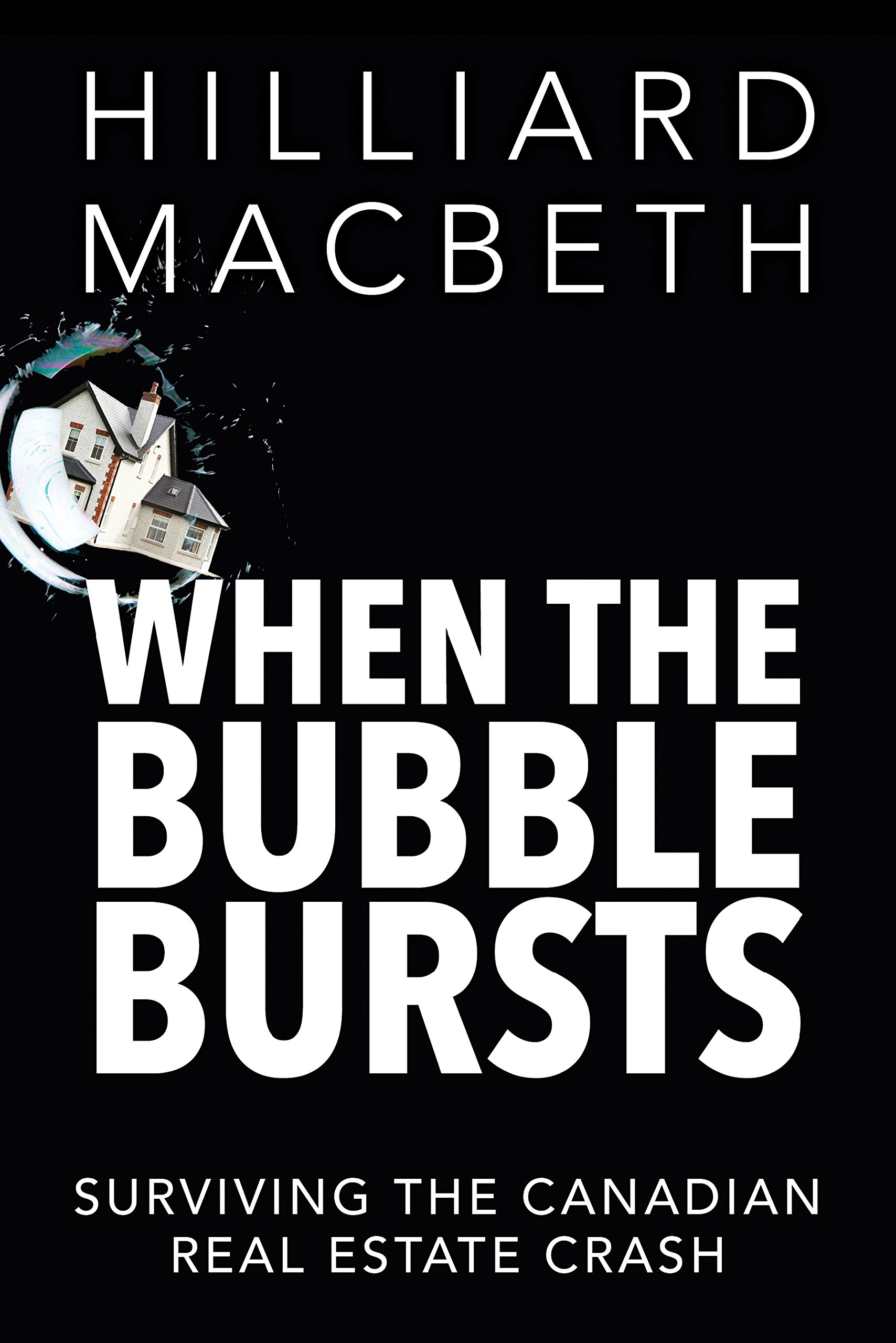
81lYobbkTmLI picked the book up on Saturday and it is terrifying. His insights are troubling and his points are all backed with reputable sources. Like all serious financial problems it is the interconnectedness of the our financial lives that magnifies the impact of any bubble. Hilliard’s chief accomplishment is to show just how interconnected these issues are. The real estate bubble eats into the middle class need of disposable income, encourages people to view their home as the primary source of savings while banks profit off the increasingly indebted backs of hard working Canadians. Government insurance on mortgages (which protects banks, not you) also ties the public coffers to the inevitable need of bank bailouts, while governments themselves worsen the situation by helping boost the homeowners’ market.

In Hilliard’s view we have sold ourselves on a dream, that our homes can increase in value forever (above the non-existent rate of inflation), that we can use our home equity lines of credit to fuel our lifestyles and that as Canadians we are somehow immune from the normal problems that affect other economies. We aren’t and we aren’t ready for the financial collapse that is coming. I’m sympathetic to this view.

HMcB
Click on the picture to see the article and interview

But since I live in Toronto, and our author lives in Edmonton I think it is important to note some financial nuances that should be considered. For instance, not every market is built equally. Bubbles are as much a product of oversupply as they are speculation (which fuels the supply). But in the last 30 years we have become an increasingly urban society. When it comes to value in homes it is frequently the land that we find valuable, not the building (the building is a depreciating asset, like your car). Desirable land is in short supply, and that explains why our urban world is more often than not a suburban world. Look at this expected growth in population around the GTA from now until 2031.

First printed in the Toronto Star, Friday Feb 27, 2015 http://www.thestar.com/news/insight/2015/02/27/ontario-farmland-under-threat-as-demand-for-housing-grows.html

Notice that there isn’t expected to be substantial growth within the core city of Toronto. But as we look to the suburbs, where land is cheaper and desirability for homes will be lower but more affordable we find our source for significant speculation. In short the insurance against significant losses on your home has everything to do with desirability of the land.

This held true particularly in the United States in their own housing bubble. Cities like Phoenix and their accompanying suburbs proved to be the most susceptible to the market downturn. New York on the other hand was far less severely impacted, and I would imagine even less so if we had numbers for Manhattan.

CaseShillerCitiesJuly2013
The above chart shows three numbers regarding several American cities using the year 2000 as a baseline; from the peak of the housing market, the lowest point in that market, and where they stood five years later (2013). In Phoenix, house prices had jumped 127% from where they had been in 2000. They then dropped back to their 2000 values in the correction, and had recovered by 37% by 2013. In New York however, prices had risen 116% from their values in 2000, but only lost 40% of those gains in 2008 and were valued at 67% above their 2000 price five years after the correction. Dallas and Denver were both above their bubble highs by 2013, while Los Vegas was still off 110% of their previous market high.

This should seem obvious. The old line on real estate is “location, location, location”, and it is location that locks in value. There is no hidden land to be developed in Leaside, no undiscovered country in Rosedale or Lawrence Park. On the other hand Vaughan, Pickering, Ajax and Mississauga are all areas to be concerned about, both because they attract younger buyers with lower savings and it is where we see the most growth in new homes. It’s logical to assume that the worst impacts of a correction will be felt there.

https://twitter.com/Walker_Report/status/580048068688678912

But the truth is, when the Canadian housing market corrects it will cause us all a problem. It will magnify the effects of a recession, put pressure on the federal budget and worsen our prospects internationally for investment. That some neighborhoods will be less affected than others is of small consequence. It will affect those with no savings far worse, disproportionately affect the younger (and more financially vulnerable) while hitting those baby boomers depending on their home sale for retirement very hard.

https://twitter.com/Walker_Report/status/580036170056269824

Since no one knows when this will happen the best thing for prospective home owners to do is have a conversation about the choices they are making now, to save more, reduce debt and rethink whether big home purchases or significant renovations are the best use of our money. Corrections are inevitable. Bubbles burst. Whether we are prepared or not can determine your financial future.

Nervous? Don’t be! Set up a meeting to talk about your financial future instead:

Go back

Your message has been sent

Warning
Warning
Warning

Warning.

Further Readings About the Housing Market:

Canada’s Problems Are More Severe Than You Realize (December 16, 2014)

Forget Scotland, Canada is Playing It’s Own Dangerous Economic Game (September 18, 2014)

Ninjutsu Economics – Watch The Empty Hand (June 20, 2014)

By The Numbers, What Canadian Investors Should Know About Canada (May 1, 2014)

Canada’s Economy Still Ticking Along, But Don’t Be Fooled (April 24, 2014)

Toronto Has A Real Estate Problem (April 11, 2014)

Canadians Losing Battle to Save For Retirement (February 19, 2014)

It’s Official, Young Canadians Need Financial Help (December 4, 2013)

Economists Worry About Canadian Housing Bubble, Canada Politely Disagrees (November 12, 2013)

How Imminent is the Next Market Crash?

image001This past week I received an article from a client regarding ideas about “wealth preservation” that made some good sense, and offered advice about calculating how much money you need for retirement. But while the premise was sound; that it makes sense to pursue investment strategies that protect your nest egg when your financial needs are already met, a one off comment about the future of the stock market caught my attention.

You can read the article HERE, but the issue I wanted to look at was the not so subtle implication that the US markets were now due for a correction. A serious one. Quoting the Wall Street Journal contributing writer William J. Berstein,

“In March, the current bull market will be six years old. It might run an additional six years—or end in April.”

This isn’t the first time I’ve heard this point before. It isn’t unique and sits on top of many other market predictioner’s tools, but its use of averages gives a veneer of knowledge the writer simply doesn’t possess.

Obviously we would all like to know when a market correction is due, and it would be great to know how to sidestep the kind of volatility that sets our retirement savings back. But despite mountains of data, some of the most sophisticated computers, university professors, mathematicians and portfolio managers have yet to crack any pattern or code that would reveal when a market correction or crash should be expected.

Which is why we still rely on rules of thumb like the one mentioned above. Is the age of a bull market a good indication of when we will have a correction? Probably not as good of one as the writer intends. Counting since 1871, the average duration of a bull market is around 4.5 years, making the current bull run old. But averages are misleading. For instance the bull markets that started in 1975, and 1988 (ending in 1987 and 2000 respectively) lasted for 153 months each, or just shy of 13 years. Those markets are outliers in the history of bull markets, but their inclusion in factoring the average duration of the bull markets extends the average by an additional year. Interestingly if you only count bull markets since the end of the second world war the average length is just over 8 years, but that would only matter if you think our modern economy has significant differences from an economy that relied on sailing vessels and horses.

table_us_bull_markets_since_1871

The fact is that the average age of bull markets is only that, an average. It has little bearing on WHY a bull market comes to an end. There was nothing about the age of the bull market in the 2000s, when people had become convinced of some shaky ideas about internet companies that make no money, that had any bearing on its end. The bull market that ended in 2008 had more to do with some weird ideas people had about lending money to people who couldn’t pay it back than it did with a built in expiration date. Even more importantly, the market correction of 1987 (Black Monday) was an interruption in what was an otherwise quarter century of solid market gains.

Taking stabs at when a market correction will occur by using averages like duration sounds like mathematical and scientific rigour, but actually reveals very little about what drives and stops markets. And a quick survey of the world tells us a great deal more about global financial health and where potential opportunities for investment are than how long we’ve been the beneficiaries of positive market gains.

Toronto’s Unbelievably Fragile Condo Market

img_7318Did you know that Toronto was in a market “lull” when it came to condos? No? Neither did I. I also wasn’t aware that Toronto was sitting on a vast precipice of economic gloom when it came to our condo market. And that is precisely the take away from both the Globe and Mail and Global News about a recent economic statistic about Toronto’s condo market.

My headline is misleading. Deliberately so. But I thought I would try my hand at provocative titles to spur readership. But I have a bee in my bonnet about this kind of reporting which peddles controversial titles while failing to offer insight to investors or potential buyers interested in the market. And while that kind of reporting is common, it’s rare for such significantly differing accounts about the same market pronouncement. For instance, this is the Globe and Mail’s title and opening line to their article:

 Toronto Condo Market Booming Again –

After years of slow growth Toronto’s condo market has come roaring back to life.

Meanwhile this is what Global News had to say:

Unsold condo’s pile up in Toronto, hit 21 year high –

As far as statistical outliers on charts go, the Bank of Montreal produced a dandy on Tuesday that should get some attention from condo market watchers in Toronto.

Both of these articles start with the same source material, a brief report from BMO Capital Markets from late February, but come to different conclusions, spinning stories about either the health or weakness of the same market. The report is frustratingly short, offering little more than the statistic that a record number of condo units came on the market in January. Far from being a new normal, the record number was the result of three things, including delayed projects being finished, regular projects reaching completion and the result of strong sales from 2011.

toronto-condo-boomHowever both these articles are technically accurate, Toronto did have a record number of units come into the market, an amount eight times greater than the monthly average over the last decade. And it is true that the amount of unsold units is at a 21 year high. But to make sense of which article was correct I thought it best to reach out to BMO Capital Markets’ Director and Senior Economist Sal Guatieri, the author of the document. Sal was kind enough to make some time for me over the phone and had some useful insight about each media outlet’s take on the one-off statistic.

“They’re both right,” in answer to my question, “but one is really about the broad health of the market, which Toronto’s market really is. Last year was a very strong year for sales. But in a few years, as nearly 50,000 units are completed and when rates eventually go up, there could be some weakness in the pricing on those units.” Sal had a few other points but they largely revolved around this dynamic, that future challenges to the market are laid in the foundations of our current success.

For journalists this kind of nuanced take on the markets isn’t helpful. It isn’t provocative, and I suspect that there is a fair amount of confirmation bias for those journalists who feel strongly about the market’s relative health. Regardless, there simply isn’t enough information in the document released to promote one view over the other, and yet that is exactly what writers at the Globe and Global News pursued, versions of the story that were both more provocative and definitive than accurate. It might help with readership, but it does nothing for informing investors.

That’s the real story, and the underlying problem of reporting business news. It isn’t advice so much as a view point. Most readers will not search for the original source, nor have an opportunity to corner the economist and author to find out more. And yet depending on which story you came across you might be forgiven for thinking you had gained some real insight into the nature of Toronto’s Real Estate Market.

On the other hand, I’m highly mistrustful of the news anyhow, which is my own confirmation bias. As the author Jon Ronson once said, “After I learned about confirmation bias I started seeing it everywhere.”


The Keystone Veto Was Meaningless

OILPossibly the most significant news in the last 24 hours was that Barack Obama had used his veto for the first time in five years to end the Keystone XL Pipeline. The pipeline, delayed by 6 years carried with it the hopes of the Canada’s Conservative party and oil executives in Alberta. The pipeline had been opposed, studied and debated, being bounced back and forth through the US government. It had been primarily opposed by environmentalists who object to the environmental impact of Alberta Tar Sand oil and hoped that by killing the pipeline less of it would be extracted, alternative fuels would fill some of the gaps and the world would be a healthier place as a result. It’s subsequent (and rather final) cancelation is being heralded as a victory by many environmental activists.

As we’ve already written, this was not case. While the pipeline hadn’t been built it hadn’t slowed the development of the oil sands, or impeded its movement to refineries. Instead it had simply been supplanted by rail cars. Although more expensive, the roughly $9 a barrel premium was well worth it when oil was above $100 a barrel.

The current price of oil helps explain why there was little real political risk to anybody in the veto of the pipeline. While oil was expensive there was real incentive to get Canadian oil to US markets. It helps offset oil from more troubling parts of the world and makes the economy run a little smoother. But the rise of US shale, the falling price of oil, the use of train cars, an improving economy and rising dollar has wrecked the economics of building the pipeline. By the time the Obama had vetoed the bill there was very little at stake politically except to satisfy his environmental base of voters. The pipeline may yet be still resurrected, but six years on and a new economic reality will likely mean little will get done soon.

The death of the pipeline is troubling most of all for Canada. Shipping oil by train is more expensive, and considerably more dangerous. It also reflects the new found reality that the government cannot rely on oil prices to bolster the economy.  But most of all it reflects the continuing declining fortunes of Alberta and returns focus to Ontario, the once and future king of the broad economy.

What a Race Car Driver Taught Me about Oil Prices

karun_carouselTesla is all over the news. Most recently I have seen several postings about the new P85D Tesla’s Insane Mode, a setting in the car that delivers the maximum amount of power to the car (a big thanks to my client who sent me the link).

Tesla, and it’s CEO Elon Musk (who is a real life bond villain) has made quite a splash, building a high quality and competitive electric car with a solid range. A real first. And while his current offerings in the market remain decidedly high end, his ambitions include creating a more affordable middle class version as well.

But the economics of electric vehicles remain challenging at best. There are more options than ever, from Chevrolet, to Ford to Toyota. But these cars all tip the scales at the upper end of the car market, and are not sensible economically on a three year lease.

This is the Tesla Model X. It's due to hit the road in 2016, and is gorgeous. Notice the "Falcon Wing." Notice it! Did you notice it?  Awesome, right?
This is the Tesla Model X. It’s due to hit the road in 2016, and is gorgeous. Notice the “Falcon Wing.” Notice it! Did you notice it?
Awesome, right?

But the problem for electric cars may be best explained by the new Formula E series that is currently in it’s inaugural season. Using a newly designed electric race car I was surprised to learn that there are limits on the power that drivers can use in races, (while fans can vote to give some drivers an addition 50 bhp to boost speed each race via twitter). Why is this? Ostensibly it is to help preserve the life of the battery, already the heaviest part of the car and not powerful enough to get a car through a single race without a second car. In other words, the economics of the battery is still the biggest challenge facing all auto producers.

By some good fortune my brother in law is a driver in Formula E for team Mahindra. Mahindra & Mahindra isn’t as well known in Canada, but is a large conglomerate and a significant auto producer that sells in many countries. This past year they have launched India’s first electric passenger vehicle, the Reva e2o, which they had loaned to Karun and afforded me the opportunity to test drive while visiting my extended family in India. It’s a good car, and I could see that Karun had enjoyed driving it. But he pointed out the first challenge to electric cars in India was that the Indian government is only just introducing an electric car subsidy (having previously canceled one in 2012). In fact it is government subsidies that have helped foster the boom in electric cars.

From NASDAQ, February 4, 2015

What this all leads to is the inevitable challenge poised by the sudden drop in the price of oil. Electric cars sit at the top of the market in terms of cost, and many aren’t even viable until after you both:

  1. Don’t have to buy gas anymore when oil is over $100 a barrel.
  2. Are given money by the government to help afford the car.

So if high gas prices underly the business case for electric cars, then a sudden cut in the price of oil does significant damage to that business case. It makes traditional petrol cars more cost effective, more competitive and more profitable compared to their e counterparts.

This tells us two things about oil and electric cars. The first is that while oil prices may stay depressed compared to previous market highs, the demand for oil is unlikely to decline and will likely recover as cheap oil spurs economic growth. The second issue is whether the rise of companies like Tesla is overstated. As exciting as they may appear, the market valuation of TESLA is the real insane mode, and certainly not in line with a traditional auto maker. The reality at least is that the end of oil, and the growth of electric cars is going to be dependent on considerable innovations in battery technology and will not be viable in the long term with cheaper oil and government subsidies. But who knows, next year’s Formula E series will allow teams to design their own cars and we may begin seeing some interesting innovations start in battery development.

Will We All Be Victims of Cheap Oil?

OILEarlier this year we wrote that Russia’s economy was fundamentally weaker than Europe’s and that their decision to start a trade war in retaliation for economic sanctions over the Ukraine would hurt Russia far more than Europe. As it happened Russia has suffered that fate and had a helping more. The collapsing price of oil was a mortal wound to the soft underbelly of the Russian economy, leading to a spectacular collapse in the value of the Ruble and an estimated 4.5% contraction in their economy for 2015.

The Ruble’s earlier decline this year had already made the entire Russian stock market less valuable than Apple Computers, but as the price of Brent oil continued to slide below $60 (for the first time since 2008) investors began to loose confidence that Russia could do much to prop up the currency, prompting an even greater sell-off. That led to an unprecedented hike in the Russian key interest rate by its central bank, moving it from 10.5% to 17% yesterday. Moves like that are designed to reassure investors, but typically they only serve to ensure a full market panic. The Ruble, which had started the year at about 30 RUB per dollar briefly dropped to 80 before recovering at around 68 to the dollar by the end of trading yesterday.

The Russian Ruble over the last year. The spike at the end represents the last few weeks.

Cheap oil seems to be recasting the economic story for many countries and millions of people. The Financial Times observes that oil importing emerging markets stand to be big winners in this. Dropping the cost of manufacturing and putting more money in the pockets of the growing middle class should continue to help those markets. The same can be said of the American consumer, who will be benefiting from the sudden drop in gas and energy prices.

The Financial Times always has the best infographics.

Losers on the other hand seem easy to spot and piling up everywhere. Venezuela is in serious trouble, so is Iran and the aforementioned Russia. Saudi Arabia should be okay for a while, as it has significant foreign currency reserves, but as the price drops other member states of OPEC will likely howl for a change in tactic. But along with the obvious oil producing nations, both the United States and Canada will likely also be victims, just not uniformly.

Carbon Tracker Initiative

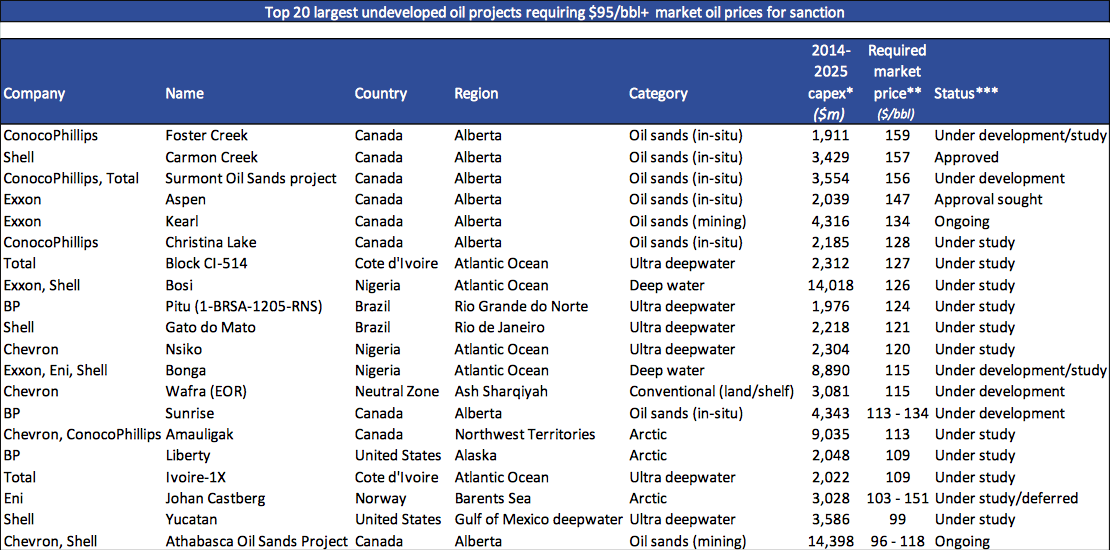
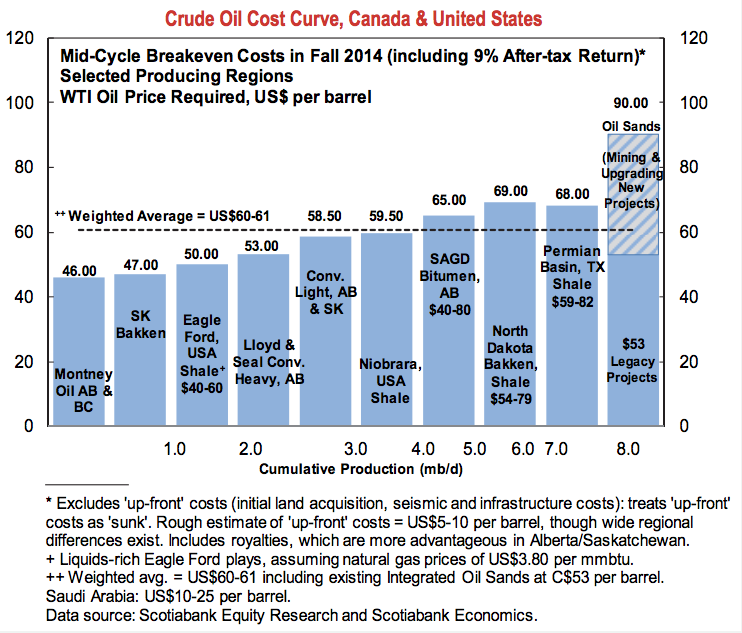
Manufacturers may be breathing a sigh of relief in Ontario, but Canadian oil producers are sweating it big. Tar sand oil requires lots of refining and considerable cost to extract. Alberta oil sands development constitute some of the most expensive projects around for energy development and a significant drop in the price of energy, especially if it is protracted, could stall or erase some future investments. This is especially true of the Keystone Pipeline which many now fear isn’t economically viable, in addition to being environmentally contentious.

This chart was produced by Scotiabank

Saudi Arabia has continued to allow the price of oil to fall with the intention of hurting the shale producers in the United States. This price war will certainly claim some producers in the US, but it will difficult to know at which point that market will be effectively throttled. Certainly new projects will likely slow down but the continued improving efficiency of the fracking technology may make those producers more resilient to cheap energy.

But there is one more potential victim of the falling price of oil. That could be all of us. I, like many in the financial field, believe that cheap energy will enormously benefit the economy. But our biggest mistakes come from the casual confidence of things we assume to be true but prove not to be. A drop in energy should help the economy, but it doesn’t have to. If people choose not to spend their new energy windfall and save it instead, deflationary pressure will continue to grow. As I’ve previously said, deflation is a real threat that is often overlooked. But even perceived positive forms of deflation, like a significant reduction in the price of oil, can have nasty side effects. The loss to the global economy in terms of the price of oil is only beneficial if that money is spent elsewhere and not saved! For now confidence is that markets will ultimately find the dropping price of oil helpful to global growth, regardless of the early losers in the global price war for oil.

Canada’s Problems Are More Severe Than You Realize

house-of-cardsOn December 10th, the Bank of Canada released it’s Financial System Review for 2014. It outlined numerous problems that continue to grow and potentially undermine the Canadian economy. Globally this report attracted a great deal of attention, not something the BoC is used too, but with a rising concern that the Canadian housing market is overvalued, an official document like the FSR gets noticed.

Screen Shot 2014-12-14 at 10.56.42 AMTo understand why Canada is growing in focus among financial analysts around the world you need to turn the clock back to 2008. While major banks and some countries went bankrupt, Canada and its banking system was relatively unscathed. And while the economy has suffered due to the general economic slowdown across the planet, the relative health of our financial system made us the envy of many.

Screen Shot 2014-12-16 at 10.39.42 AMBut the problems we’d sidestepped now seem to be hounding us. Low interest rates have helped spur our housing market to new highs, while Canadians in general have continued to amass debt at record levels. Attempts to slow the growth of both house prices and improve the standard of debt for borrowers by the government have only moved loan growth into subprime territory.

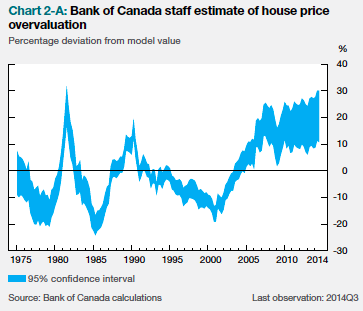
If all this sounds familiar, it’s because we’ve been talking about it for sometime, and sadly the BoC hasn’t been able to add much in the way of clarity to this story. While we all agree that house prices are overvalued, no one is sure quite how much. According to the report the range is between 10% to 30%. Just keep in mind that if you own a million dollar home and the market corrects, it would move the price from $900,000 to as low as $700,000. That can make a considerable dent to your home equity and its too big a swing to plan around.

Screen Shot 2014-12-16 at 10.39.06 AMOn top of this is the growth of the subprime sector in the market. Stiff competition between financial institutions and an already tapped out market has encouraged “certain federally regulated financial institutions” to increase “their activities in riskier segments of household lending.” This is true not just in houses but also in auto loans, where growth as been equally strong.

The Financial System Review also goes on to talk about problems growing in both cybersecurity and in ETFs (both subjects we have written about). It also talks about some of the positive outlooks for the economy, from improving economic conditions globally and support for continued economic activity. But its quite obvious that the problem Canadians are facing now is significant underlying risk in our housing and debt markets. These problems could manifest for any number of reasons (like a sudden drop in the price of oil, a significant slowdown in China, or a fresh set of problems from Europe), or they may lay dormant for months and years to come.

For Canadians the big issues should be getting over our sense of economic specialness. As I heard one economist put  it “Canadians feel that they will be sparred an economic calamity because they are Canadian.” This isn’t useful thinking for investors and as Canadians we are going to have separate our feelings about our home from the realities of the market, something that few of us are naturally good at. But long term investor success will depend on remaining diversified (I know, I link to that article a lot), and showing patience in the face of market panic.

Concerned About The Market and Recent Volatility? Contact Us!

Go back

Your message has been sent

Warning
Warning
Warning

Warning.

Only Time Gives Clarity to Investors

The reality of the 21st century is that finding clarity in world events for investors is almost impossible. Take the recent price drop in oil, which has been hailed as both a good and bad thing. And as the new lower price of energy slowly becomes the norm, everyday news reports come in about its respective benefits and unintended negative consequences.

https://twitter.com/Walker_Report/status/540161044786589698

Those seeking to know what those events mean and what guidance headlines should give will only be frustrated by the almost endless supply of information that seeks to empower decisions but leaves many scratching their heads in wonder about the future.

Screen Shot 2014-12-03 at 8.36.05 PM

A big reason for this is the sheer volume of information that we can now rely on. Since the advent of computers and the more recent rise of high-speed communication and networking we have found that the core truth of an event still isn’t apparent until after something has happened. In other words it’s almost impossible to predict corrections before they happen despite an almost inconceivable amount of data and endless ability to process it.

This is true no matter where we look in the world of investing. Consider Black Friday, the end all and be all day in shopping in the United States. This year Black Friday seemed to fizzle. Sales were down 11% year-over-year and that got people nervous. Yet Cyber Monday, the electronic version of Black Friday, sales were up 17% and topped $2 billion for the first time. Combined with the longer sales period leading up to the weekend, many suspect that total sales were actually higher.

All of this data conflicts with each other, which for investors means sometimes you will be wrong. Small things sometimes prove to be big things, and what initially appears simple turns out to be surprisingly complex, and much of it you simply won’t predict. This points investors back to some dull but surprising truths about investing.

1. Not much has changed when it comes to determining what makes a company worthwhile to invest in. Corporate health, sound governance and healthy cash flow still tell us more than loud hype about potential new markets, new products and new trends.

2. Time is a better arbiter than you about investing. The old line is time in the market, not timing the market, and that still appears true. Many Canadians are likely wringing their hands about the sudden drop of oil and the impact it is having on their portfolios. But the best course of action maybe not to abandon their investments, but make sure they are still sensibly invested and well diversified. The market still tends to correct in the long run and immediate volatility (both up and down) are smoothed out over time.

Screen Shot 2014-12-04 at 2.48.01 AM
The S&P 500 over the last 50 years. From Yahoo Finance

Not every sensible investment will work out, but a portfolio of sensible investments over time will. For investors now wondering about the future and their investments in Canada, the best thing to do is understand the logic behind their investments before choosing a course of action.


America Is In Great Shape; Be Afraid!

markets_1980043cAll year people have been expecting a correction in the US Markets. For most of the year I have listened to portfolio managers discuss their “concern” about the high valuations of American companies. I have also listened to them point out that America remains the strongest economy and the most likely to see significant growth in the coming year.

Flash forward to late-September, early October and the markets have finally had their corrections. At the bottom every market was negative, including the TSX which had given up all of its YTD high of 15%. That was the bottom. The recovery was swift, money flowed back into the markets, and hedge fund managers managed to make a mockery of some otherwise nervous DIY investors. Now the markets look strong again, with the S&P 500 reaching new highs. Nobody is happy.

All of this comes on the news that US GDP was up 3.9% in the third quarter, a full .5% above analyst expectations (that sounds small, but it’s worth billions) while energy prices continue to decline, manufacturing is highly competitive and US consumers look poised for a significant Christmas bonanza. So what’s wrong with this picture? Why are both the Globe and Mail and the Financial Times worried about the US stock market?

https://twitter.com/Walker_Report/status/537581249440014337

FullSizeRender

The answer is a combination of fear, data, and the insatiable need for stories to populate the media everyday. First is the fear. Stocks are at all time highs. The problem is that “all time high” isn’t some automatic death sentence for a stock market. The stock market always hits new highs all the time, and a by-product of that is that corrections can really only happen after a high is reached. Look at the history of the S&P 500 since 1960:

Screen Shot 2014-11-26 at 11.02.50 AMAs you can probably tell, there are a lot of “new highs” that had occurred over the last 40 years, but each new high did not automatically translate into some automatic correction. There were legitimate reasons why the economy could continue to grow, and in the process make those companies in the stock market more valuable. That isn’t to say that the stock market can’t be “frothy” or that their aren’t problems in the stock market today. It merely means that setting a new market high isn’t proof of an impending collapse.

The second issue is data. We live in an age of Big Data. Data is everywhere and there is so much it can be hard to separate the useful data from the useless. Some of the data is concrete, but much of it takes time to understand or even become clear. The first analysis of the higher than expected GDP numbers seemed great (more economy, Yay!) but upon closer inspection, there are reasons to be cautious. While the GDP was higher than expected, it was largely due to growth in government spending, not consumer spending. In fact consumer spending was lower quarter over quarter. In addition there are a number of concerns about how corporations are spending their profits and whether that is sustainable. Many of these concerns, when taken in context, seem to be the same from earlier in the year.

The third factor is the insatiable need to write something. Content is king in the news world and providing insight (read: opinion) means that you must constantly produce new stories to publish. That means that there is a need to be constantly suggesting that things are about to go wrong (or more wrong than they already have) to create a compelling story. It isn’t that these stories are wrong, just that constantly saying the stock market is going to go down isn’t insightful, since at some point we can expect the stock market to correct for one of a number of reasons.

So is America frothy? Are we poised an some kind of financial collapse? I don’t know, and nobody else does either. We are no more likely to correctly know when the market might correct again than we are to guess the future price of gas. The best response is to diversify, and remember some core elements of investing. Buy low and sell high. With that in mind sturdy investors should probably start giving the beat-up and maligned Europe a second look…

The Failure Of Google Glass Is A Useful Warning To Investors

Google_Glass_with_frameLast week Google announced that it would not be proceeding with another round of Google Glass for 2015, meaning that the most ambitious experiment in wearable technology had come to an end. Google Glass has many failings, ranging from looking stupid to attracting angry mobs of people, but it did seem to be the vanguard of wearable technology. Wearable tech has attracted a great deal of attention, both from consumers and investors, but I have a feeling that it’s rise may be overstated.

http://youtu.be/T8nJKWJTsUg

For the most part wearable technology is a subset of the “internet of things“, the growth of cloud computing, mobile sensors and high speed communication between stuff. The most beneficial forms of this could be about smart city grids communicating with cars to smooth traffic flows and reduce congestion. In reality it is largely counting how many steps you take everyday.

http://youtu.be/bvMohoDFZ30

Looking past the incredible number of terrifying elements about our privacy and data mining that go along with these devices, by and large most wearable technology hasn’t really taken off. Google Glass may be a high end flop, but the vast amount of wearable devices on the markets today have yet to win over big audiences. They remain largely niche devices with a high drop off rate. Where as people adopted smartphones on mass, many people have just shrugged their shoulders and moved on, while those that do buy into wearable tech often stop using it after a few months. This suggests that there is a disconnect between understanding what smartphones get right and wearables get wrong.

http://youtu.be/shirth1OjRE

That gap is clearly frustrating tech companies, and it will be interesting to see whether Apple’s first wearable device, the Apple Watch, is able to change the pattern. But for investors the allure of the new as a reason to invest should be tempered, and excitement over the prospect of “the next big thing” and the importance of getting in on the ground floor may prove financially costly.

Take for instance TESLA Motors (TSLA: Nasdaq). Tesla may be a car company, but it is treated like a technology company on the stock market, meaning that it is currently trading with a ridiculous P/E ratio, close to 130x next years earnings. Put simply, if Tesla were to pay out all of its earnings to its shareholders it would take 130 years (given current earnings) for you to receive the equivalent value of what you paid for a share. That gives Tesla, a company that sells cars by the thousands a market cap similar to General Motors, a company that sells cars by the millions.

That’s crazy, but normal for the tech world. This has been exceptionally true social media sites like Twitter, Linkedin and Pinterest. All of them also trade well and above “normal” valuations, especially given that they don’t make anything.

The lesson for investors is to be cautious about technology companies. They come with a host of pitfalls and unique qualities that are frequently glossed over in the excitement of the new. Investors have been swept up before with the prospect of some great new device that can’t go wrong, but with some notable exceptions much technology often finds itself on the scrapheap of history. Or maybe we will all start carrying around smart glasses for every beverage

http://youtu.be/lu4ukHmXKFU