The Financial Challenges of Being a Young Canadian

Meanwhile, at Starbucks

It is a common enough trope that people do not save enough, either for retirement or just generally in life. We are a society awash in debt, with some estimates showing Canadians carrying an astonishing $27000 of non-mortgage debt and an average of three credit cards. This financial misalignment, between how much we spend (bad) and how much we save (good) is a source of not just economic angst, but denouncements of sinfulness and failings of moral behavior.

This isn’t an exclusively Canadian problem. Pretty much everyone across the developed world has been accused of both not saving enough and carrying too much debt, and the remedy is usually the same, save more and spend less. Underneath that simplistic advice is the nuance that goes into managing money; the importance of paying down debt, of saving some of what you earn on payday (so you don’t see it) and a host of other little things that define good money habits.

bombardier-thunder-bay-plant-subway
This TTC Subway car is built in Thunder Bay. Because Toronto needs more subways, because it is a desirable, albeit expensive place to live.

But for young people trying to save and spend less they may find that the struggle is far greater than anticipated and the advice they are given can be frustrating in its obtuseness. For instance, one of the first solutions financial gurus give is “cut back on the lattes”. In one of our first articles we ever wrote was about the “Latte Effect”, (That Latte Makes You Look Poor) and how the math that underlies such advice, while not bad, isn’t going to fund a retirement.

In fact cutting costs is extremely difficult. Vox.com recently offered some advice for saving more. Pointing out that big ticket items are more useful in cost cutting than small items, the article made the improbable suggestion to “consider moving to a cheaper metropolitan area” if you are finding San Francisco or New York too expensive. Seriously. As though living in cities was a choice exclusively connected to cost, or that Minneapolis was simply New York with similar opportunities but cheaper.

In Canada this advice falls even flatter. While you can live many places, not all offer similar opportunities. Living in Windsor means (typically) making

As a financial advisor I am required to spit on the ground and curse when the subject of credit cards comes up.

cars. Thunder Bay offers both lumber production and a Bombardier plant. But if you are part of the 78% of Canadian GDP that is connected to the service sector, either through banking, finance, health services, government, retail, or high tech industries you are likely in one of four major cities, Toronto, Vancouver, Calgary or Montreal. It should be no surprise that young Canadians, facing ever increasing house prices haven’t actually abandoned major cities for “cheaper alternatives” since most of the jobs tend to be concentrated there.

full-leaf-tea-latteSo for young Canadians the challenge is quite clear. Cutting back on your expensive coffees could save you between $1000 – $2000 per year, but that won’t get you far in your retirement. Serious changes to costs of living are challenging since the biggest cost of living in cities is frequently paying for where you want to live. In between these extremes we can find some sound advice about budgeting and restraining what you spend, but it is fair to say that many young people aren’t saving because they enjoy spending their money, but because they don’t yet have enough money to cover their major costs and maintain a lifestyle that we generally aspire to.

It’s worth noting that most financial advice is pretty good and sensible, even things like watching how much you spend on coffee. Credit cards, lines of credit and overdrafts are all best avoided if possible. A solid budget that allows you to clearly see your spending habits won’t go amiss. And if you do choose to spend less on the small luxuries, it isn’t enough that the money stays in your purse or wallet. It must go somewhere so it can be both out of reach and working on your behalf or you risk spending it somewhere else.

At university and have no income? How about a credit card?

But it is financially foolish to assume that people don’t want to save. The Globe and Mail recently ran a profile on the blogger “Mr. Money Mustache” – a man who retired at 30 with his wife and claims that the solution to retiring young is to wage an endless war on wasteful spending. And he means it. Reading his blog is like reading the mind of an engineer. From how he thinks about his food budget, to what cars you own, his advice is both sound and confounding. It might be best summed up as “live like your (great) grandparents”. Sound advice? Absolutely! Confounding? You bet, since the growth in the economy and our standard of living exists precisely because we don’t want to live like our grandparents.

There is no good solution or answer here. Young Canadians face a host of challenges on top of all the regular ones that get passed down. Raising a family and buying a home are complicated by financial peer pressure and inflated house prices. Choosing sensible strategies for saving money or paying down debt (or both) often means getting conflicting advice. And young Canadians have no assurances that incomes will rise faster than their costs, nor can they simply relax about money. They must be vigilant all the time and avoid financial pitfalls that are practically encouraged by the financial industry. Finding balance amidst all this is challenging, and young Canadians should be forgiven that they find today’s world more financially difficult than the generation previous.

What Being Poor Should Mean to a Millennial

Last night I was kindly invited to speak at an event for the “Millennial Generation” hosted by AGF Investments. It was an interesting and fun evening filled with a lot of great questions and great food. But of all the questions sent to the advisors at the front of the room the question that I failed at was “what do you tell a poor client?”

Somehow this became my image of the millennial generation.

This question took me off guard because when I looked in the room I didn’t see any poor people. I saw a lot of young professionals that weren’t yet at their peak earning potential, but that is part of growing up. These people weren’t poor, they just didn’t have a lot of money.

That distinction may seem academic to someone sitting at home on a Friday night who can’t afford to go out. After all, what is it to be poor if a lack of money doesn’t define you? But poverty is about a permanence of state, and not earning enough money can be temporary. Real poverty is about having a lack of options.

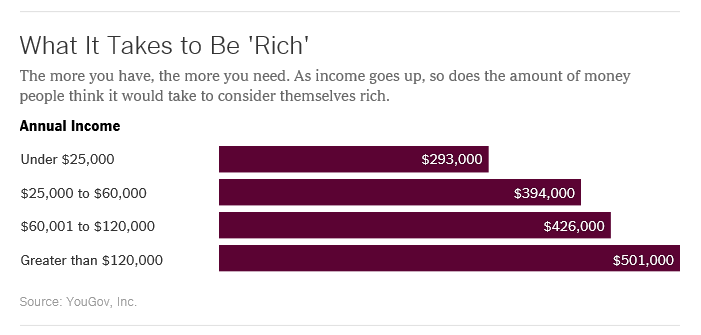
For instance, most Canadians would likely say that don’t have enough money, which isn’t the same as saying they are impoverished. It is simply a reflection of how our wants increase and grow with our incomes. In 2014 the research firm YouGov, Inc. did a survey looking for people to identify how much they needed to earn to be “rich”. Unsurprisingly as people earned more their idea of what constituted “rich” grew with their income bracket, which is why so few people self-identify as being wealthy.

Rich You can read the whole story about that from the New York Times. But for young Canadians who are fresh out of university, the climb up the financial ladder to long term wealth can seem daunting to say the least, and living in big cities can make modest salaries seem virtually impoverishing.

This place is awesome but it costs a fortune!

But that doesn’t make you “poor”.

Poor means a lack of options, or opportunities to change your situation. Well educated young Canadians in junior professional roles have lots of opportunities. But there is also a reason that we say youth is wasted on the young. Because young Canadians who don’t start saving, defer starting RRSPs and TFSAs, find that they are scrambling in their 40s and 50s to save for their retirement. They do have fewer options and are a great deal poorer for it. This isn’t a hypothetical; lots of Canadians are finding themselves in exactly this situation. Saving isn’t just about putting money aside, it’s about keeping options open in the future.

Globe & Mail Senior

The other day the Globe and Mail talked about the growth of debt among seniors, a move that was described as making seniors “Financially Fragile”. The core of investing revolves might be described as revolving around this principle: avoiding fragility. Frequently we represent investing as freeing people to enjoy their retirement on the beaches of Cape Cod, with sweaters draped over shoulders. But investing and saving is about being able to deal with all the rough spots in life.

Is this your retirement? Commercials for retirement planning frequently feature retirement as one of endless vacation.

Unexpected costs like new furnaces or car repairs can undo vacation plans and cottage retreats. Saving early doesn’t just help plan a life of leisure, it insures that your best laid plans aren’t upended by all the other things that life throws at you. It is far easier to be poor in old age once you’ve earned your last dollar than it is when you are younger and millions of opportunities await you.

So if you were one of the young Canadians worried that you don’t make very much, keep in mind that it is temporary. But if you want to avoid being actually poor in the future, start saving today so you aren’t panicking tomorrow.

Don’t want to defer your saving any longer? Drop us a message!

← Back

Thank you for your response. ✨


It Doesn’t Matter if There Isn’t A Real Estate Bubble

Last week I published a piece on the dangers of the housing bubble in Canada. It caused a stir with a number of clients and followed many articles over the past two years about our concerns with the Canadian economy.

Debt-Shackle-Charlotte-Bankruptcy-Lawyer-North-Carolina-Debt-Attorney

But on Wednesday I was at an industry lunch with another group of advisors talking about the Canadian housing market and was met with a curious objection over whether there was any real danger at all. Another advisor happily pointed out to me that while the indebtedness of Canadians may be high, it is still affordable, and we should be mindful of the famous investors you have been hoisted by their own doom saying petards.

While it’s true that many doom saying predictions don’t come to pass and we should be careful before signing on to one particular points of view, arguing that lots of debt is affordable and therefore no threat is similar to a drug addict arguing everything is under control because they still hold down a job. The job is irrelevant to the problem, although it’s absence is likely to make matters worse.

calgary1

This is why it is somewhat irrelevant to worry about the Canadian housing market. Whether you believe there will be a soft landing, a hard landing or no landing at all, what Canadians have is a debt problem. Only it’s not a problem because it’s affordable. Also it’s a problem.

If that last sentence is confusing, don’t worry. It sounds worse coming from the Bank of Canada, who in their December Financial Systems Review pointed out that debt levels continue to climb but the relative affordability of the debt remains consistent. And while an economic shock to the system could make much of that debt unserviceable, for now that seems unlikely. They concluded this section of the report identifying the risk to Canadians as “elevated”.

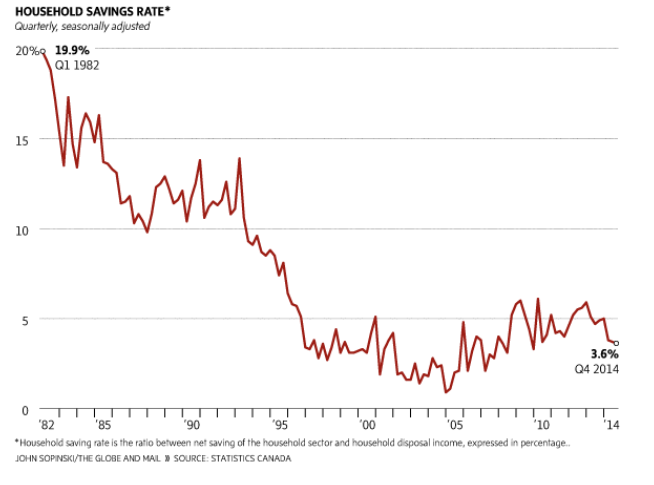
This is non-committal nonsense. In economic terms there is a bomb in the room that needs to be diffused, has no timer but will go off at some indeterminate future point. The problem is that Canadians can’t seem to help by adding more debt to the pile. In January Canadians added another $80 billion of debt through mortgages, lines of credit and credit cards, a jump of 4.6%. Our private debt is now over $1.8 Trillion, larger than our GDP. Household saving’s rates are at a five year low, 3.6%. But in 1982 the savings rate was 19.9%. In other words we’ve had a dramatic shift away from savings and towards debt.

Savings rate

While 30% of Canadian households have no debt, almost every demographic is susceptible to the growing debt burden. Even seniors have a growing debt issue. Canada is now unique in the world for having debt levels in excess of the peak of the American debt bubble in 2008, and is currently only surpassed by Greece. Traditionally I am highly cautious about grand pronouncements about market doom and gloom, but in this instance I am of the opinion that ignoring Canada’s debt problem is willful blindness.

How to best handle this problem will have to be left to others. There is no simple solution that will not trigger the bomb, and the goal of any government is to slowly reduce the average debt burden without hurting the economy or deflating the bubble. For my part I tend to advise people to pay their debts down, shy away from things they cannot afford and encourage saving rather than debt spending to limit risk. When it comes to saving for the future there is no reason to make many people’s problems your problems.

The Next Debt Bubble or The Last War?

car-bubbles
Illustration by Mike Faille/National Post

I recall hearing from my mother once that my grandparents had been deeply scarred by the great depression. In a multitude of ways it had affected the financial decisions they made for years after it was all over. It would probably be fair to say that investors have been similarly scarred by the 2008 financial collapse, and that no matter how far into the past it recedes, for a generation there will likely always be a nagging doubt about investing as they recall the days when the very future of currencies, countries and their savings seemed in very real danger.

This guy right here would like to give you a car loan even if you can't afford one! Isn't that nice?  Don't read the fine print.
This guy right here would like to give you a car loan even if you can’t afford one! Isn’t that nice?
Don’t read the fine print.

That concern has made us all highly suspect of debt and the cavalier attitudes of Wall Street financiers who remain unfazed by the dramatic peril they engineered through the early 2000s. So it should not go unnoticed when sentences with the words “subprime”, “growth” and “asset backed loans” seem to be on the rise, and recently that has been exactly the case.

Back in the early summer of 2014, Yahoo Finance ran a story about the growth of subprime auto loans and high interest leveraged loans. The short story was that banks had begun to take on more risk to counteract the weak economy and lack of decent yielding products in the market (themselves a product of trying to stimulate the economy).

In September The Economist also published a story called “Bad Carma” detailing some frightening statistics about borrowing rates, riskier assets and ample credit, all dog whistle terms to any investor who took the time to read anything following 2008.

That was followed by a report from CNBC in October regarding concerns of a new subprime lending bubble on the backs of auto loans. Again citing the same looming threat of a growth in the loan market of riskier quality, primarily driven by the desire to boost short term profits.

18psh2kqhvhtcjpg

Finally, in the beginning of this year we have begun to see some of the expected fallout of these subprime loans going bad. While default rates are still low, delinquency rates have started to creep up. Again, the culprits were car buyers with weak credit scores that had been offered subprime rates (like 22% or more) to buy cars. In fact according to the Wall Street Journal 8.4% of borrowers with weak credit scores who took out loans in the first quarter of 2014 had missed payments by November.

It’s easy to be suckered into an early freak-out with these reports, but details matter and in this instance the details, while troubling, are not the cause for concern it would be easy to let ourselves get into. According to The Economist, while the blueprint may look similar to the lead up to 2008, the fundamentals don’t match. First the total car borrowing market is $905 billion, or less than a tenth of total mortgage debt. Secondly subprime lending in the auto sector is a more established practice and accounts for about 20% of auto loans since 2000. But most importantly no one is under an illusion about the value of a car after it is driven off the lot. In the housing crisis borrowers and lenders convinced themselves that they would never lose value on a home, but in the auto sector cars are always a depreciating asset.

So should we be worried? I believe this is more a case of fighting the last war. We are so hyper aware now of what created the last bubble that we are watching for it with super vigilance. That’s not to say there isn’t risk. Wells Fargo recently announced that they would be capping the total percentage of subprime auto loans they make, and in Canada subprime auto loans are part of our dangerous growth of consumer debt. So it pays to e vigilant, but imagine if we were equally wary of tulip bulb prices and technology stocks? Wouldn’t that be ridiculous? It is good to be wary of known dangers, but it’s what we don’t know, or worse, what we choose to ignore that invariably wounds us most deeply.

Canada’s Housing Bubble Will Burst & We’re Not Ready

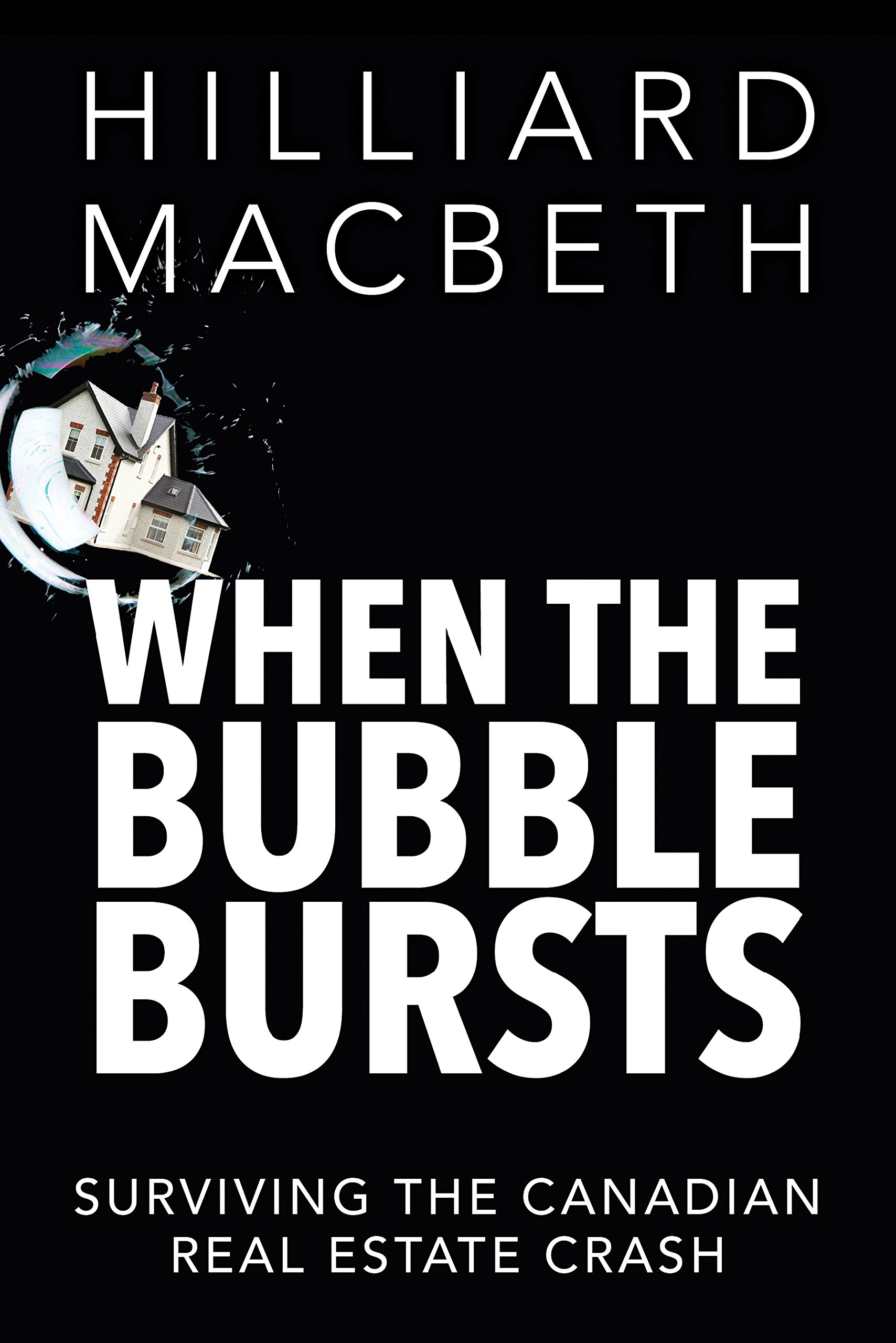
On Saturday a small book was released nation wide that made a big claim, Canadian housing prices are poised to drop between 40% to 50%. Written by a financial advisor in Edmonton, Hilliard MacBeth, When the Bubble Bursts is a grim and insightful polemic about both our obsession with housing and the danger such high valuations pose to our economy. I’ve been negative about Canada for a long time, particularly about Canada’s improbable and endless real estate boom, but what the author has done in his book is attach some actual numbers around how serious our housing problem is.

81lYobbkTmLI picked the book up on Saturday and it is terrifying. His insights are troubling and his points are all backed with reputable sources. Like all serious financial problems it is the interconnectedness of the our financial lives that magnifies the impact of any bubble. Hilliard’s chief accomplishment is to show just how interconnected these issues are. The real estate bubble eats into the middle class need of disposable income, encourages people to view their home as the primary source of savings while banks profit off the increasingly indebted backs of hard working Canadians. Government insurance on mortgages (which protects banks, not you) also ties the public coffers to the inevitable need of bank bailouts, while governments themselves worsen the situation by helping boost the homeowners’ market.

In Hilliard’s view we have sold ourselves on a dream, that our homes can increase in value forever (above the non-existent rate of inflation), that we can use our home equity lines of credit to fuel our lifestyles and that as Canadians we are somehow immune from the normal problems that affect other economies. We aren’t and we aren’t ready for the financial collapse that is coming. I’m sympathetic to this view.

HMcB
Click on the picture to see the article and interview

But since I live in Toronto, and our author lives in Edmonton I think it is important to note some financial nuances that should be considered. For instance, not every market is built equally. Bubbles are as much a product of oversupply as they are speculation (which fuels the supply). But in the last 30 years we have become an increasingly urban society. When it comes to value in homes it is frequently the land that we find valuable, not the building (the building is a depreciating asset, like your car). Desirable land is in short supply, and that explains why our urban world is more often than not a suburban world. Look at this expected growth in population around the GTA from now until 2031.

First printed in the Toronto Star, Friday Feb 27, 2015 http://www.thestar.com/news/insight/2015/02/27/ontario-farmland-under-threat-as-demand-for-housing-grows.html

Notice that there isn’t expected to be substantial growth within the core city of Toronto. But as we look to the suburbs, where land is cheaper and desirability for homes will be lower but more affordable we find our source for significant speculation. In short the insurance against significant losses on your home has everything to do with desirability of the land.

This held true particularly in the United States in their own housing bubble. Cities like Phoenix and their accompanying suburbs proved to be the most susceptible to the market downturn. New York on the other hand was far less severely impacted, and I would imagine even less so if we had numbers for Manhattan.

CaseShillerCitiesJuly2013
The above chart shows three numbers regarding several American cities using the year 2000 as a baseline; from the peak of the housing market, the lowest point in that market, and where they stood five years later (2013). In Phoenix, house prices had jumped 127% from where they had been in 2000. They then dropped back to their 2000 values in the correction, and had recovered by 37% by 2013. In New York however, prices had risen 116% from their values in 2000, but only lost 40% of those gains in 2008 and were valued at 67% above their 2000 price five years after the correction. Dallas and Denver were both above their bubble highs by 2013, while Los Vegas was still off 110% of their previous market high.

This should seem obvious. The old line on real estate is “location, location, location”, and it is location that locks in value. There is no hidden land to be developed in Leaside, no undiscovered country in Rosedale or Lawrence Park. On the other hand Vaughan, Pickering, Ajax and Mississauga are all areas to be concerned about, both because they attract younger buyers with lower savings and it is where we see the most growth in new homes. It’s logical to assume that the worst impacts of a correction will be felt there.

https://twitter.com/Walker_Report/status/580048068688678912

But the truth is, when the Canadian housing market corrects it will cause us all a problem. It will magnify the effects of a recession, put pressure on the federal budget and worsen our prospects internationally for investment. That some neighborhoods will be less affected than others is of small consequence. It will affect those with no savings far worse, disproportionately affect the younger (and more financially vulnerable) while hitting those baby boomers depending on their home sale for retirement very hard.

https://twitter.com/Walker_Report/status/580036170056269824

Since no one knows when this will happen the best thing for prospective home owners to do is have a conversation about the choices they are making now, to save more, reduce debt and rethink whether big home purchases or significant renovations are the best use of our money. Corrections are inevitable. Bubbles burst. Whether we are prepared or not can determine your financial future.

Nervous? Don’t be! Set up a meeting to talk about your financial future instead:

← Back

Thank you for your response. ✨

Further Readings About the Housing Market:

Canada’s Problems Are More Severe Than You Realize (December 16, 2014)

Forget Scotland, Canada is Playing It’s Own Dangerous Economic Game (September 18, 2014)

Ninjutsu Economics – Watch The Empty Hand (June 20, 2014)

By The Numbers, What Canadian Investors Should Know About Canada (May 1, 2014)

Canada’s Economy Still Ticking Along, But Don’t Be Fooled (April 24, 2014)

Toronto Has A Real Estate Problem (April 11, 2014)

Canadians Losing Battle to Save For Retirement (February 19, 2014)

It’s Official, Young Canadians Need Financial Help (December 4, 2013)

Economists Worry About Canadian Housing Bubble, Canada Politely Disagrees (November 12, 2013)

Why It Matters If The Fed Raises Rates

628x471This summer might prove to be quite rocky for the American and global economies. The smart money is on the Federal Reserve raising its borrowing rate from a paltry 0.25% to something…marginally less paltry. But in a world where borrowing rates are already incredibly low even a modest increase has some investors shaking in their boots.

Why is this? And why do interest rates matter so much? And why should a small increase in the government borrowing rate matter so greatly? The answer has everything to do with that financial black hole 2008.

I asked NASA to use the Hubble telescope to take a photo of the 2008 financial crash. This is what it looks like from space.

No matter how much time passes we still seem to orbit that particular mess. In this instance it is America’s relative success in returning economic strength that is the source of the woes. Following the crash their was a great deal of “slack” in the economy. Essentially factories that didn’t run, houses that sat empty and office space that was unused. The problem in a recession is convincing 1. Banks to lend to people to start or expand businesses, and 2. to convince people to borrow. During the great depression the double hit of banks raising lending rates and people being unable to borrow created a protracted problem, and it was the mission of the Federal Reserve in 2008 to not let that happen again.
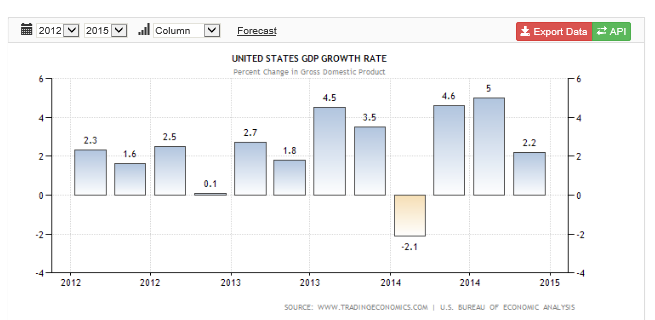
US GDP Growth 2012-2015 source: tradingeconomics.com

To do that the American government stepped in, first with bailouts to pick up the bad debt (cleaning the slate so to speak) and then with a two pronged attack, by lowering the overnight lending rate (the rate that banks can borrow at) and then promising to buy bonds indefinitely, (called Quantitative Easing). The effect is to print mountains of money, but in ways that should hopefully stimulate banks and corporations to lend and spend on new projects. But such a program can’t go on for ever. Backing this enormous expansions of the treasury requires borrowing from other people (primarily China) and the very reasonable fear is that if this goes on too long either a new financial bubble will be created, or the dollar will become worthless (or both!).

Today the Fed is trying to determine whether that time has come. And yet that answer seems far from clear. Investors are wary that the economy can survive without the crutch of cheap credit. Analysts and economists are nervous that raising rates will push the US dollar higher, making it less competitive globally. Meanwhile other countries are dropping interest rates. Germany issued a negative bond. Canada’s own key lending rates was cut earlier this year. People are rightly worried that a move to tighten lending is going in the exact opposite direction of global trends of deflation. If anything, some argue the US needs more credit.

The question of raising rates reveals just how little we really know about the financial seas that we are sailing. I often like to point to Japan, whose own economic problems are both vast and mysterious. Lots of research has gone into trying to both account for Japan’s economic malaise; it’s high debt, non-existent inflation, and how to resolve it. Currently the Japanese government is making a serious and prolonged attempt to change the country’s twenty year funk, but it is meeting both high resistance and has no guarantee of success.

Similarly we have some guesses about what might happen if the Fed raises its rates in the summer or fall. Most of the predictions are temporary instability, but generally the trend is good, raising rates usually correlates to a stronger and more profitable market.

But that’s the key word. Usually. Usually European countries aren’t issuing negative interest rates on their debt. Usually we aren’t in quite a pronounced deflationary cycle. Usually we aren’t buying billions of dollars of bonds every month. Usually.

The answer isn’t to ignore the bad predictions, or obsess over them. The best idea is to review your portfolio and make sure it’s anti-fragile. That means incorporating traditional investment techniques and keeping a steadfast watch over the markets through what are often considered the quiet months of the year.

Apple’s Watch and The End of Innovation

20130112_ldp001In early 2013 the Economist lamented that we may never produce something as innovative as the toilet. Certainly they were right in some ways, as some early innovations provided massive improvements in the standard of living with very little effort, where as new innovations did not add the same kind return for effort. It’s an interesting article and goes on to show that our understanding of innovation and whether we face a plateau in our technological progress is more nuanced and convoluted than we may be given to believe.

But industries do face innovation challenges. At some point all the easy refinements have been made and then starts the window dressing, attempts to “tart up” existing things that are little more than distractions from the initial great idea. The Apple Watch fits that criteria perfectly.

Apple Watch

To be clear, the Apple Watch does look to be all the things that Apple excels at; high quality, simple interface and good looks. But the point of the watch is somewhat unclear. You can answer phone calls, follow your heart rate, respond to messages and see your calendar. But these were all things that you can do now through your phone with a level of ease so surprising that you wonder what kind of person imagines that accessing this information is still too laborious.

The answer is likely marketers, who both see the trend towards wearable computers, and declining sales from other high priced items. Apple is a technology behemoth with a dedicated fan base of willing consumers. But even willing consumers have limits on their credit cards. High priced items like the iPad have cornered the tablet market, but they have also seen declining sales. Priced similarly like a phone, but lacking the phone contract subsidisation means that every iPad ends up costing between $500 – $1000. That’s pricey if every three years you are expected to buy a new one.

untitled

The Apple Watch then is likely trying to do several things. Boost the profitability of secondary devices beyond it’s iPhone division. Create a product with a lower entry point that people will be more willing to replace, while at the same time take a stab at a much smaller high end market with a Veblen good.

Ya, that's right. It says $22,000. Less useful than a phone, less gold than a Rolex and it needs to be charged every night.
Ya, that’s right. It says $22,000. Less useful than a phone, less gold than a Rolex and it needs to be charged every night.

But why own one? The first serious app for the apple watch is from Salesforce, the online CRM tool. Salesforce is already accessible from pretty much anywhere. You can log in from any computer and it has a very comprehensive app for all major smart phone platforms. So why would a wrist watch be the ideal place to offer notes, charts or contact information? Already people are wondering what the first “killer app” will be for the watch. I’m curious too.

What made the first iPhone great was that it made using the internet on a small device practical and easy. It was an innovative way to engage with a host of useful things that were previously outside of your reach when not in front of a computer. Apple opened a new market and ushered in a revolution. But eight years on and I am struggling to understand why you would sink any money into wearable tech, with its bad battery life, planned obsolescence and largely pointless existence.

Apple Stock

This should give investors pause. Apple and many of its competitors have done well by striving towards continuing improvements in the look and use of their products. But with each new iteration, we see less innovation and more refinement. The Apple Watch is an attempt to create something new that is actually made up of already existing technology. It doesn’t do anything better, and that should serve as a red flag to investors. As of yet there has been no truly successful wearable technology, neither in the form of glasses or watches. Apple hopes to change that with a more stylish and aspirational device. In the end however, it is a product likely to be crippled in three years by its own obsolescence. Whether that is an appealing device is up to consumers, but as an investor I wouldn’t want to make it a big bet in my portfolio.

How Imminent is the Next Market Crash?

image001This past week I received an article from a client regarding ideas about “wealth preservation” that made some good sense, and offered advice about calculating how much money you need for retirement. But while the premise was sound; that it makes sense to pursue investment strategies that protect your nest egg when your financial needs are already met, a one off comment about the future of the stock market caught my attention.

You can read the article HERE, but the issue I wanted to look at was the not so subtle implication that the US markets were now due for a correction. A serious one. Quoting the Wall Street Journal contributing writer William J. Berstein,

“In March, the current bull market will be six years old. It might run an additional six years—or end in April.”

This isn’t the first time I’ve heard this point before. It isn’t unique and sits on top of many other market predictioner’s tools, but its use of averages gives a veneer of knowledge the writer simply doesn’t possess.

Obviously we would all like to know when a market correction is due, and it would be great to know how to sidestep the kind of volatility that sets our retirement savings back. But despite mountains of data, some of the most sophisticated computers, university professors, mathematicians and portfolio managers have yet to crack any pattern or code that would reveal when a market correction or crash should be expected.

Which is why we still rely on rules of thumb like the one mentioned above. Is the age of a bull market a good indication of when we will have a correction? Probably not as good of one as the writer intends. Counting since 1871, the average duration of a bull market is around 4.5 years, making the current bull run old. But averages are misleading. For instance the bull markets that started in 1975, and 1988 (ending in 1987 and 2000 respectively) lasted for 153 months each, or just shy of 13 years. Those markets are outliers in the history of bull markets, but their inclusion in factoring the average duration of the bull markets extends the average by an additional year. Interestingly if you only count bull markets since the end of the second world war the average length is just over 8 years, but that would only matter if you think our modern economy has significant differences from an economy that relied on sailing vessels and horses.

table_us_bull_markets_since_1871

The fact is that the average age of bull markets is only that, an average. It has little bearing on WHY a bull market comes to an end. There was nothing about the age of the bull market in the 2000s, when people had become convinced of some shaky ideas about internet companies that make no money, that had any bearing on its end. The bull market that ended in 2008 had more to do with some weird ideas people had about lending money to people who couldn’t pay it back than it did with a built in expiration date. Even more importantly, the market correction of 1987 (Black Monday) was an interruption in what was an otherwise quarter century of solid market gains.

Taking stabs at when a market correction will occur by using averages like duration sounds like mathematical and scientific rigour, but actually reveals very little about what drives and stops markets. And a quick survey of the world tells us a great deal more about global financial health and where potential opportunities for investment are than how long we’ve been the beneficiaries of positive market gains.

Toronto’s Unbelievably Fragile Condo Market

img_7318Did you know that Toronto was in a market “lull” when it came to condos? No? Neither did I. I also wasn’t aware that Toronto was sitting on a vast precipice of economic gloom when it came to our condo market. And that is precisely the take away from both the Globe and Mail and Global News about a recent economic statistic about Toronto’s condo market.

My headline is misleading. Deliberately so. But I thought I would try my hand at provocative titles to spur readership. But I have a bee in my bonnet about this kind of reporting which peddles controversial titles while failing to offer insight to investors or potential buyers interested in the market. And while that kind of reporting is common, it’s rare for such significantly differing accounts about the same market pronouncement. For instance, this is the Globe and Mail’s title and opening line to their article:

 Toronto Condo Market Booming Again –

After years of slow growth Toronto’s condo market has come roaring back to life.

Meanwhile this is what Global News had to say:

Unsold condo’s pile up in Toronto, hit 21 year high –

As far as statistical outliers on charts go, the Bank of Montreal produced a dandy on Tuesday that should get some attention from condo market watchers in Toronto.

Both of these articles start with the same source material, a brief report from BMO Capital Markets from late February, but come to different conclusions, spinning stories about either the health or weakness of the same market. The report is frustratingly short, offering little more than the statistic that a record number of condo units came on the market in January. Far from being a new normal, the record number was the result of three things, including delayed projects being finished, regular projects reaching completion and the result of strong sales from 2011.

toronto-condo-boomHowever both these articles are technically accurate, Toronto did have a record number of units come into the market, an amount eight times greater than the monthly average over the last decade. And it is true that the amount of unsold units is at a 21 year high. But to make sense of which article was correct I thought it best to reach out to BMO Capital Markets’ Director and Senior Economist Sal Guatieri, the author of the document. Sal was kind enough to make some time for me over the phone and had some useful insight about each media outlet’s take on the one-off statistic.

“They’re both right,” in answer to my question, “but one is really about the broad health of the market, which Toronto’s market really is. Last year was a very strong year for sales. But in a few years, as nearly 50,000 units are completed and when rates eventually go up, there could be some weakness in the pricing on those units.” Sal had a few other points but they largely revolved around this dynamic, that future challenges to the market are laid in the foundations of our current success.

For journalists this kind of nuanced take on the markets isn’t helpful. It isn’t provocative, and I suspect that there is a fair amount of confirmation bias for those journalists who feel strongly about the market’s relative health. Regardless, there simply isn’t enough information in the document released to promote one view over the other, and yet that is exactly what writers at the Globe and Global News pursued, versions of the story that were both more provocative and definitive than accurate. It might help with readership, but it does nothing for informing investors.

That’s the real story, and the underlying problem of reporting business news. It isn’t advice so much as a view point. Most readers will not search for the original source, nor have an opportunity to corner the economist and author to find out more. And yet depending on which story you came across you might be forgiven for thinking you had gained some real insight into the nature of Toronto’s Real Estate Market.

On the other hand, I’m highly mistrustful of the news anyhow, which is my own confirmation bias. As the author Jon Ronson once said, “After I learned about confirmation bias I started seeing it everywhere.”


The Keystone Veto Was Meaningless

OILPossibly the most significant news in the last 24 hours was that Barack Obama had used his veto for the first time in five years to end the Keystone XL Pipeline. The pipeline, delayed by 6 years carried with it the hopes of the Canada’s Conservative party and oil executives in Alberta. The pipeline had been opposed, studied and debated, being bounced back and forth through the US government. It had been primarily opposed by environmentalists who object to the environmental impact of Alberta Tar Sand oil and hoped that by killing the pipeline less of it would be extracted, alternative fuels would fill some of the gaps and the world would be a healthier place as a result. It’s subsequent (and rather final) cancelation is being heralded as a victory by many environmental activists.

As we’ve already written, this was not case. While the pipeline hadn’t been built it hadn’t slowed the development of the oil sands, or impeded its movement to refineries. Instead it had simply been supplanted by rail cars. Although more expensive, the roughly $9 a barrel premium was well worth it when oil was above $100 a barrel.

The current price of oil helps explain why there was little real political risk to anybody in the veto of the pipeline. While oil was expensive there was real incentive to get Canadian oil to US markets. It helps offset oil from more troubling parts of the world and makes the economy run a little smoother. But the rise of US shale, the falling price of oil, the use of train cars, an improving economy and rising dollar has wrecked the economics of building the pipeline. By the time the Obama had vetoed the bill there was very little at stake politically except to satisfy his environmental base of voters. The pipeline may yet be still resurrected, but six years on and a new economic reality will likely mean little will get done soon.

The death of the pipeline is troubling most of all for Canada. Shipping oil by train is more expensive, and considerably more dangerous. It also reflects the new found reality that the government cannot rely on oil prices to bolster the economy.  But most of all it reflects the continuing declining fortunes of Alberta and returns focus to Ontario, the once and future king of the broad economy.